
Achieving the perfect medium-rare steak or a juicy roasted chicken hinges on one crucial factor: temperature control. Whether you're a professional chef or a weekend griller, choosing between a digital and an analog meat thermometer can make or break your culinary results. Digital thermometers offer lightning-fast, highly accurate readings with modern features like programmable alerts, making them ideal for high-stakes recipes. On the other hand, analog (bimetal) thermometers provide a reliable, battery-free experience that thrives in long-duration oven roasts. Understanding the nuances of speed, accuracy, and durability between these two tools is essential for ensuring both food safety and gourmet-level texture in every dish you serve.
| Feature | Digital Thermometers | Analog Thermometers |
|---|---|---|
| Response Time | Instant (2-5 seconds) | Slow (15-30 seconds) |
| Accuracy | High precision (±0.1°F to ±1°F) | Moderate (±2°F to ±5°F) |
| Power Source | Requires batteries (CR2032/AAA) | Mechanical (No batteries needed) |
| Readability | Backlit LCD/LED digits | Physical dial (can be small) |
| Durability | Sensitive to high heat/moisture | Heavy-duty; often oven-safe |
| Best Use | Thin cuts, quick checks, candy | Large roasts, long-term monitoring |
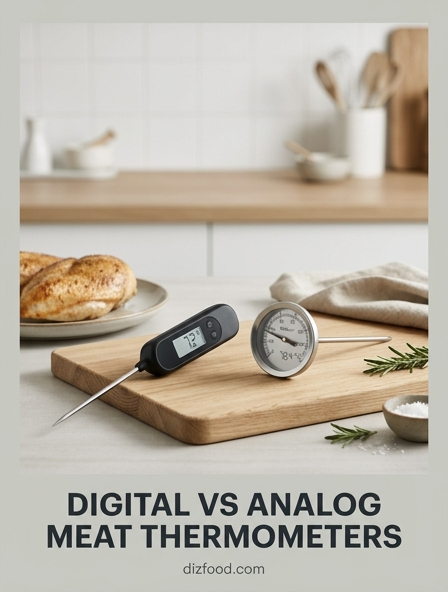
Digital vs Analog Meat Thermometers Key Differences
The primary distinction between digital and analog meat thermometers lies in their internal mechanisms and how they relay temperature information to the cook. Digital thermometers utilize electronic sensors, typically thermistors or thermocouples, to measure heat. These sensors produce an electrical signal that a microprocessor converts into a numerical value displayed on a liquid crystal display (LCD). This technology allows for rapid readings and high precision, often measuring to the tenth of a degree. Because they rely on circuitry, these devices require a power source, such as a coin cell or AAA battery, to function.
In contrast, analog thermometers, often referred to as bimetallic strip thermometers, operate on purely mechanical principles. They consist of two different metals bonded together in a coil. As the temperature rises, the metals expand at different rates, causing the coil to twist and move a physical needle across a circular dial. There are no electronic components, which means they never require batteries and are generally more resistant to high ambient heat. However, the physical movement of the needle is significantly slower than electronic sensing, and the thickness of the probe is usually greater to accommodate the mechanical coil. Understanding these fundamental mechanical differences is the first step in deciding which tool belongs in your kitchen drawer.
- Sensing Method: Electronic sensors (Digital) vs. Bimetallic coils (Analog).
- Power Source: Batteries required (Digital) vs. No power needed (Analog).
- Data Output: Numeric LCD (Digital) vs. Physical needle and dial (Analog).
- Probe Thickness: Thin, needle-like tips (Digital) vs. Thicker, robust stems (Analog).
Accuracy and Speed Comparison
When it comes to the physics of heat measurement, speed and accuracy are the two metrics that most significantly impact the quality of the final dish. Digital thermometers are the undisputed champions of speed. High-end thermocouple models can provide a stabilized temperature reading in as little as two to three seconds. This rapid response is crucial when checking the doneness of a steak over a hot grill, as it minimizes the time the cook's hand is exposed to direct heat and prevents the meat from overcooking while waiting for a reading.
Analog thermometers are considerably slower, often requiring 15 to 30 seconds to reach a final, stable temperature. This lag occurs because the physical metal coil inside the probe must physically heat up and expand to move the needle. In terms of accuracy, digital models typically offer a narrower margin of error, often within +/- 0.5 degrees Fahrenheit. Analog models are generally accurate within 1 to 2 degrees, but they are more susceptible to "parallax error," where the reading appears different depending on the angle at which the cook views the dial. The following table highlights the performance gap between the two technologies.
| Feature | Digital Thermometer | Analog Thermometer |
|---|---|---|
| Response Time | 2-5 Seconds | 15-30 Seconds |
| Temperature Increments | 0.1°F or 1.0°F | 2.0°F to 5.0°F |
| Typical Accuracy | ±0.5°F to ±1.0°F | ±2.0°F to ±5.0°F |
| Minimum Immersion Depth | 0.25 inches | 2.0 to 2.5 inches |
Pros and Cons of Digital Meat Thermometers
Digital meat thermometers have revolutionized the modern kitchen by providing professional-grade precision to home cooks. One of the most significant advantages is the inclusion of advanced features such as backlit displays, which make it easy to read temperatures in low-light environments like an evening backyard barbecue. Many digital models also include "hold" buttons to freeze the temperature on the screen or programmable alarms that beep when a target temperature is reached. Furthermore, the probes on digital thermometers are often much thinner, which preserves the integrity of the meat and prevents precious juices from leaking out through a large puncture hole.
However, digital units are not without their drawbacks. The most common frustration is the dependency on batteries; a dead battery in the middle of a Thanksgiving dinner can be a significant inconvenience. Additionally, digital thermometers are generally more delicate. The sensitive electronic components and LCD screens can be easily damaged if dropped or if the body of the thermometer is exposed to excessive heat or moisture. While the probe is heat-resistant, the plastic housing usually is not, meaning they cannot be left inside a hot oven or smoker during the cooking process unless specifically designed as a remote-probe model.
- Pro: Instant-read capabilities reduce cooking errors.
- Pro: High precision and easy-to-read numeric displays.
- Con: Requires regular battery replacements or charging.
- Con: Sensitive to water damage and extreme ambient heat.
The Benefits of Traditional Analog Thermometers
Despite the technological advancements of digital devices, traditional analog thermometers remain a staple in many professional and home kitchens due to their sheer reliability. The most prominent benefit is their "leave-in" capability. Because they contain no electronic parts or plastic housings that might melt, many analog thermometers are designed to stay inside the meat while it roasts in the oven. This allows the cook to monitor progress through the oven window without ever opening the door and losing heat. This constant monitoring is invaluable for large roasts, such as prime rib or whole turkeys, where temperature trends are more important than a single instant reading.
Another benefit is the simplicity and longevity of the device. There are no software glitches, no battery corrosion, and no flickering screens. As long as the physical components are intact, the thermometer will function. For many, the tactile nature of an analog dial provides a sense of confidence that electronics cannot match. They are also incredibly resilient to the humid, greasy, and high-vibration environments of a busy commercial kitchen. Even if an analog thermometer is dropped into a pot of water or left on a hot stove, it is much more likely to survive than its digital counterpart.
- Continuous Monitoring: Can be left in the oven during the entire roasting process.
- Zero Maintenance: No batteries to change or electronic malfunctions to troubleshoot.
- Extreme Durability: Highly resistant to moisture, steam, and high ambient temperatures.
- User-Friendly: No buttons to press or modes to toggle; just insert and read.
Durability and Battery Life Factors
When assessing the long-term viability of kitchen tools, durability and power requirements are paramount. Analog thermometers are the clear winners in terms of physical toughness. Constructed almost entirely of stainless steel and glass, they are built to withstand the rigors of a high-heat environment. They can be bumped, dropped, and subjected to steam without losing functionality. The absence of a battery means they are always ready for use, making them an excellent backup tool for any kitchen. If an analog thermometer fails, it is usually due to a bent probe or a cracked dial face, both of which are rare under normal usage conditions.
Digital thermometers, while sophisticated, are inherently more fragile. The integration of sensors, wires, and circuit boards introduces multiple points of failure. Battery life varies significantly between models; an instant-read pen might last for years on a single button cell, while a Bluetooth-enabled remote thermometer might require frequent recharging. Furthermore, moisture is the enemy of the digital thermometer. Even "water-resistant" models can suffer from internal fogging or short-circuiting if submerged in a sink or exposed to heavy steam over time. When choosing a digital model, users must weigh the convenience of the features against the inevitable reality that the device has a finite lifespan dictated by its electronic components.
- Analog Resilience: Mechanical build survives drops and extreme oven heat.
- Digital Sensitivity: Circuits can fail due to moisture, heat, or battery leakage.
- Power Reliability: Analog is always "on," whereas digital requires power management.
- Cleaning: Analog is often easier to sanitize with harsh chemicals without damaging internals.
Price and Long Term Value Comparison
The price gap between digital and analog thermometers is one of the first things a consumer will notice. Analog thermometers are generally very affordable, typically ranging from $5 to $15. Given their durability and lack of operating costs, they offer exceptional long-term value. A single analog thermometer can easily last a decade or more if handled with basic care, making the cost per use almost negligible. For a budget-conscious cook or someone who only roasts meat a few times a year, the analog option is often the most sensible financial choice.
Digital thermometers occupy a much broader price spectrum. Basic digital "stick" thermometers can be found for $15 to $20, while professional-grade thermocouples or smart, wireless probes can cost anywhere from $50 to $200. While the upfront investment is higher, the value is found in the time saved and the food waste prevented. A high-end digital thermometer can pay for itself by preventing the overcooking of an expensive cut of meat just once. However, because digital devices may need to be replaced every few years due to electronic wear or battery issues, their long-term cost of ownership is higher than that of the analog variety.
| Category | Analog (Bimetallic) | Digital (Entry-Level) | Digital (Professional) |
|---|---|---|---|
| Price Range | $5 - $15 | $15 - $30 | $50 - $150+ |
| Battery Cost | $0 | $2 - $5 annually | $0 (if rechargeable) | 10+ Years | 2-5 Years | 5-8 Years |
Ease of Use and Readability
Readability is a major factor in kitchen safety and efficiency. Digital thermometers excel in this area by providing large, high-contrast numbers that are unmistakable. Many models include a rotating display, allowing the cook to read the temperature from any angle, whether they are left-handed or right-handed. This eliminates the guesswork associated with reading a physical dial. Furthermore, the "hold" feature on many digital models allows a cook to probe a piece of meat in a dark, hot oven, press a button, and bring the device closer to their eyes to read the stabilized number, significantly reducing the risk of burns.
Analog thermometers can be more challenging to read, especially for those with declining eyesight. The numbers on the dial are often small and crowded, and the needle can obscure the exact markings. If the glass face of the thermometer fogs up due to steam from the oven, it can become nearly impossible to see the temperature without opening the oven door and wiping the dial. Furthermore, analog dials often feature both Fahrenheit and Celsius scales in close proximity, which can lead to confusion during the heat of a busy cooking session. While the simplicity of an analog device is a benefit, the cognitive load required to accurately interpret a small, vibrating needle is higher than reading a clear digital screen.
- Digital Readability: High-contrast LCDs, backlighting, and 180-degree rotation.
- Analog Readability: Small text, potential for fogging, and parallax error.
- Accessibility: Digital models are generally better for those with visual impairments.
- Feedback: Digital models often use audio alerts; analog is purely visual.
Calibration and Maintenance Requirements
To ensure food safety, every thermometer must be regularly calibrated. Both digital and analog types require this, but the process differs. The most common method is the "ice bath test," where the probe is submerged in a glass of crushed ice and a small amount of water. An accurate thermometer should read exactly 32°F (0°C). Analog thermometers are notorious for drifting out of calibration if they are dropped or subjected to rapid temperature changes. To recalibrate them, one must usually hold the dial and turn a small nut located under the head of the thermometer with a wrench until the needle points to the correct mark.
Many digital thermometers come factory-calibrated and are designed to hold their accuracy for a longer period. However, high-quality digital models often include a "Cal" button that allows the user to reset the 32°F point electronically without the need for tools. Maintenance for digital units involves keeping the battery compartment clean and ensuring the probe is wiped down after each use without getting the electronic housing wet. Analog units are more forgiving; many are even dishwasher safe (though hand-washing is always recommended to prolong the life of the bimetallic coil). Regardless of the type, a thermometer that is not regularly checked for accuracy is a liability in the kitchen.
- Perform an ice bath test at least once every few months.
- Use a small wrench for analog nut adjustments.
- Utilize the built-in "Cal" function for digital models.
- Store both types in a protective sheath to prevent probe damage.
Best Use Cases for Each Thermometer Type
Choosing between a digital and analog thermometer often depends on the specific cooking task at hand. Digital instant-read thermometers are the superior choice for high-speed cooking and thin cuts of meat. When grilling burgers, searing scallops, or frying thin chicken cutlets, the speed and thin probe of a digital thermometer are essential. They are also the preferred tool for candy making or tempering chocolate, where a difference of two degrees can mean the difference between success and failure. For any situation where you need to check multiple spots on a piece of meat quickly, digital is the way to go.
Analog thermometers shine in long-form cooking scenarios. Their best use case is as a leave-in probe for large roasts, whole poultry, or hams. Because they can withstand the constant heat of an oven or a covered grill, they provide a visual "progress bar" of the cooking process. They are also excellent for deep-frying, as many analog thermometers come with a clip to attach to the side of a pot, allowing the needle to stay submerged in hot oil indefinitely without fear of melting the device. In a professional setting, analog thermometers are often used as reliable backups or for monitoring ambient temperatures in walk-in coolers where batteries might fail due to the cold.
- Digital: Grilling, thin cuts, candy making, and checking multiple items quickly.
- Analog: Large roasts, deep-frying, and long-duration oven baking.
- Digital: Delicate proteins like fish or shrimp where minimal damage is required.
- Analog: Situations where the thermometer must remain in a high-heat environment.
Final Verdict for Home Cooks and Professionals
For the vast majority of modern home cooks, a high-quality digital instant-read thermometer is the better investment. The speed, accuracy, and ease of use it provides significantly lower the barrier to cooking meat perfectly every time. It removes the stress of guessing when a steak is medium-rare and provides the precision needed for modern recipes. While it requires batteries and a bit more care, the benefits of near-instant feedback far outweigh the minor maintenance required. A digital thermometer is a transformative tool that can immediately improve the quality of a cook's output.
For professional chefs and serious barbecue enthusiasts, the answer is usually "both." Professionals value the lightning-fast speed of a digital thermocouple during a busy service, but they also rely on the indestructible nature of analog thermometers for monitoring oil temperatures or long-term smoking projects. The analog thermometer serves as a fail-safe that doesn't care about battery life or water splashes. Ultimately, if you can only own one, go digital for its versatility and speed. If you are a traditionalist who specializes in slow-roasted meats and wants a tool that will last a lifetime, the analog thermometer remains a noble and effective choice for the kitchen.




Comments