
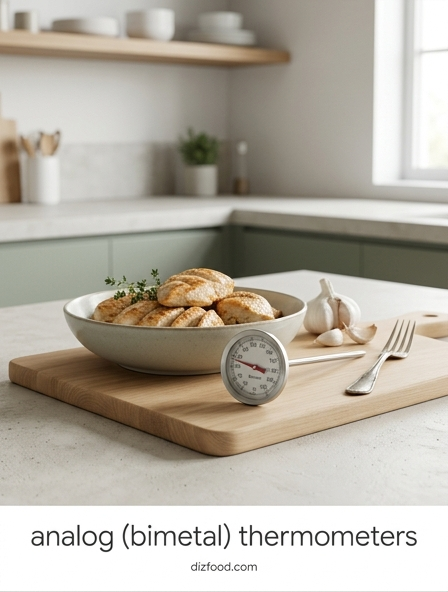
Why Analog Thermometers Excel for Roasting
Analog bimetal thermometers remain a staple in professional and home kitchens because they are specifically engineered for the high-heat environment of a roasting oven. Unlike digital sensors that often rely on heat-sensitive wires or plastic components, the all-metal construction of an analog probe allows it to stay inside the meat throughout the entire cooking duration. This provides a continuous, real-time visual of the temperature progression through the oven window, eliminating the need to frequently open the door and lose precious convective heat. The steady, mechanical movement of the needle offers a reliable sense of "momentum," helping cooks anticipate exactly when the roast will reach its target temperature.
- High heat resistance for leave-in monitoring.
- No wires to get pinched in oven doors or scorched by burners.
- Large, easy-to-read dials that function without external power.
- Physical temperature markers for quick visual reference.
For large cuts like prime rib, brisket, or whole poultry, the durability and persistence of the bimetal thermometer ensure that the center is monitored without the risk of electronic failure mid-roast. This mechanical reliability is why many veteran chefs prefer them for long-duration cooking tasks where consistency is paramount.
The Science Behind Bimetal Heat Sensors
The core of an analog kitchen thermometer is the bimetal coil, a fascinating application of thermodynamics. This sensor consists of two different metals, typically steel and copper or brass, laminated together. Because these metals have distinct coefficients of thermal expansion, they expand at different rates when exposed to heat. When the temperature rises, the strip is forced to curve or twist. In a thermometer, this strip is wound into a tight helix or coil. One end of the coil is fixed at the tip of the probe, while the other is attached to the pointer shaft. As the coil twists in response to heat, it physically rotates the needle across the calibrated dial face.
This mechanical process is entirely linear and predictable, which allows for accurate readings across a wide range of temperatures. Because the movement is driven by the physical properties of the metal itself, there are no circuits to fail or sensors to de-calibrate due to electromagnetic interference. The length of the probe is also critical; it acts as a protective housing for the coil, ensuring that the temperature measured is specifically at the tip of the device where the coil is most concentrated. This simple yet effective engineering has remained virtually unchanged for decades due to its inherent accuracy and robustness.
Battery Free Reliability in High Heat
One of the most significant advantages of analog thermometers is their independence from electronic power sources. In a busy kitchen, the last thing a cook needs is a "low battery" warning in the middle of preparing a holiday meal. Analog thermometers are always ready to use, requiring no charging and no expensive button-cell replacements. This battery-free design also makes them far more resilient to the extreme temperatures found inside ovens and grills. While digital components can melt or experience circuit failure when exposed to temperatures exceeding 120°F, the bimetal thermometer thrives in environments reaching 500°F and beyond.
- Zero downtime; always ready for immediate use.
- Environmentally friendly by reducing battery waste.
- Immune to electronic glitches caused by steam or humidity.
- Safe for long-term storage in kitchen drawers without battery leakage.
This reliability makes the analog thermometer the perfect "backup" that eventually becomes the primary tool for many cooks. Whether you are roasting in a modern convection oven or over an open fire at a campsite, the mechanical nature of the bimetal probe ensures that you have access to accurate temperature data regardless of your access to electricity or fresh batteries.
Achieving Consistent Internal Meat Temperatures
Using an analog thermometer correctly is the key to food safety and culinary excellence. Because these probes are designed to be left in the meat, they measure the gradual rise in temperature, which is essential for managing "carry-over" cooking. Carry-over occurs when the internal temperature continues to rise after the meat is removed from the heat source. By watching the dial, a cook can pull a roast at exactly five to ten degrees below the final desired temperature, ensuring the meat reaches its peak doneness during the resting phase. This prevents the common mistake of overcooking that often occurs when using instant-read probes too late in the process.
| Meat Type | Removal Temp (F) | Final Target (F) |
|---|---|---|
| Beef (Medium Rare) | 125°F | 130-135°F |
| Pork Loin | 140°F | 145°F |
| Chicken (Whole) | 160°F | 165°F |
The physical needle provides a clear indication of how fast the temperature is rising. If the needle moves rapidly, the oven may be too hot, leading to uneven cooking. A slow, steady crawl of the needle is the hallmark of a perfectly executed roast, ensuring a juicy interior and well-rendered exterior.
Durable Construction for Professional Kitchens
Professional kitchens are notoriously harsh environments where tools are subjected to high heat, frequent drops, and constant moisture. Analog bimetal thermometers are built to withstand this abuse. Most are constructed from high-grade stainless steel, which is resistant to corrosion and easy to sanitize. The dial is usually protected by a thick, tempered glass or heavy-duty polycarbonate lens that can withstand the thermal shock of moving from a hot oven to a cool countertop. Unlike digital thermometers, which feature delicate LCD screens that can crack or black out under heat, the printed metal dial of an analog unit remains legible for years.
Furthermore, the simplicity of the design means there are fewer points of failure. There are no buttons to jam, no ports for water to enter, and no screens to fail. Many professional models are also waterproof or "hermetically sealed," allowing them to be submerged for cleaning without fogging up the dial. This level of durability represents a significant cost saving over time, as a single well-maintained analog thermometer can last a lifetime, whereas digital units often need replacing every few years due to sensor degradation or electronic malfunction.
How to Calibrate Your Bimetal Probe
Maintaining the accuracy of an analog thermometer is a straightforward mechanical process that every cook should master. Over time, or after a significant drop, the needle may shift slightly out of alignment. Most quality bimetal thermometers feature a calibration nut located directly behind the dial face. To ensure your readings are precise, you should perform an ice-water test periodically. This process ensures that your thermometer is reading the freezing point of water correctly, which serves as a reliable baseline for all other temperature measurements.
- Fill a large glass with crushed ice and add just enough cold water to fill the gaps.
- Stir the mixture and let it sit for two minutes to reach a uniform 32°F (0°C).
- Insert the thermometer probe at least two inches into the ice slurry without touching the sides or bottom.
- Wait for the needle to stop moving. If it does not point to 32°F, use a small wrench to turn the calibration nut until the needle is centered on the 32 mark.
Regular calibration, perhaps once every few months or before a major cooking project like Thanksgiving, guarantees that your mechanical tool remains as accurate as its digital counterparts. This manual control gives the cook confidence that their equipment is performing exactly as intended.
Comparing Analog versus Digital Temperature Precision
While digital thermometers are praised for their speed, analog bimetal thermometers offer specific advantages in terms of environmental resilience and long-term monitoring. Digital "instant-read" thermometers are excellent for quick checks of thin foods like burgers or fillets, but they cannot be left in the oven. Analog thermometers, conversely, are designed for "dwell time." They take longer to register a final temperature-usually 15 to 30 seconds-but because they stay inside the food, this response time is irrelevant during a two-hour roast. The following table highlights the key differences between these two common kitchen tools.
| Feature | Analog Bimetal | Digital Instant-Read |
|---|---|---|
| Response Time | Slow (15-30 sec) | Fast (1-3 sec) |
| Heat Tolerance | Leave-in (High) | External Use Only |
| Power Source | Mechanical | Battery |
| Maintenance | Manual Calibration | Self-Calibrating/Fixed |
For the home cook, the choice often comes down to the cooking method. For roasting and slow-cooking, the analog thermometer's ability to provide constant data without melting is a decisive advantage. While it lacks the "to-the-degree" flickering precision of a digital screen, its mechanical accuracy is more than sufficient for achieving perfect culinary results.
Optimal Placement for Large Oven Roasts
The accuracy of an analog thermometer is only as good as its placement. Because the bimetal coil is located in the bottom inch or two of the probe, it is vital to ensure this section is positioned in the "thermal center" of the meat. This is the area furthest from the surface and the bone, which usually takes the longest to cook. If the probe touches a bone, the reading will be artificially high because bone conducts heat faster than muscle. Similarly, if the probe is embedded in a pocket of fat, the reading may be inaccurate due to the different thermal properties of adipose tissue.
- Insert the probe into the thickest part of the muscle.
- Avoid contact with bone, gristle, or the roasting pan.
- Ensure at least 2 inches of the stem is submerged in the meat.
- Angle the dial so it is visible through the oven door window.
For poultry, the best placement is usually the thickest part of the thigh, being careful to avoid the femur. For roasts, inserting the probe from the side into the very center ensures that you are measuring the coldest point. This practice guarantees that when the needle hits your target, the entire roast has reached a safe and delicious temperature.
Long Lasting Value for Home Cooks
In an era of "smart" kitchen gadgets that become obsolete or break within a few years, the analog thermometer stands out as a beacon of long-lasting value. A high-quality bimetal thermometer typically costs significantly less than a mid-range digital probe, yet its lifespan can be measured in decades rather than years. There are no software updates, no battery compartments to corrode, and no delicate wires to fray. For the casual home cook who might only roast a chicken once a week or a turkey once a year, the analog thermometer is the most cost-effective investment possible.
Beyond the financial savings, there is a tactile satisfaction in using a mechanical tool. The heavy-duty feel of the stainless steel and the clear, printed graphics of the dial offer a sense of permanence. Because they are so simple, they are also incredibly easy to clean and store. Most can simply be wiped down with a soapy cloth or, if hermetically sealed, tossed into hot dishwater. When you buy an analog thermometer, you aren't just buying a temporary sensor; you are adding a foundational tool to your culinary arsenal that will perform reliably for as long as you continue to cook.
Master Your Oven with Mechanical Accuracy
Ultimately, using an analog thermometer helps a cook develop a better "feel" for their oven and the cooking process. By observing the slow rotation of the needle over several hours, you begin to understand how your oven cycles heat and how different sizes of meat respond to temperature changes. This mechanical feedback loop builds intuition. You start to recognize that the needle moves faster during the final 20 degrees of cooking, or how a foil tent affects the rate of heat penetration. This level of observation is often lost with digital "beeping" thermometers that simply alert you when a task is finished.
Mastering mechanical accuracy means trusting the physical laws of thermal expansion. It encourages a more hands-on, engaged style of cooking where the chef is in tune with the ingredients. Whether you are aiming for a delicate medium-rare prime rib or ensuring a rotisserie chicken is safe for the family, the analog bimetal thermometer provides the honest, unadorned data needed to succeed. It is a testament to the idea that sometimes, the simplest mechanical solution is indeed the best one for the job.


Comments