
Keeping your induction cooktop sparkling requires more than just a quick wipe; it often comes down to a strategic choice between mechanical force and chemical precision. If you're battling stubborn, burnt-on residue that seems fused to the glass, an induction cooktop scraper is your surgical tool for immediate physical removal, while Soft Scrub acts as a gentle, non-abrasive cream cleanser designed to lift stains and restore a polished shine without the risk of deep micro-scratches. Understanding which tool to reach for depends on whether you're tackling a carbonized mess or routine surface grease, so let's compare how these two kitchen essentials stack up for maintaining your premium glass stove.
| Feature | Induction Cooktop Scraper | Soft Scrub (Liquid/Cream) |
|---|---|---|
| Primary Use | Heavy, carbonized, burnt-on food. | Grease, hard water spots, light film. |
| Action Method | Mechanical shearing/physical lifting. | Chemical breakdown + mild abrasion. |
| Surface Safety | Safe if held at a 45° angle. | Very safe; non-scratch formula. |
| Effort Level | Moderate; requires steady precision. | Low; simple buffing and rinsing. |
| Cleaning Frequency | Occasional; deep restoration only. | Daily or weekly maintenance. |
| Final Finish | Removes bulk; may leave streaks. | Leaves a polished, streak-free shine. |
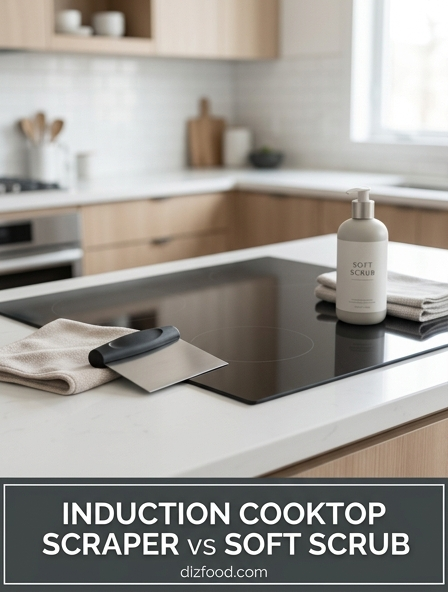
Induction Cooktop Scraper vs Soft Scrub Comparison
When maintaining the pristine appearance of an induction cooktop, homeowners often find themselves choosing between physical intervention and chemical assistance. An induction cooktop scraper typically utilizes a high-quality stainless steel or carbon steel razor blade housed in an ergonomic handle. Its primary function is the mechanical shearing of carbonized food particles that have bonded to the glass-ceramic surface. Because induction cooktops remain cooler than traditional electric coils, food rarely bakes on as intensely, but sugary spills can still create a stubborn "crust" that requires the direct force a scraper provides.
On the other hand, Soft Scrub represents a category of liquid abrasive cleaners. These products utilize mild minerals, such as calcium carbonate, suspended in a surfactant-rich liquid. While a scraper excels at removing vertical depth-lifting a thick spill off the glass-Soft Scrub is designed to address horizontal surface stains, such as cloudy mineral deposits, grease films, and light heat tinting. The choice between the two often depends on the state of the cooktop: a scraper is a heavy-duty "reset" tool, whereas Soft Scrub is a polishing and maintenance agent.
| Feature | Metal Scraper | Soft Scrub / Liquid Cleaner |
|---|---|---|
| Action Type | Mechanical Shearing | Chemical & Mild Abrasive |
| Best For | Burnt-on sugar and crust | Grease, hard water, and buffing |
| Surface Safety | High (if used at 45°) | High (non-scratch formula) |
Best Method for Removing Burnt Food Residue
Burnt food residue on an induction hob is usually the result of a "boil-over" involving starches or sugars. When these substances hit the glass-ceramic surface, they undergo a process of polymerization and carbonization. If left to cool completely, they become extremely brittle and tightly bonded to the cooktop. The best method for removal involves a phased approach that minimizes the risk of micro-pitting, a phenomenon where the cooling sugar actually pulls tiny fragments of glass away from the surface.
To effectively clear these residues, follow these prioritized steps:
- Softening: Apply a warm, damp microfiber cloth over the residue for five minutes to rehydrate the edges of the spill.
- Initial Scraping: While the area is slightly damp, use a specialized induction scraper at a low angle to lift the bulk of the material.
- Residue Breakdown: Apply a small amount of a cream cleaner like Soft Scrub to dissolve any remaining oils or sugars that the blade could not catch.
- Final Polish: Buff the area with a dry cloth to ensure no streaks remain, which can burn during the next use.
Using this combination ensures that you aren't applying excessive physical force, which is the leading cause of accidental damage during the cleaning process.
Preventing Scratches on Induction Glass Surfaces
Induction cooktops are made from a specialized glass-ceramic material designed to withstand high thermal shock but remain susceptible to physical abrasion. Preventing scratches is a continuous process that involves both how you cook and how you clean. Most scratches do not come from the cleaning tools themselves, but from microscopic grit trapped between the tool and the glass. For example, a single grain of salt or sand dragged across the surface by a sponge can create a permanent etch.
To maintain a scratch-free surface, consider the following preventative measures:
- Bottom Inspection: Always check the bottom of your pans for burrs or trapped debris before placing them on the glass.
- Lift, Don't Slide: Never slide heavy cast iron or stainless steel cookware across the zones; always lift them to move.
- Avoid Steel Wool: Never use green scouring pads or steel wool, as these are significantly harder than the glass-ceramic surface.
- Clean the Tool: If using a scraper, ensure the blade is brand new or perfectly clean. A nicked or rusted blade is the primary culprit of scraper-induced scratches.
By keeping the environment free of abrasive particulates, you ensure that when you do need to use a tool like a scraper or Soft Scrub, the tool interacts only with the residue and not with grit that could damage the hob.
Pros and Cons of Metal Scrapers for Cooktops
Metal scrapers are often viewed with hesitation by new induction owners, yet they remain the gold standard for professional appliance maintenance. Their design is deceptively simple: a sharp, flat edge that slides under debris. However, like any precision tool, they carry specific advantages and risks that must be balanced by the user. Understanding these can help you decide when to reach for the blade and when to stick to a liquid cleaner.
Pros:
- Unmatched Efficiency: They can remove burnt-on milk or sugar in seconds, tasks that would take 20 minutes of scrubbing with a sponge.
- Chemical-Free: Scrapers allow for cleaning without the use of fumes or synthetic fragrances, which is ideal for those with chemical sensitivities.
- Precision: You can target a specific spot without affecting the surrounding clean areas of the cooktop.
Cons:
- User Error: If held at too steep an angle (approaching 90 degrees), the corner of the blade can gouge the glass.
- Blade Degradation: Blades dull quickly and can develop rust if stored in a damp kitchen drawer, requiring frequent replacements to remain safe.
- Intimidation Factor: There is a learning curve to using the tool confidently without fear of damaging an expensive appliance.
Why Soft Scrub is Safe for Induction Ranges
Soft Scrub and similar cream-based cleansers are engineered specifically to be "softer" than the glass-ceramic surface they are cleaning. In the world of material science, this is dictated by the Mohs scale of mineral hardness. The abrasives used in these cleaners-most commonly calcium carbonate-typically rank around a 3 on the Mohs scale, while the glass-ceramic used in induction hobs ranks between 5.5 and 6. This means that, physically, the cleaner is incapable of scratching the glass under normal pressure.
Beyond the physical hardness, the safety of Soft Scrub lies in its surfactant chemistry. These chemicals surround grease molecules and lift them away from the glass, allowing the mild abrasives to work on the remaining solid particles without needing high-velocity friction. It also leaves behind a microscopic protective layer of silicone or similar polymers in some formulations, which can help prevent future spills from bonding as tightly to the surface. This dual-action approach-mechanical mild abrasion and chemical emulsification-makes it an exceptionally safe daily maintenance tool that avoids the risks associated with sharp metal edges.
Combining Scrapers and Soft Scrub for Deep Cleaning
The most effective cleaning regimen for a neglected or heavily used induction cooktop isn't an "either-or" choice; it is a synergistic use of both the scraper and the liquid cleaner. When food is burnt onto the surface, it often exists in layers. The top layer is carbonized organic matter, while the bottom layer is a thin film of oils and minerals. A scraper is excellent for the "macro" cleaning, while Soft Scrub handles the "micro" cleaning.
To perform a deep clean using both tools, follow this professional sequence:
- The Dry Scrape: Use the scraper on a completely dry surface to pop off the large, brittle chunks of burnt food. This prevents the liquid cleaner from becoming a gritty paste.
- The Chemical Application: Apply a generous amount of Soft Scrub over the remaining ghost-stains or cloudy areas.
- The Dwell Time: Let the cleaner sit for 2 to 3 minutes to break down the bond of the grease.
- The Wet Scrape: For incredibly stubborn spots, use the scraper *through* the liquid cleaner. The liquid acts as a lubricant, making the scraping even smoother and safer.
- Buffing: Wipe clean with a damp cloth and finish with a dry microfiber to restore the original factory shine.
How to Use a Razor Scraper Safely on Glass
Safety when using a razor scraper is as much about protecting the glass as it is about protecting your fingers. The physics of scraping glass requires a steady hand and a specific angle of incidence. If the blade is too flat, it may slide over the top of the residue without lifting it; if it is too vertical, it acts as a chisel and can chip the glass-ceramic. The "sweet spot" for induction cleaning is generally accepted to be between 30 and 45 degrees.
Follow these safety protocols to ensure a successful clean:
- Check the Blade: Before touching the glass, ensure the blade is seated firmly in the holder and is not wobbling. A loose blade can slip and cause deep scratches.
- Lubrication: If you are nervous, spray a little water or glass cleaner on the spot first. This reduces friction and heat buildup.
- Fluid Motion: Use smooth, forward pushing motions. Avoid "sawing" back and forth, as the backward motion can catch debris and drag it, causing micro-scratches.
- Corner Awareness: Keep the blade perfectly level so that the entire edge contacts the glass. Lifting one side of the scraper puts all the pressure on a single sharp corner, which is the most common way glass is damaged.
Chemical Cleaners vs Manual Scraping Tools
The debate between chemical cleaners and manual tools often centers on the "path of least resistance." Chemical cleaners, such as specialized cooktop creams or Soft Scrub, rely on time and chemistry to do the work. They are ideal for removing the "rainbow" stains caused by overheating or the white mineral rings caused by hard water. However, chemicals have limits; they cannot effectively "dissolve" a thick, carbonized layer of burnt sugar without hours of soaking.
Manual scraping tools represent immediate results. They use physical force to overcome the adhesive bond between the food and the glass. While faster, they require more focus and manual dexterity. A comparison of their profiles reveals distinct use cases:
- Chemicals: Best for daily maintenance, removing fingerprints, grease, and light cloudiness. They provide a polished finish and are very low-risk for beginners.
- Manual Tools: Best for "emergency" spills, heavy crusting, and restoration of older hobs. They require a steady hand but offer the most powerful cleaning potential.
In a high-use kitchen, the manual tool is the "heavy lifter," while the chemical cleaner is the "finisher" that provides the aesthetic gloss and removes the streaks left behind by the mechanical process.
Maintaining Your Induction Hob Shine and Longevity
Longevity for an induction cooktop is measured by its ability to maintain its sleek, reflective surface over years of use. Because the surface is the interface through which electromagnetic energy passes to your pans, keeping it clean isn't just about aesthetics-it's about efficiency. A layer of burnt-on residue can act as an insulator or cause uneven heating, which may eventually lead to the glass cracking due to localized thermal stress.
To maintain that "showroom" shine long-term, adopt these habits:
- The Instant Wipe: As soon as the "H" (hot) indicator disappears, wipe the surface with a damp cloth to prevent any spilled oils from polymerizing during the cooling phase.
- Weekly Polishing: Use a product like Soft Scrub once a week, even if the cooktop looks clean. This removes the invisible film of aerosolized cooking fats that settle on the glass.
- Blade Replacement: If you use a scraper, replace the blade every 3 to 4 heavy cleanings. A dull blade requires more pressure, and more pressure increases the likelihood of a slip.
- Buffing Technique: Always finish your cleaning with a dedicated glass-polishing microfiber cloth. Paper towels can be slightly abrasive and often leave lint behind.
Final Verdict on the Best Induction Cleaning Tool
When choosing between an induction cooktop scraper and Soft Scrub, the final verdict is that both are essential components of a complete kitchen toolkit. There is no single "best" tool, as they serve different phases of the cleaning process. For the removal of physical mass-the thick, crusty residues that occur after a pot boils over-the metal scraper is the undisputed winner. It performs a task that liquid cleaners simply cannot achieve through chemistry alone.
However, for the final aesthetic results and the removal of hazy films, Soft Scrub is the superior choice. It provides a level of polish and surface uniformity that a blade cannot provide. Using a scraper alone will leave the glass clean but potentially streaky or dull; using Soft Scrub alone on a heavy spill will result in frustration and wasted product. Therefore, the most effective strategy for any induction owner is to own a high-quality razor scraper for heavy-duty lifting and a bottle of non-abrasive cream cleaner for daily buffing and maintenance. This hybrid approach ensures the longest possible lifespan for the glass-ceramic and keeps the kitchen looking its best with the least amount of effort.


Comments