
Tackling stubborn kitchen grease and baked-on grime doesn't have to be a grueling workout for your wrists. While the traditional manual hand brush is a reliable, low-cost staple, it relies entirely on your physical strength and repetitive motion to see results. In contrast, the modern electric spin scrubber is a game-changer for deep cleaning, utilizing high-torque motorized rotation to break down dirt in seconds. By switching to a powered tool, you replace tedious "elbow grease" with effortless efficiency, allowing the interchangeable brush heads to do the heavy lifting on stovetops, grout, and sinks. If you're looking to achieve a professional-grade clean in half the time without the physical fatigue, the electric spin scrubber is the clear winner for a modern, ergonomic kitchen.
| Feature | Electric Spin Scrubber | Manual Hand Brush |
|---|---|---|
| Cleaning Action | 300-400 RPM motorized rotation | Manual scrubbing force (approx. 60 RPM) |
| Physical Effort | Minimal; tool provides the torque | High; requires significant "elbow grease" |
| Time Efficiency | Fast; cuts cleaning time by 50-70% | Slow; labor-intensive for large areas |
| Ergonomics | Reduces joint strain and wrist fatigue | High risk of hand cramping and soreness |
| Reach & Versatility | Extendable handles & specialized heads | Limited to arm's length and fixed grip |
| Power Source | Rechargeable Li-ion battery | None (Human energy) |
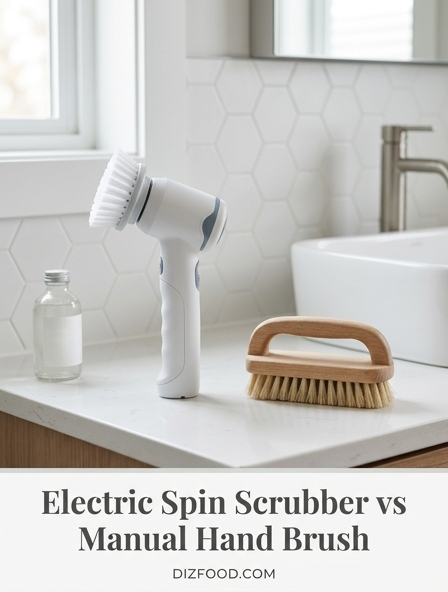
Electric Spin Scrubber vs Manual Hand Brush Comparison
In the modern kitchen, the battle between tradition and technology is most apparent when tackling grime, grease, and dried food particles. The manual hand brush has been the primary tool for generations, relying entirely on the user's physical strength and persistence to achieve a clean surface. It is a simple tool, usually consisting of a plastic or wooden handle with nylon bristles, designed for direct contact and high-pressure scrubbing. In contrast, the electric spin scrubber introduces motorized torque into the equation, using a rechargeable battery to rotate various brush heads at high speeds, often exceeding 300 RPM.
While both tools aim to sanitize and restore surfaces, their methodologies differ significantly. The manual brush offers tactile feedback, allowing the user to feel exactly how much pressure is being applied to delicate surfaces like stainless steel or glass cooktops. The electric spin scrubber, however, prioritizes speed and consistency, removing the variability of human fatigue. Choosing between them often depends on the scale of the task and the physical capability of the individual performing the cleaning.
| Feature | Electric Spin Scrubber | Manual Hand Brush |
|---|---|---|
| Power Source | Rechargeable Battery | Human Muscle |
| Action Type | High-Speed Rotation | Linear or Circular Friction |
| Surface Contact | Consistent, Motorized | Variable, Manual Pressure |
| Best For | Deep Cleaning & Large Areas | Quick Spills & Spot Cleaning |
Motorized Power vs Manual Muscle for Deep Cleaning
The core difference in performance between these two tools lies in the source of energy. Deep cleaning a kitchen often requires breaking down polymerized grease and stubborn hard-water stains around the sink. With a manual hand brush, the effectiveness is directly proportional to the "elbow grease" applied. This means that as the user becomes tired, the quality of the cleaning typically diminishes. Manual scrubbing relies on repetitive back-and-forth motions that can be difficult to sustain over long periods, especially when dealing with porous surfaces like tile grout.
Motorized power changes the dynamic by providing a constant level of force regardless of how long the task takes. An electric spin scrubber maintains its rotations per minute even when pressed against a surface, allowing the bristles to work into microscopic crevices that manual scrubbing might miss. This mechanical advantage is particularly noticeable when cleaning overhead areas or deep inside ovens where leverage is difficult to maintain. By delegating the heavy lifting to a motor, the user acts more as a guide for the tool rather than the primary engine of friction.
- Constant torque ensures even cleaning across the entire surface area.
- Reduces the need for aggressive chemical cleaners by utilizing mechanical force.
- Eliminates the "fading strength" factor during marathon cleaning sessions.
- Motorized vibration helps dislodge particles from textured surfaces better than steady manual pressure.
Cleaning Efficiency and Time Saving Benefits
Efficiency in the kitchen is often measured by how quickly one can move from food preparation to a sparkling clean environment. The manual hand brush is an "on-demand" tool that requires zero setup time, making it highly efficient for small, localized tasks like scrubbing a single pot or cleaning a small spill on the countertop. However, when the scope of work expands to include the entire backsplash, the stovetop, and the kitchen floor tiles, the efficiency of the manual brush begins to plummet as the physical toll increases and the pace slows down.
The electric spin scrubber is designed for volume. Because it performs hundreds of rotations in the time it takes a human to make two or three manual passes, it can cover significantly more square footage in a fraction of the time. For a homeowner looking to perform a "deep clean" once a week, the spin scrubber can reduce a two-hour chore into a forty-five-minute task. The time saved is not just in the scrubbing motion itself, but also in the reduced need for multiple passes over the same spot. This allows for a more systematic approach to kitchen maintenance, ensuring that high-traffic areas remain sanitary without consuming the user's entire afternoon.
Reducing Physical Strain on Back and Joints
One of the most overlooked aspects of kitchen maintenance is the ergonomic impact on the body. Manual scrubbing requires gripping a small handle tightly and applying downward or lateral force, which can lead to strain in the wrists, elbows, and shoulders. For those with conditions like arthritis or carpal tunnel syndrome, the repetitive motion of a manual brush can be genuinely painful and prohibitive. Furthermore, cleaning lower cabinets or floor corners with a manual brush usually requires bending or kneeling, putting significant stress on the lower back and knees.
Electric spin scrubbers are often designed with ergonomic handles and, in many cases, telescopic extension poles. This allows the user to clean floor-level grime or high-reaching vents while standing in a neutral, upright position. The motorized action means the user only needs to apply minimal guiding pressure, which protects the joints from the impact of heavy scrubbing. This makes deep cleaning accessible to a wider range of people, including the elderly or those recovering from injuries, ensuring that physical limitations do not result in a less hygienic living space.
- Telescopic handles eliminate the need for excessive bending or reaching.
- Vibration-dampening grips reduce the risk of repetitive strain injuries in the hands.
- Motorized rotation removes the requirement for high-impact joint movement.
- Weighted designs allow gravity to do much of the work on horizontal surfaces.
Comparing Surface Versatility and Brush Attachments
A manual hand brush is typically a "one size fits all" tool, or at best, a tool with two sides of different stiffness. While effective for general purposes, this lack of specialization can be a drawback when moving between different kitchen materials. For instance, the stiff bristles needed for a cast iron skillet could easily scratch a delicate glass-top stove or a polished marble countertop. Using the wrong manual brush often results in either an ineffective clean or permanent damage to expensive kitchen finishes.
Electric spin scrubbers usually come as a kit with multiple interchangeable heads, each engineered for a specific purpose. This versatility allows the user to transition seamlessly from heavy-duty tasks to delicate polishing. A large, flat brush might be used for the floor, while a soft sponge attachment is swapped in for the refrigerator door. Some kits even include microfiber pads for buffing stainless steel appliances to a streak-free shine. This modular approach ensures that every surface in the kitchen receives the specific care it requires without the need for a drawer full of different manual brushes.
- Pointed corner brushes for reaching into window tracks and cabinet edges.
- Extra-wide flat brushes for large surface areas like islands and floors.
- Soft-bristle attachments for sensitive surfaces like chrome and painted wood.
- Scouring pads for heavy-duty carbon buildup on oven racks.
Tackling Tough Grout and Hard to Reach Corners
The kitchen is full of awkward geometries: the space behind the kitchen faucet, the narrow gaps between the oven and the counter, and the intricate grout lines of a tile backsplash. A manual brush often struggles in these areas because the user cannot get enough leverage or "swing room" to generate the necessary friction. To clean a corner manually, one must often use the very tip of the brush, which is the least effective part for applying pressure, leading to missed spots and accumulated grime over time.
The electric spin scrubber excels in these confined spaces because the cleaning action is localized at the head of the tool. A specialized "pointed" or "dome" brush attachment can be placed directly into a corner or along a grout line, where it spins at high speed to whisk away dirt without requiring any lateral movement from the user's arm. This precision allows for a level of detail cleaning that is nearly impossible to achieve manually. It ensures that the hidden areas of the kitchen-where bacteria and mold are most likely to grow-are treated with the same intensity as the wide-open countertops.
Battery Life and Cordless Convenience vs Reliability
The primary advantage of the manual hand brush is its absolute reliability; it is always ready to work, requires no charging, and has no electronic components that can fail. For a quick five-minute cleanup after dinner, the simplicity of a manual brush is unbeatable. There is no anxiety about whether the tool is charged or if the battery will die halfway through a task. This "analog" nature makes it a staple for those who prefer a minimalist approach to household chores.
However, modern electric spin scrubbers have made significant leaps in battery technology, typically utilizing Lithium-Ion cells that provide 60 to 90 minutes of continuous runtime. This is usually more than enough for even a comprehensive deep clean of a large kitchen. While they do require a charging cycle, the cordless nature of these devices means they are just as portable as a manual brush once they are powered up. The trade-off is a matter of planning; as long as the device is docked after use, the power it provides far outweighs the inconvenience of the occasional recharge.
| Metric | Electric Scrubber (Li-Ion) | Manual Hand Brush |
|---|---|---|
| Preparation Time | Requires Periodic Charging | Instant Use |
| Run Time | 60-90 Minutes | Unlimited (Human Dependent) |
| Portability | High (Cordless) | Highest (No Battery) |
| Fail Points | Motor, Battery, PCB | Bristle Wear Only |
Long Term Durability and Maintenance Requirements
When considering durability, the manual hand brush is the clear winner in terms of lifespan per unit. Since it lacks moving parts and sensitive electronics, it can be submerged in water, dropped on hard floors, and stored in damp under-sink environments without any risk of failure. The only real maintenance required is rinsing the bristles after use and eventually replacing the entire brush once the bristles become frayed or flattened. It is a low-stakes tool that can last for years with minimal care.
Electric spin scrubbers require a bit more attention to ensure longevity. Because they contain motors and batteries, they must be kept away from complete submersion unless they are specifically rated with a high IPX waterproof score. The contact points for the charging cable must be kept clean, and the internal battery should be exercised regularly to maintain its capacity. However, most spin scrubbers are designed with replaceable heads, meaning the expensive motorized handle remains a permanent fixture while only the inexpensive bristles are discarded. This can actually be more sustainable in the long run than throwing away dozens of plastic manual brushes over a lifetime.
Cost Analysis and Overall Value for Homeowners
The financial aspect of this comparison involves looking at both the initial investment and the long-term cost of ownership. A manual hand brush is extremely inexpensive, usually costing between $2 and $10. For many homeowners, this low entry price makes it an easy choice. However, because manual brushes are often treated as semi-disposable, the cost can add up over time if they are replaced frequently. Additionally, the "hidden cost" of manual cleaning includes the extra time spent and the potential cost of more aggressive cleaning chemicals needed to compensate for less mechanical force.
An electric spin scrubber represents a higher upfront cost, typically ranging from $40 to $100 depending on the brand and the number of included accessories. While this is a significant jump, the value is found in the labor saved and the professional-level results achieved at home. When spread over several years of use, the cost per cleaning session becomes negligible. For a homeowner who values their time and physical health, the spin scrubber often pays for itself within the first few months by turning a difficult, avoided chore into a manageable and even satisfying task.
- Initial Investment: $40-$100 (Electric) vs $2-$10 (Manual).
- Replacement Heads: $10-$20 per set (Electric) vs Full Replacement (Manual).
- Value Add: Significant time savings and reduced physical exhaustion.
- Chemical Savings: High-speed scrubbing often requires less detergent.
Final Verdict on the Best Tool for Deep Cleaning
After evaluating both tools, the "best" option depends largely on the frequency and intensity of your cleaning habits. For daily maintenance and quick cleanups of small messes, the manual hand brush remains an essential, reliable, and cost-effective tool that every kitchen should have. Its simplicity and immediate availability make it perfect for the "clean as you go" philosophy of cooking. It provides a level of control and feedback that electronics cannot yet perfectly replicate for delicate tasks.
However, for true deep cleaning-the kind that involves tackling the oven, the tile grout, and the grime that builds up in hard-to-reach places-the electric spin scrubber is the undisputed winner. The combination of motorized power, ergonomic design, and specialized attachments allows for a more thorough clean with significantly less physical effort. It transforms the most dreaded kitchen chores into quick, efficient processes. For the modern homeowner looking to maintain a pristine kitchen without sacrificing their back or their weekend, the electric spin scrubber is a worthy investment that elevates the standard of household hygiene.




Comments