
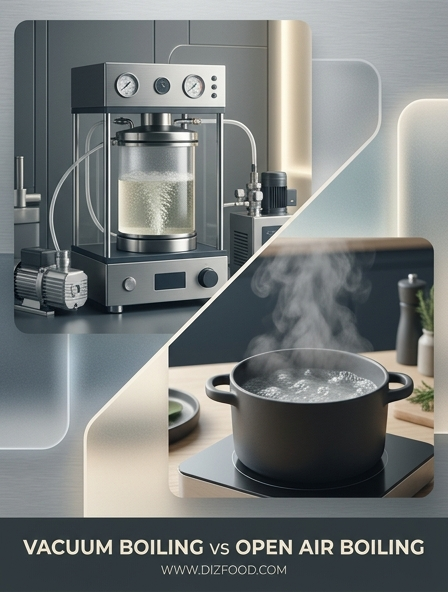
When it comes to preserving the soul of your ingredients, the battle between vacuum boiling and traditional open-air methods is a game-changer for culinary quality. Standard open-air boiling subjects delicate produce to high thermal stress and oxidation, often resulting in muted flavors, dull colors, and a significant loss of water-soluble vitamins. In contrast, vacuum boiling leverages reduced atmospheric pressure to lower the boiling point of water significantly. This "cool boil" technique allows you to cook or reduce liquids at temperatures that protect heat-sensitive phytonutrients and lock in volatile aromatic compounds, making it the superior choice for chefs and health enthusiasts aiming for maximum nutritional density and vibrant, concentrated taste profiles.
| Feature | Open-Air Boiling | Vacuum Boiling |
|---|---|---|
| Boiling Temperature | Fixed at 100°C (212°F) | Variable (30°C-60°C / 86°F-140°F) |
| Nutrient Retention | High degradation of Vit C & B-complex | Maximum preservation of enzymes & vitamins |
| Flavor Profile | Aromatics escape via steam (diluted) | Hermetically sealed (intense & pure) |
| Oxidation Risk | High; atmospheric oxygen causes browning | Near-zero; prevents enzymatic browning |
| Color Retention | Pigments (chlorophyll) fade quickly | Vibrant, natural "raw" colors preserved |
| Primary Use Case | Pasta, blanching, bulk preparation | Reductions, infusions, delicate extractions |
Understanding Atmospheric Pressure in Boiling
Atmospheric pressure is a fundamental force that dictates how liquids behave when heat is applied. In a standard kitchen environment, we are surrounded by a column of air that exerts a specific amount of weight onto everything it touches. At sea level, this pressure is approximately 14.7 pounds per square inch (psi), or one atmosphere. This pressure acts as a physical lid on the surface of a liquid, holding the molecules in their liquid state and resisting their transition into a gas.
As we increase the altitude, the column of air above us becomes thinner and lighter, resulting in lower atmospheric pressure. This environmental change has a direct impact on the boiling process. Because there is less downward force pressing on the surface of the water, the molecules require less kinetic energy-and therefore a lower temperature-to break free into the air as steam. This phenomenon explains why water boils at a lower temperature in mountain regions compared to coastal cities.
- Sea Level: Boiling occurs at 100°C (212°F).
- High Altitude (e.g., Denver): Boiling occurs at approximately 95°C (203°F).
- Extreme Altitude (e.g., Mount Everest): Boiling occurs at roughly 71°C (160°F).
In the culinary world, understanding this relationship is crucial for consistency. When atmospheric pressure shifts due to weather or geography, cooking times must be adjusted. If the pressure is low, the boiling point is low, meaning food cooks slower because the water cannot get hot enough to facilitate rapid chemical changes within the ingredients.
The Physics of Vacuum Boiling Explained
Vacuum boiling is the process of inducing a liquid to boil at temperatures significantly lower than its standard boiling point by mechanically reducing the surrounding pressure. While open-air boiling relies on increasing the temperature of the liquid until its vapor pressure equals the atmospheric pressure, vacuum boiling changes the equation by lowering the external pressure until it meets the vapor pressure of the liquid, even at room temperature.
The core physics involves a vacuum pump and a sealed chamber. By removing air molecules from the space above the liquid, the pump reduces the number of collisions occurring at the liquid's surface. This reduction in resistance allows the most energetic molecules in the liquid to escape into the gas phase with minimal thermal input. In some high-vacuum environments, water can be made to boil at temperatures as low as 20°C (68°F), which feels cool to the touch despite the vigorous bubbling traditionally associated with intense heat.
This method is distinct from traditional heating because it decouples "boiling" from "high heat." In a kitchen context, this allows for the evaporation of water from delicate sauces or purees without the risk of scorching or browning. The physics of the vacuum ensures that the latent heat of vaporization is still required, but the baseline temperature remains controlled and low, protecting the integrity of the substance being processed.
Boiling Point Variations at Reduced Pressure
The relationship between pressure and the boiling point of water is non-linear and can be plotted to show how dramatic the changes become as we approach a near-vacuum state. In professional culinary laboratories and industrial food processing, precise control over these variations allows for the creation of concentrates and distillates that retain the fresh profile of the original ingredient.
| Pressure (kPa) | Pressure (Atm) | Boiling Point (°C) | Boiling Point (°F) |
|---|---|---|---|
| 101.3 | 1.00 | 100 | 212 |
| 70.0 | 0.69 | 90 | 194 |
| 47.4 | 0.46 | 80 | 176 |
| 12.3 | 0.12 | 50 | 122 |
| 2.3 | 0.02 | 20 | 68 |
As demonstrated in the table above, even a modest reduction in pressure leads to a significant drop in the temperature required for phase change. This variation is the cornerstone of modern molecular gastronomy. For example, a chef wishing to reduce a delicate fruit juice into a thick syrup without changing its bright, fresh flavor profile will utilize a vacuum system to boil the juice at 40°C. This ensures the water evaporates while the heat-sensitive esters and aromatic compounds remain unchanged, whereas boiling at 100°C would result in a "cooked" or jam-like flavor.
Energy Efficiency Comparison of Both Methods
When comparing energy efficiency between open-air boiling and vacuum boiling, several factors must be considered, including the energy required for the vacuum pump versus the energy saved by avoiding high-temperature maintenance. Open-air boiling is inherently inefficient due to heat loss to the surrounding environment. As the pot heats up, energy radiates into the kitchen air, and significant energy is lost through the steam escaping the vessel.
Vacuum boiling systems are typically closed loops, which drastically reduces convective and radiative heat loss. Because the boiling occurs at a lower temperature, less sensible heat is required to bring the liquid to its boiling threshold. However, the energy required to operate the mechanical vacuum pump must be factored into the total "energy cost" of the process. In industrial settings, the efficiency of vacuum systems is often superior because they allow for faster processing times and the recovery of heat through specialized condensers.
- Heat Loss: Open systems lose up to 30% of energy to the air; vacuum systems are insulated by the vacuum itself.
- Start-up Time: Vacuum systems reach boiling states faster because the thermal "climb" is shorter.
- Latent Heat: The energy required to turn liquid to gas (latent heat) remains constant regardless of pressure.
- Equipment Load: Vacuum boiling requires electrical energy for pumps, while open boiling relies purely on thermal energy.
In a home kitchen, open-air boiling is more practical, but for high-volume reduction tasks, the vacuum method provides a more controlled and often more energy-conservative approach by preventing the unnecessary heating of the entire workspace.
Thermal Sensitivity and Nutrient Retention
One of the primary advantages of vacuum boiling in a culinary context is the preservation of thermal-sensitive compounds. Many essential nutrients, such as Vitamin C and various B vitamins, are labile, meaning they break down rapidly when exposed to temperatures near the standard boiling point of 100°C. Similarly, the enzymes and antioxidants found in fresh vegetables and fruits are often denatured or deactivated by high heat.
By lowering the boiling point via a vacuum, chefs can remove water or extract flavors at temperatures that do not exceed 40°C to 50°C. This allows for the concentration of flavors without the "thermal degradation" that characterizes traditional reduction. For instance, a vacuum-reduced tomato essence will retain the bright, acidic, and herbaceous notes of a raw tomato, whereas a traditionally boiled tomato sauce develops deeper, caramelized, and darker flavor notes due to the Maillard reaction and sugar pyrolysis.
Color retention is another significant benefit. Chlorophyll, the pigment responsible for the green color in vegetables, turns a dull olive-brown when exposed to prolonged high heat. In a vacuum system, the vibrant green is maintained because the temperature never reaches the threshold for pigment breakdown. This makes vacuum boiling an essential tool for high-end culinary presentations where the nutritional density and aesthetic vibrancy of the food are paramount.
Industrial Applications of Vacuum Distillation
Vacuum distillation and boiling are not merely kitchen experiments; they are the backbone of several major food and beverage industries. By manipulating pressure, manufacturers can create products that would be impossible to produce through standard atmospheric heating. The ability to separate components based on boiling points without using excessive heat is a game-changer for product quality and consistency.
- Sugar Refining: Sugar syrups are concentrated in vacuum pans to prevent the sugar from caramelizing or burning, ensuring a white, pure crystalline product.
- Coffee Extraction: Instant coffee and concentrated coffee extracts use vacuum evaporation to remove water while keeping the volatile aromatic oils intact, which would otherwise be lost to the air.
- Essential Oil Production: Distilling oils from herbs and flowers at low temperatures prevents the delicate scents from being destroyed by heat.
- Milk Powder Production: Milk is concentrated under a vacuum before spray drying to protect the proteins and vitamins from heat damage.
In these industrial settings, the use of large-scale vacuum chambers allows for the processing of thousands of liters of liquid simultaneously. The process is highly controlled, often utilizing multi-stage evaporators where the vapor from one stage is used to heat the next, further increasing the efficiency of the operation. This industrial scale demonstrates the reliability and necessity of low-pressure boiling in modern food science.
Standard Open Air Boiling Mechanisms
Open air boiling is the most common cooking technique worldwide, characterized by the heating of a liquid in a vessel exposed to the atmosphere. The mechanism is straightforward: heat is transferred from a source (gas, electric, or induction) to the bottom of the pot, and subsequently to the liquid through conduction and convection. As the liquid heats up, its density changes, creating convection currents that distribute the thermal energy throughout the vessel.
The defining characteristic of open-air boiling is the temperature ceiling. Once a liquid reaches its boiling point at a given atmospheric pressure, its temperature will not rise further, regardless of how much heat is applied. All additional energy is consumed as latent heat of vaporization, converting the liquid into steam. This provides a stable, predictable temperature for cooking, which is why boiling is a favored method for tasks like hydrating pasta or blanching vegetables.
However, the open-air method has limitations. The constant evaporation leads to a loss of volume and a concentration of solutes, which can be desirable for a stock but detrimental for delicate infusions. Furthermore, the maximum temperature is capped at 100°C (at sea level), which means that to achieve higher temperatures for faster cooking, one must move to a different mechanism, such as pressure cooking, which is effectively the opposite of vacuum boiling.
Vapor Pressure and Molecular Dynamics
To truly differentiate between vacuum and open-air boiling, one must look at the molecular dynamics of vapor pressure. Vapor pressure is the pressure exerted by a vapor in thermodynamic equilibrium with its condensed phases at a given temperature in a closed system. In simpler terms, it is the "escape tendency" of molecules from the surface of the liquid. Every liquid has a vapor pressure that increases as its temperature rises.
In an open-air system, boiling occurs only when the vapor pressure of the liquid equals the surrounding atmospheric pressure. This requires significant heat because the air molecules are constantly "pushing back" on the liquid. In a vacuum, we reduce the "push back" from the air, meaning the vapor pressure of the liquid can reach the ambient pressure threshold much sooner and at a lower kinetic energy level.
- Molecular Speed: In open boiling, molecules must move fast enough to overcome 101.3 kPa of pressure.
- Collision Frequency: Lowering pressure reduces the frequency of gas molecules striking the liquid surface.
- Phase Transition: Boiling is a bulk phenomenon; in a vacuum, bubbles form throughout the liquid at much lower energy states.
This molecular perspective highlights that boiling is a balance of forces. By manipulating the external environment (the vacuum), we change the physical requirements for the phase transition, allowing us to control the state of the matter without relying solely on thermal intensity.
Safety Protocols for Vacuum vs Open Systems
Safety is a critical consideration when moving from standard boiling to vacuum-assisted systems. Open-air boiling carries well-known risks, primarily centered around thermal burns from hot liquids or steam. Standard kitchen safety involves stable pot placement and careful handling of hot handles. However, vacuum systems introduce a different set of physical hazards that require specialized training and equipment.
- Implosion Risk: Unlike pressure cookers which can explode, vacuum chambers can implode if the vessel is structurally compromised. Only reinforced glassware or stainless steel rated for vacuum use should be employed.
- Boil-Over Control: In a vacuum, liquids can foam and "bump" violently. Sudden drops in pressure can cause the liquid to erupt out of the container, potentially clogging the vacuum pump.
- Seal Integrity: Maintaining a vacuum requires airtight seals. Any leak can cause a sudden change in pressure, potentially splashing hot liquid.
- Equipment Maintenance: Vacuum pumps require regular oil changes and filters to prevent the intake of moisture, which can degrade the motor over time.
While vacuum boiling occurs at lower temperatures, reducing the risk of severe thermal burns, the mechanical complexity of the system introduces new failure points. Users must ensure that all valves are operated in the correct sequence to avoid "shocking" the system. Proper safety protocols involve wearing eye protection and ensuring that the vacuum release is performed slowly to return the chamber to atmospheric pressure gradually.
Choosing the Right Boiling Method for Results
The choice between vacuum boiling and open-air boiling depends entirely on the desired culinary outcome. For most daily kitchen tasks, such as boiling eggs, cooking grains, or preparing pasta, open-air boiling is the superior choice. Its simplicity, lack of expensive equipment, and the specific temperature of 100°C are perfectly suited for these tasks, where the goal is often the structural modification of proteins and starches.
Vacuum boiling should be reserved for high-precision tasks where flavor and nutrient integrity are the priority. It is the ideal method for creating fruit concentrates, clarifying liquids without losing aromatics, and infusing oils with delicate herbs. If the goal is to reduce a liquid while maintaining its "raw" or "fresh" characteristics, a vacuum system is the only viable path. Conversely, if the goal is to develop deep, complex flavors through reduction and caramelization, open-air boiling or simmering is necessary.
Chefs often use a combination of both. A stock might be simmered in the open air to extract gelatin and develop savory depth, but then clarified and reduced in a vacuum to create a crystal-clear, intensely flavored glaze. Understanding the strengths and limitations of both methods allows for a more scientific approach to cooking, moving beyond simple heat application to true control over the physical and chemical state of the ingredients.

Comments