
Ever wondered if that pinch of salt really makes your pasta pot boil faster or if it's just an old kitchen myth? Whether you're a home cook or a culinary enthusiast, understanding the science behind salted versus plain water is a game-changer for both efficiency and taste. While adding salt technically raises the boiling point through a process called boiling point elevation, the primary benefit isn't speed-it's the profound impact on flavor and texture. This guide explores how seasoning your water acts as a deep-infusion tool, ensuring your starches and vegetables are seasoned from the inside out, rather than just on the surface, while debunking common misconceptions about heat-up times.
| Feature | Plain Water | Salted Water |
|---|---|---|
| Boiling Point | 212°F (100°C) at sea level. | Higher (approx. +0.1°F per Tbsp/quart). |
| Heating Speed | Standard baseline. | Marginally slower due to higher boiling point. |
| Flavor Impact | Neutral; can lead to bland results. | Enhances food molecules; seasons internally. |
| Food Texture | Can soften starches too quickly. | Strengthens pectin; keeps pasta/veggies firm. |
| Osmotic Effect | Draws nutrients/salts out of food. | Drives seasoning into the food cells. |
| Primary Use | Teas, coffees, and delicate poaching. | Pasta, potatoes, and blanched greens. |
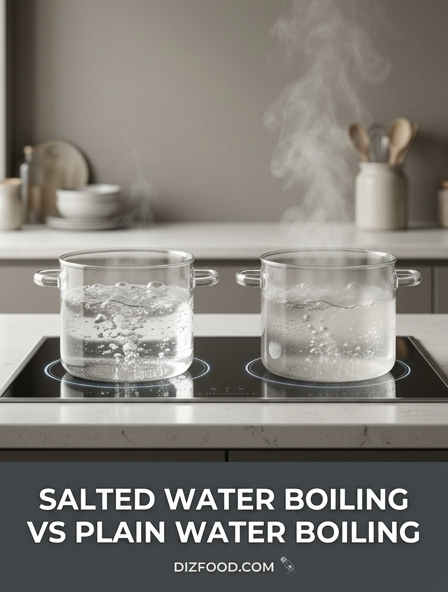
The Science Behind Boiling Point Elevation
The phenomenon of boiling point elevation occurs when a non-volatile solute, such as sodium chloride, is added to a pure solvent like water. In a culinary setting, this transition is governed by the principles of colligative properties, which depend on the number of solute particles rather than their identity. When salt dissolves in water, it dissociates into sodium and chloride ions. These ions create ion-dipole attractions with water molecules, effectively "holding" them in the liquid phase more tightly than the hydrogen bonds present in pure water.
To transition from a liquid to a gas, water molecules must overcome the atmospheric pressure pushing down on the surface. Because the dissolved salt ions occupy space and exert an attractive force, the water molecules require more kinetic energy-and thus a higher temperature-to break free into the vapor phase. For every 58 grams of salt added to a liter of water, the boiling point increases by approximately 0.5 degrees Celsius. While this shift is chemically significant, it is often too minor to be noticed by the average home cook without high-precision equipment.
- Ion-Dipole Interaction: The attraction between charged ions and polar water molecules that stabilizes the liquid state.
- Entropy: The introduction of salt increases the disorder of the liquid, requiring more energy to reach the transition point to a gas.
- Atmospheric Influence: Boiling occurs when vapor pressure equals atmospheric pressure; salt lowers vapor pressure, necessitating more heat.
Common Myths About Salt and Boiling Speed
One of the most persistent myths in the kitchen is that adding salt to water makes it boil faster. From a purely physical standpoint, this is a misunderstanding of how solutes interact with heat capacity and boiling points. While it is true that salt water has a lower specific heat than pure water-meaning it requires less energy to raise the temperature of the solution by one degree-the amount of salt typically used in cooking is so small that this effect is virtually non-existent. In fact, because salt raises the boiling point, the water actually has to reach a higher temperature before it begins to bubble vigorously.
In practical kitchen scenarios, the time difference between boiling salted and unsalted water is measured in seconds, not minutes. Most chefs who claim salt speeds up the process are likely witnessing the physical agitation caused by salt crystals being dropped into hot water. These crystals provide "nucleation sites," which allow bubbles to form more easily and give the illusion of an instant boil. However, this is a temporary reaction and does not represent an overall increase in the heating rate of the liquid mass.
- The "Faster Boil" Fallacy: The idea that salt significantly reduces the time to reach a boil.
- The Concentration Error: Assuming a pinch of salt is enough to change the chemical properties of a gallon of water.
- Nucleation Misinterpretation: Confusing the sudden release of steam upon adding salt with the actual boiling point of the solution.
Flavor Profiles of Salted Versus Plain Water
The primary reason for salting water in a professional kitchen is flavor development. When food is boiled in plain water, the lack of solutes in the liquid creates an osmotic imbalance. Water moves into the food, but the food's natural flavors and salts leach out into the surrounding liquid to reach equilibrium. This often results in a bland final product. Conversely, salted water acts as a seasoning medium that permeates the food during the cooking process. This is particularly crucial for starches like pasta and potatoes, which absorb water as they hydrate and gelatinize.
Seasoning the water allows the salt to reach the center of the food, providing a deep, consistent flavor that cannot be achieved by simply salting the surface after cooking. Plain water cooking results in a "flat" profile where the internal components of the ingredient remain unseasoned. Salt also acts as a flavor enhancer by suppressing bitterness and highlighting the natural sweetness of vegetables. Without this mineral presence, the delicate nuances of legumes and grains are often lost to the dilution of the boiling process.
Effect of Salinity on Pasta and Vegetable Texture
Salinity plays a critical role in the structural integrity of both cell walls in vegetables and starch networks in pasta. In vegetable cookery, salt helps to maintain the vibrance and texture of the plant matter. It assists in the breakdown of hemicellulose, which softens the vegetables more evenly. Furthermore, salt reduces the solubility of chlorophyll in the water, which helps green vegetables like broccoli and green beans retain their bright color rather than turning a dull, muddy brown.
For pasta, the presence of salt in the boiling water influences the gelatinization of starches and the behavior of surface proteins. While salt does not significantly change the "al dente" window, it does prevent the pasta from becoming overly gummy or sticky. The ions in the salt interact with the protein network of the pasta, providing a firmer bite. Without salt, the starch granules on the surface of the pasta swell excessively, leading to a slippery, mushy exterior that fails to hold sauce effectively.
| Ingredient | Effect of Salted Water | Effect of Plain Water |
|---|---|---|
| Pasta | Firm texture, reduced surface stickiness. | Gummy exterior, bland internal flavor. |
| Root Vegetables | Even softening, enhanced sweetness. | Leached nutrients, uneven cooking. |
| Green Vegetables | Bright color retention, crisp-tender. | Rapid chlorophyll loss, mushy texture. |
Heat Retention Properties of Brine Solutions
Once water reaches a boil, its ability to maintain that temperature when food is added is vital for consistent cooking results. A brine solution, or salted water, has slightly different thermal properties compared to plain water. Because of the dissolved ions, a salted solution has a higher density and a different thermal conductivity. These factors contribute to how the liquid responds when a cold ingredient, such as a pound of refrigerated pasta, is dropped into the pot. While the specific heat capacity of salt water is lower (meaning it holds slightly less energy per gram), the higher boiling temperature provides a marginal buffer.
In high-volume cooking, the retention of heat ensures that the "recovery time"-the time it takes for the water to return to a boil after adding food-is minimized. Using salted water in a heavy-bottomed pot creates a thermal environment that is more resistant to rapid fluctuations. Although the difference is subtle in small home batches, the cumulative effect of higher boiling temperatures and altered density helps in maintaining a steady simmer. This stability is essential for delicate tasks like poaching or blanching, where temperature precision dictates the final texture of the protein or vegetable.
Nutritional Differences in Salted Water Cooking
Cooking in salted water involves a trade-off between flavor and sodium intake. When vegetables or grains are boiled in salted water, they absorb a portion of the sodium. For individuals on strict low-sodium diets, this can be a concern. However, research suggests that the amount of salt actually absorbed is relatively low compared to the amount added to the pot. Much of the salt remains in the discarded cooking water. Interestingly, salted water can help preserve certain nutrients; by shortening the cooking time through more efficient heat transfer and pectin breakdown, heat-sensitive vitamins like Vitamin C may have less time to degrade.
Additionally, the presence of salt can influence the leaching of minerals. In plain water, the high concentration gradient encourages minerals like potassium to exit the food and enter the water. A balanced salinity in the cooking liquid can slow this process. Furthermore, the aesthetic benefit of salt-preserving the green color of chlorophyll-carries a psychological nutritional value, as bright, vibrant foods are often perceived as fresher and more appetizing, encouraging higher consumption of fiber-rich vegetables.
- Sodium Absorption: Generally ranges from 1% to 10% of the salt added to the water depending on the food's porosity.
- Mineral Leaching: Plain water increases the loss of water-soluble minerals into the pot.
- Chlorophyll Preservation: Salted water prevents the magnesium atom in chlorophyll from being replaced by hydrogen.
Corrosion Risks for Stainless Steel Cookware
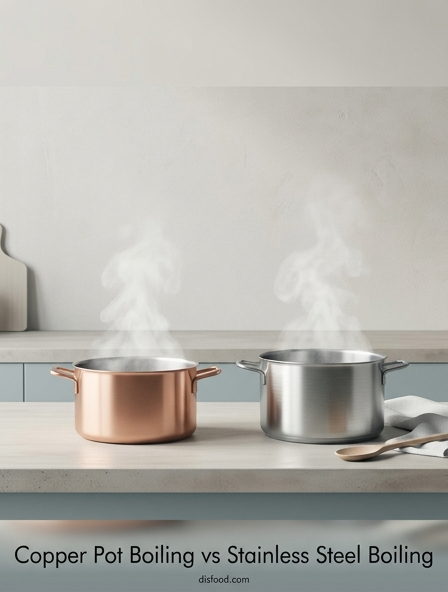
While salt is a boon for flavor, it can be an enemy to stainless steel cookware. Many home cooks are unaware of "pitting corrosion," a localized form of damage that creates small, permanent holes in the surface of a pot. This occurs when salt is added to cold water and allowed to sink to the bottom. Because cold water does not dissolve salt as quickly as hot water, the concentrated undissolved salt crystals sit against the steel. The chloride ions in the salt attack the protective passive layer of chromium oxide that makes the steel "stainless."
Once this protective layer is breached, the iron in the steel is exposed to oxygen and moisture, leading to rapid oxidation. To prevent this, it is an industry standard to wait until the water has reached a full boil before adding salt. At boiling temperatures, the kinetic energy of the water molecules ensures that the salt dissolves almost instantly, distributing the chloride ions evenly throughout the liquid and preventing them from settling in high concentrations at the base. This simple adjustment in timing can extend the life of high-end cookware by decades.
Solute Concentration and Vapor Pressure Changes
The relationship between solute concentration and vapor pressure is fundamental to understanding why salted water behaves differently. According to Raoult's Law, the vapor pressure of a solvent decreases when a non-volatile solute is added. In a pot of plain water, the surface is entirely composed of water molecules ready to evaporate. When salt is introduced, the surface area is shared between water molecules and solute ions. Because the ions do not evaporate, they effectively block a portion of the escape route for the water molecules.
This reduction in vapor pressure means that the liquid must be heated to a higher temperature to reach the point where its internal vapor pressure equals the external atmospheric pressure. This is the definition of the boiling point. The concentration of the solute determines the extent of this change. In the kitchen, we rarely reach concentrations high enough to see dramatic shifts in vapor pressure, but the underlying physics explains the consistent, steady bubble of a well-salted pasta pot versus the sometimes erratic "rolling" boil of pure distilled water.
Optimal Ratios for Seasoning Boiling Water
Achieving the perfect balance of seasoning requires an understanding of the specific ingredient being cooked. The old adage that pasta water should taste "like the sea" is actually a culinary exaggeration; seawater is roughly 3.5% salinity, which would make most pasta unpalatably salty. For most dried pasta, a ratio of 1% to 1.5% salinity is considered ideal. This equates to roughly 10 to 15 grams of salt per liter of water. This concentration ensures that the pasta is seasoned through its core without requiring excessive rinsing or heavy saucing to mask the saltiness.
Vegetables and potatoes generally require slightly less salt than pasta, as they have different absorption rates. When blanching green vegetables, a slightly higher salt concentration can be used for a shorter duration to lock in color and flavor without over-salting the interior. Conversely, when boiling potatoes for mash, a moderate salt level is preferred to ensure the starch is seasoned as it swells. Below is a guide for standard kitchen ratios using Diamond Crystal Kosher salt, which is a common industry standard.
| Application | Recommended Salinity | Approx. Amount per Liter |
|---|---|---|
| Dried Pasta | 1.0% - 1.5% | 1 - 1.5 Tablespoons |
| Potatoes / Tubers | 0.5% - 0.75% | 0.5 - 0.75 Tablespoons |
| Green Vegetables | 1.5% - 2.0% | 1.5 - 2 Tablespoons |
| Soups / Stocks | 0.2% - 0.5% | 0.25 Tablespoons (to start) |
Final Verdict on Salted Versus Unsalted Methods
The debate between salted and unsalted boiling water is easily resolved when distinguishing between physical efficiency and culinary quality. From a physics perspective, the differences in boiling speed and temperature are so marginal that they do not justify salting water on their own. The time saved or heat gained is negligible in the context of a standard home kitchen. However, from a gastronomic perspective, salting boiling water is an indispensable technique that fundamentally changes the character of the food.
The final verdict is clear: salt should always be used when boiling starches and vegetables, provided there are no medical contraindications. The improvement in texture, the preservation of color, and the depth of flavor provided by internal seasoning cannot be replicated by post-cooking adjustments. To protect your equipment, always add the salt after the water has reached a boil, and use a consistent ratio to ensure your dishes are perfectly seasoned every time. Plain water boiling should be reserved for specific tasks like tea, coffee, or when the goal is to purposefully leach salt out of a preserved ingredient like salt cod.



Comments