
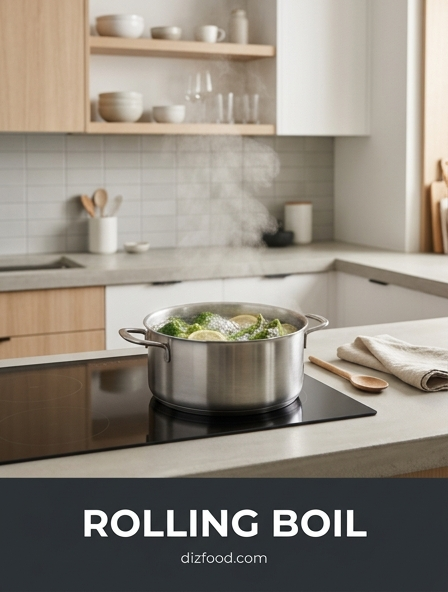
The Science of a True Rolling Boil
A rolling boil occurs when water reaches its maximum temperature at a given atmospheric pressure, typically 212°F (100°C) at sea level. Unlike a gentle simmer, a rolling boil is characterized by large, vigorous bubbles that originate from the bottom of the vessel and break the surface with significant force. This state is scientifically defined by the point where the vapor pressure of the liquid equals the surrounding atmospheric pressure. The key identifier for a chef is that the agitation does not stop even when the liquid is stirred vigorously with a spoon. This constant motion is the result of rapid phase transitions, where liquid water absorbs enough latent heat to transform into steam.
- Nucleation: Small imperfections on the pot surface where bubbles first form.
- Convection Currents: The rapid movement of hot water rising and cooler water sinking.
- Vapor Pressure: The force exerted by the steam trying to escape the liquid.
Achieving this state requires a high energy input. Once reached, the temperature remains stable because any additional heat energy is consumed by the evaporation process rather than increasing the liquid's temperature further. This creates a predictable environment for high-heat culinary tasks.
Starch Management for Perfect Pasta Texture
When dry pasta is submerged in boiling water, the starch granules on its surface immediately begin to absorb liquid and swell, a process known as gelatinization. During the first few minutes of cooking, these granules release a sticky amylopectin film. Without the intense movement of a rolling boil, this film acts as a powerful adhesive, causing individual strands or shapes to fuse together into unappetizing clumps. The high-energy environment of a rolling boil ensures that the pasta remains in constant motion, preventing prolonged contact between surfaces.
- Initial immersion triggers rapid starch expansion and surface stickiness.
- Agitation from boiling bubbles physically separates the pasta pieces.
- Ample water volume dilutes the concentration of sloughed-off starch.
- High heat ensures the pasta core hydrates before the exterior overcooks.
Effective starch management is impossible in lukewarm water. If the temperature drops too low, the starch becomes a gummy paste rather than a clean coating. By maintaining a vigorous boil, the chef ensures that the excess starch is washed away into the cooking liquid, leaving the pasta surface smooth and ready to bond correctly with the accompanying sauce later.
Why Vigorous Agitation Prevents Clumping
Agitation is the mechanical byproduct of a rolling boil, functioning as an invisible kitchen tool that constantly stirs the contents of the pot. In the context of small or delicate items like grains, peas, or ravioli, this turbulence is essential. When food is added to water, the density and surface tension of the liquid change. Without the kinetic energy provided by rising steam bubbles, gravity would pull the ingredients to the bottom where they would settle and stick to the hot metal surface or to one another. The rapid displacement of water during a boil creates a chaotic environment where no two items can remain in contact for more than a fraction of a second.
This physical separation is particularly important for high-starch items. As proteins denature and starches swell, they become chemically prone to bonding. The vigorous agitation provides enough shear force to break these weak chemical bonds before they become permanent. This results in a finished product where every grain or noodle is distinct. Furthermore, the agitation ensures that heat is distributed evenly throughout the pot, preventing "cold spots" that could lead to uneven cooking or localized sticking in larger batches.
Temperature Stability and Heat Retention
Maintaining a rolling boil is not just about the intensity of the heat, but also about the thermal mass of the system. When a cold ingredient, such as a pound of refrigerated pasta or a bag of frozen vegetables, is added to boiling water, the temperature of the water drops instantly. If the volume of water is too small or the heat source is too weak, the water will fall below the boiling point, resulting in a soggy texture and uneven cooking. A true rolling boil indicates that the system has enough stored energy to recover quickly from this thermal shock.
| Component | Role in Stability | Impact on Boiling |
|---|---|---|
| Water Volume | Thermal Buffer | Minimizes temperature drop upon ingredient addition. |
| Pot Material | Heat Conductivity | Distributes heat from the burner to the water efficiently. |
| Burner Output | Energy Input | Determines how fast the water returns to 212°F. |
Using a large pot with a high volume-to-ingredient ratio is the best way to ensure temperature stability. The more water there is, the less the overall temperature will fluctuate when food is introduced. This stability is critical for precision cooking where timing is calculated based on a constant 212°F environment.
Maximizing Evaporation for Quick Reductions
A rolling boil is the most efficient state for reducing liquids, such as stocks, wines, or watery sauces. Evaporation is a cooling process where the most energetic molecules escape into the air as gas. By increasing the heat to a rolling boil, you provide more molecules with the energy required to overcome the surface tension of the liquid. This significantly accelerates the rate at which the volume of the liquid decreases. For chefs, speed is often a factor, and a simmer simply cannot move the volume of water necessary for a rapid reduction.
The surface area of the pan also plays a major role in this process. A wide, shallow pan combined with a rolling boil creates the maximum possible exit path for steam. As the water evaporates, the concentration of solids-such as sugars, salts, and proteins-increases. This process transforms a thin, flavored water into a viscous, rich glaze. However, because the reduction happens so quickly at a rolling boil, it requires constant monitoring to prevent the liquid from scorching or reducing too far, which can lead to an overly salty or bitter flavor profile as the solutes become too concentrated.
Concentrating Flavors Through Rapid Boiling
While gentle simmering is preferred for clarity and delicate extractions, rapid boiling is used to forcefully concentrate flavors and emulsify fats. In many culinary traditions, such as the preparation of tonkotsu ramen broth, a rolling boil is used to break down marrow and collagen into gelatin, while simultaneously forcing fat to emulsify with the water. This creates a creamy, opaque liquid that is far richer than a standard clear stock. The violent motion of the water acts as a mechanical emulsifier, smashing oil droplets into smaller sizes until they are suspended throughout the liquid.
- Maillard Reaction: While usually occurring at higher temps, prolonged boiling of concentrated solutes can deepen color.
- Extraction: Rapid movement forces water into the crevices of bones and aromatics.
- Homogenization: Prevents fats from separating and floating on the surface.
As the water evaporates, the flavor compounds become more densely packed. This concentration is the secret to deep, savory glazes and jus. By the time a stock has reduced by half at a rolling boil, its viscosity and flavor intensity have fundamentally changed, providing a more robust base for sauces that require a "thick" mouthfeel without the need for additional starch or flour-based thickeners.
The Difference Between Simmering and Rolling
Understanding the distinction between a simmer and a rolling boil is fundamental to heat control in the kitchen. These two states represent different energy levels and are used for entirely different culinary outcomes. A simmer is typically used for delicate proteins like fish or for long-term extractions where clarity is desired. A rolling boil is reserved for starchy foods and rapid reductions where movement and high heat are beneficial. The physical differences are easily observable through bubble activity and temperature readings.
| Feature | Simmering | Rolling Boil |
|---|---|---|
| Temperature | 185°F - 205°F | 212°F (at sea level) |
| Bubble Size | Small, "pinhead" bubbles | Large, aggressive bubbles |
| Surface Agitation | Gentle rippling | Violent breaking |
| Best For | Poaching, Stocks | Pasta, Blanched Greens |
The transition from a simmer to a boil occurs as more energy is introduced. While a simmer allows for more control and prevents fragile foods from breaking apart, the rolling boil provides the kinetic energy and thermal consistency required for heavy-duty cooking. Mistaking one for the other can result in either undercooked, gummy pasta or toughened, overcooked meats.
Achieving Al Dente with Consistent Kinetic Energy
The term "al dente" translates to "to the tooth," describing pasta that is cooked through but retains a firm, chewy center. Achieving this perfect state depends heavily on the consistent kinetic energy of a rolling boil. If the water temperature fluctuates or the agitation is insufficient, the outer layer of the pasta can become over-hydrated and mushy before the heat has a chance to penetrate the core. A constant rolling boil ensures that the rate of hydration is even and predictable across the entire surface of the noodle.
- Continuous movement prevents localized overcooking.
- High heat ensures the starch on the outside gelatinizes quickly but stays firm.
- Predictable timing allows the chef to pull the pasta just as the white core disappears.
Because a rolling boil maintains a fixed temperature, it acts as a reliable baseline for timing. If a package says eight minutes, that estimate assumes the pasta is entering a high-energy environment. Without that kinetic energy, the pasta sits in its own starch cloud, slowing down the heat transfer and making the window for achieving a perfect al dente texture much smaller and harder to hit consistently.
How High Heat Impacts Sauce Density
The density of a sauce is a result of the ratio between solids and liquids. A rolling boil impacts this density primarily through rapid dehydration. As steam escapes, the concentration of natural pectins, fibers, and proteins increases, which naturally thickens the sauce. This is particularly evident in tomato-based sauces or fruit preserves. The high heat also facilitates the breakdown of cell walls in vegetables, releasing their internal juices and thickeners into the liquid more quickly than a gentle simmer would allow.
However, high heat also affects the molecular structure of some thickeners. For example, if a sauce is thickened with a roux (flour and fat), a rolling boil can help "set" the starch, but prolonged boiling might eventually break down the starch chains, causing the sauce to thin out again. Conversely, for reductions, the rolling boil is the most efficient path to a syrupy density. The key is to use the high heat to reach the desired thickness rapidly, then reduce the heat to maintain that density without scorching the sugars. This balance between evaporation and chemical breakdown is what defines a chef's control over sauce texture and mouthfeel.
Essential Equipment for Sustained Boiling Water
To maintain a sustained rolling boil, especially when adding large quantities of food, the choice of equipment is paramount. The pot must be able to conduct heat efficiently from the burner to the water. Materials with high thermal conductivity, such as copper or aluminum, are excellent, though heavy-duty stainless steel with an encapsulated aluminum core is the industry standard for durability and heat distribution. The size of the vessel also matters; it should be large enough to allow for plenty of water movement around the food items without boiling over.
- High-BTU Burners: Necessary to provide the energy required to reach and keep a boil.
- Thick Bottomed Pots: Prevent "hot spots" that can scorch food while the water boils.
- Tight-Fitting Lids: Useful for reaching the boiling point faster by trapping heat.
- Tall Sides: Prevent the violent bubbles from splashing out of the vessel.
Furthermore, the shape of the pot influences how the convection currents move. A tall, narrow stockpot is ideal for boiling pasta or blanching vegetables because it encourages a strong vertical movement of water. This ensures that the rolling action is centralized and powerful, providing the necessary agitation to keep ingredients moving and cooking uniformly throughout the process.

Comments