
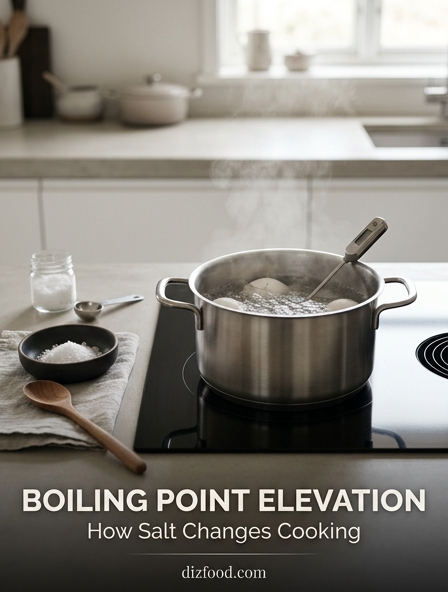
The Science of Boiling Point Elevation
Boiling point elevation is a colligative property that occurs when a non-volatile solute, such as salt or sugar, is dissolved in a pure solvent like water. In the kitchen, this phenomenon explains why seasoned liquids behave differently than plain water. When solutes are introduced, they occupy space at the liquid's surface, effectively reducing the number of solvent molecules available to escape into the vapor phase. Consequently, the vapor pressure of the solution drops below that of the pure solvent.
To reach the boiling point, the vapor pressure of the liquid must equal the surrounding atmospheric pressure. Because the solute has lowered the vapor pressure, the solution requires more thermal energy-and thus a higher temperature-to bridge the gap and begin the phase transition from liquid to gas. This shift is mathematically described by the Ebullioscopic constant, which varies depending on the solvent. In culinary applications, understanding this shift is vital for precise temperature management and achieving consistent results across various heat-intensive cooking methods.
Solutes and Culinary Heat Dynamics
The introduction of solutes into a boiling pot alters the fundamental heat dynamics of the cooking environment. As the concentration of particles increases, the intermolecular forces within the liquid are modified. Water molecules are attracted to solute particles through ion-dipole or hydrogen bonding, which necessitates a higher kinetic energy to break these bonds and initiate boiling. This increased thermal requirement means that the cooking medium operates at a higher internal temperature than pure water.
- Ion-Dipole Attractions: Occur when ionic solutes like salt interact with polar water molecules.
- Hydrogen Bonding: Predominant when organic solutes like sugar are dissolved.
- Kinetic Energy: The measurement of thermal movement required to overcome atmospheric pressure.
For a chef, these dynamics imply that a seasoned stock or a heavy syrup will hold more heat per unit of volume than plain water. This allows for faster cooking of submerged ingredients, although the difference is often marginal unless solute concentrations are exceptionally high, as seen in confectionery or heavy brine reduction processes.
Impact of Salt on Cooking Temperatures
Sodium chloride is the most common solute used in the kitchen, and its impact on the boiling point is a staple of culinary science. When salt is added to water, it dissociates into sodium and chloride ions. These ions disrupt the equilibrium of the water molecules, requiring the temperature to rise above 100°C (212°F) at sea level for boiling to occur. However, the magnitude of this change is frequently misunderstood in home cooking scenarios.
| Salt Concentration | Boiling Point Shift (Approx.) | Culinary Use Case |
|---|---|---|
| 1 teaspoon per liter | +0.05°C | Standard pasta water |
| 20% Brine solution | +1.50°C | Professional pickling |
| Saturated solution | +2.50°C | Specialized curing |
While the thermal increase from a pinch of salt is negligible for reducing cooking time, the presence of these ions significantly affects the flavor profile and the structural integrity of the food being cooked, such as the softening of pectin in vegetables.
Achieving Superior Flavor Through Temperature Control
Temperature control facilitated by boiling point elevation plays a critical role in flavor extraction. When water boils at a slightly higher temperature due to dissolved solutes, the rate of chemical reactions within the food increases. This can lead to a more efficient extraction of fat-soluble flavor compounds and essential oils from herbs and spices. In a professional kitchen, manipulating these boiling points allows for a more aggressive infusion process.
- Enhanced Solvent Power: Higher temperatures increase the solubility of various flavor-carrying compounds.
- Maillard Acceleration: Elevated heat promotes complex flavor development in stocks.
- Enzymatic Deactivation: Faster heat penetration can quickly neutralize enzymes that cause off-flavors in vegetables.
By carefully managing the concentration of solutes, a cook can fine-tune the thermal environment to ensure that aromatics are fully realized without overcooking the primary ingredients. This precision is what distinguishes a standard boil from a controlled culinary extraction, resulting in deeper, more complex profiles in soups, sauces, and braising liquids.
Sugar Concentration and Boiling Precision
In the realm of confectionery, boiling point elevation is not just a scientific curiosity; it is a fundamental tool for measurement. As a sugar syrup boils, water evaporates, causing the concentration of sugar to increase. This rising concentration leads to a predictable and progressive increase in the boiling temperature of the syrup. Pastry chefs use these specific temperature markers to determine the water content remaining in the sugar, which dictates the final texture of the candy.
| Syrup Stage | Temperature Range | Sugar Concentration |
|---|---|---|
| Soft Ball | 112°C - 115°C | Approx. 85% |
| Hard Ball | 121°C - 130°C | Approx. 92% |
| Hard Crack | 149°C - 154°C | Approx. 99% |
Because the boiling point is so sensitive to the solute concentration, a thermometer becomes a proxy for a refractometer. Precise tracking of these elevated temperatures allows for the creation of everything from soft caramels to brittle toffee with absolute consistency and scientific accuracy.
Solute Management for Optimal Texture
The texture of boiled foods is heavily influenced by the boiling point of the surrounding liquid. Solute management ensures that the internal temperature of the food reaches the necessary threshold for structural transformation. For example, when boiling tough cuts of meat or fibrous vegetables, a liquid with a high solute content can maintain a higher temperature, which more effectively breaks down collagen and hemicellulose. This leads to a tenderizing effect that pure water might achieve more slowly.
However, excessive boiling point elevation can be counterproductive if the exterior of the food cooks too rapidly relative to the interior. Professional chefs balance the concentration of salts and sugars to ensure that the heat transfer is sufficient to soften tough fibers while maintaining the overall integrity of the ingredient. This balance is particularly important in techniques like glazing or poaching fruit, where the sugar concentration must be high enough to elevate the temperature and create a glossy finish, but not so high that the fruit becomes dehydrated through osmotic pressure before it softens.
Enhancing Heat Transfer in the Kitchen
Effective heat transfer is the cornerstone of efficient cooking. Boiling point elevation contributes to this by creating a more "energetic" cooking medium. When a liquid contains solutes, the increased temperature results in a higher thermal gradient between the liquid and the submerged food. According to the laws of thermodynamics, a larger temperature difference results in faster heat transfer, potentially reducing the cooking time for dense proteins and starches.
Furthermore, the presence of solutes can change the viscosity and density of the liquid, which in turn affects convection currents within the pot. A denser, solute-rich liquid may circulate heat differently than pure water, often leading to more uniform temperature distribution in thick stews or purees. Understanding these nuances allows cooks to manipulate the boiling environment to maximize energy efficiency. While the physical rise in temperature might be a few degrees, the cumulative effect on heat flux and molecular agitation can significantly alter the outcome of high-heat boiling processes in professional culinary settings.
The Maillard Reaction and Boiling Shifts
The Maillard reaction, responsible for the savory "browned" flavors in cooked food, typically requires temperatures above 140°C (284°F). Under normal circumstances, boiling water is capped at 100°C, making browning impossible in a submerged environment. However, by utilizing boiling point elevation through extreme solute concentrations-specifically in heavy syrups or alkaline solutions-cooks can push the boiling temperature closer to the Maillard threshold.
- Alkaline Adjustments: Adding baking soda to a boiling liquid can lower the activation energy for browning.
- Concentrated Reductions: As sauces reduce and solutes concentrate, the temperature rises, allowing for subtle browning even in a liquid state.
- Pressure Synergy: Combining high solute loads with increased pressure further elevates the thermal ceiling.
While a standard salt boil will not brown a steak, the principles of boiling point elevation allow for the development of "liquid gold" stocks and deeply caramelized onion reductions where the temperature exceeds the standard boiling limit of pure water, facilitating complex chemical rearrangements that produce deep umami notes.
Atmospheric Pressure Versus Solute Elevation
Cooking at high altitudes presents a unique challenge: lower atmospheric pressure causes water to boil at much lower temperatures, often resulting in undercooked food. Boiling point elevation via solutes offers a partial scientific countermeasure to this problem. By increasing the salt or sugar content of the cooking water, a chef can artificially raise the boiling point back toward sea-level standards, ensuring that the thermal energy is sufficient to cook grains and proteins thoroughly.
This relationship is a tug-of-war between the environment and the recipe. At 10,000 feet, water boils at approximately 90°C (194°F). To compensate, a significant increase in solute concentration would be required to reach a 100°C boil, which might render the food unpalatable. Therefore, professional chefs in high-altitude locations must find a balance between using solutes to elevate the boiling point and adjusting cooking times or using pressure vessels. Understanding the intersection of barometric pressure and colligative properties is essential for maintaining consistency in global culinary operations.
Practical Applications for Professional Boiling Results
For the professional chef, mastering boiling point elevation is about consistency and precision. Whether crafting a delicate consommé or a robust syrup, the concentration of solutes must be measured and maintained. This is often achieved through the use of tools like the refractometer or a high-precision digital thermometer, which can detect the slight deviations in boiling temperature that signify changes in the liquid's composition.
- Consistent Brining: Using salt to ensure specific thermal peaks for poultry.
- Reduction Monitoring: Watching for the "temp jump" to signal that a sauce has reached the desired density.
- Candy Precision: Relying on boiling points to ensure the perfect crystal structure in fudge and ganache.
By applying these scientific principles, chefs can move beyond "intuitive" cooking and into a realm of technical mastery. Controlling the boiling point through solute management ensures that every batch of product meets the same rigorous standards for flavor, texture, and appearance, regardless of the kitchen's environmental variables.

Comments