
Mastering the subtle art of heat application can transform your home cooking from average to artisanal, and the real secret lies in knowing when to parboil versus when to commit to a full boil. While full boiling is the straightforward process of cooking food until it is tender and ready for immediate consumption, parboiling is a strategic "partial cook" that softens the internal structure of hardy ingredients without sacrificing their crunch or nutritional integrity. By utilizing parboiling as a high-efficiency meal prep technique, you can significantly reduce final roasting or grilling times, ensuring that dense vegetables like potatoes or grains like brown rice achieve a uniform texture that is never mushy. Whether you are looking to lock in vibrant colors, stabilize starches, or simply streamline your kitchen workflow, understanding these two thermal methods is the key to achieving professional-grade results and perfect mouthfeel every time.
| Feature | Parboiling (Partial) | Full Boiling (Complete) |
|---|---|---|
| Primary Goal | Pre-treatment for further cooking (roasting/searing). | Total hydration and immediate consumption. |
| Cooking Duration | 25%-50% of the standard cooking time. | 100% until the "al dente" or soft stage. |
| Internal Texture | Firm, slightly translucent, and structurally intact. | Soft, tender, and fully gelatinized/broken down. |
| Nutrient Retention | High; quick heat seals in vitamins and minerals. | Lower; water-soluble nutrients often leach out. |
| Efficiency Edge | Cuts final oven/grill time by up to 40%. | Requires no secondary cooking phase. |
| Common Use Case | Crispy roast potatoes, stir-fry prep, or brown rice. | Pasta, mashed vegetables, or hard-boiled eggs. |
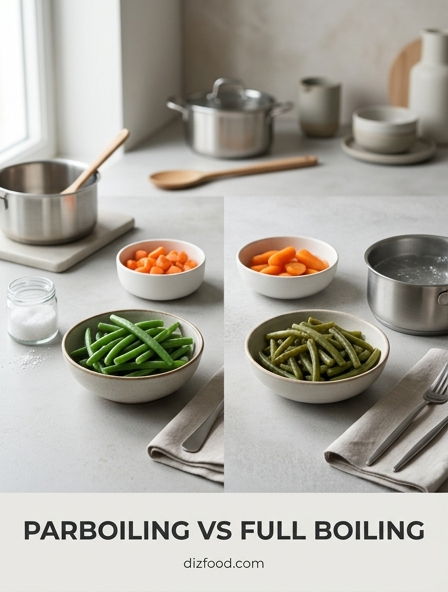
Understanding the Core Differences Between Parboiling and Full Boiling
In the culinary world, the distinction between parboiling and full boiling lies primarily in the duration of the cooking process and the intended final state of the ingredient. Parboiling, often referred to as partial boiling, involves cooking food in boiling water only until it is partially cooked. The goal is to soften the outer layers while maintaining a firm interior. This technique is frequently used as a preparatory step for complex dishes where the ingredient will undergo a second cooking process, such as roasting, frying, or stewing. Because the item is removed from the heat before it is fully tender, it retains its structural integrity, preventing it from becoming mushy when exposed to further heat treatments.
Full boiling, on the other hand, is the process of cooking food in water at its boiling point until it is entirely tender and ready for immediate consumption. This method is the standard for preparing pasta, soft-boiled eggs, or vegetables intended for mashing. Unlike parboiling, full boiling aims for complete gelatinization of starches and the softening of cellulose fibers. While parboiling requires the cook to monitor the clock closely to stop the process at roughly 50% to 70% doneness, full boiling continues until the core of the food has reached a palatable temperature and texture. Understanding these differences allows a cook to manipulate the final mouthfeel of a dish, ensuring that each component is cooked perfectly according to its specific requirements.
Nutritional Retention in Partial Versus Complete Cooking Methods
The duration for which food is exposed to high temperatures and water significantly impacts its nutritional profile. Parboiling is often touted for its ability to lock in certain vitamins and minerals that might otherwise be lost during extended boiling. When grains like rice are parboiled, the process involves steaming the grain in its husk, which forces nutrients-specifically B vitamins and minerals-from the bran into the endosperm. This results in a final product that is nutritionally superior to standard white rice, even after the husk is removed. Because parboiling uses a shorter immersion time in water, there is also less opportunity for water-soluble vitamins, such as Vitamin C and the B-complex group, to leach out into the cooking liquid.
- Vitamin Preservation: Shorter boiling times reduce the thermal degradation of heat-sensitive antioxidants.
- Mineral Density: Parboiling can help retain potassium and magnesium within the cellular structure of vegetables.
- Husk-to-Grain Transfer: In grains, the parboiling pressure treatment enriches the interior of the kernel.
Conversely, full boiling can lead to significant nutrient loss if the cooking water is discarded. Many of the vital micronutrients dissolve into the water during the long cooking cycle. While full boiling makes certain fibers easier to digest, it often results in a lower density of micronutrients compared to parboiled or steamed alternatives. To mitigate this in full boiling, chefs often use the leftover water for stocks or soups to reclaim the lost nutrients.
How Texture Changes During Parboiling and Full Boiling Processes
Texture is perhaps the most visible differentiator between parboiling and full boiling. When an ingredient is parboiled, the heat penetrates just deep enough to begin breaking down the pectin and cellulose in the cell walls. This results in a "snap" or a "bite" that is highly desirable in stir-fries and salads. For instance, parboiling a potato before roasting creates a thin, starch-rich surface that crisps up beautifully in the oven, while the inside remains fluffy but not disintegrated. The internal structure remains largely intact, allowing the food to withstand aggressive secondary cooking methods like deep-frying or high-heat sautéing without falling apart.
Full boiling leads to a complete transformation of the ingredient's physical properties. For starchy foods, the starch granules swell and eventually burst, a process known as gelatinization, which creates a soft, creamy, or even mushy texture. In fibrous vegetables, the structural proteins that hold the cells together are completely denatured, resulting in a limp or tender consistency. While this is ideal for a smooth cauliflower purée or a bowl of soft noodles, it can be detrimental if the food is meant to maintain a specific shape. The transition from parboiled to overboiled can happen in a matter of seconds, making timing the most critical factor in texture management.
The Impact of Starch Breakdown on Digestion and Health
The physiological impact of how we boil our food is often overlooked. The degree of starch breakdown during cooking directly influences how quickly our bodies can convert that food into glucose. Parboiled grains and vegetables generally have a lower Glycemic Index (GI) compared to their fully boiled counterparts. This is because parboiling often creates "resistant starch," which acts more like fiber in the digestive tract. This resistant starch is not fully broken down in the small intestine, leading to a slower release of energy and improved gut health through the fermentation process in the colon.
| Feature | Parboiled Starch | Fully Boiled Starch |
|---|---|---|
| Digestive Speed | Slow and sustained | Rapid absorption |
| Glycemic Response | Lower insulin spikes | Higher insulin spikes |
| Resistant Starch | Higher concentrations | Minimal concentrations |
Full boiling optimizes the starch for rapid digestion. While this can be beneficial for athletes needing immediate glycogen replenishment, it may not be ideal for individuals managing blood sugar levels. The intense heat of full boiling breaks the molecular bonds of the starch so thoroughly that the enzymes in our saliva and stomach can convert them to sugar almost instantly. By choosing to parboil, cooks can provide a more balanced metabolic response, making the meal healthier for the long term.
Mastering the Timing for Perfect Parboiled Grains and Vegetables
Achieving the perfect parboil requires a combination of high heat, precise timing, and an immediate cooling phase. Unlike full boiling, where the food is often left in the pot until it is soft, parboiling requires the cook to intervene at a specific threshold. The goal is to reach a state of "al dente" for vegetables or a semi-translucent state for grains. Once this state is reached, the cooking must be stopped immediately to prevent the residual heat from continuing the process, which is why most parboiling instructions include a "shocking" step in an ice bath.
- Preparation: Cut vegetables into uniform sizes to ensure even heat distribution.
- Immersion: Place ingredients into already boiling, salted water rather than starting in cold water.
- Monitoring: Test for firmness every 60 seconds; vegetables usually take 2-5 minutes, while grains take 5-10.
- The Shock: Immediately drain and submerge in ice water to lock in color and texture.
For grains like brown rice, parboiling usually involves boiling for about 12 to 15 minutes before draining and finishing by steaming or baking. For hardy vegetables like carrots or broccoli, a 3-minute parboil is often sufficient. If you are parboiling meat, such as ribs before grilling, the time may extend to 20 minutes to ensure the connective tissues begin to soften without the meat falling off the bone prematurely. Accuracy in these windows determines the success of the final dish.
Why Professional Chefs Prefer Parboiling for Flavor Infusion
In professional kitchens, parboiling is a strategic tool for flavor management. Chefs rarely boil an ingredient to completion in plain water because it limits the opportunity to introduce complex flavors later. By parboiling in a lightly seasoned or acidic liquid, the chef "primes" the ingredient. The partial breakdown of the exterior surface creates a porous texture that is much more receptive to marinades, sauces, and fats in the subsequent cooking stages. For example, a parboiled potato has a rougher surface area than a raw one, allowing it to soak up duck fat or herb-infused oils more effectively during roasting.
Furthermore, parboiling is used to remove unwanted flavors before the main cooking event. This is common with certain bitter greens or gamey meats. A quick parboil and a water change can strip away excess bitterness or impurities, leaving a clean palate for the chef to build upon. In the context of large-scale service, parboiling also allows for better seasoning control. Ingredients can be parboiled in batches and then finished to order with fresh herbs and spices, ensuring that the flavors are vibrant and "front-forward" rather than muted by a long, continuous boiling process that can dull the aromatic compounds of the food.
Comparing Shelf Life and Food Safety of Both Techniques
From a food safety and preservation perspective, parboiling and full boiling serve different roles. Parboiling is an excellent technique for meal prep and long-term storage. By partially cooking vegetables and then shocking them in ice water, you deactivate the enzymes that cause browning and spoilage. This "blanch-parboil" method allows vegetables to be frozen while maintaining their vibrant color and nutritional value for months. Full boiling, however, renders the food more susceptible to structural collapse during freezing, often resulting in a watery, unappealing texture upon thawing.
- Enzyme Inactivation: Parboiling stops the biological processes that lead to decay.
- Moisture Control: Fully boiled foods retain more internal water, which can lead to ice crystal damage in freezers.
- Reheating Stability: Parboiled foods hold up better when reheated, whereas fully boiled foods often overcook.
However, it is important to note that parboiled food is not "preserved" in the sense of being shelf-stable at room temperature. Because it is only partially cooked, it still requires refrigeration or freezing. In some cases, parboiling meat can actually increase the risk of bacterial growth if the secondary cooking isn't performed immediately, as the internal temperature may sit in the "danger zone" for too long. Therefore, parboiled items should be cooled rapidly and stored at 40°F (4°C) or below. Fully boiled foods are generally safer for immediate short-term storage because the high heat has thoroughly pasteurized the ingredient, though they degrade faster in quality.
Energy Efficiency and Cooking Speed Comparison
When considering energy consumption in the kitchen, the choice between these two methods can impact both your utility bill and your schedule. Parboiling is inherently more energy-efficient for complex meals because it utilizes the high heat of boiling water for only a short window. The rest of the cooking is often done using residual heat or more efficient methods like pan-searing. For instance, parboiling pasta for a baked casserole reduces the oven time significantly, which is often a more expensive heat source than a gas or induction cooktop. By using the "boil-and-stop" method, you minimize the time the stove is running at maximum output.
Full boiling, especially for tough grains or legumes, can require the stove to be on for an hour or more. This not only consumes more energy but also releases a significant amount of humidity and heat into the kitchen environment. In a professional setting, parboiling is used as a "speed-sell" technique. By having parboiled components ready to go, a line cook can finish a dish in three minutes that would otherwise take fifteen. This split-stage cooking maximizes the output of the kitchen during peak hours. For the home cook, parboiling during the weekend can cut weekday dinner preparation times in half, making it a superior method for time-strapped individuals.
Selecting the Right Method for Specific Ingredients and Recipes
The decision to parboil or fully boil should be dictated by the physical characteristics of the ingredient and the requirements of the final recipe. Some ingredients are naturally suited for one over the other. For example, delicate greens like spinach should never be fully boiled as they turn to a stringy mess; a quick parboil (or blanch) is all they can handle. Conversely, dry pasta intended for a cold salad must be fully boiled to ensure a consistent, soft texture that won't harden when chilled. Choosing the wrong method can ruin the mouthfeel of even the most expensive ingredients.
| Ingredient | Recommended Method | Reasoning |
|---|---|---|
| Potatoes for Roasting | Parboil | Creates a starchy surface for crisping. |
| Pasta for Mac & Cheese | Parboil | Prevents mushiness after baking in sauce. |
| Cauliflower for Mash | Full Boil | Requires complete fiber breakdown for smoothness. |
| Broccoli for Stir-fry | Parboil | Maintains bright color and "snap." |
When preparing stews, parboiling hardy root vegetables like carrots and parsnips separately can ensure they are perfectly cooked at the same time as the tender meat. If you were to fully boil them before adding them to the stew, they would likely dissolve into the liquid. Mastering the selection process involves anticipating how the ingredient will react to the second phase of heat. If the recipe involves a second heat source (oven, grill, or pan), parboiling is almost always the superior choice.
Key Takeaways for Choosing Between Parboiling and Full Boiling
The choice between parboiling and full boiling is a fundamental skill that elevates a cook from a novice to an expert. Parboiling is a versatile preparatory technique that focuses on structural preservation, flavor priming, and nutritional density. It is the best choice when an ingredient is part of a multi-step process or when you want to maximize the health benefits of starches through the development of resistant starch. It requires more attention to detail, specifically regarding timing and the "shocking" process, but the results in texture and appearance are often well worth the extra effort.
- Use Parboiling: For roasting, frying, freezing, or lowering the glycemic index of grains.
- Use Full Boiling: For immediate consumption, mashing, puréeing, or preparing standard pasta dishes.
- Consistency: Always use uniform cuts to ensure the partial cooking is even across all pieces.
Ultimately, full boiling serves its purpose for simple, direct preparation where softness is the goal. However, parboiling offers greater control over the final dish's complexity. By understanding how heat interacts with the cellular structure of food, you can decide which method serves your culinary goals. Whether you are looking to save time during a busy weeknight or aiming to produce a restaurant-quality roast with a perfectly crisp exterior, knowing when to stop the boil is just as important as knowing when to start it. This knowledge ensures every meal is both delicious and nutritionally optimized.

Comments