
Choosing between vegetable shortening and lard can transform your baking from basic to brilliant, as each fat brings a unique chemistry to your kitchen. While vegetable shortening is a shelf-stable, 100% plant-based fat engineered for a high melting point and neutral flavor, lard is traditional rendered pork fat prized by artisans for creating incomparable flaky layers. If you are chasing tall, soft cookies and airy frostings, shortening's structural stability is your best friend; however, for those seeking the ultimate savory depth and the crispest pie crusts imaginable, lard remains the gold standard. Understanding these functional differences ensures you pick the perfect lipid to achieve that desired melt-in-your-mouth texture every time you preheat the oven.
| Feature | Vegetable Shortening | Lard (Rendered Fat) |
|---|---|---|
| Source | Soybean, palm, or cottonseed oils | Rendered pork fat (leaf or back fat) |
| Flavor Profile | Completely neutral; takes on other flavors | Mildly savory or "porky" (unless leaf lard) |
| Melting Point | Higher (~117°F); holds shape longer | Lower (~90°F-110°F); melts quickly |
| Final Texture | Soft, tender, and uniform crumb | Distinctly flaky, layered, and crisp |
| Dietary Info | Vegan; zero cholesterol; contains trans/sat fat | Animal-based; contains cholesterol |
| Best Used For | Frosting, cookies, and shelf-stable pies | Biscuits, savory crusts, and flour tortillas |
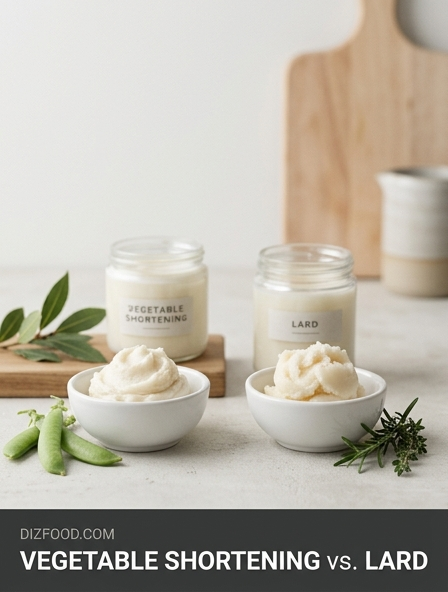
Vegetable Shortening vs Lard Key Differences Explained
Vegetable shortening and lard are two of the most significant solid fats used in traditional and modern cooking. While they often serve similar roles in the kitchen, their origins and physical properties vary considerably. Vegetable shortening is a modern invention, typically made from hydrogenated vegetable oils like soybean or cottonseed oil. It was designed to remain solid at room temperature, mimicking the functional properties of animal fats without the need for refrigeration. Lard, conversely, is one of the oldest culinary fats known to man, produced by rendering the fatty tissue of pigs. It has been a staple in global cuisines for centuries, prized for its ability to create exceptionally tender crusts and savory fried foods.
The primary differences between these two fats lie in their source, flavor profile, and chemical structure. Shortening is 100% fat and contains no water, which allows it to create a very specific crumbly texture in baked goods. Lard is also nearly 100% fat but contains large fat crystals that behave differently when manipulated in dough. Because shortening is a manufactured product, it is engineered for consistency and a high melting point, making it more forgiving for novice bakers. Lard's quality can vary significantly depending on the part of the pig it was sourced from and how it was processed, leading to different results in the final dish. Understanding these nuances is essential for any cook looking to master the art of pastry and frying.
The Composition of Plant Based Fats vs Animal Fats
The chemical composition of vegetable shortening and lard dictates how they perform under heat and how they interact with other ingredients. Vegetable shortening is created through a process called hydrogenation, where hydrogen is added to liquid vegetable oils to turn them into a solid at room temperature. This process alters the molecular structure of the oil, resulting in a product that is highly stable and resistant to oxidation. Lard, being a natural animal product, is composed of various fatty acids, including oleic acid, palmitic acid, and stearic acid. Unlike shortening, lard is not chemically altered through hydrogenation, though some commercial varieties are bleached or deodorized for shelf stability.
| Feature | Vegetable Shortening | Lard |
|---|---|---|
| Source | Soybean, palm, or cottonseed oil | Rendered pork fat |
| Fat Content | 100% Lipid | 98-100% Lipid |
| Processing | Hydrogenation/Interesterification | Rendering (Wet or Dry) |
| Physical State | Homogeneous semi-solid | Crystalline semi-solid |
The fat crystals in lard are naturally larger than those found in shortening. These large crystals are what contribute to the legendary flakiness of a lard-based pie crust. Shortening, being more uniform in its molecular distribution, provides a consistent, tender crumb but lacks the distinct crystalline structure that creates visible layers in puff pastry or biscuits. Furthermore, lard contains natural cholesterol, a trait completely absent in vegetable shortening, which is derived entirely from plant sources.
Baking Performance Texture and Flakiness Comparison
In the realm of baking, the choice between shortening and lard often comes down to the desired texture of the finished product. Shortening has a higher melting point than lard and butter. This means that as a dough or batter heats up in the oven, shortening takes longer to melt, allowing the structure of the baked good to set before the fat liquefies. This results in cookies that spread less and cakes that have a higher, more stable rise. Shortening is often the preferred choice for decorative frostings because it maintains its shape even in warmer ambient temperatures.
Lard is widely considered the gold standard for flakiness, particularly in pie crusts and biscuits. This is due to its unique crystalline structure and its ability to remain as distinct clumps of fat within the dough. When the dough hits the hot oven, the fat melts and the moisture within the dough turns to steam, creating pockets that translate into thin, delicate layers. While shortening also produces a flaky result, it tends to be more "short" or crumbly rather than layered. Many bakers utilize a combination of fats to achieve the perfect balance. Common techniques include:
- Using lard for the primary fat to ensure structural flakiness.
- Adding a small amount of butter for flavor and browning.
- Using shortening for intricate lattice work that needs to hold its shape during baking.
Ultimately, lard provides a more rustic, crisp texture, while shortening offers a softer, more uniform "melt-in-the-mouth" sensation that is highly valued in commercial baking and soft-style cookies.
Flavor Profiles Neutral Shortening vs Savory Lard
Flavor is perhaps the most immediate differentiator between these two fats. Vegetable shortening is designed to be completely neutral. It is deodorized and refined so that it does not impart any specific taste to the food. This makes it an ideal medium for recipes where the flavor of the other ingredients, such as high-quality chocolate, delicate fruits, or complex spices, needs to shine through without interference. It acts primarily as a structural agent, providing moisture and texture without adding its own personality to the dish.
Lard, on the other hand, possesses a distinct flavor profile that can range from very mild to intensely savory. The flavor of lard depends heavily on the "rendering" process and the source of the fat. "Leaf lard," which comes from the fat around the pig's kidneys, is the highest quality and has the most neutral flavor, making it suitable even for sweet pastries. However, regular rendered lard often carries a subtle, porky undertone. This savory quality is highly prized in traditional cooking, particularly in Mexican cuisine for making tamales, or in British cooking for savory meat pies. When used in frying, lard adds a depth of flavor that vegetable oils cannot replicate, lending a richness to fried chicken or donuts that is unmistakable. For bakers who find the pork flavor distracting in sweets, the choice is usually shortening or highly refined leaf lard.
Smoke Points and Frying Stability for High Heat Cooking
When it comes to high-heat applications like deep frying or searing, the smoke point of the fat is a critical safety and flavor consideration. The smoke point is the temperature at which a fat begins to break down, producing smoke and developing acrid, bitter flavors. Both vegetable shortening and lard are well-suited for frying because they have relatively high smoke points compared to unrefined oils or butter, but they behave differently under prolonged heat exposure.
Vegetable shortening typically has a smoke point around 360°F to 410°F (182°C to 210°C), depending on the specific oil blend and additives used by the manufacturer. It is very stable and resists breaking down over multiple frying cycles, which is why it is often used in commercial deep fryers. Lard has a similar smoke point, generally ranging from 370°F to 400°F (188°C to 204°C). Because lard is a natural animal fat, it contains fewer impurities than butter but more than a highly refined industrial shortening. This makes it excellent for pan-frying or "shallow" frying where the temperature can be closely monitored. Key considerations for frying include:
- Consistency: Shortening provides a very consistent fry with little flavor transfer.
- Recovery: Both fats have good heat retention, allowing for faster temperature recovery after adding cold food.
For home cooks, lard is often preferred for its ability to create a golden-brown, flavorful crust, while shortening is favored for its convenience and long-term stability in the fryer.
Nutritional Breakdown Saturated Fats and Trans Fats
The nutritional profile of these two fats has been the subject of much debate and evolution over the last few decades. Historically, vegetable shortening was criticized for its high trans-fat content, a byproduct of the partial hydrogenation process. Trans fats have been linked to various cardiovascular issues and are now largely phased out of most commercial shortenings. Modern shortening is typically made from fully hydrogenated oils or through interesterification, which results in a product with zero grams of trans fat per serving, though it remains high in saturated and monounsaturated fats.
| Nutrient (per 100g) | Vegetable Shortening | Lard (Rendered) |
|---|---|---|
| Total Fat | 100g | 100g |
| Saturated Fat | 25g - 40g | 39g - 45g |
| Monounsaturated Fat | 40g - 50g | 45g - 50g |
| Cholesterol | 0mg | 95mg |
| Vitamin D | None | Varies (High if pasture-raised) |
Lard is naturally high in monounsaturated fats, particularly oleic acid-the same heart-healthy fat found in olive oil. In fact, lard contains more monounsaturated fat than butter does. However, because it is an animal product, it contains dietary cholesterol, which is absent in shortening. For those watching their cholesterol intake, shortening may be the preferred option. However, for those seeking a "whole food" with minimal processing, lard is often viewed as the more natural choice, especially if sourced from pasture-raised animals, which can also be a source of Vitamin D.
Substituting Shortening for Lard in Traditional Recipes
In most recipes, vegetable shortening and lard can be substituted for one another on a 1:1 ratio. Because they are both nearly 100% fat and contain no water (unlike butter, which is about 15-20% water), the substitution is straightforward and does not require complex mathematical adjustments. However, while the volume remains the same, the sensory experience of the final product will change. If you are substituting shortening for lard in a savory dish, you may need to increase the salt or spices to compensate for the loss of lard's natural richness. Conversely, if substituting lard into a sweet recipe, using a high-quality leaf lard is essential to avoid a "meaty" aftertaste.
To successfully swap these fats in your kitchen, follow these general steps:
- Check the Temperature: Ensure both fats are at the temperature specified in the recipe. If the recipe calls for "chilled lard," ensure your shortening is equally cold.
- Monitor Consistency: Lard is often softer than shortening at room temperature. If your dough feels too soft after the swap, chill it for 15 minutes before rolling.
- Consider the Flavor: If using shortening in place of lard for frying, consider adding a drop of bacon grease or a pinch of smoked salt if you want to mimic the traditional savory profile.
While the substitution is technically easy, the most noticeable difference will be in the structure of pastries. Shortening will result in a more tender, crumbly cookie or crust, whereas lard will yield the distinct, shatteringly flaky layers typical of traditional pies.
Shelf Life and Storage Requirements for Cooking Fats
Storage and longevity are areas where vegetable shortening typically has the upper hand. Because shortening is a highly refined, plant-based product, it is exceptionally stable. An unopened can of vegetable shortening can last for up to two years at room temperature. Once opened, it remains shelf-stable for six months to a year, provided it is kept in a cool, dark place with the lid tightly sealed. It does not require refrigeration, making it a convenient "pantry staple" for occasional bakers. It is resistant to rancidity because the hydrogenation process removes many of the unstable components found in natural oils.
Lard is more sensitive to environmental conditions. While shelf-stable commercial lard (which often contains preservatives like BHT) can sit in the pantry for several months, natural or home-rendered lard should ideally be stored in the refrigerator or freezer. Exposure to light, heat, and oxygen will cause lard to go rancid much faster than shortening. Rancid lard develops a sharp, sour smell and an unpleasant taste that can ruin a dish. To maximize the life of your lard, follow these storage tips:
- Keep it in an airtight container to prevent it from absorbing odors from the fridge.
- Use a clean utensil every time you scoop from the container to avoid bacterial contamination.
- Freeze lard for long-term storage; it can last over a year in the freezer without losing quality.
If you only bake once or twice a year, shortening is the more practical choice. For those who cook daily and value traditional flavors, lard is worth the extra care required for storage.
Dietary Considerations Vegan Alternatives and Animal Products
The choice between vegetable shortening and lard is often dictated by dietary restrictions, religious laws, and ethical considerations. Vegetable shortening is a plant-derived product, making it suitable for vegans and vegetarians. For those following a vegan lifestyle, shortening provides the necessary solid fat to create baked goods that would otherwise require butter or lard. It is also a vital ingredient in many Kosher and Halal kitchens, as it allows for the creation of "pareve" baked goods (those containing neither meat nor dairy) that can be eaten with any meal.
Lard is strictly an animal product and is therefore avoided by vegetarians and vegans. Furthermore, because it is derived from pigs, it is not permissible in Halal or Kosher diets. For those following these dietary laws, shortening serves as the primary functional substitute for lard. On the other hand, lard is often preferred by those on specialized diets like Paleo or Keto. These diets prioritize natural, animal-based fats over industrially processed seed oils. In these communities, lard is viewed as a "cleaner" fat than chemically modified shortening. When choosing a fat, it is important to consider the dietary needs of everyone at the table, as shortening offers the most universal compatibility across different cultural and ethical dietary standards.
Final Verdict Which Fat is Better for Your Kitchen
Deciding whether vegetable shortening or lard is "better" depends entirely on your specific culinary goals and lifestyle needs. There is no single winner; instead, there is a right tool for every job. Vegetable shortening is the champion of convenience and consistency. It is the best choice for those who want a long shelf life, a neutral flavor profile, and a fat that is easy to work with in a variety of temperatures. It is also the inclusive choice for households with diverse dietary requirements, such as vegans or those following religious dietary laws.
Lard remains the superior choice for the traditionalist and the gourmet. Its ability to create incomparable flakiness in pastry and a savory, crisp finish on fried foods is unmatched by plant-based alternatives. If you are aiming for a world-class pie crust or traditional ethnic dishes, lard is the indispensable ingredient. To help you choose, consider the following summary:
- Choose Vegetable Shortening if: You want a neutral taste, a soft texture, a long shelf life, or a vegan-friendly ingredient.
- Choose Lard if: You want maximum flakiness, a savory depth of flavor, a more natural/less processed fat, or are following a Paleo/Keto diet.
In many modern kitchens, the best approach is to keep both on hand. By understanding their unique chemical properties and flavor profiles, you can swap between them to achieve the perfect result for every recipe you tackle.

Comments