
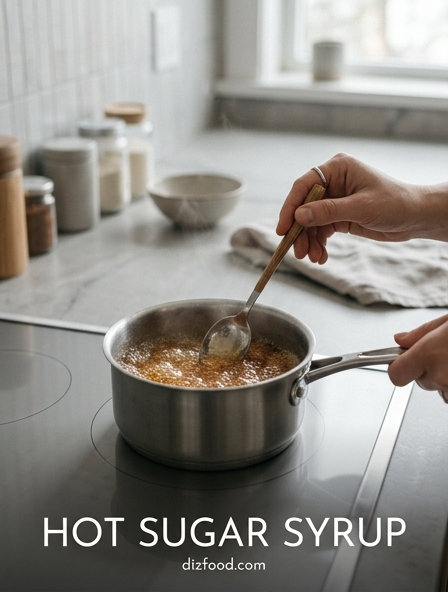
The secret to achieving that signature glossy, rock-solid stability in Italian meringue lies in the precise science of hot sugar syrup. When you drizzle syrup heated to the "soft-ball" stage into whipping egg whites, the intense heat simultaneously cooks and denatures the proteins, creating a reinforced molecular structure. This process results in a dense, marshmallow-like texture that is remarkably resilient and won't collapse, even when used as a topping for tarts or cakes. Unlike other methods, this heat-stabilized foam provides a velvety mouthfeel and superior durability for professional-looking desserts. To understand how this cooked method differs from the classic raw approach, explore the key differences between French Meringue vs. Italian Meringue.
The Science of Thermal Denaturation in Egg Whites
Thermal denaturation is the fundamental process that transforms liquid egg whites into a structural masterpiece. When egg whites are subjected to heat, the proteins-primarily ovalbumin, conalbumin, and ovomucoid-begin to unfold from their naturally coiled, globular states. This unfolding is triggered by the kinetic energy of the hot syrup, which disrupts the weak hydrogen bonds holding the proteins in their specific shapes. As these protein chains stretch out, they expose hydrophobic and hydrophilic regions that were previously tucked away.
In the presence of air bubbles introduced through whipping, these unfolded proteins realign themselves at the air-water interface. The heat from the sugar syrup accelerates this realignment, allowing the proteins to form a sophisticated network of new bonds. This process is distinct from mechanical denaturation caused by whisking alone; the thermal component ensures a more permanent reconfiguration. The result is a foam that is not only voluminous but also significantly more robust, as the heat effectively "cooks" the protein matrix into a fixed, semi-rigid state that can support the weight of added fats or flavorings.
Achieving the Soft Ball Stage for Maximum Stability
In the realm of sugar confectionery, the soft ball stage-typically reached between 235°F and 240°F (112°C-116°C)-is the critical threshold for creating Italian meringue. At this specific temperature range, the sugar solution has reached a concentration of approximately 85% sugar and 15% water. This concentration is high enough to provide significant structural reinforcement without being so brittle that it shatters or crystallizes prematurely upon contact with the egg whites.
- Thread Stage (230°F): Too much water remains, leading to a runny meringue.
- Soft Ball Stage (235°F-240°F): Ideal for a flexible, marshmallow-like texture.
- Firm Ball Stage (245°F-250°F): Results in a stiffer, denser foam that may lose volume.
Pouring syrup at the soft ball stage into whipping whites ensures that the heat is sufficient to pasteurize the eggs and denature the proteins instantaneously. The viscosity of the syrup at this stage allows it to coat the protein strands evenly, creating a protective shield that prevents the air bubbles from migrating and coalescing. This precision ensures the finished product maintains a velvet-like consistency and a high degree of stability over time.
How Sugar Concentration Reinforces Protein Structures
The interaction between high-concentration sucrose and egg white albumin is a cornerstone of pastry physics. Sugar is highly hygroscopic, meaning it attracts and holds water molecules. When a concentrated syrup is integrated into an egg white foam, it pulls water away from the protein films surrounding the air bubbles. This dehydration of the protein film increases its viscosity and thickness, making the bubbles less likely to pop or merge. This phenomenon is often referred to as the "crowding effect," where the presence of sugar molecules physically interferes with the proteins' tendency to over-bond and squeeze out water.
Furthermore, the high sugar concentration increases the density of the continuous liquid phase. This added weight might seem counterintuitive to volume, but it actually provides a stabilizing backbone. The sugar acts as a molecular "glue," coating the denatured protein strands and preventing them from collapsing under the atmospheric pressure or the weight of additional ingredients like butter in a buttercream. Without this high concentration, the protein lattice would remain fragile and prone to syneresis, eventually leading to a complete breakdown of the aerated structure.
The Role of Heat in Creating Permanent Aeration
Aeration in a raw meringue is a temporary state, governed by surface tension and mechanical agitation. However, the introduction of heat via hot sugar syrup converts this temporary state into permanent aeration. As the hot syrup is drizzled into the egg whites, it causes the air trapped within the bubbles to expand slightly. Simultaneously, the heat begins to coagulate the surrounding protein walls. This dual action of expansion and solidification creates a "set" structure similar to the way bread sets in an oven.
The permanent nature of this aeration is what allows cooked meringues to be used in complex applications, such as mousses or parfaits, where they must withstand being folded into heavy bases. The heat-treated proteins form a resilient mesh that resists the physical stress of folding. Unlike raw foams, which rely on a delicate balance of air and liquid, heat-stabilized foams are thermally "cured." This curing process ensures that the tiny air pockets are encased in a durable, sugar-coated protein shell, maintaining the airy texture even after hours of refrigeration or exposure to varying humidity levels.
Why Hot Syrup Prevents Meringue Weeping and Collapse
Weeping, or syneresis, occurs when the protein network in a meringue contracts too tightly, squeezing out the water held between the strands. This is a common failure in French meringues, where the proteins remain largely raw. The use of hot syrup prevents this by precisely controlling the degree of protein coagulation. The heat from the syrup is sufficient to bond the proteins in a spacious, stable configuration that effectively traps water molecules rather than expelling them. Because the sugar is already fully dissolved in the syrup, there is no risk of undissolved granules drawing moisture from the air or the eggs later on.
- Protein Setting: The syrup heat "fixes" the proteins before they can over-coagulate.
- Water Binding: High sugar levels bind water through hydrogen bonding, preventing leakage.
- Interfacial Stability: The syrup creates a thick, viscous film at the air-liquid interface.
By stabilizing the liquid phase, the hot syrup ensures that the meringue remains dry and firm. This is particularly vital when the meringue is used as a topping for tarts or pies, where moisture from the filling could otherwise migrate into the foam and cause it to slide or liquefy.
Molecular Bonding Between Sucrose and Albumin Proteins
At the molecular level, the stability of a cooked meringue is the result of intricate bonding between sucrose molecules and egg white proteins. When the hot syrup meets the albumin, it facilitates the formation of a high density of hydrogen bonds. Sucrose molecules contain numerous hydroxyl (-OH) groups that are capable of forming these bonds with the amino acid side chains of the unfolded proteins. This molecular "cross-linking" creates a composite material that is much stronger than either the sugar or the protein alone.
The heat acts as a catalyst for these interactions, providing the energy required for the molecules to overcome repulsive forces and find stable bonding sites. This bond is not merely a physical mixture but a chemical reinforcement of the protein matrix. The sugar molecules intercalate between the protein chains, acting as spacers that prevent the proteins from aggregating into clumps. This results in a fine-textured, homogeneous foam where every air bubble is reinforced by a sugar-protein hybrid wall. This molecular harmony is what gives Italian and Swiss meringues their characteristic glossy appearance and their ability to hold sharp, defined peaks indefinitely.
Thermal Precision for a Silky and Resilient Finish
Achieving a professional pastry texture requires rigorous thermal precision. The difference between a grainy, dull meringue and a silky, resilient one often comes down to just a few degrees of temperature in the sugar syrup. If the syrup is too cool, it will fail to sufficiently denature the proteins, leading to a soft, unstable foam that lacks the "body" required for piping. If the syrup exceeds the hard ball stage, it may form small, hard beads of sugar upon contact with the cool egg whites, ruining the smoothness of the finish.
Precision is maintained through the use of a calibrated candy thermometer. The goal is to hit the exact moment when the sugar concentration and temperature are in harmony. When the syrup is poured at precisely 118°C (244°F) in a steady, thin stream, it incorporates seamlessly. This allows for a gradual rise in the temperature of the egg whites, ensuring that the denaturation is uniform throughout the entire batch. This controlled heat transfer results in a meringue that exhibits a brilliant sheen and a "short" texture-one that breaks cleanly when bitten but remains soft and elastic on the palate.
Comparing Structural Integrity in Cooked Versus Raw Meringues
The structural differences between cooked (Italian/Swiss) and raw (French) meringues are significant, primarily due to the state of the protein-sugar matrix. Raw meringues rely on the mechanical aeration of proteins and the gradual addition of crystalline sugar, which provides less immediate support. In contrast, cooked meringues utilize thermal energy to create a permanent, cured structure. This results in vastly different performance characteristics in the kitchen.
| Feature | Raw (French) | Cooked (Italian/Swiss) |
|---|---|---|
| Stability | Low; prone to weeping | High; very stable |
| Texture | Light, airy, fragile | Dense, silky, marshmallow-like |
| Safety | Contains raw eggs | Pasteurized by heat |
| Usage | Soufflés, baked shells | Buttercreams, toppings, mousses |
The cooked version is essentially a "cooked" foam before it even enters an oven. This pre-stabilization means that the meringue will not lose its shape when piped into intricate designs or when subjected to the weight of heavy garnishes, making it the preferred choice for professional pastry applications.
The Impact of Temperature on Peak Retention and Density
Temperature plays a pivotal role in determining the final density and peak retention of a meringue. When hot syrup is added, the temperature of the egg whites typically rises to between 120°F and 145°F. At this temperature, the foam is at its most plastic and workable. As the meringue is whisked while it cools, the sugar-protein matrix begins to set. If the whisking stops while the mixture is still too hot, the air bubbles may expand too much and then collapse as they cool, leading to a loss of volume.
Conversely, whisking until the mixture reaches room temperature ensures that the peaks are firm and the density is ideal. The cooling process increases the viscosity of the sugar syrup, "locking" the air bubbles into place. A well-timed cooling phase results in a meringue that can hold "stiff peaks"-sharp, upright points that do not droop. This density is crucial for structural tasks, such as creating layers in a cake or forming the base for a baked Alaska. The final product is a balance of lightness from the aeration and strength from the thermally-induced density.
Mastering Heat Transfer for Professional Pastry Texture
Mastering the art of heat transfer is what separates amateur results from professional-grade pastry. The method of introducing the hot syrup-pouring it down the side of the bowl while the whisk is running-is designed to maximize even heat distribution while minimizing the risk of "scrambling" the egg whites. If the syrup hits the whisk directly, it can splatter and cool too quickly; if it is dumped in all at once, it can thermally shock the proteins, causing localized over-coagulation and lumps.
A professional texture is characterized by a lack of graininess and a uniform crumb. This is achieved by ensuring the syrup is integrated at a speed that allows the egg whites to absorb the heat gradually. This steady transfer of energy ensures that every protein molecule is treated equally, creating a perfectly homogenous foam. Once the syrup is fully incorporated, continued whisking at a medium speed facilitates the formation of smaller, more uniform air bubbles. This leads to a finer, more delicate mouthfeel and a surface that catches the light, providing that iconic glossy finish essential for high-end patisserie.

Comments