
Deciding between active sourdough starter and discard is all about balancing structural integrity with complex flavor profiles. If you're chasing a dramatic oven spring and that signature open crumb, an active starter-captured at its bubbly, peak height-provides the vigorous natural leavening required to lift heavy doughs. Conversely, sourdough discard is the unsung hero of the kitchen, offering a concentrated, tangy acidity and tenderizing lactic acid that transforms quick breads, crackers, and pancakes into gourmet treats. Whether you need the metabolic "muscle" of a refreshed culture or the mellow, fermented depth of an older batch, understanding these two states allows you to manipulate both the lift and the tang of every bake.
| Feature | Active Sourdough Starter | Sourdough Discard |
|---|---|---|
| Metabolic State | Peak activity; highly aerated | Dormant; acidic and liquefied |
| Leavening Power | Primary lift (CO2 production) | Minimal; requires chemical aid |
| Flavor Profile | Mild, milky, and yeasty | Sharp, vinegary, and robust |
| Dough Texture | Elastic with strong gluten mesh | Tender; breaks down gluten |
| Best For | Artisan loaves, baguettes, brioche | Waffles, brownies, flatbreads |
| Prep Requirement | Fed 4-12 hours prior to use | Straight from the refrigerator |
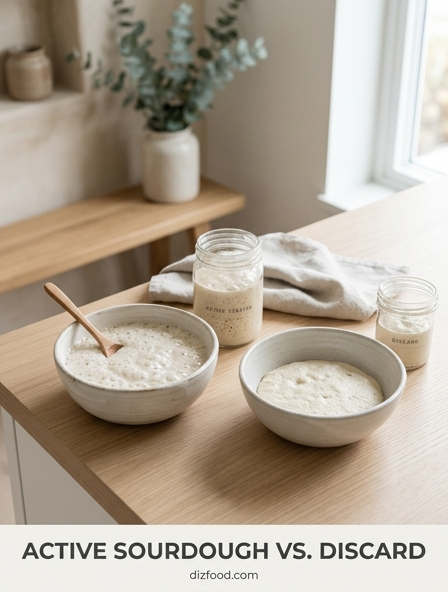
Understanding the Difference Between Active Sourdough Starter and Discard
In the world of sourdough baking, the terms "active starter" and "discard" refer to the same biological culture at different stages of its metabolic cycle. An active sourdough starter is a portion of flour and water colonized by wild yeast and lactic acid bacteria that has been recently fed and is currently at its peak level of fermentation. This state is characterized by intense bubbling, a significant increase in volume-often doubling or tripling-and a pleasant, yeasty aroma. Bakers rely on this peak activity to provide the necessary lift for bread dough without the need for commercial leavening agents.
Sourdough discard, conversely, is the portion of the starter that is removed and set aside before a new feeding occurs. As the microorganisms consume the available starches and sugars in the flour, they eventually run out of fuel. The starter then "falls," becoming more liquid, acidic, and dormant. While many beginners view discard as waste, it is a valuable ingredient in the kitchen. The primary differences between the two states can be summarized as follows:
- Vitality: Active starter is teeming with vigorous yeast ready to expand dough; discard contains sluggish or dormant yeast.
- Consistency: Active starter is aerated and mousse-like, whereas discard is runny and lacks structural bubbles.
- Acidity: Discard has a much higher concentration of organic acids, resulting in a sharper, more pronounced sour flavor.
- Purpose: Active starter is the engine for bread; discard is an additive for flavor and texture in non-leavened or chemically leavened recipes.
The Science of Leavening Active Starter vs Sourdough Discard
The science of leavening hinges on the production of carbon dioxide gas by wild yeast. In an active sourdough starter, the yeast population is in its exponential growth phase. As these fungi metabolize maltose and glucose, they release CO2, which becomes trapped in the gluten network of the starter. This creates the buoyant, airy structure required to lighten dense bread doughs. Because the yeast is highly active, it can continue this gas production throughout the bulk fermentation and proofing stages of bread making, ensuring the loaf rises effectively in the oven.
Sourdough discard behaves differently because the yeast has entered a stationary or decline phase. The lack of fresh nutrients means gas production has slowed significantly or stopped entirely. While discard still contains yeast cells, they are not numerous or energetic enough to lift a heavy loaf of bread on their own. However, discard is highly effective when paired with chemical leaveners like baking soda or baking powder. In these instances, the acidity of the discard reacts with the alkaline baking soda to produce immediate aeration.
| Feature | Active Starter | Sourdough Discard |
|---|---|---|
| Primary Leavening Force | Biological (CO2 from yeast) | Chemical (Reaction with base) |
| Yeast Growth Phase | Exponential/Log Phase | Stationary/Decline Phase |
| Gas Retention | High due to strong gluten | Low due to enzymatic breakdown |
| Enzymatic Activity | Balanced | High (Protease breakdown) |
How Yeast Activity Varies Between Active Sourdough and Discard
Yeast activity is a spectrum governed by temperature, hydration, and time since the last feeding. In an active starter, the microbial ecosystem is optimized. When a baker feeds their culture, they are essentially diluting the accumulated waste products and providing a fresh buffet of carbohydrates. Within four to eight hours, the yeast activity reaches a crescendo. During this window, the yeast cells are multiplying rapidly, and their metabolic rate is at its highest, which is essential for creating the "oven spring" seen in professional-quality loaves.
Once the starter passes its peak, yeast activity begins to wane. Sourdough discard is essentially "exhausted" starter. The environment becomes increasingly hostile for the yeast as the pH drops and alcohol (ethanol) accumulates as a byproduct of fermentation. While the yeast doesn't die immediately, it enters a state of dormancy to survive the acidic conditions. If discard is kept in the refrigerator, this metabolic slowdown is even more pronounced. Understanding this variation is crucial for the baker: using active starter provides predictable, timed rising, while using discard requires an understanding that the biological "engine" is currently idling and cannot be expected to perform heavy lifting without intervention or a significant "wake-up" period.
When to Use Active Sourdough Starter vs Discard in Recipes
Choosing between active starter and discard depends entirely on the structural requirements of the final product. Active starter is the gold standard for traditional sourdough boules, baguettes, and any bread where a long, natural fermentation is desired. Because the yeast is at its strongest, it can handle the long proofing times necessary to develop complex flavors and the characteristic open crumb of sourdough bread. If a recipe relies solely on the starter for its rise, active starter is non-negotiable.
Sourdough discard is best reserved for "quick" recipes or those where the primary goal is flavor rather than a massive rise. Since discard is acidic and liquid, it serves as an excellent tenderizer in batters and doughs. It is ideal for recipes that include other leavening agents or those that don't need to rise much at all. Common applications for discard include:
- Pancakes and Waffles: Discard provides a classic tangy flavor and reacts with baking soda for fluffiness.
- Crackers and Flatbreads: These require little to no lift, making discard an ideal way to add fermented depth.
- Cookies and Brownies: The acidity of discard can cut through the sweetness and improve the texture of the crumb.
- Muffins and Quick Breads: Discard adds moisture and a subtle sourdough "tang" that complements fruits and nuts.
Comparing Flavor Profiles Active Sourdough vs Sourdough Discard
The flavor profile of a sourdough culture evolves significantly as it moves from active to discard status. This evolution is driven by the ratio of lactic acid to acetic acid. When a starter is active and freshly fed, the flavor is generally milder, often described as creamy, nutty, or slightly fruity. This is because the lactic acid bacteria (LAB) are producing lactic acid, which is smoother on the palate. Breads made with active starter tend to have a balanced, complex sweetness that doesn't overpower the natural flavor of the grain.
Sourdough discard, however, is a concentrated source of tang. As the culture sits unfed, the acetic acid levels rise, especially if stored in the refrigerator or left for long periods. This results in a much sharper, vinegar-like acidity. Furthermore, discard often develops "hooch," a thin layer of grey liquid that is essentially alcohol produced by the yeast. While hooch can be stirred back in for an even more intense sourness, it signals a very mature discard. The following table highlights these flavor distinctions:
| Characteristic | Active Starter Flavor | Sourdough Discard Flavor |
|---|---|---|
| Intensity | Mild to Moderate | Sharp and Assertive |
| Primary Notes | Yeast, Cream, Cereal | Vinegar, Lemon, Tang |
| Aftertaste | Clean and Sweet | Lingering Sourness |
| Complexity | Balanced Aromatics | Strong Acidic Profile |
Can You Bake Bread with Sourdough Discard Instead of Active Starter
It is a common question whether discard can be used to bake a standard loaf of bread. The answer is technically yes, but with significant caveats. Because the yeast in discard is dormant or sluggish, a dough made with discard will take much longer to rise-sometimes twice or thrice as long as a dough made with active starter. This extended time can be problematic because the high acidity of the discard begins to break down the gluten proteins in the new flour, potentially leading to a loaf that is flat, gummy, or overly sour.
To successfully bake bread with discard, bakers often employ one of two strategies. The first is the "hybrid" method, where a small amount of commercial yeast is added to the dough to ensure a reliable rise while using the discard for its fermented flavor. The second is the "long-cold-ferment" method, where the dough is kept at a low temperature to allow the sluggish wild yeast to work slowly without the gluten-degrading enzymes destroying the dough's structure. If you choose to use discard for bread, follow these steps:
- Ensure the discard is not too old (less than a week in the fridge is ideal).
- Warm the discard to room temperature before mixing to encourage yeast activity.
- Consider adding a pinch of instant yeast if you require a predictable baking schedule.
- Monitor the dough closely for signs of over-proofing or structural collapse.
Identifying Peak Fermentation in Active Sourdough vs Discard
Mastering the timing of your sourdough culture is the key to consistent baking results. Active starter is used at its "peak," which is the moment it has reached its maximum volume before it starts to recede. You can identify this peak through visual and physical cues. The surface will be covered in small and large bubbles, and the top will appear domed. If you jiggle the jar, the starter should look like a thick, aerated mousse. Another popular test is the "float test," where a small spoonful of starter is dropped into a glass of water; if it floats, it is sufficiently aerated and ready for bread making.
Sourdough discard is identified by the absence of these peak characteristics. Once the starter has peaked, it will begin to flatten out and eventually sink back down the sides of the jar, leaving a "tide mark" of dried flour behind. The bubbles on the surface will pop and not be replaced, leading to a liquid, soupy consistency. Identifying discard is less about a specific moment and more about a state of exhaustion. Signs that your starter has transitioned into discard include:
- Loss of Volume: The culture has fallen significantly from its highest point.
- Aroma Change: The smell shifts from sweet/yeasty to sharply acidic or boozy.
- Texture: The starter becomes thin and loses its ability to hold a shape.
- Surface Liquid: The appearance of hooch (clear or dark liquid) on top.
The Role of Acidity in Active Sourdough vs Sourdough Discard
Acidity plays a dual role in sourdough baking, acting as both a flavor enhancer and a structural modifier. In an active starter, the pH typically ranges between 3.5 and 4.5. This level of acidity is sufficient to inhibit the growth of harmful bacteria while providing the signature sourdough tang. The acidity also helps to strengthen the gluten network during the initial stages of bread making, contributing to a better crumb structure. However, in active starter, the acidity is balanced by the ongoing production of new yeast cells and fresh flour sugars.
In sourdough discard, the acidity is much more concentrated. As the culture ages without being fed, the lactic acid bacteria continue to produce acid until the environment becomes too acidic even for them. This high acidity can be a double-edged sword. While it provides incredible flavor to pancakes and biscuits, it can be detrimental to bread dough. Excessive acidity triggers protease enzymes, which act like tiny scissors, cutting through the gluten strands that give bread its shape. This is why using very old, very acidic discard in a bread recipe often results in a "puddle" of dough that refuses to hold its form during shaping or baking.
Best Baking Applications for Active Sourdough Starter and Discard
To maximize the potential of your sourdough journey, it is helpful to categorize recipes based on which form of the culture they utilize most effectively. Active sourdough starter is the king of fermentation-driven recipes. Its primary role is to provide aeration and structural integrity. Without it, many classic sourdough products would lack the chew and airiness that define them. On the other hand, discard is a versatile culinary tool that acts as a flavor concentrate and a texture improver in a wide variety of secondary bakes.
Here are the best matches for each type of culture:
- Active Starter Applications:
- Country Loaves and Boules
- Sourdough Baguettes and Ciabatta
- Naturally Leavened Brioche or Challah
- Sourdough Pizza Crust (for a light, bubbly rim)
- Sourdough Discard Applications:
- Savory Scallion Pancakes
- Buttermilk-style Biscuits
- Chocolate Chip Cookies (adds chewiness)
- Tempura Batter (acidity creates a crispier fry)
- Banana Bread or Pound Cakes
Converting Recipes Between Active Sourdough Starter and Discard
Converting a recipe to use sourdough discard or active starter requires a basic understanding of baker's percentages, specifically hydration. Most sourdough starters are maintained at 100% hydration, meaning they consist of equal parts flour and water by weight. When adding discard to a recipe that wasn't designed for it, you must subtract the flour and water weights present in the discard from the rest of the ingredients to maintain the correct dough consistency. For example, if you add 100g of 100% hydration discard, you must remove 50g of flour and 50g of liquid from the original recipe.
When converting a bread recipe from active starter to discard, you must also account for the loss of leavening power. Simply swapping one for the other will likely result in a failed rise. To adjust, follow this logic:
- Calculate the weight of the starter/discard and adjust flour/water levels.
- If using discard in a bread recipe, add roughly 1/4 to 1/2 teaspoon of instant yeast per cup of discard used to compensate for the lower microbial activity.
- If using active starter in a "discard" recipe (like pancakes), you may need to let the batter sit for 30 minutes to allow the active yeast to "relax" so the final product isn't overly elastic or tough.
- Adjust the sugar or honey in the recipe slightly if using discard, as the extra acidity may require a touch of sweetness for balance.


Comments