
Mastering the art of a perfect, pillowy meringue requires more than just whisking; it demands a solid understanding of protein stabilization. When you incorporate acidic ingredients like cream of tartar or lemon juice, you are essentially helping the egg white proteins denature and bond more effectively, creating a structure that resists collapsing or weeping. This scientific approach ensures your peaks remain stiff and glossy, whether you are baking delicate macarons or a towering lemon meringue pie. To find the best acid for your specific recipe needs, explore our detailed breakdown of Cream of Tartar vs. Lemon Juice.
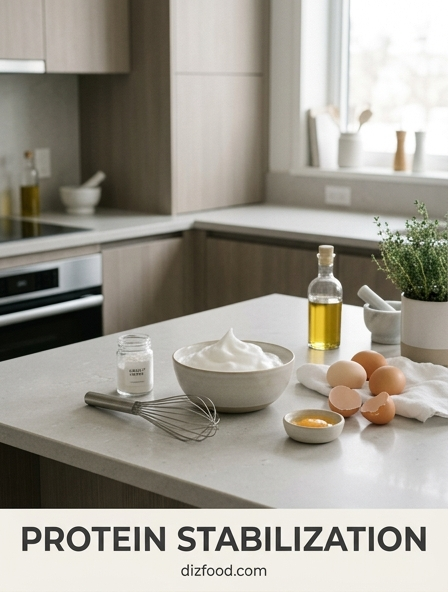
The Science of Egg White Protein Stabilization
Egg whites, or albumen, consist of approximately 90% water and 10% proteins, primarily ovalbumin, conalbumin, and ovomucoid. When these proteins are subjected to mechanical shear via whisking, they undergo a process called denaturation. This physical agitation unfolds the tightly coiled protein chains, exposing their hydrophobic and hydrophilic regions. As air is incorporated, the proteins realign at the air-water interface. The hydrophobic ends orient themselves toward the air bubbles, while the hydrophilic ends remain in the aqueous phase, creating a protective film that encapsulates the air.
To ensure this structure remains stable, the proteins must form a cohesive network without bonding too tightly. In an untreated environment, the proteins eventually form disulfide bonds, which can cause the foam to contract and expel water. Stabilization science focuses on managing these bonds to maintain a delicate balance between rigidity and flexibility. Key factors influencing this process include:
- Temperature of the egg whites (room temperature promotes faster denaturation).
- Copper ions (which can form stable complexes with conalbumin).
- The presence of stabilizers like sugar or acids to regulate protein aggregation.
Why Acids Are Essential for Meringue Structure
The primary role of an acid in meringue production is to manipulate the electrical charge of protein molecules. In their natural state, egg white proteins are negatively charged, causing them to repel one another. While this repulsion prevents them from clumping in the raw egg, it also makes it difficult for them to form a sturdy network during whisking. Introducing an acid lowers the pH of the mixture, bringing the proteins closer to their isoelectric point.
At a lower pH, the proteins become less negatively charged, reducing the repulsive forces between them. This allows the proteins to bond more readily, but in a controlled and gradual manner. Without this intervention, protein molecules might bond too quickly and too tightly, a phenomenon that leads to "over-coagulation." By slowing down the rate of bond formation, acids ensure that the protein film remains elastic enough to expand as more air is beaten into the mixture, resulting in a foam that is both resilient and structurally sound.
Cream of Tartar Versus Lemon Juice Comparison
In the culinary world, the choice of acid often depends on the desired consistency and the specific requirements of the recipe. Cream of tartar (potassium bitartrate) and lemon juice (citric acid) are the most common agents used for stabilization, yet they possess different physical properties that affect the final outcome.
| Characteristic | Cream of Tartar | Lemon Juice |
|---|---|---|
| Form | Dry, acidic salt powder | Liquid aqueous solution |
| Concentration | Highly consistent acidity | Variable acidity levels |
| Moisture Impact | Negligible; preserves dry peaks | Adds water, thinning the foam |
| Flavor Profile | Neutral/Metallic in large doses | Bright, citrusy notes |
Cream of tartar is generally preferred for its precision and lack of added moisture. Since it is a dry byproduct of winemaking, it does not dilute the protein concentration. Lemon juice, conversely, introduces water and citric acid, which can be useful for softer meringues but may slightly reduce the absolute stability of a stiff peak due to the increased liquid volume.
Optimal Timing for Adding Stabilizers to Foams
The sequence of ingredient integration is critical for achieving the desired foam architecture. Adding a stabilizer too early can interfere with the initial denaturation of proteins, while adding it too late may fail to prevent over-coagulation. The most effective window for introducing acidic stabilizers is during the "foamy" stage, just as the large bubbles begin to transform into a more uniform, opaque white structure.
Following a specific timeline ensures the best results:
- Whisk egg whites on low speed until they become frothy and lose their yellowish transparency.
- Add the acid (cream of tartar or lemon juice) once the surface is covered in small, consistent bubbles.
- Increase speed to medium and begin adding sugar gradually only after soft peaks have formed.
Adding stabilizers at the beginning helps the proteins start their networking process with the correct charge. However, adding sugar too early can significantly delay the foaming process because sugar competes with the proteins for water, requiring much longer whisking times to reach full volume.
Achieving Maximum Volume and Bubble Elasticity
The volume of an egg foam is determined by the size and distribution of air bubbles. For maximum volume, the goal is to create a large number of very small, uniform bubbles rather than a few large ones. Small bubbles provide a higher surface-area-to-volume ratio, which allows the protein film to support the structure more effectively. Elasticity is the second component of this equation; the protein film must be able to stretch as the air inside expands when heated in an oven.
If the protein network is too rigid, the bubbles will pop under pressure, leading to a collapsed meringue. If the network is too weak, the bubbles will coalesce, creating large pockets of air that make the texture coarse. Stabilizers ensure that the protein-to-protein bonds are flexible. This elasticity allows for the "oven spring" seen in soufflés and sponge cakes, where the trapped air expands significantly before the proteins finally set into a permanent solid structure through heat-induced coagulation.
Preventing Overbeating Through pH Manipulation
Overbeating occurs when protein molecules form too many disulfide bonds, creating a dense, tight mesh that squeezes out the water previously trapped between the protein strands. Visually, this manifests as a dry, grainy foam that begins to weep liquid. Once a foam has over-coagulated, it loses its ability to integrate with other ingredients and will likely collapse during baking. This is where pH manipulation becomes a mechanical safeguard.
By lowering the pH with an acid, the proteins are chemically discouraged from forming these excessive, tight bonds. The acid acts as a buffer, ensuring that even if the whisking continues slightly longer than necessary, the proteins remain somewhat repelled by one another. This provides the chef with a larger "margin of error." Without an acid, the window between "stiff peaks" and "overbeaten" is incredibly narrow, often lasting only a few seconds. A stabilized foam remains glossy and smooth, maintaining its structural integrity and moisture-holding capacity for a significantly longer period.
Precision Ratios for Superior Meringue Peaks
While professional bakers often work by feel, understanding the scientific ratios of stabilizers to proteins is essential for consistency. The amount of acid required is relatively small compared to the total volume of egg whites, yet its impact is profound. Using too much acid can result in a foam that is too soft and fails to reach stiff peaks, while too little will not provide the necessary structural reinforcement.
Standard industry recommendations for acid-to-protein ratios include:
- Cream of Tartar: 1/8 teaspoon per large egg white (approx. 30g of white).
- Lemon Juice: 1/2 teaspoon per large egg white.
- Sugar: 50g to 60g per egg white for a standard hard meringue.
When using these ratios, it is important to measure accurately. In a high-volume kitchen, these ratios are often scaled by weight. For instance, for every 100 grams of egg whites, a baker might use 0.5 grams of cream of tartar. This precision ensures that the pH level is consistently lowered to approximately 6.0 or 6.5, which is the ideal range for protein film stability in culinary applications.
How Acidic Ingredients Prevent Protein Drainage
Protein drainage, scientifically known as syneresis, is the process where liquid leaks out of the foam structure. This usually happens because the protein network is either too weak to hold the water or so tight that it forces the water out. Acids prevent drainage by creating a more uniform and robust protein matrix. Because the acid allows the proteins to bond more evenly throughout the foam, the "walls" of the air bubbles are consistent in thickness and strength.
This uniform network acts like a microscopic sponge, trapping water molecules more effectively through capillary action and hydrogen bonding. When sugar is added to an acidified foam, it further prevents drainage by increasing the viscosity of the liquid phase. The sugar dissolves into the water between the bubbles, creating a thick syrup that is much harder to "drain" through the protein mesh. Together, acid and sugar create a synergistic effect that results in a stable, weep-free meringue that can stand for hours without losing its shape or leaking liquid onto the bottom of a pie or tray.
Texture and Gloss Benefits of Stabilized Foams
The aesthetic quality of a meringue-its gloss and smoothness-is a direct result of successful protein stabilization. A well-stabilized foam reflects light beautifully because the air bubbles are so small and the protein film is so thin and even. This creates a surface that appears satiny and luminous. Conversely, an unstabilized foam often appears dull and matte because the larger, irregular bubbles scatter light in different directions.
Texture is also significantly improved through stabilization. The mouthfeel of a stabilized meringue is creamy and melt-in-the-mouth, rather than spongy or chewy. This is particularly important in delicate desserts like French macarons or Italian meringue buttercream, where the protein structure must be fine enough to incorporate smoothly with fats or almond flour. The acid ensures that the proteins do not form clumps, allowing the foam to be folded into other mixtures without deflating or creating a lumpy consistency. This refinement in texture and appearance is the hallmark of professional-grade pastry work, separating amateur results from culinary excellence.
Troubleshooting Structural Collapse in Egg Foams
Even with stabilizers, egg foams can be temperamental. Structural collapse is often the result of environmental factors or contamination. One of the most common culprits is fat. Even a microscopic trace of egg yolk or oil on the whisk will prevent the proteins from surrounding the air bubbles. Fat molecules are more attracted to the hydrophobic regions of the proteins than the air is, effectively blocking the proteins from forming a film. If a foam fails to increase in volume, it is almost always due to fat contamination or using eggs that are too fresh (which have very tight proteins) without sufficient whisking time.
Other common issues include:
- Humidity: Sugar is hygroscopic and pulls moisture from the air, making the meringue soft and sticky.
- Temperature: Cold eggs are more stable but take longer to reach maximum volume; room temperature eggs foam faster.
- Speed: Beating on high speed too early creates large, unstable bubbles that are prone to popping.
To fix a collapsing foam, ensure all equipment is wiped with lemon juice or vinegar prior to use to remove residual fats, and always monitor the speed of the mixer to build a foundation of small, stable bubbles.

Comments