
Optimal Feeding Ratios for Peak Activity
Achieving a vigorous sourdough starter requires precision in the ratio of carryover culture to fresh flour and water. While a 1:1:1 ratio is standard for daily maintenance, increasing the ratio to 1:3:3 or 1:5:5 can prolong the fermentation window and encourage a more robust yeast population. High feeding ratios dilute accumulated acidity, which prevents the gluten-degrading enzymes from becoming overly aggressive. This practice ensures that when the starter is added to the final dough, it possesses maximum leavening power and a mild flavor profile.
| Ratio | Purpose | Typical Peak Time |
|---|---|---|
| 1:1:1 | Fast revitalization | 3-5 hours |
| 1:2:2 | Standard baking prep | 6-8 hours |
| 1:5:5 | Overnight fermentation | 10-12 hours |
The choice of ratio depends heavily on the ambient temperature and the specific microbial activity of your culture. In warmer kitchens, higher ratios are essential to prevent the starter from peaking and collapsing before you are ready to mix your dough. Consistently using a scale rather than volume measurements ensures that these ratios remain accurate and your results repeatable.
Timing the Starter Peak for Maximum Lift
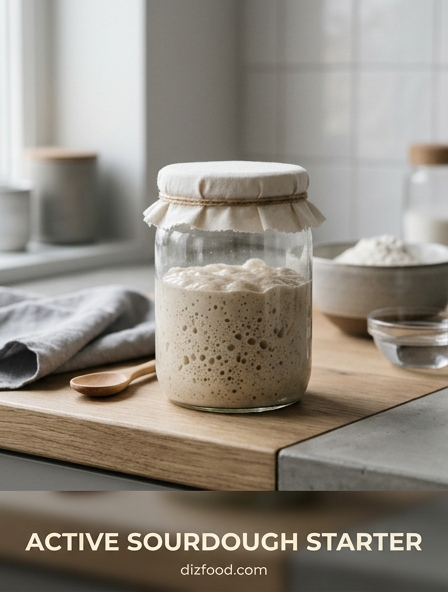
The window of peak activity is the brief interval when the yeast population is at its highest concentration and the gas production is most intense. Using a starter exactly at its peak ensures the final loaf will have the greatest possible oven spring. If the starter is used too early, it will lack the necessary yeast density; if used too late, the increasing acidity will weaken the dough's gluten structure. Monitoring the physical transformation of the starter is the most reliable way to gauge its readiness for the bake.
- Visual Domination: The surface should be rounded or slightly domed, indicating gas is still trapped.
- Bubbling Pattern: Look for large, active bubbles on the surface and small, uniform bubbles throughout the sides.
- Aroma Profile: A ripe starter should smell pleasantly tangy and fruity, not sharply like vinegar or acetone.
- Texture: When stirred, the starter should feel web-like, aerated, and significantly expanded in volume.
To capture this peak consistently, many bakers utilize the "rubber band method" on their jars to track the exact doubling or tripling of volume. Once the center begins to flatten or slightly dip, the peak has passed, and the starter has entered the exhaustion phase, requiring a fresh feeding before it can be used effectively for leavening.
Water Temperature and Fermentation Control
Temperature is the primary lever for controlling the rate of fermentation in sourdough baking. The thermal energy in the water used for feedings and final dough mixing directly influences the metabolic rate of both wild yeast and lactic acid bacteria. Ideally, a Desired Dough Temperature (DDT) of 78°F to 82°F is targeted to balance flavor development with timely fermentation. Cold water can drastically slow the process, leading to under-fermentation, while excessively hot water can kill the delicate microbial colonies or cause the dough to become unmanageably sticky.
In the kitchen, calculating the necessary water temperature involves accounting for the ambient air temperature, the temperature of the flour, and the heat generated by the friction of mixing. If the kitchen is cool, using water at 90°F can help kickstart activity. Conversely, during summer months, iced water may be necessary to keep the bulk fermentation from progressing too quickly. Maintaining a stable temperature environment, such as using a proofing box or a turned-off oven with the light on, provides the consistency needed to master the timing of the rise and ensure a predictable crumb structure in every loaf.
The Role of the Float Test
The float test is a common diagnostic tool used to determine if a sourdough starter has incorporated enough carbon dioxide to effectively leaven a heavy dough. While not infallible-particularly with high-hydration or whole-grain starters-it serves as a quick physical indicator of aeration and metabolic readiness. A starter that floats signifies that the yeast has produced sufficient gas and the gluten network within the starter is strong enough to trap that gas, which is a prerequisite for a successful rise in the oven.
- Fill a small transparent glass with room temperature water.
- Gently drop a teaspoon of active starter into the water without stirring or deflating it.
- Observe if the sample stays buoyant at the surface or sinks to the bottom.
- If it sinks, wait thirty minutes for further gas buildup and retest.
It is important to remember that some flours, like rye, do not trap gas well due to their low gluten content, often causing them to fail the float test even when they are microbially ready. In such cases, visual cues like volume increase and scent should take precedence over the float test results to avoid over-fermenting the culture while waiting for buoyancy.
Implementing Fermentolyse for Better Structure
Fermentolyse is a specialized technique where the flour, water, and active sourdough starter are mixed and allowed to rest before the addition of salt. This process differs from a standard autolyse by introducing the leavening agent earlier, which initiates the fermentation process alongside gluten hydration. During this rest period, typically lasting thirty to sixty minutes, enzymes like protease begin to soften the gluten, making the dough more extensible and easier to handle during subsequent folds. The early presence of the starter also ensures an even distribution of microbes throughout the dough matrix.
By delaying the salt, which naturally inhibits yeast activity and tightens gluten, the baker allows for a more thorough initial hydration of the flour particles. This results in a more cohesive dough that requires less physical kneading to achieve strength. Fermentolyse is particularly effective for high-hydration recipes where structural integrity is difficult to maintain. Once the rest period is complete, the salt is dimpled into the surface and incorporated, which then provides the necessary tension to support the airy crumb desired in artisanal loaves. This method balances the need for elasticity and extensibility, setting the stage for a superior oven spring.
Strengthening Gluten with Stretch and Folds
Traditional kneading is often too aggressive for high-hydration sourdough, which is why the stretch and fold technique is preferred. This method involves gently pulling the edges of the dough upward and folding them over the center at regular intervals during the first few hours of bulk fermentation. This action aligns the gluten proteins into a strong, organized network without degassing the dough. Each set of folds increases the dough's surface tension and structural integrity, allowing it to hold the expanding gases produced by the yeast.
A typical schedule involves four to six sets of folds spaced thirty minutes apart. As the fermentation progresses, you will notice the dough transforming from a shaggy, slack mass into a smooth, elastic ball that holds its shape. The frequency and intensity of the folds should be adjusted based on the flour type; stronger bread flours may require more vigorous stretching, while delicate flours like spelt or einkorn need a gentler touch. By the final set, the dough should pass the windowpane test, indicating that the gluten is sufficiently developed to support a light and airy internal crumb structure during the final proof and bake.
Managing Bulk Fermentation for Airy Crumb
Bulk fermentation, also known as the first rise, is the most critical stage in sourdough production. It is during this period that the flavor is developed and the primary aeration of the dough occurs. Success depends on ending the fermentation at the precise moment when the dough is sufficiently aerated but still retains enough strength to be shaped. Over-fermenting leads to a sticky, unmanageable dough that collapses in the oven, while under-fermenting results in a dense, gummy crumb with large, uneven "fools holes."
Bakers must look for specific indicators to judge the end of bulk fermentation. The dough should have increased in volume by approximately 30% to 50%, look slightly domed at the edges, and feel full of air when touched. Small bubbles should be visible just beneath the surface. If the dough is jiggled, it should move like gelatin. The temperature plays a massive role here; a warmer environment accelerates the process, requiring a shorter duration. Mastering bulk fermentation involves developing a "feel" for the dough, recognizing when it has reached its peak potential for expansion before moving to the shaping stage.
Pre-Shaping Techniques for Structural Integrity
Pre-shaping is an intermediate step that bridges the gap between bulk fermentation and final shaping. It involves gently rounding the divided dough pieces into loose balls on the workbench. This step serves two main purposes: it organizes the gluten fibers and builds an initial layer of surface tension. After pre-shaping, the dough undergoes a "bench rest" for twenty to thirty minutes, which allows the gluten to relax just enough so that it can be final-shaped without tearing or resisting.
- Gentle Handling: Use a bench scraper to move the dough to avoid deflating the delicate air bubbles.
- Light Flour Use: Use as little flour as possible on the work surface to ensure the dough grips and builds tension.
- Surface Tension: Drag the dough toward you on the counter to create a taut skin.
- Relaxation: Allow the dough to sit uncovered; a slight skin formation can help with scoring later.
By implementing a proper pre-shape, you ensure that the final loaf has a consistent internal structure. This structural foundation prevents the dough from spreading out into a pancake shape when it is turned out of the proofing basket, ultimately leading to a taller, more aesthetically pleasing loaf with a defined shape and better volume.
Scoring Depth and Angle for Oven Spring
Scoring is the process of making intentional incisions on the surface of the dough just before it enters the oven. These cuts act as "exhaust valves," directing the expansion of the loaf as the internal gases heat up and seek an exit. Without proper scoring, the bread will burst at its weakest points, leading to an irregular and unattractive shape. For a classic "ear," the blade-or lame-should be held at a 45-degree angle relative to the dough's surface. This creates a flap of dough that lifts and curls back as the loaf expands.
The depth of the score is equally important; a cut that is roughly half an inch deep is usually sufficient for most sourdough loaves. Too shallow, and the loaf will break through the skin elsewhere; too deep, and it may lose its structural support and flatten. For high-hydration doughs, a quick, confident stroke is necessary to prevent the blade from dragging or sticking. Cold-proofing the dough in the refrigerator before scoring makes the surface firmer and much easier to cut cleanly, allowing for intricate decorative patterns or the bold, single-slash signature of an artisan loaf.
Maintaining Microbial Balance for Consistent Rise
The health of a sourdough starter depends on the delicate balance between wild yeast and lactic acid bacteria (LAB). Yeast is primarily responsible for leavening and carbon dioxide production, while LAB provides the characteristic sour flavor and contributes to the dough's preservation. If a starter becomes too acidic, the LAB can dominate, leading to a proteolysis effect where the gluten is broken down too quickly, resulting in a flat loaf. Maintaining a consistent feeding schedule with high-quality, unbleached flour is the best way to keep these populations in equilibrium.
Factors such as flour type and hydration levels significantly impact this balance. Whole grain flours, like rye or whole wheat, provide more nutrients and minerals, which can speed up fermentation and increase acidity. Conversely, white bread flour provides a more stable and predictable environment for the yeast. If the starter smells overly vinegary, it likely needs more frequent feedings or a lower storage temperature. By observing the rise and fall of the culture and adjusting the environment, a baker can cultivate a starter that provides a reliable, consistent rise and a perfectly balanced flavor profile for every single bake.





Comments