
Ever wonder why your homemade bread didn't reach its full potential? Mastering the choice between Active Dry Yeast vs. Instant Yeast is the secret to a perfect rise every time, ensuring your dough achieves the ideal texture and volume. While Active Dry Yeast consists of larger granules that require "blooming" in warm water to activate, Instant Yeast is engineered with finer particles that can be mixed directly into your dry ingredients for a faster fermentation process. Whether you are a patient baker looking for deep flavor development through a slow rise or a busy home cook utilizing a bread machine, understanding these leavening agents allows you to bake with confidence and precision.
| Feature | Active Dry Yeast | Instant Yeast |
|---|---|---|
| Preparation | Must be dissolved (bloomed) in warm water. | Add directly to dry ingredients. |
| Fermentation Speed | Slower; ideal for long, cold fermentations. | Rapid; 25-50% faster than Active Dry. |
| Granule Size | Large, coarse granules with a protective coat. | Fine, porous granules that dissolve quickly. |
| Substitution Ratio | Use 1.25 parts for every 1 part Instant. | Use 0.75 parts for every 1 part Active Dry. |
| Bread Machine Use | Not recommended (granules may not dissolve). | Highly recommended for all cycles. |
| Best Application | Artisan breads and slow-rise doughs. | Quick recipes and everyday sandwich loaves. |
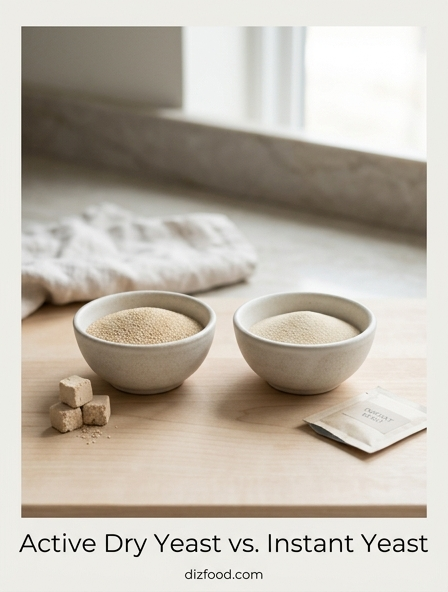
Understanding the Core Differences Between Active Dry and Instant Yeast
At the microscopic level, all dry yeasts belong to the species Saccharomyces cerevisiae, yet the manufacturing processes for active dry and instant yeast create distinct functional differences. Active dry yeast is subjected to a high-heat drying process that leaves many of the yeast cells dormant. These dormant cells are encased in a thick jacket of dead yeast cells, which necessitates a rehydration step in warm liquid to "wake up" the live organisms. This results in larger, coarser granules that resemble small beads or grains of sand.
In contrast, instant yeast-often labeled as rapid-rise or bread machine yeast-is processed using a gentler drying method that preserves a higher percentage of living cells. The granules are significantly smaller and more porous, allowing them to dissolve almost instantly when they come into contact with moisture. Because the protective coating of dead cells is thinner, instant yeast does not require a dedicated blooming period and can be integrated directly into the dry ingredients of a recipe. While active dry yeast provides a slower, more traditional fermentation process, instant yeast is engineered for speed and reliability, making it a favorite for modern home bakers who prioritize efficiency without sacrificing the structural integrity of their bread.
How to Properly Bloom Active Dry Yeast for Success
Blooming is a critical preliminary step when working with active dry yeast, serving as both a rehydration process and a viability test. Because active dry yeast has been processed into large, dormant granules, it must be dissolved in liquid to release the active cells. Failure to bloom this yeast often results in small, undissolved pebbles within the finished dough, leading to uneven rising and a gritty texture in the crumb of the bread.
- Measure the specific amount of water or milk required by your recipe, ensuring the temperature falls between 105°F and 115°F.
- Pour the warm liquid into a small bowl and add a pinch of sugar or honey; this provides immediate fuel for the yeast to consume.
- Sprinkle the active dry yeast granules over the surface of the liquid and stir gently until no large dry clumps remain.
- Allow the mixture to sit undisturbed for 5 to 10 minutes in a draft-free area.
- Look for a thick layer of tan foam to develop on the surface, accompanied by a distinct yeasty aroma. If the liquid remains flat or clear, the yeast is likely dead and should be discarded.
Once the yeast is successfully bloomed, it can be combined with the flour and remaining ingredients. This process ensures that the fermentation begins immediately upon mixing, providing the necessary lift for heavy doughs.
The Speed Advantage of Using Instant Yeast in Baking
The primary appeal of instant yeast lies in its streamlined application and rapid fermentation capabilities. For bakers who find themselves on a tight schedule, instant yeast eliminates the ten-minute blooming period required by its active dry counterpart. Because the particles are exceptionally fine and highly porous, they can be whisked directly into the flour, salt, and other dry components before the liquid is added. This "one-bowl" method reduces the risk of thermal shock to the yeast and simplifies the mixing workflow.
Beyond the preparation stage, instant yeast is specifically formulated to work faster during the bulk fermentation and proofing stages. It contains a higher concentration of live cells and often includes additives like ascorbic acid (Vitamin C), which acts as a dough conditioner. This leads to a more aggressive production of carbon dioxide gas, significantly shortening the time required for the dough to double in size. In many modern recipes, instant yeast allows bakers to skip the first rise entirely, moving straight from kneading to shaping. This speed is particularly advantageous for making quick dinner rolls, sandwich loaves, or pizza crusts on a weeknight when time is at a premium.
Substitution Guide Converting Active Dry to Instant Yeast
While most bread recipes are forgiving, substituting one type of yeast for another requires careful measurement adjustments to ensure the rise time remains consistent. Because instant yeast is more concentrated and has a higher percentage of living cells per gram, you generally need less of it than active dry yeast to achieve the same results. A common mistake is using a 1:1 ratio, which can lead to over-proofing and a dough that collapses in the oven due to excessive gas production.
| Active Dry Yeast Amount | Equivalent Instant Yeast | Adjustment Requirement |
|---|---|---|
| 1 Teaspoon | 3/4 Teaspoon | Reduce by 25% |
| 1 Standard Packet (0.25 oz) | 1.75 Teaspoons | Standard conversion |
| 2 Teaspoons | 1.5 Teaspoons | Maintain 4:3 ratio |
When converting from active dry to instant yeast, you can skip the blooming step and add the yeast directly to the flour. Conversely, if a recipe calls for instant yeast and you only have active dry, you must increase the amount by 25% and ensure you bloom it in warm liquid first. If you fail to increase the quantity of active dry yeast when substituting for instant, your dough may take significantly longer to rise, potentially leading to a denser final product.
Temperature Requirements for Activating Different Yeast Types
Temperature control is the most influential factor in yeast activity, as it dictates how quickly the organisms consume sugars and produce carbon dioxide. Active dry yeast is particularly sensitive to the temperature of the liquid used for blooming. If the water is too cold (below 100°F), the yeast will remain dormant and fail to dissolve properly. If the water is too hot (above 120°F), the yeast cells will begin to die off, resulting in a lifeless dough. The ideal range for blooming active dry yeast is consistently cited between 105°F and 115°F.
Instant yeast offers a bit more flexibility but still requires warmth for optimal performance. When mixing instant yeast directly with dry ingredients, the liquid added to the dough can be slightly warmer, typically between 120°F and 130°F. The presence of the flour acts as a buffer, protecting the delicate yeast cells from the higher heat. However, bakers should be cautious; temperatures exceeding 140°F will instantly kill any variety of yeast. For slow-fermented breads or sourdough hybrids, using cooler water (around 70°F) can be beneficial to slow down the fermentation process, allowing for deeper flavor development while keeping the yeast healthy over several hours.
Shelf Life and Proper Storage Tips for Dry Yeast Varieties
Dry yeast is a living organism in a state of suspended animation, and its longevity is entirely dependent on its environment. Moisture, heat, and exposure to oxygen are the primary enemies of yeast viability. An unopened packet or jar of dry yeast is generally stable at room temperature for up to two years, provided it is kept in a cool, dark pantry. However, once the seal is broken, the clock begins to tick rapidly on its effectiveness.
- Refrigeration: Once opened, yeast should be stored in the refrigerator in an airtight container to slow down the degradation of the cells.
- Freezing: For long-term storage, dry yeast can be kept in the freezer for up to a year. It does not freeze solid, so it can be measured directly from the container.
- Air Exposure: Use a vacuum sealer or a glass jar with a tight silicone seal to prevent oxygen from oxidizing the yeast.
- Viability Check: If you are unsure of the yeast's age, always perform a bloom test even if using instant yeast.
By following these storage protocols, you can ensure that your yeast remains potent. Yeast stored in the freezer remains active much longer than yeast kept in a warm kitchen cupboard, where high humidity can cause the granules to clump and lose their lifting power within weeks.
Impact on Dough Rise Times and Final Texture
The choice between active dry and instant yeast significantly influences the physical characteristics of the finished loaf. Because instant yeast works faster, it produces a rapid burst of gas that can create a very light, airy crumb structure. This is ideal for sandwich breads or brioche where a soft, uniform texture is desired. However, a faster rise is not always a better rise. The fermentation process is where the "bread flavor" develops; as yeast consumes sugars, it produces secondary byproducts like organic acids and alcohols that contribute to a complex aroma.
Active dry yeast, which typically requires a longer fermentation period, allows these flavor compounds more time to develop. A dough that rises slowly over two hours will generally have a more nuanced taste than a dough that rises in forty-five minutes using instant yeast. Additionally, the slower action of active dry yeast can lead to a more durable gluten structure, which is beneficial for artisanal boules or baguettes that require a chewy, open crumb. If you use instant yeast but want the flavor of a slow rise, you can decrease the amount of yeast used or place the dough in the refrigerator for a cold ferment, effectively mimicking the pace of active dry yeast while retaining the convenience of the instant variety.
Best Recipes for Active Dry vs Instant Yeast Applications
Selecting the right yeast often depends on the specific requirements of the recipe and the desired timeline for the baking project. Certain doughs benefit from the quick action of instant yeast, while others are better suited to the steady, traditional pace of active dry yeast. Understanding these nuances helps in achieving the perfect crumb and crust for different styles of bread.
- Best for Instant Yeast: Quick dinner rolls, focaccia, and bread machine recipes. Since bread machines use controlled heat and rapid cycles, the fast-dissolving nature of instant yeast is essential.
- Best for Active Dry Yeast: Slow-rising artisanal loaves, whole wheat breads, and doughs that require multiple rises. The slower pace helps soften tough whole-grain fibers.
- No-Knead Breads: While both can be used, instant yeast is often preferred for 12-hour room temperature ferments because a very small amount (1/4 teaspoon) provides consistent results without the need for pre-dissolving.
- Enriched Doughs: For heavy doughs containing lots of butter, eggs, and sugar (like Cinnamon Rolls), active dry yeast provides a reliable, strong rise that can handle the weight of the added fats.
Ultimately, while the two yeasts are interchangeable with adjustments, using the one specified in the recipe usually yields the most predictable outcome regarding both timing and volume.
Common Mistakes When Swapping Yeast Types in Bread Making
One of the most frequent errors in the kitchen is treating all yeasts as equal in both quantity and method. When a baker substitutes active dry yeast into a recipe designed for instant yeast without blooming it first, they often find the dough fails to rise at all. The granules remain encapsulated and cannot interact with the flour's starches. Conversely, adding instant yeast to a warm liquid bath intended for active dry yeast can sometimes "exhaust" the yeast too early if the water is at the higher end of the temperature spectrum.
Another common pitfall involves the "RapidRise" variety of instant yeast. Many bakers assume this can be used for long, cold fermentations in the fridge. However, RapidRise is specifically engineered to work fast and then quit; using it for a multi-day ferment can result in a dough that loses its structural integrity and collapses. Finally, neglecting to adjust the liquid temperature is a major mistake. Since instant yeast is often mixed with dry ingredients, the water should be warmer than what is used for blooming active dry yeast. Using lukewarm water for the "dry mix" method often results in a sluggish rise that takes twice as long as the recipe predicts.
Final Verdict Which Yeast is Better for Your Baking Style
The debate over which yeast is superior ultimately comes down to the individual baker's priorities: precision and tradition versus speed and convenience. For the occasional baker or those who prefer a "set it and forget it" approach, instant yeast is the clear winner. Its ability to be mixed directly into dry ingredients and its reliable, fast-acting nature make it nearly foolproof for modern recipes and bread machines. It eliminates the anxiety of wondering if the yeast is "alive" before the dough is even mixed.
However, for the artisanal baker who views bread-making as a slow, meditative craft, active dry yeast remains the gold standard. The ritual of blooming the yeast provides a tactile connection to the fermentation process, and the slightly slower rise times are often credited with producing a superior flavor profile and a more traditional crust. Many professional bakers still reach for active dry yeast when working with complex, multi-day doughs. If you are a beginner, starting with instant yeast can build confidence, but mastering active dry yeast is a rite of passage that offers more control over the final product. Regardless of your choice, keeping both in the pantry-properly stored-ensures you are prepared for any baking challenge that arises.

Comments