
Ever wondered why your cookies turn out crumbly while your pie crusts feel tough? The secret often lies in the protein content of your flour. Choosing between pastry flour and whole wheat flour isn't just about health; it's about mastering the science of texture to ensure a professional finish. While pastry flour is the low-protein hero designed for a delicate, tender crumb in tarts and biscuits, whole wheat flour provides a robust, nutty profile packed with fiber and germ. Understanding these distinct characteristics allows you to manipulate gluten development and moisture absorption, giving you the power to achieve the perfect bake every time you step into the kitchen.
| Feature | Pastry Flour | Whole Wheat Flour |
|---|---|---|
| Protein Content | 8% - 9% (Low) | 13% - 14% (High) |
| Texture | Fine, silky, and light | Coarse, dense, and grainy |
| Gluten Strength | Minimal (Tender results) | Strong (Structural/Chewy) |
| Best Used For | Pie crusts, cookies, pastries | Hearty breads, rustic rolls |
| Liquid Absorption | Low; keeps dough moist | High; requires more hydration |
| Nutritional Profile | Refined; lower fiber/vitamins | Unrefined; high fiber and bran |
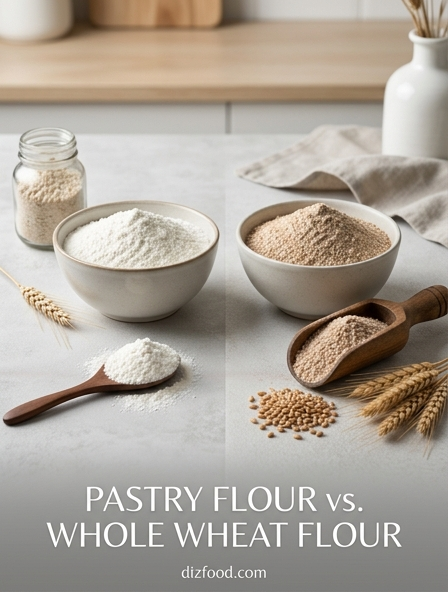
Understanding Pastry Flour vs Whole Wheat Flour
Navigating the diverse world of baking requires a fundamental understanding of how different flours interact with moisture and heat. At one end of the spectrum lies pastry flour, a specialized product derived from soft wheat. It is designed specifically for delicate baked goods that require a fine, tender crumb. Its primary purpose in the kitchen is to provide enough structure to hold a shape without introducing the toughness associated with higher-protein breads. Because it is highly refined, the bran and germ are removed, leaving behind a powdery, white substance that blends seamlessly into fats and sugars.
In stark contrast, whole wheat flour represents the "whole grain" philosophy. It is produced by grinding the entire wheat kernel, which includes the nutrient-rich germ and the fibrous outer shell known as the bran. This inclusion fundamentally changes the flour's behavior in recipes. While pastry flour seeks to be invisible and light, whole wheat flour is assertive, providing a dense, hearty texture and a distinct appearance characterized by brown specks. Understanding these two flours involves recognizing their primary roles:
- Pastry Flour: Optimized for tenderness, lightness, and a pale finish.
- Whole Wheat Flour: Optimized for nutrition, density, and a robust mouthfeel.
Choosing between them is rarely about a direct swap; rather, it is about identifying the desired end result. A baker seeking a melt-in-the-mouth shortbread will reach for pastry flour, while one crafting a rustic, artisanal loaf or a fiber-rich muffin will prioritize whole wheat. These flours sit at opposite ends of the functional spectrum, dictated largely by their botanical origins and the way they are processed after harvest.
Key Differences in Protein and Gluten Content
The performance of any flour is largely dictated by its protein content, which directly correlates to gluten development. Gluten is the elastic network formed when wheat proteins, specifically glutenin and gliadin, are hydrated and agitated. Pastry flour is milled from soft wheat varieties and typically contains a protein range of 8% to 10%. This lower concentration ensures that even with mixing, the dough remains soft and pliable, preventing the "rubbery" texture often found in over-mixed cakes or crusts.
Whole wheat flour, conversely, is usually milled from hard red wheat or hard white wheat, resulting in a significantly higher protein content, often ranging from 13% to 15%. However, the presence of the bran in whole wheat flour acts like tiny shards of glass, physically cutting the gluten strands as the dough is kneaded. This creates a paradox where the flour has high protein but struggles to maintain a light, airy volume compared to refined flours.
| Flour Type | Protein Percentage | Gluten Strength | Ideal Result |
|---|---|---|---|
| Pastry Flour | 8% - 10% | Weak / Low | Tender, Flaky |
| Whole Wheat | 13% - 15% | Strong but Impeded | Dense, Hearty |
Because of these differences, pastry flour is the preferred choice for items where "snap" or "crunch" is undesirable. Whole wheat is chosen when the structural integrity of a bread or a heavy dough is necessary, though it requires more hydration to manage the thirsty nature of the bran and germ components.
Texture and Crumb Structure Comparison
The "crumb" refers to the pattern of air cells and the internal texture of a baked good. Pastry flour produces what bakers call a "short" crumb. This means the gluten strands are short and easily broken, leading to a texture that is silky, fine-grained, and often crumbly in a pleasant, buttery way. In a sponge cake or a tart shell, pastry flour allows for microscopic air bubbles to expand without the resistance of a tough gluten web, resulting in a light and airy lift that feels effortless on the palate.
Whole wheat flour produces a much tighter, denser crumb structure. Because the bran particles occupy space and disrupt the continuity of the starch-protein matrix, the air bubbles are typically smaller and less uniform. The resulting texture is "toothy" and substantial. When you bite into a whole wheat biscuit, you feel the graininess of the fiber, which provides a satisfying resistance that pastry flour lacks. This density is why whole wheat products often feel much more filling.
The moisture retention qualities also differ significantly. Pastry flour creates a crumb that can dry out quickly if overbaked, as it lacks the oils found in the wheat germ. Whole wheat, while initially appearing drier because it absorbs more liquid during mixing, often results in a more moist, heavy crumb due to the natural fats present in the germ. This leads to a weightier mouthfeel that is often described as "rustic" or "homestyle," whereas pastry flour products feel professional, refined, and delicate.
Flavor Profiles of Refined vs Whole Grain Flour
Flavor is perhaps the most immediate sensory difference between these two kitchen staples. Pastry flour is prized for its neutral, mild, and slightly sweet profile. Because the bran and germ-the parts of the wheat kernel containing the most oils and tannins-are removed during milling, the flour tastes primarily of starch. This neutrality is a strategic advantage in the kitchen; it allows the high-quality fats like cultured butter, or delicate aromatics like vanilla bean and citrus zest, to take center stage without competition.
Whole wheat flour, on the other hand, brings a complex array of flavors to the table. It is often described as having the following notes:
- Nutty: A deep, roasted flavor reminiscent of toasted seeds.
- Earthy: A grounded, cereal-like taste that suggests a harvest-fresh quality.
- Tannic/Bitter: A slight sharp edge on the back of the palate caused by the phenolic compounds in the bran.
These flavors can be polarizing. Some bakers love the robust, "real food" taste of whole wheat, while others find the bitterness distracting in sweet applications. To mitigate the intensity, some choose "White Whole Wheat," which is milled from a different variety of wheat that has a lighter color and a milder flavor than the traditional hard red wheat. However, even white whole wheat is significantly more flavorful and intense than the whisper-light profile of refined pastry flour. When choosing a flour, one must decide if the flour should be a background player or a primary flavor component.
Best Baking Applications for Pastry Flour
Pastry flour is the "specialist" of the baking world, excelling in recipes where tenderness is the ultimate goal. Its low protein content and fine grind make it the gold standard for pie crusts. When used in a pate brisee or a flaky tart shell, it ensures the dough remains delicate enough to shatter into layers rather than becoming tough or leathery. This is essential for professional-grade pastry work where the mouthfeel of the crust is just as important as the filling.
Beyond pies, pastry flour is the secret ingredient for superior cookies and biscuits. In a chocolate chip cookie, substituting a portion of all-purpose flour with pastry flour can result in a softer, more "tender-crisp" edge and a center that melts away. It is also frequently used in certain types of cakes, such as pound cakes or Bundt cakes, where a tighter but soft crumb is desired. Unlike cake flour, which is often bleached and extremely low in protein, pastry flour offers just enough structure to support inclusions like nuts or fruit without the cake collapsing.
- Croissants and Danishes: Provides the necessary stretch with minimal toughness.
- Shortbread: Ensures a sandy, melt-in-your-mouth texture.
- Pancakes and Waffles: Results in a fluffier, more delicate breakfast treat.
- Muffins: Helps achieve a high rise with a soft internal structure.
Essentially, any recipe that warns against "over-mixing" is a prime candidate for pastry flour. Since the risk of developing too much gluten is naturally lowered by the flour's composition, the baker has a wider margin of error for achieving a light, airy result.
Nutritional Benefits of Whole Wheat Flour
From a health perspective, whole wheat flour is significantly superior to pastry flour. Because it contains all three parts of the grain-the endosperm, the germ, and the bran-it preserves the full nutritional profile intended by nature. The bran provides a high concentration of insoluble fiber, which is crucial for digestive health and helps regulate blood sugar levels by slowing the absorption of carbohydrates. This gives whole wheat a lower glycemic index compared to refined flours, preventing the rapid insulin spikes associated with white bread and pastries.
The germ is the "embryo" of the seed and serves as the nutrient powerhouse. It is rich in healthy fats, vitamin E, and various B-vitamins such as folate and thiamine. Additionally, whole wheat flour contains essential minerals that are largely stripped away during the refining process used for pastry flour. These include:
- Magnesium: Important for nerve function and bone health.
- Iron: Vital for transporting oxygen in the blood.
- Zinc: Supports the immune system and cellular metabolism.
While some refined flours are "enriched" with synthetic vitamins to replace what was lost, they often lack the complex phytonutrients and natural fiber found in the original grain. Consuming whole wheat products has been linked to a reduced risk of heart disease, obesity, and type 2 diabetes. For the health-conscious baker, the challenge lies in balancing these significant nutritional benefits with the functional differences in dough behavior, often resulting in "half-and-half" blends to get the best of both worlds.
Milling Processes and Bran Content Explained
The journey from a wheat kernel to a bag of flour involves complex milling processes that determine the final product's characteristics. Pastry flour undergoes a process called "tempering" and "reduction rolling." The goal is to isolate the endosperm-the starchy center of the kernel-and grind it into a very fine powder. The bran (the outer protective shell) and the germ (the oily heart) are completely sifted out. This results in a flour that is highly stable and has a long shelf life, as the absence of the germ's oils prevents the flour from going rancid quickly.
Whole wheat flour milling is more inclusive. Traditional stone-ground whole wheat is produced by grinding the entire kernel between two stones, ensuring that nothing is removed. Commercial high-speed steel rollers may also be used, where the components are separated and then reconstituted in their original proportions. The presence of the bran is the most significant factor here; bran is tough and hydrophobic initially, but it eventually absorbs more water than starch. It also gives the flour its characteristic darker color and "flecked" appearance.
The particle size also differs. Pastry flour is typically milled to a much finer consistency than whole wheat. The coarse nature of whole wheat bran can interfere with the smoothness of a batter. Some modern millers offer "ultra-fine" whole wheat, which attempts to bridge the gap by grinding the bran and germ into particles as small as the endosperm, allowing for a smoother texture while maintaining the full nutritional value of the whole grain. Understanding the "extraction rate"-how much of the original grain remains in the flour-is key to mastering these ingredients.
Substituting Pastry Flour for Whole Wheat
Substituting these flours for one another is not a simple 1:1 exchange because of their vastly different hydration needs and structural properties. If you replace whole wheat flour with pastry flour, your dough will likely feel too wet and sticky. This is because pastry flour lacks the thirsty fiber of the bran. You will need to decrease the liquid in the recipe or increase the amount of flour. Furthermore, the resulting product will be much flatter and more fragile, as the pastry flour cannot provide the same "heft" and protein support as whole wheat.
Replacing pastry flour with whole wheat is even trickier. If you use 100% whole wheat in a recipe designed for pastry flour, the result will likely be dry, crumbly, and unpleasantly dense. To successfully make this swap, consider the following steps:
- Increase Hydration: Add an extra tablespoon or two of liquid per cup of flour to account for the bran's absorption.
- Rest the Dough: Allow the batter or dough to sit for 20-30 minutes before baking so the bran can fully soften.
- Sift the Flour: Use a fine-mesh sieve to remove the largest bits of bran for a smoother texture.
- Use a Blend: Start by replacing only 25% to 50% of the pastry flour with whole wheat to maintain some lightness.
Generally, pastry flour is used to lighten a recipe, while whole wheat is used to add substance. If a recipe calls for whole wheat and you only have pastry flour, you might want to add a bit of vital wheat gluten to boost the protein content and help the dough hold its shape during the rise.
How Flour Choice Affects Dough Elasticity
Elasticity and extensibility are two critical concepts in dough physics. Elasticity refers to the dough's ability to "snap back" after being stretched, while extensibility refers to how far it can be pulled before breaking. Pastry flour has high extensibility but low elasticity. This means you can roll it out very thin-perfect for a pie crust or a phyllo-style dough-and it will stay put without shrinking back. This is due to the low protein content, which prevents the formation of a tight, springy gluten network.
Whole wheat flour presents a more complicated scenario. While it has more protein (which should theoretically increase elasticity), the physical presence of the bran acts as a mechanical disruptor. The bran fragments act like tiny knives, cutting through the gluten as it forms. This results in a dough that is neither very elastic nor very extensible compared to refined high-protein flours. It tends to be "short" and prone to tearing. If you pull on a whole wheat dough, it often breaks abruptly rather than stretching into a thin translucent sheet.
This lack of elasticity is why 100% whole wheat breads are often dense. The gas bubbles produced by yeast cannot be easily contained by the weak, broken gluten strands, leading to a smaller "oven spring." Bakers often combat this by adding "autolyse" stages (soaking flour and water) or adding ascorbic acid, which helps strengthen the few gluten bonds that do manage to form around the bulky bran and germ particles. Selecting the right flour is essentially a choice about how much "fight" you want the dough to have during the shaping process.
Selecting the Right Flour for Your Recipe
The final decision on which flour to use should be guided by the desired experience of the person eating the final product. A professional baker considers the "intent" of the recipe. Is the goal a delicate, sophisticated pastry that highlights the flavor of a fruit filling? If so, pastry flour is the clear winner. Is the goal a hearty, sustaining breakfast loaf that provides lasting energy and a rustic, farmhouse aesthetic? Then whole wheat is the appropriate choice. Often, the best results in home baking come from a nuanced understanding of these two flours' strengths.
Before starting your next project, use this quick checklist to determine your flour needs:
- Desired Texture: Soft and melting (Pastry) vs. Chewy and substantial (Whole Wheat).
- Flavor Profile: Clean and buttery (Pastry) vs. Nutty and complex (Whole Wheat).
- Nutritional Goal: Indulgent treat (Pastry) vs. Nutrient-dense staple (Whole Wheat).
- Structural Needs: Thin, fragile layers (Pastry) vs. Sturdy, thick walls (Whole Wheat).
In many modern kitchens, the "hybrid" approach is becoming the standard. Mixing 70% pastry flour with 30% whole wheat can produce a biscuit that is both tender and flavorful, offering a compromise that satisfies both the palate and the nutritional requirements. By mastering the differences between the refined elegance of pastry flour and the rugged utility of whole wheat, you gain complete control over the crumb, crust, and character of everything you bake.



Comments