
When it comes to maintaining a truly sanitary kitchen, the design of your whisk handle is far more important than the number of wires it holds. Hollow handle whisks are common but often feature small gaps where the wires meet the base, creating a hidden "moisture trap" where old batter and dishwater accumulate, leading to internal mold and bacterial growth. In contrast, a sealed handle whisk utilizes a food-grade epoxy or a seamless stainless steel construction to eliminate any internal cavities. This design ensures that no organic matter or liquids can penetrate the handle, providing a hermetically sealed tool that guarantees a bacteria-free clean every time it passes through your dishwasher. For home cooks and professionals alike, choosing a sealed handle is the most effective way to prevent cross-contamination and ensure long-term food safety.
| Feature | Sealed Handle Whisk | Hollow Handle Whisk |
|---|---|---|
| Hygiene Rating | Maximum: No internal cavities for bacteria. | Lower: High risk of trapped mold/moisture. |
| Construction | Filled with food-grade epoxy or solid mold. | Empty tube with a press-fit end cap. |
| Dishwasher Safety | 100% safe; no water ingress possible. | Prone to "leakage" after cycle completion. |
| Weight & Balance | Heavier; better leverage for thick batters. | Lightweight; can feel top-heavy. |
| Durability | Wires are permanently anchored in sealant. | Wires may loosen or pop out over time. |
| Best Application | Professional kitchens & high-fat recipes. | Light, occasional use for airy meringues. |
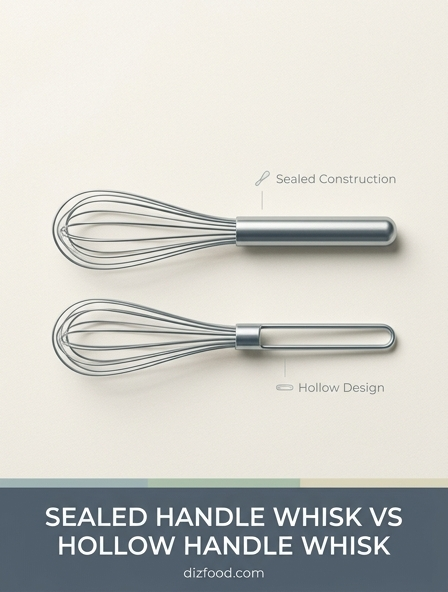
Understanding the Core Differences Between Whisk Handle Designs
In the world of culinary tools, the whisk is an indispensable instrument, yet its construction often goes overlooked until a failure occurs. The primary distinction between whisk designs lies in how the wires are anchored into the handle. A hollow handle whisk typically features a stainless steel tube that is crimped or capped at the end, with the wires inserted into the opening. This design often relies on mechanical tension or light adhesives to keep the wires in place, leaving a significant amount of empty space within the handle itself.
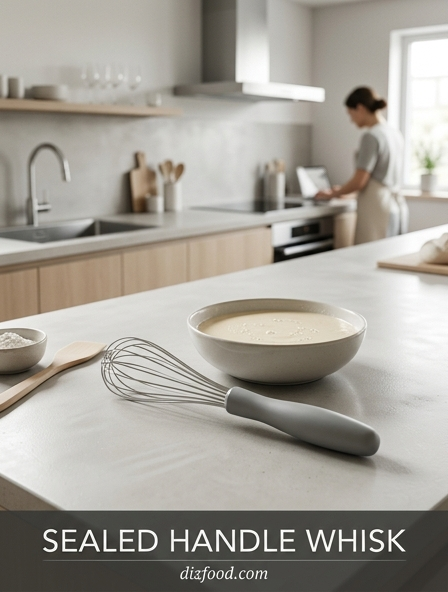
Conversely, a sealed handle whisk is engineered with a solid internal structure. In high-quality models, the wires are embedded into a composite material or a high-temperature epoxy resin that fills the handle entirely. This creates a monolithic unit where no air or liquid can penetrate the interior. While both tools are designed to aerate, blend, and emulsify, their physical architecture dictates their performance over time. Key differences include:
- Material Density: Sealed handles are often made from Exoglass or heavy-duty polymers, whereas hollow handles are almost exclusively thin-walled stainless steel.
- Assembly Method: Hollow handles are assembled in parts, while sealed handles are often molded as a single, continuous piece.
- Wire Retention: Sealed designs lock each individual wire loop into a solid base, preventing the "wobble" common in aged hollow whisks.
Understanding these foundational differences is the first step in realizing why professional chefs and home enthusiasts often gravitate toward one specific style for long-term kitchen success.
The Hygiene Factor Why Sealed Handles Win for Food Safety
Food safety is the most critical argument in the debate between sealed and hollow whisk handles. In a professional environment, cross-contamination is a constant threat, and the tools used must be capable of being rendered completely sterile. Hollow handles pose a significant sanitary risk because they are not airtight. During the mixing of batters, eggs, or sauces, liquid can migrate into the small crevices where the wires meet the handle. Once inside the hollow cavity, these organic materials are trapped in a dark, damp environment-the perfect breeding ground for bacteria and mold.
Sealed handles eliminate this risk entirely. Because the wires are encapsulated in a solid resin or composite material, there is no physical space for food particles or moisture to enter. This "zero-void" construction ensures that the interior of the tool remains as clean as the day it was manufactured. For anyone working with raw proteins, such as egg whites or cream, the assurance that no old, decaying material is hiding inside the tool is paramount. Health inspectors often look for these details in commercial kitchens, frequently favoring NSF-certified sealed whisks that meet strict sanitation standards. By choosing a sealed design, you are prioritizing the health of those consuming your food and simplifying your sanitization protocols.
Weight and Balance Comparing Ergonomics in Kitchen Tools
The ergonomics of a whisk can determine how quickly a cook experiences hand fatigue during labor-intensive tasks like making a Hollandaise sauce or whipping heavy cream. The distribution of weight in a whisk is a direct result of its handle construction. A hollow handle whisk is naturally lighter, but this lightness often leads to a "top-heavy" feel. Because the wires are often heavier than the thin-walled steel handle, the center of gravity shifts toward the loops, forcing the user to grip the tool more tightly to maintain control.
Sealed handles, being solid, provide a necessary counterweight to the whisk wires. This added mass in the palm of the hand creates a more balanced pivot point, allowing for more efficient circular motions with less strain on the wrist. When the handle has some heft, the whisk does more of the work for you through inertia. The following table illustrates how these design choices impact the physical experience of the user:
| Feature | Hollow Handle | Sealed Handle |
|---|---|---|
| Overall Weight | Ultra-lightweight | Moderate to Heavy |
| Center of Gravity | Near the wires | Near the palm |
| Hand Fatigue | High (requires more grip) | Low (balanced motion) |
| Vibration Dampening | Minimal | High (solid core) |
The Hidden Dangers of Hollow Handle Whisks and Water Traps
The most frustrating experience with a hollow handle whisk often occurs long after the dishes are done. This phenomenon is known as the "water trap." When a hollow whisk is submerged in a sink or run through a dishwasher, water inevitably finds its way into the handle through the gaps around the wires. Even if the whisk appears dry on the outside, the interior remains filled with a mixture of water and diluted food residue. Over time, this stagnant water can lead to internal corrosion or the growth of black mold.
The real danger manifests the next time you use the tool. As you whisk a fresh bowl of ingredients, the motion and the heat of the food can cause the trapped, contaminated liquid to leak out from the handle and drip directly into your preparation. Many home cooks have been baffled by mysterious grey or black streaks appearing in their whipped cream, only to realize it is "whisk juice" leaking from a hollow handle. Sealed handles are physically incapable of this failure. Since there is no void to fill with water, there is no risk of unexpected leakage. This reliability makes the sealed handle a much safer and more predictable tool for both hot and cold culinary applications, ensuring that the only ingredients in your bowl are the ones you intentionally put there.
Durability and Longevity Which Construction Lasts Longer
When investing in kitchenware, durability is a key metric of value. Hollow handle whisks are generally prone to structural failure at the junction point. Because the wires are held in place by friction or a thin cap, they can become loose over time. A single wire snapping or pulling out of a hollow handle often renders the entire tool useless, as the remaining wires lose their tension and the structural integrity of the head collapses. Furthermore, the thin stainless steel used in hollow handles is susceptible to denting or bending if dropped.
Sealed whisks are built for the rigors of high-volume production. The process of embedding wires into a solid core creates a bond that is nearly impossible to break through normal use. You could pull on an individual wire with significant force, and it would remain anchored because it is fused into the handle's internal matrix. This construction method offers several longevity benefits:
- Stress Distribution: The solid core absorbs the mechanical stress of thick batters, preventing the wires from snapping at the base.
- Impact Resistance: Composite sealed handles can withstand being dropped on hard kitchen floors without cracking or deforming.
- Heat Resistance: High-quality sealed handles are often rated for temperatures exceeding 400°F, preventing the handle from melting or degrading when left near a hot stovetop.
While a hollow whisk might last a year or two of casual use, a well-made sealed whisk is frequently a lifetime purchase.
Dishwasher Safety Sealed vs Hollow Handle Maintenance
The convenience of a dishwasher is a staple of the modern kitchen, but it is the natural enemy of the hollow handle whisk. The high-pressure jets and extreme heat cycles of a dishwasher force water and detergent into the smallest apertures of a hollow tool. Because there is no airflow inside the handle, the moisture cannot evaporate, leading to the "swishing" sound of trapped water that many users find intolerable. Over repeated cycles, the detergent can also eat away at the internal adhesives, causing the whisk wires to eventually fall out.
Sealed handles are designed with the dishwasher in mind. Because they are airtight and watertight, they can be tossed into a dishwasher cycle without any concern for internal damage. The materials used in sealed designs, such as glass-fiber reinforced polymers, are specifically chosen for their ability to withstand the caustic chemicals found in dishwasher detergents and the thermal shock of the drying cycle. Maintenance for a sealed whisk is as simple as it gets: wash, dry, and store. There is no need to hang it at a specific angle to "drain" or to worry about rust forming in places you cannot see. This ease of maintenance makes sealed whisks the superior choice for busy cooks who value their time as much as their tools.
Professional Kitchen Standards Choosing the Right Whisk Build
In a professional kitchen, tools are selected based on efficiency, compliance, and stamina. Executive chefs rarely stock hollow handle whisks because they do not meet the rigorous demands of a line. Professional standards almost always dictate the use of sealed-handle, NSF-certified equipment. The National Sanitation Foundation (NSF) provides a certification that ensures a tool is easy to clean and does not harbor bacteria. A whisk with a hollow handle rarely meets these criteria because the interior is "uncleanable."
Furthermore, the performance requirements in a bakery or restaurant are much higher than at home. A pastry chef might whisk forty egg whites by hand in a single shift. In this scenario, the balance and grip of a sealed handle are not just luxuries; they are ergonomic necessities to prevent carpal tunnel syndrome and other repetitive strain injuries. Professional-grade whisks often feature:
- Non-Slip Grips: Sealed handles are frequently textured to ensure a secure hold even when hands are wet or oily.
- High Wire Count: Professional sealed whisks often have more wires for faster aeration.
- Anti-Roll Handles: Many sealed designs have a flattened side or a specific shape to prevent the tool from rolling off a stainless steel prep table.
When you buy a sealed whisk, you are essentially bringing a piece of industrial-grade equipment into your home kitchen.
Baking Efficiency How Handle Weight Impacts Your Technique
Baking is a science that relies on precision and technique, particularly when it comes to aeration. Whether you are folding air into a sponge cake batter or creating a stiff-peak meringue, the way you manipulate the whisk matters. The weight of a sealed handle plays a subtle but vital role in this process. A heavier handle acts as a counterweight, which changes the physics of the whisking motion. It allows the user to utilize the weight of the tool to maintain a consistent rhythm, which is essential for developing the structure of delicate foams.
With a hollow handle, the lack of weight means the user must provide all the force and stabilization. This can lead to erratic movements that may "knock out" the air you are trying to incorporate. Additionally, the solid core of a sealed whisk dampens the vibrations that travel from the wires to the hand. This might seem like a minor detail, but during a ten-minute whipping session, those vibrations contribute significantly to hand fatigue. Efficiency in baking isn't just about speed; it's about maintaining a consistent, controlled motion over time. The structural integrity of a sealed handle allows for a more forceful whip without the fear of the tool flexing or the wires shifting, resulting in better volume and a more refined texture in your finished baked goods.
Cost Versus Quality Analyzing the Value of Sealed Designs
At the point of purchase, a hollow handle whisk is almost always the cheaper option. They are mass-produced using inexpensive stamping and crimping methods, making them attractive to budget-conscious shoppers. However, a true cost-benefit analysis reveals that sealed designs offer significantly better value over time. The "cost per use" of a sealed whisk is remarkably low because it rarely needs to be replaced. A cheap hollow whisk that costs five dollars but needs replacement every year due to rust or broken wires is far more expensive than a twenty-dollar sealed whisk that lasts two decades.
The following table breaks down the value proposition between the two designs based on typical kitchen usage over a five-year period:
| Metric | Budget Hollow Whisk | Premium Sealed Whisk |
|---|---|---|
| Initial Investment | $5 - $8 | $18 - $30 |
| Replacements Needed (5 yrs) | 2 to 3 | 0 |
| Performance Retention | Worsens over time | Remains consistent |
| Peace of Mind (Hygiene) | Low | High |
When you consider the potential for food waste (due to contamination) and the physical toll of poor ergonomics, the premium paid for a sealed design is a wise investment for any serious cook.
Final Verdict Which Whisk Design Belongs in Your Kitchen
After examining the hygiene, durability, ergonomics, and long-term value, the conclusion is clear: the sealed handle whisk is the superior kitchen tool in nearly every category. While hollow handle whisks are widely available and tempting due to their low price, they carry hidden risks that can compromise the quality and safety of your food. The "black water" issue alone is a compelling enough reason for most home cooks to purge hollow whisks from their utensil drawers. The risk of leaking old, bacteria-laden moisture into a fresh dish is a failure that no amount of cost savings can justify.
If you are a casual cook who rarely uses a whisk, a hollow design might suffice in the short term. However, for anyone who enjoys baking, makes their own sauces, or values a well-organized and sanitary kitchen, the sealed handle is the gold standard. Look for reputable brands that offer NSF certification and handles made from high-temperature composites like Exoglass. By choosing a sealed handle whisk, you are investing in a tool that is safer, more comfortable to use, and built to last a lifetime. It is a classic example of the culinary adage that the best tool is the one that allows you to focus on the recipe, not the limitations of your equipment.

Comments