
Understanding the science of emulsification is the secret to elevating your home cooking from basic to professional. This fascinating culinary process involves forcing two naturally incompatible liquids-like oil and vinegar-to bond through high-speed agitation and the strategic use of stabilizers. Mastering silky smooth textures requires more than just quality ingredients; it demands a grasp of mechanical shear and fluid dynamics to break down fat globules into a stable, velvety suspension. Whether you are perfecting a delicate hollandaise or a creamy vinaigrette, your choice of kitchen tools is essential for achieving that flawless consistency, especially when comparing a cage whisk vs spring whisk for optimal aeration and control.
Understanding the Molecular Bond
At the heart of every emulsion lies a fundamental conflict between two immiscible liquids: water and fat. On a molecular level, water is a polar molecule, meaning it carries a slight electrical charge that attracts other polar substances. Conversely, oil molecules are non-polar and hydrophobic, causing them to repel water and clump together to minimize surface area contact. To bridge this divide, a third component known as an emulsifier is required. These molecules possess a dual nature, featuring a hydrophilic (water-loving) head and a lipophilic (fat-loving) tail.
When introduced into a mixture, the emulsifier positions itself at the interface between the two liquids. The lipophilic tails embed themselves into the oil droplets, while the hydrophilic heads remain anchored in the surrounding water. This orientation creates a protective barrier that prevents the oil droplets from coalescing back into a single layer. This microscopic architecture is what allows a cook to create a stable, creamy sauce from ingredients that naturally want to remain separate. Understanding this polarity is the first step in mastering the complex chemistry of the modern kitchen.
The Role of Surface Tension
Surface tension is the physical force that holds the surface of a liquid together, acting like an elastic membrane. In the context of a kitchen, this tension is the primary obstacle to creating a smooth vinaigrette or sauce. When oil and water are combined, the high interfacial tension between them encourages the oil to form large, buoyant spheres that float to the top. To overcome this, mechanical energy must be applied to break these large globules into thousands of microscopic droplets.
Reducing this tension is essential for long-term stability. As the size of the internal phase droplets decreases, the surface area increases exponentially. Without the presence of surfactants to lower the surface tension, these tiny droplets would collide and fuse almost instantly due to kinetic energy. The following table illustrates how different factors influence the behavior of surface tension during the mixing process:
| Factor | Effect on Surface Tension | Kitchen Outcome |
|---|---|---|
| Increased Heat | Decreases tension | Easier initial dispersal |
| Surfactant Addition | Significantly lowers tension | Prevents droplet coalescence |
| Agitation Speed | Physically overcomes tension | Smaller droplet size |
Essential Tools for Effective Aeration
The success of an emulsion often depends on the tools used to provide the necessary shear force. Manual tools, such as the balloon whisk, are traditional favorites because they allow for precise control over the speed and volume of oil being incorporated. However, manual whisking is limited by human endurance and speed. For more robust and permanent emulsions, high-speed mechanical tools are often preferred. These devices generate enough force to shatter oil molecules into much smaller particles than a hand whisk ever could.
Choosing the right equipment depends on the desired volume and the thickness of the final product. A heavy-duty stand mixer is ideal for large batches of mayonnaise, while a high-speed immersion blender is the tool of choice for small-batch herb oils or foams. The shearing action of the blades creates a vortex that draws the oil into the aqueous base, ensuring a rapid and thorough distribution of the lipid phase throughout the continuous phase. Using the correct tool ensures that the emulsion reaches its peak structural integrity without separating under its own weight.
Natural Emulsifiers and Chemical Stabilizers
While mechanical force initiates the emulsion, chemical components provide the long-term stability required for service. Natural emulsifiers are found in many common kitchen staples, and knowing which to use can elevate the texture of a dish. These ingredients act as the "glue" that keeps the microscopic droplets suspended. Beyond natural options, modernist cooking often utilizes refined chemical stabilizers to achieve textures that are impossible with traditional ingredients alone.
- Egg Yolks: Rich in lecithin, the gold standard for mayonnaise and hollandaise.
- Prepared Mustard: Contains mucilage which acts as a physical barrier between droplets.
- Honey: Increases the viscosity of the continuous phase, slowing droplet movement.
- Xanthan Gum: A stabilizer that prevents phase separation even in very thin liquids.
- Soy Lecithin: A powerful additive used to create stable culinary foams and "airs."
By combining these elements, a chef can manipulate the shelf life and mouthfeel of a sauce. For instance, adding a small amount of mustard to a simple vinaigrette not only adds flavor but significantly increases the time it takes for the oil to separate from the vinegar.
Mastering the Mechanics of Whisking
Mastering the Mechanics of Whisking
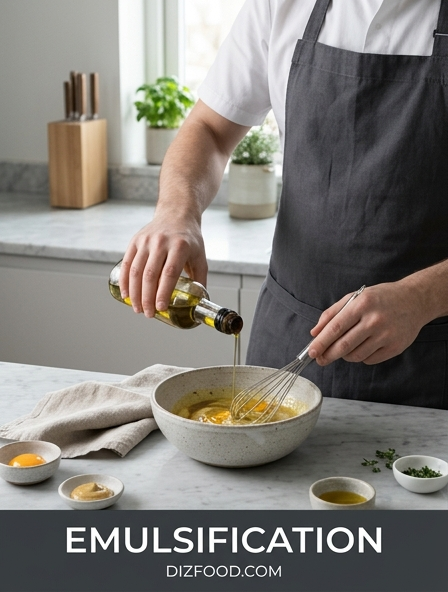
The physical act of whisking is more than just stirring; it is a calculated application of shear force designed to suspend one liquid within another. The technique begins with the "slow start" method. Initially, the aqueous base and the emulsifier are combined in a bowl. The oil must then be introduced drop by drop. If the oil is added too quickly at the start, the mixture will become saturated, and the emulsion will fail before it even begins to form. As the nucleus of the emulsion develops, the rate of oil addition can be gradually increased.
- Stabilize the mixing bowl with a damp towel to allow for two-handed operation.
- Vigorously whisk the base until light and frothy to incorporate air.
- Begin adding oil in a thin, microscopic stream while maintaining a constant whisking rhythm.
- Observe the thickening of the sauce; once it gains body, the flow of oil can be slightly increased.
- Periodically stop to check the "tightness" of the emulsion and adjust with a few drops of water if it becomes too thick.
Consistency is key. A steady, side-to-side motion is generally more effective at creating shear than a circular motion, as it forces the liquids to collide with more kinetic energy.
Temperature Control for Stability
Temperature plays a critical role in the thermodynamic stability of any kitchen emulsion. Heat affects the kinetic energy of the molecules and the viscosity of the fats involved. For example, in a Hollandaise sauce, the butter must be warm enough to be liquid but not so hot that it "cooks" the egg yolks, which would cause the proteins to denature and lose their emulsifying power. Conversely, if the butter is too cold, it will solidify, causing the sauce to become grainy and eventually break.
Maintaining a "Goldilocks" zone is essential. Cold emulsions, like mayonnaise, are generally more stable when the ingredients are at room temperature initially, as this allows the lecithin to move more freely. However, once formed, chilling them increases the viscosity of the oil, which helps lock the structure in place. In professional kitchens, sauces are often held in a bain-marie at a specific temperature to ensure they remain fluid enough for service without the heat reaching a point where the molecular bonds begin to vibrate apart, leading to a greasy separation.
Achieving Peak Viscosity and Sheer
Viscosity refers to a liquid's resistance to flow, and in the world of emulsification, it is a primary indicator of success. As more oil is whisked into a base, the droplets become more tightly packed. This crowding increases the internal friction of the liquid, causing it to thicken. The point of peak viscosity is reached when the oil droplets are so numerous that they can no longer move freely past one another. This creates the rich, luxurious mouthfeel associated with high-quality sauces.
The concept of "shear" is equally important. High-shear mixing creates smaller droplets, which in turn creates a thicker and more stable product. If a sauce feels heavy or greasy rather than light and creamy, it is likely that the oil droplets are too large due to insufficient shear. Professionals often use an immersion blender at the final stage of sauce preparation to "tighten" the emulsion, applying a burst of high-intensity shear that shatters any remaining large globules and produces a perfectly smooth, velvet-like consistency that coats the back of a spoon.
Common Causes of Broken Emulsions
An emulsion "breaks" when the two liquids separate, leaving a greasy mess and a thin, watery liquid at the bottom. Understanding why this happens is the best way to prevent it. Most failures occur due to a violation of the physical limits of the mixture. If the balance of fat to water is incorrect, or if the environmental conditions change too rapidly, the protective barrier provided by the emulsifier will collapse.
The most frequent causes of a broken sauce include:
- Rapid Oil Addition: Flooding the base with oil before the initial droplets are stabilized.
- Extreme Temperature: Overheating causes proteins to coagulate; overcooling causes fats to crystallize.
- Saturation: Attempting to force more oil into a base than the amount of water and emulsifier can support.
- Insufficient Agitation: Failing to provide enough mechanical energy to break the oil into microscopic droplets.
When an emulsion breaks, it loses its opacity and takes on a curdled appearance. This is a sign that the oil droplets have successfully overcome the surfactant barrier and merged back together into a continuous layer of fat.
Repairing Textures and Restoring Gloss
A broken emulsion is not necessarily a lost cause. In many cases, the texture can be repaired through the re-application of shear and the addition of a new continuous phase. The most effective method involves starting a fresh emulsion and slowly incorporating the broken one into it. Because the broken sauce already contains the necessary ingredients, the goal is simply to re-disperse the fat droplets that have clumped together.
To fix a broken mayonnaise or vinaigrette, place a small amount of water, lemon juice, or a fresh egg yolk into a clean bowl. Whisk this base until it is frothy, then very slowly begin whisking in the broken mixture, one spoonful at a time. The new base provides a fresh set of emulsifiers and enough "room" for the oil to be redistributed. For warm sauces like Beurre Blanc, sometimes a simple splash of heavy cream and a vigorous whisking over low heat can provide enough stability to pull the fats back into suspension and restore the sauce's characteristic glossy sheen.
Advanced Techniques for Professional Finishes
Modern culinary science has introduced techniques that go beyond the traditional whisk and bowl. Professional chefs now use specialized ingredients like mono- and diglycerides or esters to create emulsions that are incredibly stable across a wide range of temperatures. One popular advanced technique is the use of a whipping siphon. By charging an emulsified liquid with nitrous oxide, the gas dissolves into the fat phase. When released, the gas expands, creating an incredibly light, aerated foam known as an "espuma."
Another technique involves the use of ultrasonic homogenizers, which use sound waves to create microscopic bubbles that implode, creating intense local shear. This allows for the creation of emulsions with virtually no stabilizers, producing a pure flavor profile. Finally, "cold-oil" emulsification, where oils are infused with aromatics and then emulsified with acidified juices using xanthan gum, allows for vibrant, colorful sauces that maintain their integrity even when plated on hot proteins. These methods allow for greater creativity and precision, pushing the boundaries of what is possible with simple oil and water.


Comments