
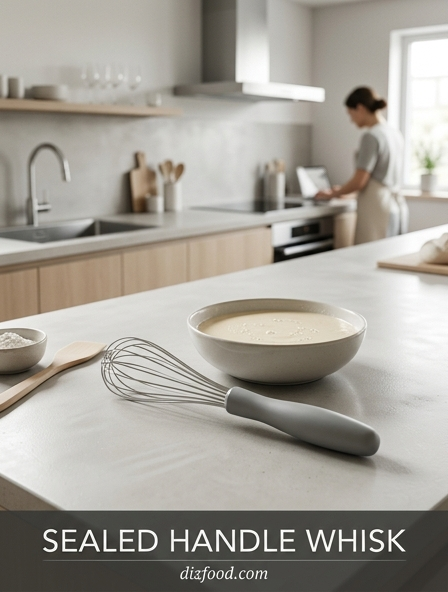
When you're whipping up your favorite recipes, maintaining a hygienic kitchen is essential for keeping everyone safe. Opting for a sealed handle whisk is the best way to prevent cross-contamination because it eliminates hidden crevices where bacteria thrive. Traditional designs often allow moisture and food particles to seep inside the handle, creating a breeding ground for germs that can contaminate your next meal. By choosing a fully sealed design, you ensure that old food residue stays out of your fresh ingredients, providing professional-level food safety at home. To find the right tool, compare the benefits of a sealed handle whisk vs hollow handle whisk.
The hidden dangers of hollow whisk handles
Traditional kitchen whisks often feature hollow handles where the wires are crimped or simply inserted into a metal tube. This design creates a significant hidden hazard in both residential and commercial kitchens. When these whisks are submerged in soapy water or used to mix thin batters, liquid is drawn into the handle through capillary action. Once inside, this moisture becomes trapped in a dark, anaerobic environment that is nearly impossible to dry or sanitize. Over time, the trapped organic matter begins to rot, leading to the development of foul odors and the accumulation of internal rust.
- Accumulation of stagnant "black water" that leaks during use.
- Internal corrosion that weakens the structural integrity of the wires.
- Growth of unseen pathogens in hard-to-reach internal cavities.
- Risk of metal fatigue and wire snapping due to internal oxidation.
This internal degradation often goes unnoticed until the whisk begins to leak a dark, foul-smelling liquid back into the food being prepared. These hidden dangers make the transition to sealed handle technology a necessity for maintaining a safe and sanitary food preparation environment.
Anatomy of a sealed handle whisk
The engineering of a sealed handle whisk focuses on creating a completely impenetrable barrier between the whisking wires and the handle interior. Unlike standard whisks, these professional-grade tools utilize high-tech polymers or epoxy resins to fill the void where the wires meet the grip. This ensures that no air or liquid can enter the handle, regardless of how long the tool is submerged or how much pressure is applied during the mixing process.
| Component | Material Specification | Function |
|---|---|---|
| Wires | 18/8 Stainless Steel | Provides tension and resists oxidation. |
| Sealant | Food-grade Epoxy/Silicone | Eliminates gaps at the entry point. |
| Handle | Ergonomic Composite | Offers slip-resistance and heat insulation. |
| End Cap | Ultrasonically Welded | Prevents moisture entry at the base. |
The seamless transition from the wire loops to the handle surface allows for a smooth, continuous exterior. This anatomy not only improves hygiene but also enhances the balance of the tool, as there is no shifting weight from trapped liquids inside the handle.
How bacteria thrives in open whisk gaps
Bacteria require moisture, nutrients, and a protected surface to colonize effectively, and the gaps in a traditional whisk handle provide the perfect incubator. When food particles like egg proteins, dairy, or flour mixtures are pulled into these crevices, they provide a constant food source for microbial growth. Common pathogens such as Salmonella and E. coli can survive in these damp recesses, protected from the heat and chemicals used during standard dishwashing procedures.
- Capillary action pulls raw ingredients into the handle gap.
- Residual moisture prevents the internal cavity from drying.
- Microbes form biofilms on the internal wire surfaces.
- Pressure during whisking forces contaminated fluids back into fresh food.
Because the interior of an open handle is shielded from UV light and airflow, bacterial colonies can multiply rapidly without any visible signs of contamination. The resulting biofilm is highly resistant to traditional cleaning agents, making the whisk a permanent reservoir for harmful microorganisms that compromise every dish it touches.
Eliminating food debris traps for better hygiene
Hygiene in a high-volume kitchen depends on the ability to remove all organic matter from utensils after every use. Sealed handle whisks facilitate this by eliminating the "debris traps" commonly found at the junction where the wires enter the handle. These traps are notorious for catching small fibers, spices, and thick sauces that can become cemented in place. By creating a flush, sealed surface, manufacturers ensure that every part of the whisk is accessible to the bristles of a cleaning brush or the high-pressure spray of a dishwasher.
The removal of these crevices means that proteins cannot coagulate in hidden areas, which is especially critical when working with raw eggs or heavy creams. A hygienic whisk should have a surface geometry that allows water to bead and roll off efficiently, preventing the buildup of limescale or mineral deposits. Without these traps, the drying process is significantly faster, further reducing the window of time in which microbes could potentially settle on the tool's surface.
HACCP compliance and professional kitchen standards
Professional kitchens operate under strict Hazard Analysis Critical Control Point (HACCP) guidelines to ensure food safety. Sealed handle whisks are a cornerstone of these standards because they represent a "preventative control" against biological hazards. Inspectors often look for NSF (National Sanitation Foundation) certification on smallwares, which mandates that tools be easily cleanable and free from pits, cracks, and crevices where pathogens can hide.
- NSF/ANSI Standard 2 certification for food equipment.
- Verification of non-toxic, non-absorbent materials.
- Resistance to high-temperature commercial sanitization cycles.
- Documentation of smooth, continuous welds and seals.
Implementing sealed whisks allows kitchen managers to streamline their safety audits. When a tool is designed to be inherently sanitary, the risk of human error during the cleaning process is greatly reduced. For commercial bakeries and restaurants, using tools that meet these professional standards is not just a matter of quality; it is a regulatory requirement to prevent large-scale foodborne illness outbreaks.
The science of cross contamination in whisking
Cross-contamination occurs when pathogens or allergens are transferred from one surface or food item to another. In the context of whisking, the most dangerous form of cross-contamination is the "delayed release" of contaminants from inside a hollow handle. A whisk used to mix a raw egg batter yesterday may harbor salmonella within its handle; if used today to whip a heat-stable frosting, the contaminated liquid can leak into the ready-to-eat product. This science involves the physics of thermal expansion and contraction.
When a whisk is placed in warm food, the air inside a hollow handle expands, and as it cools, it creates a vacuum that sucks in the surrounding liquid. Later, when the whisk is moved or subjected to centrifugal force during vigorous mixing, that liquid is expelled. Sealed handles negate this physical process entirely. By ensuring the handle is a solid or hermetically sealed unit, there is no exchange of air or fluid with the external environment, effectively breaking the chain of contamination between different batches of food.
Moisture resistance and mold prevention benefits
Mold and mildew thrive in the damp, dark environments found inside traditional whisk handles. Once mold spores take root in the internal crevices of a kitchen tool, they are exceptionally difficult to eradicate. Sealed handle whisks offer total moisture resistance, which is the primary defense against fungal growth. By using hydrophobic sealing materials like high-grade silicone or specialized resins, these whisks prevent the "wicking" effect that brings water into the core of the tool.
This moisture resistance is particularly beneficial in humid kitchen environments where air-drying is slow. A sealed whisk can be dried externally with a cloth and immediately stored without the risk of internal condensation forming. Furthermore, the materials used in sealed handles are typically non-porous, meaning they do not absorb oils or fats that could go rancid. Preventing mold is not only about health but also about protecting the flavor profile of the food; even a trace amount of moldy liquid leaking from a handle can ruin the delicate taste of a meringue or sauce.
Superior cleaning and dishwasher safety features
Modern kitchen sanitation relies heavily on high-temperature dishwashers that use both chemical sanitizers and thermal energy to kill bacteria. Sealed handle whisks are specifically engineered to withstand these harsh conditions without compromising their structural integrity. While cheap whisks may have seals that crack or handles that melt, professional-grade sealed whisks use materials with high heat deflection temperatures. This allows them to go through repeated commercial dishwasher cycles without the seal degrading.
| Feature | Traditional Whisk | Sealed Whisk |
|---|---|---|
| Dishwasher Ingress | High risk of internal flooding | Zero moisture penetration |
| Heat Resistance | Handle may loosen or warp | Materials rated for 400°F+ |
| Sanitization | External only | Complete surface sterilization |
| Drying Time | Extended (internal) | Instant (external only) |
The lack of internal cavities means there is no risk of "cloudy water" spots or rust streaks appearing on the wires after a wash. This superior cleanability ensures that the tool is ready for immediate use in another task without cross-flavor contamination.
Long term durability of sealed construction
Investing in a sealed handle whisk is a matter of long-term kitchen economy. Traditional whisks often fail when the wires become loose within the handle due to internal corrosion or the weakening of the mechanical crimp. In a sealed whisk, the wires are usually embedded deep into a solid plug of epoxy or silicone, providing a much larger surface area for mechanical bonding. This construction method prevents individual wires from pulling out or shifting, even when whisking heavy doughs or thick batters.
The durability is also enhanced by the exclusion of oxygen and moisture from the wire ends. Stainless steel is resistant to rust, but constant exposure to trapped moisture and cleaning chemicals can eventually lead to pitting and stress corrosion cracking at the stress points. By sealing these points, the lifespan of the tool is extended by years. For professional chefs, this means fewer replacements and a consistent "spring" in the wires that does not degrade over time, ensuring the tool performs as well in its third year as it did on its first day.
Protecting your kitchen from foodborne illnesses
The ultimate goal of using sealed handle whisks is the protection of the consumer and the reputation of the kitchen. Foodborne illnesses are often traced back to poor utensil hygiene, where a seemingly clean tool was actually a vector for disease. By choosing a sealed design, you are implementing a passive safety system that works 24/7 to prevent the accumulation of pathogens. This is an essential step in a comprehensive food safety plan, whether in a high-volume catering operation or a home kitchen.
Protecting the kitchen involves more than just washing surfaces; it requires the selection of tools that are fundamentally incapable of harboring danger. When you eliminate the possibility of internal rot and bacterial colonies within your whisks, you remove a significant variable from the safety equation. This proactive approach to tool selection demonstrates a commitment to the highest culinary standards and provides peace of mind that every whipped cream, emulsified vinaigrette, or tempered egg yolk is as safe as it is delicious.

Comments