
If you've ever struggled to scrape stubborn bits of roux from the tight edges of a skillet, you know that the geometry of your kitchen tools can make or break a delicate sauce. While the traditional aeration">cylindrical balloon whisk remains the undisputed champion of aeration, perfect for whipping air into egg whites or heavy cream in deep bowls, the conical whisk is the specialized hero of the stovetop. Specifically engineered with a tapered, flat-bottomed profile, the conical whisk (often called a spiral or flat whisk) is designed to hug the "secret corners" of your pan where heat concentrates and sauces often scorch. Whether you are deglazing a pan or emulsifying a shallow reduction, understanding the mechanical advantage of these two shapes ensures you never leave a single drop of flavor behind.
| Feature | Conical (Spiral/Flat) Whisk | Cylindrical (Balloon/French) Whisk |
|---|---|---|
| Primary Goal | Corner reach and pan deglazing. | Volume and high-speed aeration. |
| Vessel Synergy | Shallow pans, skillets, and sauciers. | Deep mixing bowls and stockpots. |
| Motion Style | Horizontal sweeping and scraping. | Vertical loops and vigorous beating. |
| Best For | Gravy, roux, and pan-seared sauces. | Meringues, whipped cream, and batters. |
| Corner Access | 100% coverage; fits 90° angles. | Poor; leaves "dead zones" at edges. |
| Material Density | Handles thick, heavy reductions easily. | Best for thin liquids needing air. |
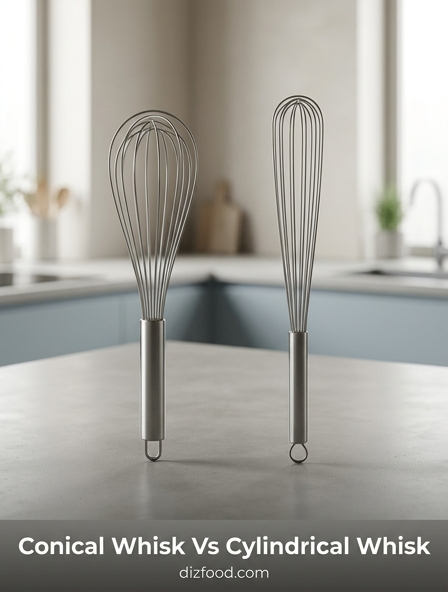
Conical vs Cylindrical Whisk Shapes Defined
The distinction between conical and cylindrical whisks lies primarily in their geometric profile and how that geometry interacts with culinary vessels. A conical whisk, often referred to as a French whisk or a tapered sauce whisk, features wires that narrow significantly toward the tip. This creates a teardrop or elongated V-shape that allows the tool to penetrate deep into narrow spaces. The design is intentional, focusing the agitation power at a specific point rather than distributing it evenly across a wide radius. This shape is preferred for working in smaller pots where a traditional balloon whisk would be too cumbersome to move freely.
In contrast, the cylindrical whisk, frequently associated with the classic balloon whisk or a heavy-duty piano whisk, maintains a more consistent width throughout its body before rounding off at the end. These whisks are designed with a larger diameter and a more spherical or barrel-like arrangement of wires. This shape is optimized for high-volume tasks where the goal is to interact with as much liquid as possible in a single stroke. While the cylindrical shape provides excellent coverage, its lack of a tapered point makes it less effective at reaching the specific junctions where the bottom of a pan meets its vertical walls.
Understanding these definitions is the first step in selecting the right tool for professional or home kitchen use. The conical whisk is a tool of precision and depth, whereas the cylindrical whisk is a tool of volume and breadth. Both are typically constructed from stainless steel wires, but their structural silhouettes dictate their unique mechanical advantages during the mixing process.
Precision Mixing and Corner Reach Performance
When preparing delicate emulsions or thick reductions, the ability to clear the corners of a pan is vital to prevent scorching. The conical whisk excels in this specific area of performance. Because the wires converge at a narrow point, the user can apply direct pressure to the "dead zones" of a saucepan. In these tight corners, ingredients often get trapped and overheat, leading to lumps or a burnt aftertaste. The tapered design allows for a scraping motion that keeps the entire volume of the sauce in constant motion.
- Pointed Agitation: Reaches the crevice where the pan base meets the side walls.
- Variable Depth: The narrowing profile allows the whisk to work efficiently in tall, narrow beakers or graduated cylinders.
- De-glazing Efficiency: Ideal for lifting fond from the bottom of a pan after searing meats.
- Reduced Drag: The slimmer profile encounters less resistance when moving through thick pastes or heavy roux.
Cylindrical whisks, by comparison, often struggle with corner reach. Their rounded bottoms leave a small gap between the wires and the pan's edge, which can result in uneven cooking if the chef is not vigilant. While they are superior for broad sweeping motions in a large mixing bowl, they lack the surgical precision required for advanced saucier work. For any recipe that involves a thick base or a long reduction time, the conical whisk's ability to maintain total surface contact is an essential performance metric that prevents common kitchen failures like lumpy béchamel or broken hollandaise.
The Aeration Power of Cylindrical Whisks
Aeration is the process of incorporating air into a liquid to create volume, lightness, and structure. Cylindrical whisks, particularly those with a high wire count, are the undisputed champions of this task. The wide, rounded shape creates a massive amount of turbulence as it passes through ingredients like heavy cream or egg whites. Each wire acts as a tiny blade that cuts through the liquid, trapping air bubbles and stabilizing them within the protein or fat matrix. This is why the cylindrical balloon whisk is the standard choice for meringues and whipped creams.
The mechanical advantage of the cylindrical shape comes from its surface area. Because the whisk does not taper, it moves a larger volume of air with every rotation of the wrist. This leads to faster results when trying to achieve soft or stiff peaks. In a professional setting, where speed and consistency are paramount, using a conical whisk for aeration would be inefficient. The narrow tip of a conical whisk simply does not move enough air to create the necessary loft in a reasonable amount of time. The cylindrical design ensures that air is distributed evenly throughout the entire mixture, rather than just at the bottom of the bowl.
Furthermore, the spacing between the wires in a cylindrical whisk is often wider at the center, allowing for maximum expansion of the foam. This architectural feature prevents the whisk from becoming clogged with thick foam, ensuring that the aeration process remains continuous and effective until the desired texture is reached. For any task requiring a light, fluffy result, the cylindrical whisk remains the superior engineering choice.
Best Applications for Conical Tip Designs
The conical whisk is a specialized tool that shines in specific culinary scenarios where control is more important than volume. Its design is particularly well-suited for high-temperature cooking and tasks involving thick, viscous ingredients. Because the tip is the narrowest part, it allows the chef to exert concentrated force, which is necessary for breaking down lumps in a roux or incorporating heavy starches into a liquid base. The following list highlights the primary applications where a conical whisk outperforms its cylindrical counterpart:
- Small Batch Sauces: Perfect for preparing a quick pan sauce or a single serving of gravy.
- Double Boiler Work: The narrow profile fits easily into the restricted space of a bain-marie or double boiler.
- Emulsifying Dressings: Ideal for slowly drizzling oil into vinegar while maintaining a vigorous, focused stir.
- Narrow Containers: When mixing ingredients directly in a measuring cup or a small jar, the conical shape prevents splashing.
- Pastry Creams: Helps in maintaining a smooth consistency as the cream thickens on the stovetop.
In addition to these uses, the conical whisk is the preferred choice for deglazing. After roasting or searing, the caramelized bits stuck to the pan (the fond) require targeted scraping to be incorporated into a sauce. The pointed wires of the conical whisk act as a multi-pronged scraper, efficiently lifting these flavorsome bits without the need for a separate spatula. This versatility makes it an indispensable tool for the saucier station in a professional kitchen, where efficiency and flavor extraction are the top priorities.
Surface Area Coverage and Speed Comparison
When evaluating whisk efficiency, one must consider the relationship between the tool's surface area and the speed of the desired outcome. The cylindrical whisk is designed for maximum coverage, making it the faster option for large-scale mixing. Because its diameter remains wide across its length, it impacts a broader path of liquid with every stroke. This is especially noticeable when working in wide-bottomed mixing bowls. A single pass with a cylindrical whisk can agitate three to four times the volume of liquid compared to a narrow conical whisk.
| Feature | Cylindrical Whisk | Conical Whisk |
|---|---|---|
| Primary Motion | Broad Sweeping / Beating | Targeted Stirring / Scraping |
| Speed of Aeration | Very High | Low to Moderate |
| Coverage Area | Wide and Rounded | Narrow and Focused |
| Liquid Displacement | Significant | Minimal |
In a head-to-head speed comparison, the cylindrical whisk wins in tasks like thinning out a large vat of batter or whipping a liter of cream. The conical whisk, while slower in these contexts, offers better "control speed." Control speed refers to the ability to mix thoroughly without over-incorporating air or causing overflow in a small vessel. If you attempt to use a large cylindrical whisk in a small saucepan, you will likely encounter splashing and uneven mixing. Therefore, while the cylindrical whisk is faster for volume, the conical whisk is faster for achieving a perfectly smooth, bubble-free texture in confined spaces.
Ergonomics and Maneuverability for Professionals
Professional chefs often spend hours performing repetitive mixing motions, making ergonomics a critical factor in whisk selection. The maneuverability of a whisk is determined by its weight distribution and the resistance it meets in the product. Conical whisks are generally lighter and have a lower center of gravity near the handle. This makes them feel more like a precision instrument, similar to a pen or a scalpel. The tapered shape also reduces "drag" when moving through heavy liquids, which can significantly reduce wrist strain during long shifts at the stove.
Cylindrical whisks, especially the heavy-duty versions used for large batches, require more physical effort to operate. The wider wire span creates more resistance, demanding more power from the forearm and shoulder. However, many professional cylindrical whisks feature ergonomic handles with silicone grips or weighted ends to help counterbalance the large wire head. This allows the weight of the whisk itself to do some of the work during the downward stroke of a whipping motion. The choice between the two often comes down to the specific motion being used: the conical whisk is optimized for a horizontal, circular stirring motion, while the cylindrical whisk is optimized for a vertical, elliptical whipping motion.
For a chef specializing in pastry, the bounce and flexibility of a cylindrical whisk are essential for developing rhythm. For a line cook on the sauce station, the rigid precision of a conical whisk allows for quick, flicking motions that provide instant feedback from the bottom of the pan. Both tools serve to protect the long-term health of the cook's joints by providing the right mechanical advantage for the specific task at hand, preventing the need for excessive force.
Which Whisk Works Best for Sauces
The quest for the perfect sauce often hinges on the choice of whisk. For the majority of cooked sauces, the conical whisk is the superior choice. This is due to the physics of heat transfer and fluid dynamics. Sauces, particularly those based on starches or proteins like eggs, are prone to thickening unevenly. The conical whisk allows for constant agitation of the entire liquid mass, ensuring that no part of the sauce remains stationary against the hot surface of the pan for too long. This is the secret to achieving a silky, lump-free texture in gravies, béchamel, and velouté.
However, there are exceptions where the cylindrical whisk is preferred. If you are making a cold sauce that requires a lot of air, such as a sabayon or certain types of vinaigrettes that need to be highly aerated to stay suspended, the cylindrical shape is better. The cylindrical whisk is also useful when making very large quantities of sauce in a stockpot, where the volume is so great that the precision of a conical tip is lost. In these macro-environments, the sheer power of the cylindrical wires is necessary to move the heavy liquid.
Ultimately, the "saucier's choice" remains the conical whisk for its ability to navigate the geometry of a saucepan. When whisking a reduction, the narrowing profile allows the chef to monitor the consistency of the sauce as it coats the wires. The tight wire grouping at the tip provides an excellent sensory tool for feeling the thickness of the sauce against the bottom of the pan, providing a level of feedback that a rounded balloon whisk simply cannot offer.
Structural Differences in Wire Configuration
The effectiveness of a whisk is not just about its outer shape, but also the internal configuration and gauge of its wires. Conical whisks usually feature stiffer, thicker wires that are packed more tightly together. This rigidity is necessary because the whisk is often used to "plow" through thick roux or to scrape the bottom of a pan. If the wires were too flexible, they would simply bend rather than moving the heavy ingredients. The tight spacing at the tip also ensures that even the smallest lumps are caught and broken down during the mixing process.
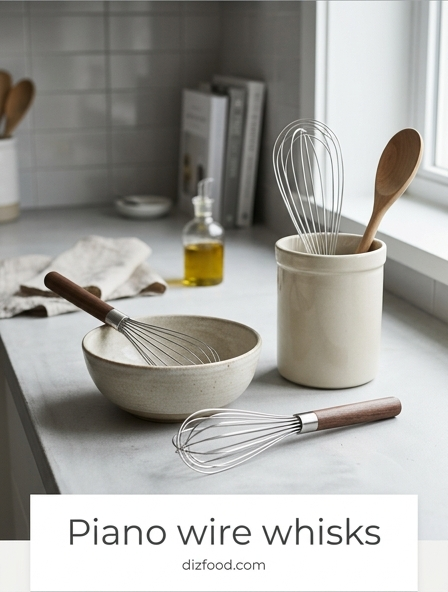
Cylindrical whisks, specifically the piano whisk variety, utilize thinner, more flexible wires. This flexibility is essential for aeration. As the whisk is moved, the wires vibrate and "spring" back into place, which helps to chop the air into the liquid more efficiently. The number of wires also tends to be higher in cylindrical whisks, sometimes featuring 10 to 12 loops, compared to the 6 to 8 loops found in a standard conical whisk. This higher wire count increases the number of "cuts" per stroke, which is the primary driver of foam formation.
- Conical Wires: High gauge, rigid, fewer loops, focused at a point.
- Cylindrical Wires: Low to medium gauge, flexible, high loop count, distributed evenly.
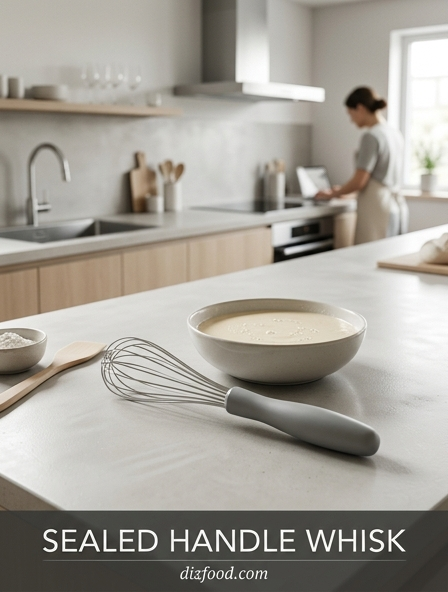
- Attachment: Conical wires are often sealed with epoxy at the handle to prevent moisture from entering the narrow tip assembly.
- Flexibility: Cylindrical whisks rely on the "spring" of the wire to incorporate volume.
These structural differences mean that the tools are not interchangeable for high-performance tasks. Using a thin-wired cylindrical whisk to mix a heavy dough or thick paste could permanently deform the wires, while using a stiff conical whisk to whip egg whites will result in a flat, dense product and a very tired arm.
Optimizing Texture With the Right Tool
The ultimate goal of any whisking task is to achieve a specific texture. Whether you are aiming for a dense, glassy emulsion or a light, ethereal foam, the tool you choose acts as the primary architect of that texture. A conical whisk is designed to produce high-density textures. Because it incorporates very little air, it is perfect for creating smooth, heavy emulsions like mayonnaise or thick chocolate ganache. These preparations require the ingredients to be tightly bound together without the interference of air bubbles, which would detract from the richness and mouthfeel.
On the other hand, if the goal is a texture that is light and voluminous, the cylindrical whisk is the only option. The texture of a chiffon cake or a soufflé depends entirely on the air bubbles created by the flexible wires of a balloon whisk. The cylindrical shape ensures that the bubbles are small and uniform, which creates a stable structure that can withstand the heat of the oven. Without the specific turbulence patterns created by the cylindrical wire arrangement, these delicate textures would be impossible to achieve by hand.
Texture optimization also involves the speed at which ingredients are combined. The conical whisk allows for a "slow and low" approach, which is vital when tempering eggs into a hot liquid. By using the conical tip, you can stir the eggs rapidly in a small area as the hot liquid is added, preventing the eggs from scrambling. The cylindrical whisk, while powerful, often moves too much liquid at once for this delicate tempering process, increasing the risk of thermal shock and ruined texture. Matching the whisk to the desired final mouthfeel is a hallmark of an experienced cook.
Summary of Conical and Cylindrical Benefits
In summary, both conical and cylindrical whisks are essential components of a well-equipped kitchen, but they serve vastly different purposes. The choice between them should be dictated by the shape of the vessel, the desired amount of aeration, and the viscosity of the ingredients. The conical whisk is the specialist of the stovetop, providing the precision and power needed for sauces and reductions. The cylindrical whisk is the workhorse of the pastry station, providing the volume and speed required for whipping and aerating.
| Context | Preferred Whisk | Primary Reason |
|---|---|---|
| Whipping Egg Whites | Cylindrical | Maximum aeration and volume. |
| Making Pan Gravy | Conical | Reaches corners and prevents scorching. |
| Mixing Thick Batter | Cylindrical (Heavy) | High coverage and liquid displacement. |
| Tempering Custard | Conical | High control in small areas. |
| Deglazing a Pan | Conical | Stiff wires for lifting fond. |
For most home cooks, a medium-sized cylindrical balloon whisk is often the first purchase, but adding a conical whisk to the collection will immediately improve the quality of their savory cooking. Professionals will almost always have several of each on hand, recognizing that the right tool not only produces a better final product but also makes the process more efficient and less physically taxing. By understanding the mechanical differences between these two shapes, you can optimize your cooking technique and ensure that every sauce, cream, and batter reaches its full potential.


Comments