
Understanding Whisk Geometry
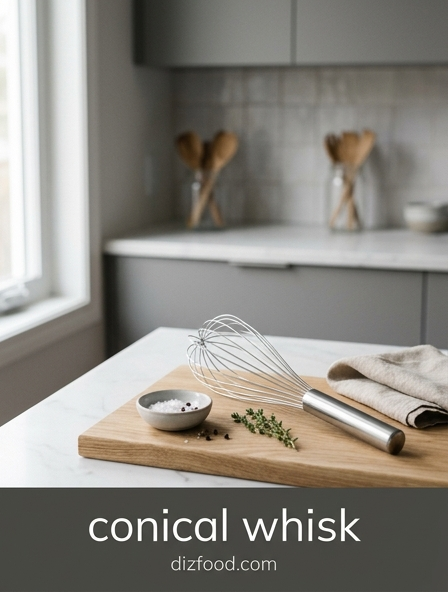
The geometry of a whisk dictates its fluid dynamics and utility within various culinary vessels. Traditional whisks often feature a rounded, bulbous end, but the conical whisk is defined by its distinct tapered profile. This shape begins with a narrower tip that gradually expands toward the handle, creating a triangular silhouette. Such geometry is not merely aesthetic; it serves a critical function in accessing the tight corners of saucepans and sauté pans where a standard balloon whisk might fail to reach. This specialized form factor allows for targeted agitation in restricted spaces.
When analyzing the structural layout, one must consider the wire gauge and the tension of the loops. In a conical design, the wires are often more rigid, allowing for forceful scraping against flat surfaces. This architectural choice enables the user to maintain contact with the bottom of the pan, ensuring that ingredients are constantly agitated and preventing the formation of hot spots. The relationship between the angle of the wires and the surface area of the vessel is fundamental to mastering professional saucier techniques.
| Feature | Conical Whisk | Balloon Whisk |
|---|---|---|
| Tip Shape | Pointed/Narrow | Rounded/Bulbous |
| Wire Tension | High/Rigid | Flexible/Springy |
| Primary Vessel | Shallow Pans | Deep Bowls |
Conical Whisk Design Benefits
The primary advantage of the conical whisk lies in its specialized shape, which is engineered for precision and depth. Unlike its balloon-shaped counterparts, the conical whisk excels in shallow environments. Because the wires converge at a point, the tool can penetrate the intersection of the pan's wall and its base. This prevents the buildup of unmixed flour or thickening agents in roux-based preparations. The concentrated wire arrangement ensures that no portion of the sauce remains stagnant, which is vital for achieving a uniform texture.
Specific benefits of this design include:
- Superior contact with the bottom of flat-bottomed pans.
- Increased control when working with small volumes of liquid.
- Enhanced ability to scrape and incorporate fond during deglazing.
- Reduced splashing due to the concentrated wire arrangement.
- Improved ergonomics for lateral whisking motions.
Furthermore, the rigid construction of these whisks makes them ideal for heavier mixtures. While a flexible whisk might buckle under the weight of a thick béchamel or a dense custard, the conical whisk maintains its structural integrity, providing the leverage necessary to ensure a smooth, lump-free consistency throughout the entire cooking process.
Cylindrical Balloon Whisk Structure
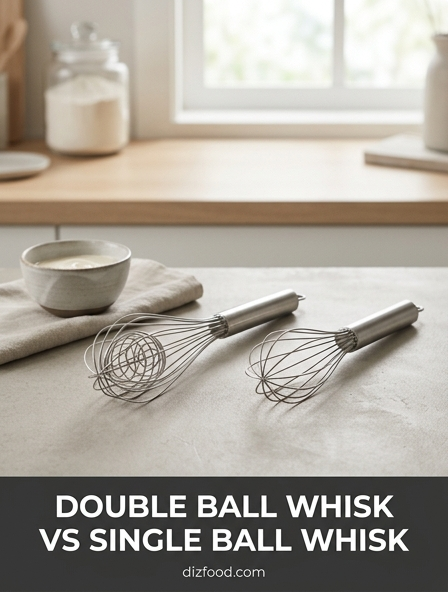
To understand the specific utility of the conical whisk, one must contrast it with the cylindrical balloon whisk. The balloon whisk is characterized by a wide, rounded head with flexible, springy wires. This design is optimized for movement through large volumes of liquid in deep, rounded bowls. The expansive surface area and the spacing between the wires are intended to pull in as much air as possible, which is the primary goal when whipping cream or beating egg whites into stiff peaks. The spherical nature of the balloon whisk allows it to follow the curve of a mixing bowl perfectly.
However, this structural elasticity becomes a disadvantage when working in flat-bottomed pans. The rounded tip cannot reach the sharp angles of a saucepan, leading to pockets of unincorporated dry ingredients or scorched liquid at the edges. While the balloon whisk is the champion of the prep bowl, it lacks the directional focus required for the stovetop. Understanding these structural differences helps a chef determine which tool will provide the most efficient agitation for the task at hand, whether it be aeration or emulsification.
Achieving Maximum Aeration
Aeration is the process of incorporating air into a liquid to create volume, lightness, and a specific mouthfeel. While conical whisks are often associated with heavy sauces, their design can be leveraged for specific types of aeration, particularly in small-batch applications. When whisking a sabayon or a hollandaise over a bain-marie, the narrow profile allows for rapid, high-frequency strokes that introduce air without requiring the massive overhead clearance of a balloon whisk. The density of the wires plays a crucial role in breaking down air bubbles into a fine, stable foam.
Factors influencing aeration efficiency include:
- Wire Count: More wires create more shear force to trap air.
- Stroke Frequency: Rapid lateral movements increase bubble formation.
- Vessel Shape: Shallow pans allow for better surface-to-air interaction.
- Temperature: Heat affects the stability of the air bubbles being incorporated.
In many professional settings, the conical whisk is preferred for delicate foams because it provides better tactile feedback. The chef can feel the resistance of the liquid as it thickens, allowing for precise adjustments in speed. This level of control ensures that the mixture reaches the desired volume without being over-whisked into an unstable state.
Deglazing with Conical Whisks
Deglazing is a critical step in building flavor, involving the release of caramelized food particles, or fond, from the bottom of a pan using a liquid. The conical whisk is arguably the best tool for this task. Its rigid, pointed tip allows the chef to apply targeted pressure to the corners and flat surfaces of the pan, effectively scraping up every bit of flavor. Unlike a wooden spoon, which has a broad, blunt edge, the multiple wires of the whisk provide several points of contact simultaneously, accelerating the dissolution of the fond into the deglazing liquid.
The process generally follows these steps:
- Removing excess fat from the pan after searing proteins.
- Adding a cold liquid like wine, stock, or vinegar to the hot pan.
- Using the conical whisk to scrape the bottom vigorously.
- Whisking in a circular motion to incorporate the particles.
- Reducing the liquid to concentrate the flavors.
Because the conical whisk is built for durability, it can withstand the high heat of a recently used pan without warping. This makes it an essential tool for creating the foundational base of complex pan sauces and gravies in a professional kitchen environment.
The Science of Pan Sauces
A pan sauce is a culinary emulsion that relies on the scientific principles of suspension and reduction. The goal is to create a harmonious blend of fats, aromatics, and liquids that coats the back of a spoon. Achieving this requires constant agitation to prevent the fats from separating and the proteins from clumping. The conical whisk facilitates this by providing high-shear mixing at the very point where the heat is most intense. By keeping the sauce in motion, the whisk ensures that the reduction happens evenly, preventing the edges from overcooking while the center remains thin.
Viscosity plays a major role in the success of a pan sauce. As moisture evaporates, the concentration of solutes increases, making the liquid thicker. The conical whisk is designed to handle this increasing resistance. Its narrow profile allows it to move through dense liquids with minimal drag, yet its rigid wires are strong enough to break up any lumps of butter or cold stock added during the mounting process. This scientific approach to agitation ensures a glossy, stable, and perfectly textured finish every time the tool is employed.
Whisking Maneuverability and Control
Control is the hallmark of professional whisking, and the conical design offers a unique ergonomic profile that maximizes maneuverability. Because the center of gravity is often closer to the handle, the chef can execute rapid movements with less wrist fatigue. This is particularly important during long reduction processes or when making labor-intensive sauces like Béarnaise. The ability to tilt the whisk at various angles without losing contact with the pan surface provides a level of versatility that bulbous whisks cannot match.
| Metric | Conical Whisk | Standard Whisk |
|---|---|---|
| Wrist Strain | Low | Medium to High |
| Corner Access | 95% to 100% | 60% to 70% |
| Lateral Speed | Very High | Moderate |
| Tactile Feedback | Excellent | Good |
Precision control also extends to the management of heat. By using a conical whisk, a chef can quickly move ingredients away from "hot spots" on the stove. The narrow tip can be used to swirl small amounts of liquid in specific areas of the pan, allowing for micro-adjustments during the cooking process. This level of dexterity is essential for maintaining the delicate balance of temperature-sensitive emulsions.
Volume versus Precision Whisking
Choosing between volume and precision is a fundamental decision for any cook. Volume whisking is required when dealing with large quantities of ingredients, such as a gallon of whipped cream or a dozen egg whites. In these scenarios, the balloon whisk is the superior choice because its large, airy structure facilitates maximum displacement. However, most stovetop tasks require precision whisking. When preparing a small amount of glaze or a single-serving pan sauce, the massive size of a balloon whisk becomes a hindrance, leading to wasted ingredients and uneven mixing.
The conical whisk thrives in the following precision scenarios:
- Emulsifying a small vinaigrette in a narrow cup.
- Mixing a roux in a small butter warmer.
- Stirring a thick chocolate ganache.
- Whisking a single egg for a wash.
- Incorporating spices into a concentrated reduction.
While the balloon whisk is a macro-tool, the conical whisk is a micro-tool. Having both in a kitchen allows the chef to scale their technique to the size of the task. For most daily stovetop duties involving sauces and reductions, the precision offered by the conical design is indispensable for achieving professional-grade results.
Essential Kitchen Tool Selection
Selecting the right conical whisk involves evaluating materials, wire thickness, and handle construction. Stainless steel is the industry standard due to its durability, resistance to rust, and ability to be sanitized in high-temperature dishwashers. For non-stick cookware, silicone-coated conical whisks are available to prevent scratching the delicate coating while still providing the necessary reach into the pan's corners. The handle should be ergonomically designed, often featuring a weighted end to balance the tool and a non-slip grip for safety in oily or wet environments.
Consider these factors when selecting a whisk:
- Material: Stainless steel for heat and durability; silicone for non-stick.
- Size: Typically 8 to 12 inches for home and professional pan work.
- Wire Stiffness: Thicker wires for heavy sauces; thinner for light emulsions.
- Sealed Handles: Prevents food particles from entering the handle base.
A high-quality conical whisk is an investment in culinary efficiency. By choosing a tool with a seamless connection between the wires and the handle, you ensure longevity and hygiene. A well-balanced whisk will feel like an extension of the arm, allowing for effortless movement and consistent results throughout its lifespan in the kitchen.
Optimizing Emulsification Techniques
Emulsification is the art of joining two liquids that naturally resist one another, such as oil and water. The conical whisk is the ideal instrument for this process because it provides the high-intensity shear required to break oil droplets into microscopic sizes. To optimize this technique, the chef must introduce the oil slowly while maintaining a constant, rhythmic whisking motion. The tapered tip of the whisk ensures that the oil is immediately incorporated into the base liquid before it has a chance to pool or separate.
The physics of the conical whisk allow for a "zigzag" motion rather than just circular stirring. This lateral movement is more effective at disrupting the surface tension of the liquids, leading to a more stable emulsion. Whether creating a Caesar dressing or a complex beurre blanc, the mechanical action of the conical whisk ensures that the emulsifying agents, such as mustard or egg yolks, are distributed evenly. This leads to a sauce with a luxurious, velvety texture that remains stable even as it sits. Mastery of these techniques depends on the tool's ability to provide constant, high-energy agitation within the specific geometry of the cooking vessel.


Comments