
Ever wondered why your hollandaise isn't quite as fluffy or your pan gravy still has stubborn lumps? Choosing between a cage whisk and a spring whisk is the secret to achieving professional-grade texture in your home kitchen. While the classic cage whisk-with its wide, bulbous loops-is your powerhouse for aerating heavy batters and whipping egg whites into voluminous peaks, the agile spring whisk is a specialist designed for shallow pans and emulsification. By understanding how the open wires of a cage whisk incorporate air versus how the tight, bouncing coils of a spring whisk break down particles in small batches, you can ensure your sauces stay silky and your batters remain perfectly balanced for the best possible mouthfeel.
| Feature | Cage Whisk (Balloon/French) | Spring Whisk (Coil/Spiral) |
|---|---|---|
| Primary Function | Aeration and high-volume mixing | Emulsifying and lump-breaking |
| Ideal Vessels | Deep mixing bowls and stockpots | Shallow pans, skillets, and mugs |
| Movement Style | Circular, sweeping, or side-to-side | Up-and-down "pumping" or flat whisking |
| Best For | Meringues, soufflés, and cake batters | Gravies, roux, and vinaigrettes |
| Design Edge | Multiple wires increase surface contact | Flexible neck reaches tight corners |
| Texture Result | Light, airy, and highly voluminous | Dense, smooth, and perfectly integrated |
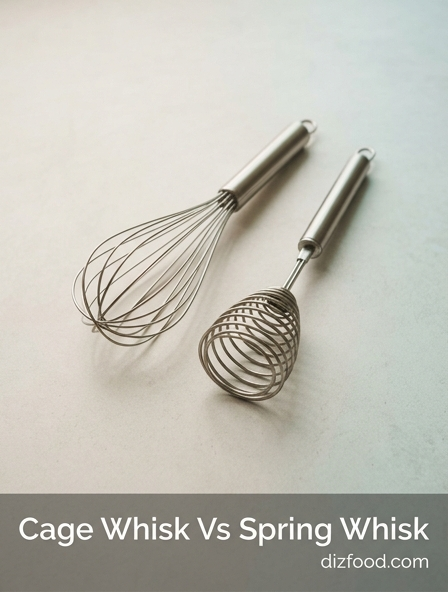
Understanding the structural differences between cage and spring whisks
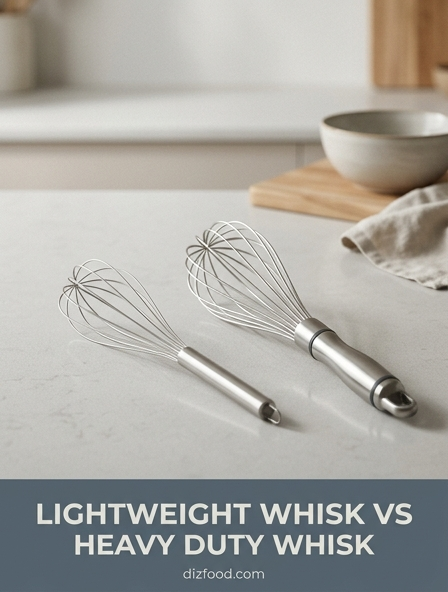
The structural integrity of a whisk defines its utility in the culinary environment. The cage whisk, most commonly recognized in its balloon or French variations, consists of several wire loops that join at a central handle. These loops are typically made of stainless steel and are arranged in a bulbous, symmetrical pattern. The design is intended to create a large internal volume where air can be trapped, while the outer wires provide multiple points of contact with the liquid. The rigidity of the wires varies; balloon whisks feature flexible, thin wires for maximum vibration, while French whisks use stiffer, thicker wires to handle denser ingredients.
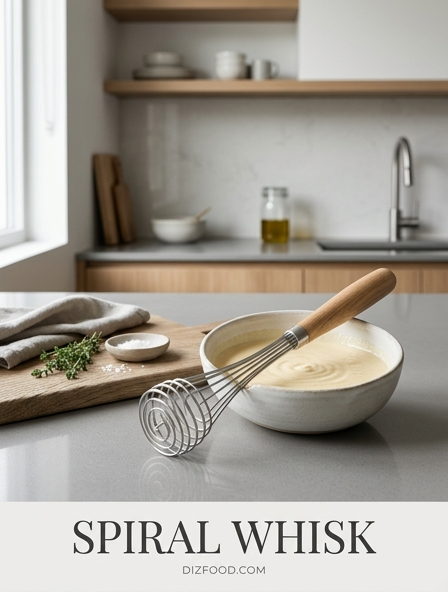
In contrast, the spring whisk, also known as a coil or spiral whisk, features a single wire that descends from the handle and terminates in a tightly wound, flat or slightly angled horizontal coil. This coil is often surrounded by a larger stabilizing wire loop. Unlike the three-dimensional volume of the cage whisk, the spring whisk is essentially a two-dimensional tool with a flexible, spring-loaded head. This allows the tool to compress and bounce against the bottom of a container. The fundamental difference lies in the direction of movement: the cage whisk is designed for circular or "figure-eight" motions in deep bowls, whereas the spring whisk is engineered for up-and-down pumping or flat scraping motions in shallow pans or narrow vessels.
| Feature | Cage Whisk | Spring Whisk |
|---|---|---|
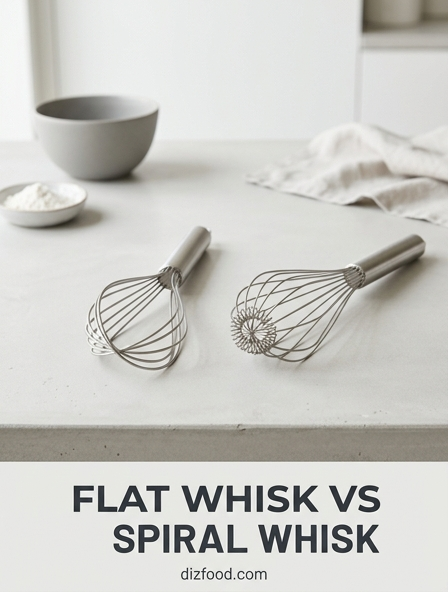
| Primary Shape | Teardrop / Bulbous | Flat Coil / Spiral |
| Wire Orientation | Vertical Loops | Horizontal Rings |
| Movement Style | Sweeping / Rotating | Pumping / Scraping |
Best applications for the traditional cage whisk design
The cage whisk remains the gold standard for tasks requiring significant volume and aeration. Because of its multi-wire construction, a single pass of a cage whisk through a liquid performs the work of several individual stirrers. This makes it the indispensable tool for whipping egg whites into stiff peaks or transforming heavy cream into fluffy peaks. The spacing between the wires allows air to be incorporated rapidly, which is essential for meringues, soufflés, and mousses. Beyond aeration, the cage whisk is excellent for dry ingredient integration. When whisking flour, baking powder, and salt, the wires act like a sifter, breaking up clumps and ensuring an even distribution of leavening agents before wet ingredients are introduced.
Furthermore, the traditional cage whisk is the preferred choice for large-batch mixing in deep bowls. Its rounded head can reach the "corners" of a mixing bowl, ensuring that no unmixed pockets of flour or sugar remain at the bottom. It is particularly effective for the following applications:
- Creating stable emulsions like mayonnaise or hollandaise in large bowls.
- Whisking thin batters, such as those for crepes or Yorkshire puddings, to ensure a lump-free consistency.
- Beating large quantities of eggs for omelets or frittatas.
- Gently folding ingredients where a spatula might be too slow but a mixer too aggressive.
- Rapidly cooling hot liquids by increasing surface area contact with the air.
The versatility of the cage whisk allows it to function as both a heavy-duty mixer and a delicate aerator, depending on the thickness of the wires and the speed of the user's wrist.
How the spring whisk excels at pan sauces and gravies
While the cage whisk struggles in shallow environments, the spring whisk is specifically designed to master the flat surface of a sauté pan or skillet. When making a pan sauce or gravy, the goal is often to incorporate a liquid-like stock or wine-into a roux or to deglaze the flavorful browned bits, known as fond, from the bottom of the pan. The flat, springy head of the coil whisk allows it to maintain constant contact with the pan's surface. As you move the whisk, the coil compresses and expands, effectively "scrubbing" the metal to ensure every bit of flavor is lifted and integrated into the sauce.
The spring whisk is also superior for preventing scorching. In a traditional gravy, flour-based thickeners can quickly clump or burn if not constantly agitated. The horizontal orientation of the spring whisk means it can reach into the sharp edges where the side of the pan meets the bottom-areas that a rounded balloon whisk would completely miss. This thorough coverage ensures a perfectly smooth texture. Additionally, the spring whisk requires less vertical clearance, making it ideal for working under low-hanging cabinets or in crowded stove environments. It excels at emulsifying butter into sauces at the final stage of cooking, providing a velvety finish without introducing excessive air, which could ruin the glossy appearance of a classic demi-glace or silk-textured gravy.
Comparing aeration capabilities for light and fluffy textures
Aeration is a mechanical process where air is trapped within a liquid matrix, and the efficiency of this process depends heavily on the tool's surface area and wire frequency. The cage whisk is structurally superior for this task. Every loop of the cage whisk creates two planes of agitation. As the whisk moves, these wires create a vacuum behind them, pulling air into the mixture. This is why a balloon whisk is used for tasks requiring significant volume increases, such as making Chantilly cream. The wide diameter of the "balloon" maximizes the amount of air incorporated with every stroke, leading to faster results and more stable foam structures.
The spring whisk, conversely, is a poor choice for high-volume aeration. Its design is focused on horizontal displacement rather than vertical air entrapment. While you can bounce a spring whisk up and down to create some bubbles-a technique often used for frothing small amounts of milk for coffee-it lacks the complex wire network needed to build the delicate protein structures required for a meringue. In a side-by-side comparison for whipping cream, a cage whisk will typically achieve stiff peaks in nearly half the time required by a spring whisk. For the home cook, the choice depends on the desired outcome:
- Use a cage whisk when the recipe calls for "light," "fluffy," or "increased volume."
- Use a spring whisk when the recipe calls for "smooth," "blended," or "emulsified" without bubbles.
Understanding this distinction prevents the common mistake of over-working a sauce with a cage whisk or failing to achieve lift with a spring whisk.
Cage whisk vs spring whisk for small batch mixing
Size and scale often dictate the best tool for the job. In the context of small-batch mixing-such as preparing a single-serving salad dressing, a cornstarch slurry, or a small amount of scrambled eggs-the cage whisk often proves too cumbersome. Most standard cage whisks are between 10 and 12 inches long with a wide head that cannot fit into a standard drinking glass, a small ramekin, or a narrow measuring cup. Attempting to use a large cage whisk in a small vessel often results in splashing or incomplete mixing because the wires cannot move freely within the confined space.
The spring whisk is the definitive winner for small-scale culinary tasks. Its slim profile and narrow head allow it to reach the very bottom of a mug or a small jar. Because the coil is flexible, it can be pressed against the walls of a small container to break up stubborn clumps of dry cocoa powder or protein supplement. It is also the preferred tool for "micro-emulsions," such as whisking a tablespoon of vinaigrette directly in a serving bowl. The spring whisk's ability to operate in as little as half an inch of liquid makes it much more efficient for these minor tasks. When kitchen space is limited, or when preparing ingredients for a single diner, the spring whisk provides a level of precision and control that the larger, more chaotic cage whisk simply cannot match. It bridges the gap between a fork and a full-sized whisk, offering professional results in a compact form factor.
Which whisk style is easier to clean and maintain
Maintenance is a critical consideration for any kitchen tool, and the design of a whisk directly impacts how easily it can be sanitized. The cage whisk presents a unique cleaning challenge: the "nexus" or the point where all the wires meet at the handle. This area frequently traps thick batters, raw egg, or dried sauce, and it can be difficult to reach even with a stiff brush. If not cleaned immediately after use, food can harden in this junction, potentially leading to bacterial growth or cross-contamination. Furthermore, the overlapping wires in the center of the cage can be tricky to scrub thoroughly, often requiring the whisk to be soaked or run through a high-pressure dishwasher cycle.
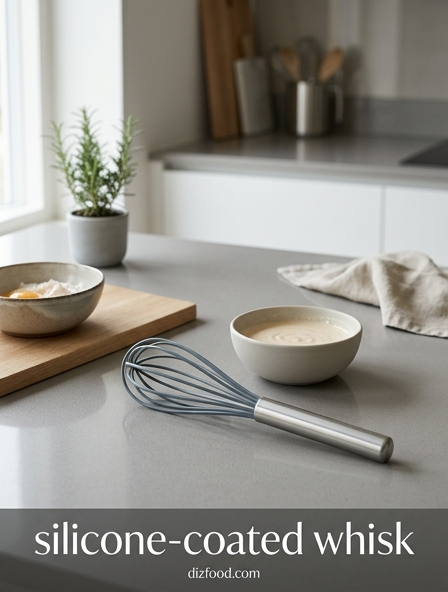
The spring whisk is generally considered easier to clean because it is more "open" in its construction. The single-coil design allows water and soap to flow freely around the wire. There are fewer overlapping points where food can hide. However, the spring whisk is not without its flaws; the tight coils can sometimes trap small particles of herbs or ground spices. To clean a spring whisk effectively, one simply needs to "pump" it in hot soapy water, using its own spring action to dislodge any stuck debris. In terms of durability, the cage whisk is more prone to losing its shape if stored in a crowded drawer, as the wires can become bent or tangled. The spring whisk, being flatter and more compact, is easier to store without damage. Most modern versions of both tools are made of dishwasher-safe stainless steel or silicone-coated wire, but the spring whisk's simpler geometry typically leads to a faster and more reliable manual cleaning experience.
Evaluating flexibility and movement in tight kitchen vessels
Flexibility is the hallmark of the spring whisk. Unlike the rigid or semi-rigid loops of a cage whisk, the coil on a spring whisk is designed to be pushed, bent, and compressed. This "active" movement is essential when working in tight kitchen vessels like graduated cylinders, narrow saucepans, or even deep jars of preserves. When you press a spring whisk against the bottom of a container, the coil flattens out, increasing the surface area and ensuring that every milliliter of liquid is agitated. This makes it incredibly effective for dissolving sugar into a heavy syrup or mixing thick honey into tea.
The cage whisk, by comparison, relies on its static volume. In a tight vessel, the cage whisk is often "choked," meaning the wires are squeezed together, which eliminates the very gaps needed for the tool to function correctly. If the vessel is narrower than the whisk's widest point, the user loses the ability to perform the necessary circular motions. This leads to "dead zones" at the bottom of the container where ingredients remain unmixed. The spring whisk avoids this by utilizing a vertical axis of movement. You can mix effectively by simply moving the handle up and down, a motion that requires zero lateral space. This makes the spring whisk the superior choice for high-walled, narrow-diameter vessels where a traditional whisking stroke is physically impossible. For the chef who frequently works with reductions or specialized extracts in small containers, the mechanical flexibility of the spring coil is an essential asset that a cage whisk cannot replicate.
The science of emulsion cage versus spring coils
An emulsion is a mixture of two liquids that are normally immiscible, such as oil and water. Creating a stable emulsion requires mechanical energy to break the dispersed phase into tiny droplets. The cage whisk achieves this through sheer wire count. As you whisk a vinaigrette, the multiple wires of a cage whisk slice through the oil, shearing it into smaller and smaller globules. The large volume of the cage whisk also helps by moving the entire body of liquid, ensuring that the emulsifying agent (like mustard or egg yolk) is constantly brought into contact with the oil droplets. This is why the cage whisk is the preferred choice for a classic, thick mayonnaise where high-shear force is necessary.
The spring whisk approaches emulsion through a different physical principle: turbulence and vibration. The coil creates a series of small vortices as it moves through the liquid. While it may not provide the same high-shear force as a multi-wire cage whisk, it is exceptionally good at "integration" emulsions. In a spring whisk, the springy motion adds a layer of vibration that can help stabilize an emulsion by ensuring the droplets stay suspended during the mixing process. However, because it lacks the multiple "blades" of the cage whisk, it is less efficient at creating the ultra-fine droplets required for a very thick, shelf-stable emulsion. The science suggests that for heavy-duty emulsification, the cage whisk's geometry is superior, whereas for light, temporary emulsions (like a quick balsamic dressing), the spring whisk's ease of use and rapid agitation are perfectly sufficient.
Choosing the right whisk for thick batters and heavy creams
When dealing with high-viscosity substances like thick pancake batter, muffin mix, or heavy pastry cream, the resistance against the whisk increases significantly. The choice of whisk here is a balance between strength and efficiency. A balloon-style cage whisk is often too flimsy for heavy batters; the thin wires may bend or even snap under the weight of the mixture. However, a "French" cage whisk, which features stiffer and more densely packed wires, is the ideal tool. It provides the mechanical strength to cut through thick flour-and-water pastes while still providing enough surface area to remove lumps quickly.
The spring whisk is generally not recommended for heavy batters. The very flexibility that makes it great for sauces becomes a liability in a thick dough. The coil will simply collapse or "load up" with dough, becoming a solid mass that is difficult to move. The spring whisk lacks the structural "skeleton" to push through a dense medium effectively. For heavy creams that are being thickened into puddings or custards, the cage whisk is again the better choice because it can handle the increasing resistance as the starches gelatinize. To help decide, consider the following table regarding viscosity and tool performance:
| Ingredient Type | Recommended Whisk | Reasoning |
|---|---|---|
| Thin Crepe Batter | Cage Whisk | High aeration and lump removal. |
| Heavy Muffin Batter | Stiff Cage (French) | Structural strength to move mass. |
| Pan Gravy / Roux | Spring Whisk | Surface contact to prevent burning. |
| Whipped Cream | Cage Whisk | Maximum air incorporation. |
Essential guide to selecting between cage and spring whisks
Selecting the right whisk is not about finding a single "best" tool, but rather about matching the tool to the specific culinary task at hand. For the well-equipped kitchen, both a cage whisk and a spring whisk are essential. The cage whisk is your "macro" tool-it is built for volume, speed, and aeration. If you are baking a cake, whipping cream for a dessert, or mixing a large bowl of salad dressing, the cage whisk's multi-wire design will save you time and physical effort. It is the workhorse of the pastry department and the primary tool for any task that involves incorporating air into liquids.
The spring whisk is your "micro" and "specialty" tool. It excels in the two areas where the cage whisk fails: flat surfaces and narrow containers. If your cooking involves frequent pan sauces, gravies, or small-batch emulsions, the spring whisk will provide a level of control and efficiency that you cannot get elsewhere. It is also the perfect "beaker whisk" for home baristas or those who mix supplements into drinks. When deciding which to use, ask yourself two questions: Is the container flat or deep? Do I want to add air or just mix thoroughly? If the answer is "deep and airy," reach for the cage whisk. If the answer is "flat and smooth," the spring whisk is your best ally. By understanding these functional boundaries, you can ensure smoother textures, better emulsions, and a more enjoyable cooking process.

Comments