
Benefits of the spring whisk design
The spring whisk, often referred to as a coil or spiral whisk, features a unique design that sets it apart from traditional kitchen implements. Its primary advantage lies in the flexible, coiled wire head that is typically set at an angle. This specific geometry allows the tool to maintain constant contact with the bottom of a pan or bowl, ensuring that no ingredients are left untouched during the mixing process. Unlike rigid whisks, the spring mechanism provides a responsive bounce, which effectively breaks up clumps of dry ingredients with minimal effort from the cook.
- Enhanced aeration through rapid vertical vibrations.
- Improved ergonomics by reducing the need for vigorous wrist rotation.
- Superior performance in shallow vessels compared to rounded whisks.
- Compact profile for easy storage in crowded utensil drawers.
The spring's ability to compress and expand also facilitates a "pumping" action. This motion is particularly useful for frothing small amounts of milk or beating a single egg in a narrow cup. Because the wire coil is tightly wound, it creates more surface area for agitation, which leads to faster results when incorporating air or combining ingredients of different densities. This makes it an indispensable tool for precision tasks in both baking and savory cooking.
How to reach every pan corner
One of the most frustrating aspects of making sauces in a straight-sided sauté pan or a shallow skillet is the buildup of scorched flour or liquid in the tight corners. Standard balloon whisks are often too bulbous to navigate these sharp angles, leaving a ring of unmixed material that can ruin the final texture of a dish. The spring whisk solves this problem through its flat, angled head. By applying slight downward pressure, the coil flattens further, spreading its reach into the very perimeter of the cookware.
To effectively reach every corner, the cook should utilize a dragging motion rather than a circular one. By pulling the whisk from the center toward the edges, the spring acts as a squeegee, lifting stuck-on bits of roux or fond. This ensures that the heat is distributed evenly across all ingredients, preventing localized burning. The flexibility of the neck allows the user to maintain an optimal angle regardless of the height of the pan walls. Consequently, the spring whisk is the preferred choice for deglazing, as it can scrape and stir simultaneously, ensuring that every bit of flavor is incorporated into the liquid base without scratching the surface of high-quality pans.
The secret to lump free gravy
Achieving a silky, lump-free gravy is a hallmark of a skilled cook, and the spring whisk is the secret weapon for this task. Lumps usually form when liquid is added too quickly to a starch base, causing the outer layer of flour particles to hydrate and trap dry pockets inside. The spring whisk combats this through its high-frequency vibration and ability to stay flat against the pan. As you add stock or milk, the coil breaks through these stubborn pockets of dry flour before they have a chance to set.
- Begin by creating a smooth roux of fat and flour.
- Add a small splash of warm liquid while whisking vigorously in a back-and-forth motion.
- Use the spring's bouncing action to flatten any visible clumps against the bottom of the pan.
- Gradually increase the liquid volume, ensuring the mixture is homogenous before each addition.
The constant contact with the pan bottom provided by the spiral head prevents the "skin" from forming at the base, which is a common cause of graininess. By using the spring whisk's unique profile, you ensure that the starch is evenly dispersed and fully hydrated, resulting in a professional-grade sauce every time.
Achieving perfect sauce emulsification
Emulsification is the process of forcing two immiscible liquids, such as oil and vinegar or butter and lemon juice, into a stable mixture. This requires significant shear force to break droplets into microscopic sizes. The spring whisk is exceptionally well-suited for this task because the tight coils act as dozens of tiny agitators. When moved rapidly, these coils create turbulence that shears fat globules much more efficiently than the thick wires of a French whisk. This is particularly vital when preparing delicate emulsions like Hollandaise or Beurre Blanc.
In these preparations, the spring whisk's ability to work in small, shallow pans is crucial, as these sauces are often made in small batches. The user can employ a rapid "side-to-side" or "up-and-down" pumping motion, which generates the necessary energy to stabilize the emulsion without over-incorporating air. This results in a sauce that is thick, glossy, and resistant to breaking. Furthermore, the whisk allows for precise temperature control, as its thin profile permits the cook to see the entire surface of the sauce, making it easier to spot the early signs of curdling or separation before they become irreversible.
Spring whisk versus balloon whisk
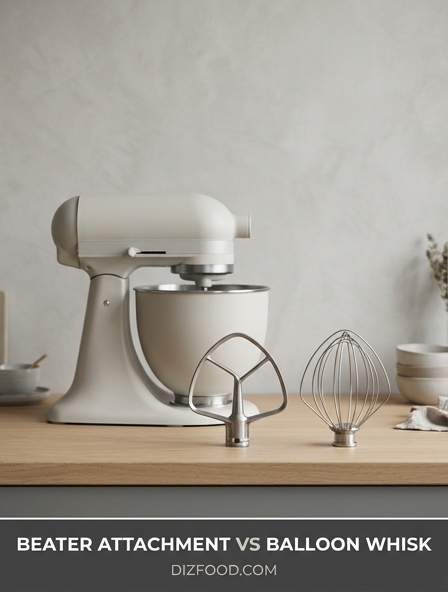
While both tools are essential in a well-equipped kitchen, they serve very different purposes based on their geometry and mechanical action. The balloon whisk is designed for volume and aeration, making it the king of whipped cream and egg whites. Its large, rounded cage is intended to trap as much air as possible in deep bowls. In contrast, the spring whisk is a tool of precision and surface contact, designed for flat or shallow environments where the goal is thorough mixing and scraping rather than fluffiness.
| Feature | Spring Whisk | Balloon Whisk |
|---|---|---|
| Best Pan Type | Shallow/Flat pans | Deep mixing bowls |
| Primary Goal | Smoothing/Emulsifying | Aerating/Volumizing |
| Motion | Up-and-down/Flat stir | Circular/Whisking |
| Corner Reach | Excellent | Poor |
The spring whisk's design allows it to navigate the flat bottom of a skillet, whereas the balloon whisk only touches the center point of the pan. This difference makes the spring whisk superior for gravies and pan sauces, while the balloon whisk remains the standard for batters and meringues.
Best cookware for flat whisking
To maximize the efficiency of a spring whisk, selecting the appropriate cookware is essential. Because the whisk is designed to work against a flat surface, sauté pans, skillets, and sauciers are the ideal vessels. A wide, flat-bottomed sauté pan allows the spring whisk to cover a large surface area quickly, which is critical when reducing liquids or thickening a roux. The low sides of these pans also accommodate the angled handle of the spring whisk, preventing the cook's hand from hitting the rim of the pan during vigorous movement.
- Stainless steel skillets: Ideal for high-heat deglazing and vigorous whisking.
- Cast iron pans: Suitable for thick gravies, provided the whisk is stainless steel.
- Non-stick pans: Require a silicone-coated spring whisk to prevent scratching the coating.
- Copper sauciers: Perfect for delicate emulsions requiring precise heat and constant motion.
It is important to match the whisk material to the pan's interior. A traditional metal spring whisk can damage non-stick surfaces, so a silicone-wrapped version should be used in those instances. However, for stainless steel or copper, the metal-on-metal contact is actually beneficial, as it helps lift the flavorful browned bits from the bottom of the pan more effectively than softer materials.
Mastering the up and down motion
The spring whisk is unique because it rewards a vertical "pumping" motion as much as a horizontal one. This up-and-down movement leverages the spring's inherent elasticity to create rapid agitation within a liquid. To master this technique, hold the whisk handle firmly and press the head against the bottom of the vessel. Push down and release in quick succession. As the coil compresses and expands, it forces liquid through the tight gaps of the wire, which is an excellent way to froth milk for coffee or to incorporate dry cocoa powder into a small amount of liquid.
This vertical action is also a powerful way to break up stubborn clumps of flour that have settled at the bottom of a pot. Instead of chasing the clumps around the pan with a circular motion, a direct downward pump can crush them instantly against the hard surface. This method is far more ergonomic than traditional whisking, as it uses the larger muscles of the arm rather than the small muscles of the wrist. For cooks with joint pain or carpal tunnel, mastering the up-and-down motion of a spring whisk can make sauce-making much more comfortable and efficient.
Essential tools for smooth roux
Creating a perfect roux is the foundation of many classic sauces, from Béchamel to Velouté. While the ingredients are simple-fat and flour-the technique requires the right tools to avoid graininess. The spring whisk is arguably the most important tool in this process. Its ability to stay in constant contact with the pan ensures that the flour is cooked evenly and doesn't scorch. However, it should be used in conjunction with other high-quality implements to ensure success across all stages of sauce development.
- Heavy-bottomed pan: Provides even heat distribution to prevent hot spots.
- Spring whisk: For initial mixing and constant agitation of the roux.
- Fine-mesh strainer: To ensure the final sauce is perfectly clear of any incidental particles.
- Measuring spoons: Precision is key for the 1:1 ratio of fat to flour.
By using the spring whisk to combine the melted fat and flour, you create a paste that is perfectly homogenous. As the roux cooks to its desired color, the whisk keeps the particles moving. When the liquid is finally introduced, the spring whisk's unique design allows for the rapid incorporation required to prevent the starch from clumping, resulting in a base that is both stable and smooth.
Tips for consistent sauce texture
Consistency in sauce making is often a matter of temperature and timing. When using a spring whisk, it is important to manage the heat of your pan carefully. Because the whisk is so efficient at mixing, it can be tempting to work at high temperatures, but this can lead to the sauce thickening too quickly or "breaking." For the best results, maintain a medium-low heat and use the whisk to keep the liquid in constant motion. This prevents a skin from forming and ensures that the heat is distributed through the entire volume of the sauce.
- Introduce liquids at room temperature or slightly warmed to avoid shocking the roux.
- Whisk in a figure-eight pattern to cover the center and the edges of the pan.
- Use the whisk to feel for resistance; a thickening sauce will push back against the spring.
- Finish the sauce with a cold pat of butter, whisking rapidly to emulsify.
The spring whisk provides excellent tactile feedback. As the sauce thickens, the resistance against the coil changes, allowing the cook to "feel" the viscosity. This sensory input is invaluable for determining exactly when to remove the pan from the heat, ensuring a consistent texture every time you cook.
Cleaning and caring for your whisk
The intricate design of the spring whisk, while excellent for cooking, can present a challenge when it comes to cleaning. Food particles, particularly thick batters or sticky sauces, can become trapped within the tight coils. To ensure the longevity of the tool and maintain hygiene, it is best to clean the whisk immediately after use. Rushing the whisk under hot water or giving it a quick "pump" in a bowl of soapy water will dislodge most residue before it has a chance to dry and harden.
For deeper cleaning, most stainless steel spring whisks are dishwasher safe. However, if you are using a silicone-coated whisk, check the manufacturer's instructions, as high heat can eventually degrade the bond between the silicone and the wire. To dry the whisk, it is effective to give it a few vigorous shakes or a quick tap against a towel to remove water trapped inside the spring. Periodic inspection of the coils is also recommended to ensure no wires have bent out of shape, which could affect the whisk's ability to sit flat against your pans. Proper storage, such as hanging on a rack or placing in a wide utensil crock, will prevent the spring from being compressed or distorted by heavier kitchen tools.

Comments