
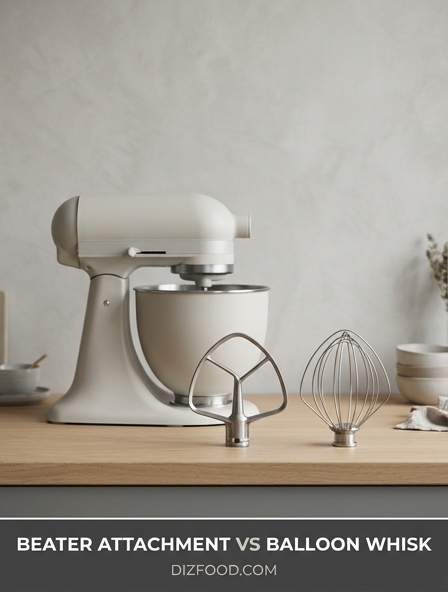
Choosing between a beater attachment and a balloon whisk is the fundamental "make or break" decision for any baker aiming for that elusive, professional-grade texture. While both are kitchen staples, they function on polar opposite mechanical principles: the flat beater is engineered to mix and cream without trapping excessive air, ensuring a dense, uniform crumb for cookies and pound cakes. In contrast, the balloon whisk uses its thin, arched wires to cut through liquids, dragging in maximum air to create the structural volume required for delicate meringues and whipped creams. Understanding this balance between aeration and emulsification allows you to manipulate your ingredients with precision, ensuring every bake achieves its intended structural integrity.
| Feature | Beater Attachment | Balloon Whisk |
|---|---|---|
| Primary Purpose | Creaming, folding, and mixing. | High-speed aeration and volume. |
| Air Incorporation | Minimal to moderate. | Maximum (structural bubbles). |
| Best Ingredients | Butter, sugar, heavy batters. | Egg whites, cream, light sauces. |
| Texture Result | Smooth, velvety, and consistent. | Light, airy, and voluminous. |
| Load Capacity | Heavy, stiff, or dense mixtures. | Liquid or very thin mixtures. |
| Speed Setting | Low to Medium-High (2-6). | High to Max (8-10). |
Key Differences Between Beater Attachments and Balloon Whisks
The primary distinction between a flat beater and a balloon whisk lies in their structural design and intended interaction with ingredients. A flat beater, often referred to as a paddle attachment, is characterized by its broad, solid frame and internal crossbars. This design is engineered to push, pull, and fold ingredients together with significant force. In contrast, a balloon whisk consists of a series of thin, flexible wires formed into a rounded, bulbous shape. These wires are designed to cut through liquids and semi-liquids rapidly, rather than pushing them as a solid mass.
| Feature | Flat Beater Attachment | Balloon Whisk Attachment |
|---|---|---|
| Primary Material | Coated metal or stainless steel | Thin stainless steel wires |
| Movement Style | Folding and scraping | Slicing and whipping |
| Main Goal | Uniformity and density control | Maximum aeration and volume |
| Ingredient Type | Thick batters and fats | Thin liquids and egg whites |
Furthermore, the physical footprint of the tools dictates their efficiency in the mixing bowl. The beater typically reaches closer to the sides and bottom of the bowl to ensure that heavy ingredients like cold butter or cream cheese are thoroughly integrated without leaving unmixed pockets. The balloon whisk, while covering a large area, relies on high-speed rotation to pull air into the mixture, making it less effective for scraping the bowl but superior for expanding the volume of light ingredients.
When to Choose a Flat Beater for Mixing
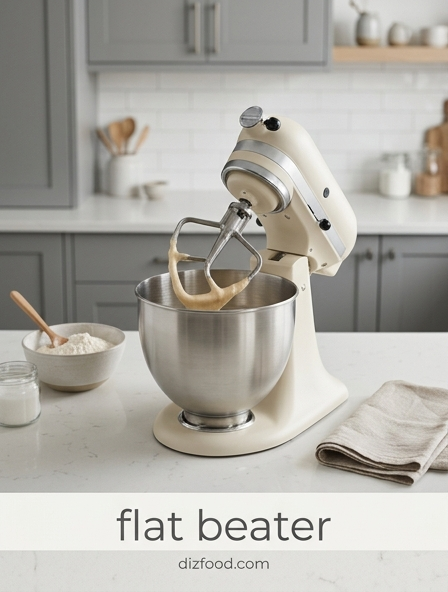
Selecting the flat beater is the standard protocol for the vast majority of baking tasks that require a uniform, medium-density consistency. The beater excels when you need to combine ingredients without incorporating an excessive amount of air, which is crucial for items that should remain tender yet structured. This attachment is the workhorse of the kitchen, designed to handle the resistance of fats and sugars being blended into a cohesive emulsion.
- Creaming Fats and Sugars: This is the most common use for a beater. It beats air into the butter and sugar to create a light, pale texture without the fragility of whipped whites.
- Mixing Cake Batters: For standard sponges and pound cakes, the beater ensures that flour is fully incorporated without overworking the gluten or adding too much air.
- Combining Cookie Doughs: Because cookie dough is thick and often contains mix-ins like chocolate chips or nuts, the beater provides the necessary torque.
- Preparing Frostings: Buttercreams and cream cheese frostings require the beater to achieve a smooth, spreadable consistency that isn't riddled with large air pockets.
You should opt for the beater whenever the recipe uses the terms "mix until combined," "cream together," or "beat until smooth." It is the ideal tool for tasks where a whisk would be too flimsy to move the mass and a dough hook would be too aggressive. Its ability to provide consistent friction makes it indispensable for achieving the "ribbon stage" in specific batters where stability is more important than sheer lift.
The Science of Aeration with Balloon Whisks
The balloon whisk operates on the principle of surface area and fluid dynamics. As the multiple wires of the whisk travel through a liquid at high speeds, they create a series of small wakes and vortices. These disturbances trap tiny pockets of air and pull them into the liquid's molecular structure. In substances like egg whites or heavy cream, proteins and fats surround these air bubbles, creating a stable foam that significantly increases the volume of the original ingredient.
When whipping egg whites, the mechanical action of the whisk wires physically denatures the proteins. These proteins uncurl and then realign to form a protective coating around the air bubbles. A balloon whisk is specifically shaped to maximize the number of wire-to-liquid contacts per rotation. The wide "balloon" shape ensures that as the whisk moves, it touches a larger cross-section of the bowl's contents, accelerating the aeration process. This is why a whisk can turn a small volume of liquid into a towering peak of foam in just a few minutes.
The efficiency of this aeration is dependent on the thickness of the wires and the speed of the mixer. Thinner wires are generally better for creating smaller, more stable bubbles, which results in a finer, more velvet-like texture. If a flat beater were used for this task, its broad surface would likely collapse the delicate air bubbles as quickly as they were formed, resulting in a flat, dense liquid rather than a light foam.
Best Uses for Beater Attachments in Baking
The versatility of the beater attachment makes it the most frequently used tool for both professional and home bakers. Its primary strength is handling ingredients that possess high viscosity or resistance. For example, when making a cheesecake, the beater is essential for breaking down the blocks of cream cheese into a perfectly smooth liquid without introducing the large air bubbles that cause the cake to crack during baking.
- Mashed Potatoes: Beyond baking, the beater is excellent for whipping boiled potatoes into a fluffy, lump-free side dish without making them gummy.
- Meatloaf and Meatballs: The paddle efficiently distributes seasonings and binders through ground meat without over-processing the proteins.
- Quick Breads: For muffins and banana breads, the beater integrates the wet and dry ingredients quickly, which helps prevent over-mixing.
- Pastry Crusts: While some prefer a pastry cutter, a beater can be used on a low setting to cut cold butter into flour for flaky pie crusts.
In many recipes, the beater is used for the "all-in-one" method, where all ingredients are placed in the bowl and mixed simultaneously. Because the beater covers so much surface area and provides substantial lateral force, it can emulsify eggs, fats, and liquids into flour much more effectively than a whisk. This ensures that the structural integrity of the baked good is preserved, as the beater manages the development of the crumb by controlling the distribution of leavening agents and moisture throughout the batter.
Achieving Fluffy Textures with a Balloon Whisk
The balloon whisk is the ultimate tool for textures that are described as "airy," "ethereal," or "cloud-like." Its ability to lift and fold air into a mixture is unparalleled by any other mixer attachment. This is particularly important for recipes that rely on mechanical leavening-where the air trapped by the whisk is the primary source of the food's rise in the oven, rather than chemical leaveners like baking powder or yeast.
To achieve the best results with a whisk, one must monitor the stages of aeration. For instance, when whipping cream, the whisk first creates soft mounds, then "soft peaks" that curl over when the whisk is lifted, and finally "stiff peaks" that stand straight up. The whisk's wires are essential here because they provide the precision needed to stop exactly at the right moment before the cream turns into butter or the egg whites become dry and grainy. This level of control is impossible with a flat beater, which would simply stir the cream rather than lofting it.
Common applications for the balloon whisk include:
- Meringues and Pavlovas: Creating the stiff, glossy peaks required for these desserts.
- Chiffon and Angel Food Cakes: Folding air into the batter to ensure the cake rises tall and stays light.
- Mousses: Incorporating air into chocolate or fruit bases for a melt-in-the-mouth sensation.
- Soufflés: The critical step of whipping whites to hold the structure of the souffle depends entirely on whisk efficiency.
Beater vs Whisk for Heavy Batters and Doughs
Understanding the mechanical limits of your attachments is vital for the longevity of your mixer and the quality of your food. When dealing with heavy batters-such as those for brownies, blondies, or dense fruitcakes-the flat beater is the mandatory choice. These mixtures provide high resistance that thin whisk wires cannot withstand. Using a balloon whisk for a thick brownie batter can result in the wires bending, warping, or even snapping out of the attachment head.
Heavy doughs, like those for bread or pizza, actually require a third tool-the dough hook-but in the absence of one, a beater is the only other acceptable option for the initial mixing phase. A whisk should never be used for any mixture that is thick enough to "climb" the attachment or stick heavily between the wires. If the batter has the consistency of wet cement, the beater's solid construction allows it to plow through the mass, ensuring that no dry flour pockets remain hidden in the center of the dough.
Furthermore, the beater is better suited for batters containing chunky ingredients. If your recipe includes nuts, dried fruits, or chocolate chunks, a whisk will likely trap these items inside its wire cage, making the mixing process inefficient and frustrating to clean. The beater's open-frame design allows these heavy inclusions to pass through and around the attachment, distributing them evenly without getting stuck or damaging the tool.
Understanding the Design and Function of Mixer Tools
The geometry of mixer attachments is rooted in the physics of agitation. The flat beater is designed with a specific taper that mimics the shape of the mixing bowl's walls. This is intentional; it allows the tool to create a "shearing" action, where ingredients are pressed between the beater and the side of the bowl. This shearing is what breaks down the crystalline structure of sugar and the solid mass of fats, facilitating a chemical bond known as an emulsion. Without this specific design, fats would simply slide around the bowl rather than integrating with other ingredients.
The balloon whisk, on the other hand, is designed for "displacement." The rounded shape ensures that it displaces as much liquid as possible with every turn. Because the wires are thin, they offer very little resistance to the liquid itself, allowing the mixer to run at much higher speeds (often settings 8 through 10) without splashing the contents out of the bowl. This high speed is necessary to generate the centrifugal force required to pull air into the center of the whisk's "balloon" and distribute it throughout the mixture.
Materials also play a role in function. Many flat beaters are coated with nylon or silicone to prevent sticking and to make them dishwasher safe. Balloon whisks are almost always polished stainless steel because the wires must remain rigid enough to hold their shape under high speed, yet flexible enough to vibrate slightly, which further aids in the breaking up of protein bonds for better aeration.
Why Your Recipe Calls for a Beater Attachment
When a recipe developer specifies a "beater" or "paddle" attachment, they are giving a command regarding the final density and texture of the product. Recipes for items like pound cakes, cookies, and quick breads rely on a specific crumb structure that is achieved by mixing, not whipping. If you were to ignore this and use a whisk, you would likely introduce too much air into the batter. While "more air" sounds positive, in a cake, it can cause the item to rise too quickly in the oven and then collapse, resulting in a rubbery or sunken center.
The beater is also called for when temperature control is important. For example, when "rubbing in" butter for scones or biscuits, the beater can quickly incorporate the fat before the heat from the friction or the room melts it. The whisk is too slow and inefficient for this, likely resulting in a warm, greasy dough rather than a cold, flaky one. Additionally, the term "beat" implies a level of force. Standard cookie recipes require the beating of eggs into the creamed butter-sugar mixture; the beater emulsifies these components into a stable saturated fat, which acts as the foundation for the cookie's spread and chew.
In summary, following the attachment recommendation is about controlling the air-to-solid ratio. The beater provides the perfect balance for structural baking, ensuring that the chemical leaveners (like baking soda) do the heavy lifting in the oven, rather than relying on fragile air bubbles created during the mixing process.
How Balloon Whisks Create Maximum Volume
Maximum volume is the hallmark of professional pastry work, and the balloon whisk is the primary engine for this result. The secret to its success is the sheer number of "cutting edges" it possesses. Each wire acts as a blade that slices through the surface tension of the liquid. When you have six to twelve wires spinning at high revolutions per minute, you are essentially performing thousands of tiny folds every second. This rapid mechanical action is the only way to achieve the 800% volume increase seen when whipping egg whites into a stiff meringue.
The "balloon" aspect of the whisk is also functional for depth. By being rounded, it can reach into the curved bottom of a standard mixing bowl, ensuring that even a single egg white can be aerated. If the whisk were flat, it would only hit the surface of small quantities. The volume is also a result of "lift." As the whisk rotates, the angle of the wires helps pull the liquid from the bottom of the bowl and toss it toward the top, exposing more of the mixture to the air at the surface.
This attachment is also vital for thinning out mixtures without losing their body. When folding a heavy base into a whipped cream (such as in a mousse), a few quick turns with the whisk can help equalize the densities before the final folding is done by hand. This prevents the final product from feeling "heavy" on the palate. Without the whisk's ability to create this initial volume, many classic French desserts would be impossible to execute.
Selecting the Proper Attachment for Perfect Results
Choosing between a beater and a whisk is the first step toward a successful bake. The general rule of thumb is to look at your ingredients and your desired outcome. If your recipe starts with solid fat (butter, shortening, cream cheese) or requires the addition of flour as a main component, the beater is almost certainly the correct choice. If your recipe starts with thin liquids (egg whites, heavy cream, aquafaba) and the goal is to make them thick and foamy, the balloon whisk is your tool.
Consider the following checklist before starting your mixer:
- Consistency: Is the batter thick like honey or stiff like clay? Use the beater. Is it watery or like milk? Use the whisk.
- Speed: Do you need to run the mixer on high speed for several minutes? Use the whisk. Does the recipe say "low to medium speed"? Use the beater.
- Goal: Are you trying to make the mixture bigger (volume)? Use the whisk. Are you trying to make the mixture smooth and uniform? Use the beater.
- Add-ins: Are there chips, nuts, or chunks? Stick with the beater to avoid clogging the whisk wires.
Using the wrong attachment is a common mistake that leads to poor texture. A whisk used on cookie dough will likely bend and fail to cream the butter, while a beater used on heavy cream will produce a dense, oily liquid that never quite reaches the fluffy peaks needed for a topping. By understanding the mechanical purpose of each tool, you ensure that every recipe achieves its intended crumb, lift, and mouthfeel.

Comments