
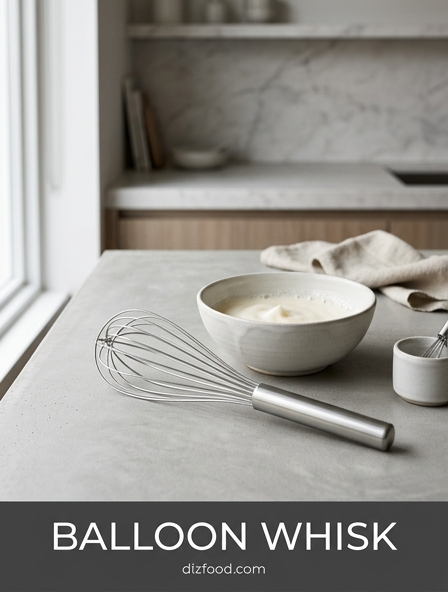
Mastering the Balloon Whisk Technique
The balloon whisk is characterized by its bulbous shape and overlapping wire loops, specifically designed to increase the volume of air in liquid mixtures. To master this tool, one must understand that the whisking action is not merely about stirring, but about creating friction and surface area contact. By utilizing the wide, rounded end of the whisk, you can effectively cut through proteins in egg whites or fats in heavy cream, stretching them into thin films that trap air bubbles. A proper grip is essential for control; hold the handle as you would a large pencil rather than gripping it with your entire palm. This allows for more nuanced movements and reduces the physical strain on the forearm during extended preparation sessions.
- Hold the whisk at a slight angle to increase surface contact.
- Use a relaxed grip to prevent early muscle fatigue.
- Focus on the bottom of the bowl to ensure no liquid remains unagitated.
- Keep the wires clean and straight for maximum air displacement.
Success with the balloon whisk depends heavily on rhythm and tempo. Starting with a deliberate, steady pace allows the initial structure of the foam to form properly before you transition into high-speed agitation. This methodical approach ensures that the resulting foam is stable and uniform throughout the entire mixture.
Selecting the Best Mixing Bowl
The relationship between the balloon whisk and the mixing bowl is fundamental to kitchen success. The curvature of the bowl should ideally match the radius of the whisk's bulbous end. A round-bottomed bowl, often referred to as a "cul-de-lampe," is superior because it eliminates corners where ingredients can hide from the whisk's wires. Material choice is equally critical, as different surfaces interact with ingredients in unique ways. For example, copper is the gold standard for egg whites due to a chemical reaction that stabilizes proteins, while stainless steel is preferred for general tasks because of its durability and non-reactive nature.
| Material | Best Use Case | Primary Benefit |
|---|---|---|
| Copper | Egg Whites | Superior foam stability |
| Stainless Steel | General Mixing | Durable and non-reactive |
| Glass | Acidic Sauces | Non-porous and visual clarity |
Avoid plastic bowls when whisking meringues, as they often retain microscopic fat residues that prevent egg whites from reaching their full volume. A deep bowl is always preferable to a wide, shallow one, as it contains the splashes during high-speed whisking and allows the balloon whisk to submerge more deeply into the mixture.
Temperature Impact on Aeration Speed
The temperature of your ingredients dictates the efficiency of the balloon whisk and the final texture of the mixture. When working with egg whites, room temperature is optimal. At roughly 70 degrees Fahrenheit, the proteins are more relaxed, allowing them to stretch more easily and encompass larger volumes of air. Conversely, when whisking heavy cream, the environment must be as cold as possible. Cold fat globules are firmer and more likely to stick together, forming a stable network that holds the air bubbles in place. If the cream is too warm, the fat may melt, leading to a collapsed or grainy texture that no amount of whisking can repair.
Professional chefs often chill both the balloon whisk and the metal mixing bowl in the freezer for ten minutes before attempting to whip cream. This ensures that the friction generated by the whisking motion does not raise the temperature of the dairy. For meringues, even a slight chill can double the time required to reach stiff peaks. Understanding these thermal requirements allows you to synchronize your whisking speed with the physical state of your ingredients, resulting in a more efficient process and a significantly more stable final product that maintains its loft over time.
The Mechanics of Incorporating Air
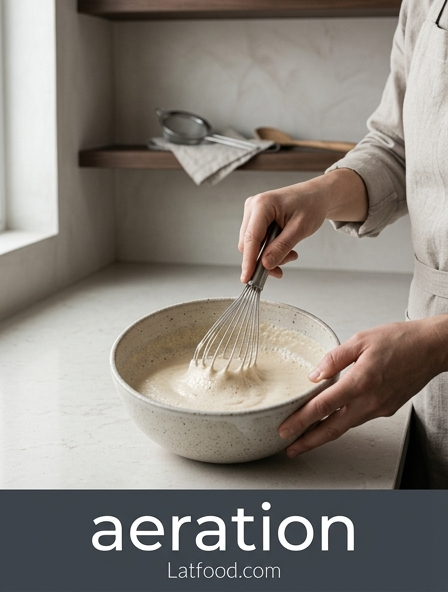
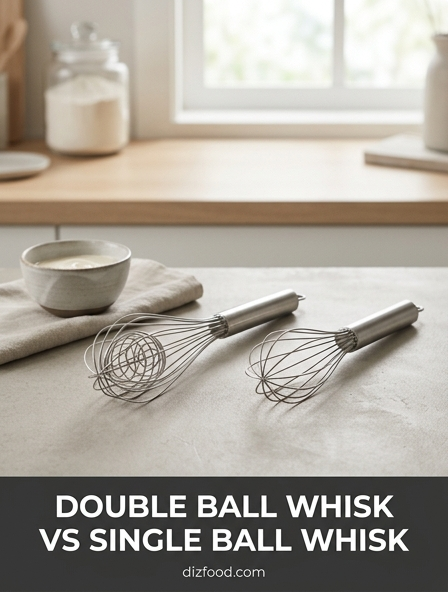
Aeration is a mechanical process where the wires of the balloon whisk act as tiny knives, slicing through the liquid to create voids that are instantly filled by air. The number of wires and their flexibility play a crucial role in this process. A whisk with many thin, flexible wires is more efficient for thin liquids like egg whites, whereas a whisk with fewer, thicker wires is better for heavy batters. As the whisk moves through the medium, it creates a vacuum effect in its wake, drawing air into the mixture. This is why the specific "balloon" shape is so effective; it maximizes the volume of the "wake" created during every stroke.
- Thin wires create smaller, more stable air bubbles.
- Wider wire spacing allows for faster movement in thick liquids.
- The bulbous tip increases the velocity of the outer wires.
- Flexible loops help reach the very edges of the mixing vessel.
When these bubbles are formed, they are coated in the proteins or fats present in the liquid. The goal of using a balloon whisk is to create a massive quantity of these tiny, uniform bubbles rather than a few large ones. Uniform bubbles create a stronger structural network, which is why a consistent whisking motion is often more important than pure speed alone.
Wrist Motion for Maximum Efficiency
Many beginners make the mistake of using their entire arm to whisk, which leads to rapid exhaustion and inconsistent results. The most efficient way to use a balloon whisk is to drive the motion entirely through the wrist. By keeping your elbow tucked close to your body and using a flicking motion, you can achieve a much higher oscillation frequency. This side-to-side motion, often called the "beating" stroke, is generally more effective than a circular stirring motion because it forces the whisk to cross the center of the bowl repeatedly, ensuring all parts of the mixture are aerated equally.
- Position your forearm parallel to the work surface.
- Hold the whisk handle lightly between the thumb and first two fingers.
- Initiate a rapid side-to-side snapping motion with the wrist.
- Rotate the bowl occasionally with your other hand to ensure even mixing.
The "figure-eight" motion is another advanced technique that maximizes air incorporation. By moving the whisk in an eight-shaped path, you create turbulence that disrupts the liquid more aggressively than a simple circle. This mechanical disruption is the key to transforming a liquid into a foam quickly and with minimal physical effort, allowing for longer whisking sessions without the need for breaks that could cause the foam to deflate.
Ensuring a Grease Free Environment
The balloon whisk is a precision tool that relies on the chemical properties of your ingredients, and nothing ruins a foam faster than a trace of fat. This is particularly true when whisking egg whites for meringues or soufflés. Fat molecules compete with protein molecules for space around the air bubbles, but they lack the ability to form a stable bond. Even a microscopic amount of oil on the whisk wires or the side of the bowl can prevent the whites from ever reaching stiff peaks. To combat this, always wash your equipment with hot, soapy water and dry it with a clean lint-free towel.
Many chefs go a step further by wiping the bowl and the balloon whisk with a piece of lemon or a cloth soaked in white vinegar. The acid removes any lingering grease and provides a slightly acidic environment that actually helps stabilize the egg proteins. It is also vital to be meticulous when separating eggs; even a single drop of yolk, which is high in fat, will compromise the entire batch. If you encounter a stubborn residue on your whisk, a quick soak in a mixture of baking soda and water can help strip away organic buildup that standard dish soap might miss, ensuring that every wire is perfectly primed for aeration.
Stabilizing Your Meringues and Creams
While the mechanical action of the balloon whisk creates the foam, chemical stabilizers help it stay that way. When whisking with a balloon whisk, timing the addition of stabilizers is crucial. For egg whites, adding an acid like cream of tartar or lemon juice early in the process helps the proteins uncoil and bond more effectively. For whipped cream, stabilizers like confectioners' sugar (which contains cornstarch) or a small amount of gelatin can prevent the cream from weeping or losing its shape when stored in the refrigerator. The whisking process itself should be gradual to allow these stabilizers to integrate fully.
- Add acids at the foamy stage to strengthen protein bonds.
- Incorporate sugar slowly after soft peaks have formed.
- Use chilled bowls to maintain the integrity of dairy fats.
- Avoid over-whisking once stabilizers are added to prevent graininess.
Sugar is the most common stabilizer, but it is also heavy. If added too early, it can weigh down the air bubbles before they have formed a strong enough network to support the weight. By waiting until the balloon whisk has already created a voluminous foam, you ensure that the sugar dissolves into the moisture of the foam, creating a glossy, stable matrix that resists collapsing even under heat or during folding.
Visual Guide to Perfect Peaks
Knowing when to stop whisking is just as important as the whisking itself. The balloon whisk acts as a gauge for the consistency of your mixture. By lifting the whisk out of the bowl and observing how the mixture behaves, you can determine exactly which stage of aeration you have reached. This is critical for recipes that require specific textures, such as "soft peaks" for mousses or "stiff peaks" for pavlovas. Over-whisking can lead to the protein bonds tightening too much, squeezing out the water and turning your smooth foam into a curdled, dry mess.
| Stage | Visual Description | Best Application |
|---|---|---|
| Soft Peak | Tips curl over when whisk is lifted. | Mousses and light sauces. |
| Firm Peak | Tips hold shape but are slightly flexible. | Cakes and standard meringues. |
| Stiff Peak | Tips stand straight up and look glossy. | Piping and structural meringues. |
If the mixture begins to look grainy or loses its gloss, you have likely over-agitated the proteins. At this point, the structural integrity is compromised. Monitoring these visual cues throughout the process ensures that you maximize the utility of the balloon whisk without pushing the ingredients past their physical limits.
Consistent Speed for Structural Integrity
The temptation to whisk at maximum speed from the beginning is high, but consistency is the secret to a long-lasting foam. Starting at a medium-low speed with your balloon whisk allows for the creation of small, uniform air bubbles. These small bubbles act like the bricks in a wall; the more uniform they are, the stronger the wall will be. If you start too fast, you create large, irregular bubbles that are prone to popping. Once a base of fine bubbles is established, you can gradually increase your speed to build volume and achieve the desired peak consistency.
A consistent rhythm also helps in maintaining control over the mixture's temperature and development. Rapid, erratic movements can introduce too much heat through friction or cause uneven aeration, where the top of the bowl is fluffy but the bottom remains liquid. By maintaining a steady, rhythmic cadence, you ensure that every rotation of the balloon whisk contributes to a cohesive structure. This structural integrity is what allows a soufflé to rise evenly in the oven or a whipped cream to hold its shape on a warm dessert. Mastery of speed modulation is what separates a professional result from a collapsed failure.
Maintaining Lightness in Final Mixtures
After the balloon whisk has done its job of creating a voluminous foam, the final challenge is incorporating it into heavier ingredients without losing the air you worked so hard to trap. While a balloon whisk is primarily for aeration, it can also be used as a delicate folding tool. Its thin wires can cut through a heavy batter and lift it over the foam with less resistance than a flat spatula. This "cutting and folding" motion is essential for maintaining the lightness of the mixture, especially in recipes like sponge cakes or chiffons where the air in the egg whites provides the only leavening.
- Add a small portion of foam to the heavy base to lighten it.
- Place the remaining foam on top of the base.
- Cut through the center with the whisk and lift from the bottom.
- Rotate the bowl and repeat until just barely combined.
The goal is to stop the moment no streaks of white remain. Every additional stroke with the whisk at this stage will deflate a portion of the air bubbles. By treating the balloon whisk as a precision instrument during the folding phase, you preserve the maximum possible volume, ensuring that your final baked goods or chilled desserts have the ethereal, light texture that characterizes professional-grade culinary work.

Comments