
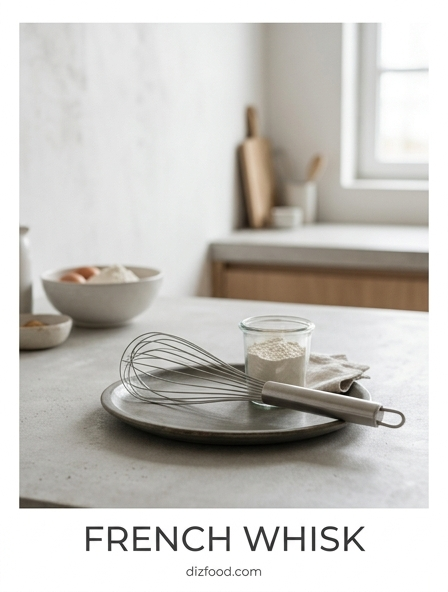
The Anatomy of a French Whisk
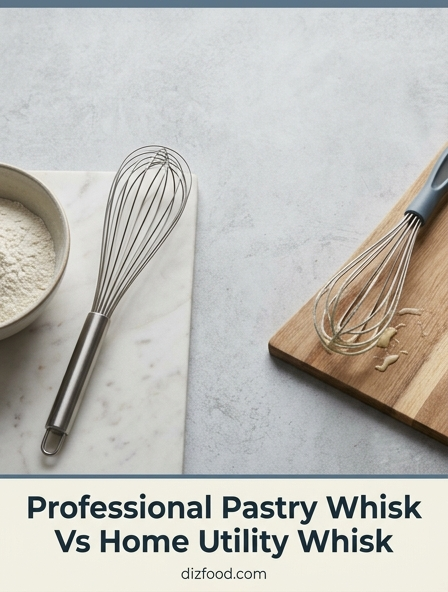
The French whisk is a masterclass in functional design, characterized by its elongated, narrow profile and stiff wire construction. Unlike its bulbous counterparts, this tool features a series of loops that are pulled tight into a tapered shape, allowing it to navigate confined spaces with ease. The wires are typically forged from high-gauge stainless steel to ensure durability and resistance to the high acidity found in many sauces. The handle is often weighted to provide a counterbalance to the repetitive motion of the wrist, facilitating extended use without significant fatigue.
- Wire Loops: Closely spaced and stiff, designed for heavy mixing rather than aeration.
- Collar: The reinforced point where wires meet the handle, ensuring structural integrity under pressure.
- Tapered Tip: A narrow end designed to reach the crevices of saucepans and small mixing bowls.
- Handle Grip: Often sealed with epoxy or silicone to prevent moisture from entering the base.
The structural rigidity of the French whisk allows it to cut through thick batters and viscous sauces where more flexible whisks might buckle. This anatomy is specifically optimized for liquid-to-liquid integration and the breakdown of stubborn lumps in flour-based mixtures.
Precision Agitation for Silky Emulsions
Achieving a silky emulsion requires the systematic breakdown of fat droplets into a continuous liquid phase. The French whisk excels at this by providing high-intensity agitation within a localized area. Because the wires are more numerous and positioned closer together than those on a balloon whisk, they create multiple shear points during every rotation. This mechanical action is vital when incorporating cold butter into a reduction or slowly drizzling oil into an egg yolk base. The lack of air-incorporating volume is a deliberate feature, as excessive bubbles can often compromise the structural integrity and mouthfeel of a delicate emulsion.
When using this tool, the chef applies a rapid side-to-side motion rather than a circular one. This technique maximizes the impact of the stiff wires against the liquid, ensuring that the oil and water phases are forced into a stable bond. The result is a sauce with a dense, glossy finish that reflects light evenly. By prioritizing precision over volume, the French whisk ensures that every gram of fat is perfectly suspended, preventing the dreaded separation that often plagues lazily mixed vinaigrettes and complex sauces.
French Whisk vs Balloon Whisk Performance
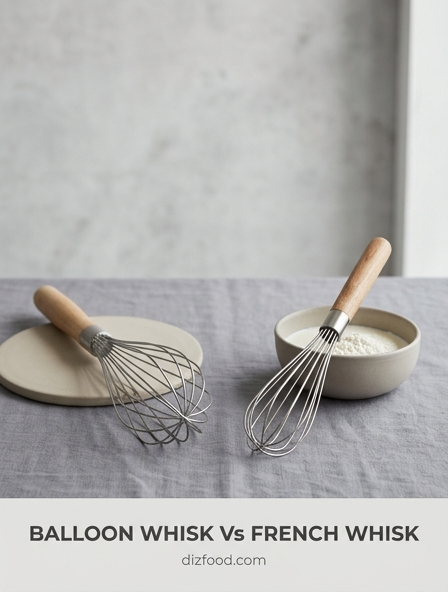
Understanding the performance differences between whisk types is essential for selecting the correct tool for specific culinary tasks. While both are used for mixing, their aerodynamic and mechanical properties differ significantly. The balloon whisk is designed for aeration, featuring a wide, rounded shape that traps air to create volume in egg whites and heavy creams. In contrast, the French whisk is designed for density and thorough integration of heavy ingredients.
| Feature | French Whisk | Balloon Whisk |
|---|---|---|
| Primary Function | Emulsifying and smoothing | Aerating and whipping |
| Wire Tension | High/Stiff | Low/Flexible |
| Ideal Cookware | Narrow pans and pots | Wide mixing bowls |
| Common Usage | Bechamel, Gravies | Meringues, Whipped Cream |
The French whisk's stiffness allows for better control when working with thick roux or heavy custards. It provides the necessary resistance to scrape the bottom of a pan effectively, preventing scorching while ensuring a homogeneous mixture that a balloon whisk simply cannot achieve in a high-heat environment.
Optimizing Control in Narrow Cookware
Cooking in a high-pressure kitchen environment often requires the use of specialized vessels like sauciers, small pots, and narrow bain-maries. In these environments, space is at a premium and a standard wide whisk becomes a hindrance rather than a help. The French whisk is specifically engineered to solve this problem. Its narrow profile allows the cook to maintain a full range of motion even when the whisk is submerged deep within a tall, narrow container. This maneuverability is critical when creating mother sauces that require constant stirring over low heat.
The ergonomic advantage of the French whisk lies in its ability to be held like a pencil or gripped firmly in the palm, depending on the required torque. Because it does not flare out, it avoids clashing with the sides of the pan, reducing splatter and ensuring that the force is directed entirely into the sauce. This level of control is indispensable for professional chefs who must manage multiple components on a crowded rangetop. It allows for a clean, efficient workflow where the tool conforms to the cookware rather than forcing the chef to adapt their technique to a bulky implement.
Mastering Stable Oil and Water Bonds
The creation of a stable emulsion is a fundamental skill in French cuisine, and the French whisk is the primary instrument for this task. The challenge of bonding oil and water lies in their natural tendency to repel one another. To overcome this, the French whisk uses its dense wire configuration to physically shear the oil into microscopic droplets. When these droplets are sufficiently small, they can be effectively coated by emulsifiers like mustard or lecithin, preventing them from coalescing back into a separate layer.
- Begin with the continuous phase (water or vinegar) in a stable bowl.
- Add your emulsifying agent and whisk vigorously to disperse.
- Drizzle the oil in a thin, steady stream while maintaining rapid lateral whisking.
- Observe the thickening of the liquid as the droplets are suspended.
- Continue whisking for thirty seconds after the oil is added to ensure total stability.
This process requires a tool that can provide consistent, high-speed impact without introducing too much air, which would weaken the emulsion. The French whisk's narrow design ensures that the energy is focused exactly where the oil meets the base liquid, resulting in a robust and velvety sauce that holds its form for extended periods.
Why Wire Density Matters for Sauces
The effectiveness of a French whisk is largely determined by the density of its wires. Unlike a balloon whisk, which may only have six to eight flexible wires, a professional French whisk often features a dozen or more stiff, tightly packed loops. This density is not merely for durability; it serves a specific mechanical purpose in fluid dynamics. Each wire acts as a cutting edge, slicing through the viscosity of the sauce to break down clumps of flour, fat, or starch. This is particularly important when whisking a roux into milk for a Béchamel sauce.
High wire density increases the frequency of contact between the whisk and the ingredients per stroke. This means that a chef can achieve a smooth consistency in half the time compared to using a less dense tool. Furthermore, the resistance provided by the dense wires allows the user to feel the texture of the sauce through the handle. This tactile feedback is essential for determining when a sauce has reached the proper "nappe" consistency. By providing more surface area and more cutting points, the dense wire configuration ensures that no particle of flour remains unhydrated, leading to a flawlessly smooth culinary result.
High Speed Liquid Integration Techniques
Speed is a critical factor when integrating liquids of varying densities, such as pouring heavy cream into a simmering reduction. The French whisk is designed for high-frequency movement, which is best achieved through a flicking motion of the wrist rather than the entire arm. This technique allows the whisk to oscillate rapidly within the liquid, creating a localized vortex that draws new ingredients into the center of the agitation zone. Because the whisk is narrow, the resistance against the liquid is minimized, allowing for much higher speeds than could be achieved with a broader tool.
To master high-speed integration, the cook should maintain a relaxed grip on the handle, allowing the weight of the whisk to do some of the work. The focus should be on short, sharp strokes that cross the diameter of the pot. This rapid action prevents "hot spots" where ingredients might sit too long against the bottom of the pan and scorch. Whether finishing a pan sauce with a splash of wine or tempering eggs for a custard, the high-speed capability of the French whisk ensures that the integration is instantaneous and thorough, preventing unwanted curdling or uneven flavor distribution.
Reaching Every Corner of the Pan
One of the most common failures in sauce making is the buildup of scorched residue in the "corner" of the pan-the junction where the wall meets the base. A standard rounded whisk often misses this area, leading to burnt flavors that can ruin an entire batch. The tapered, narrow tip of the French whisk is specifically designed to address this vulnerability. By angling the whisk slightly, the chef can drive the stiff wires directly into the corner, ensuring that every millimeter of the pan surface is agitated and cleared of sticking solids.
This capability is especially vital when deglazing a pan after searing meat. The fond, or browned bits of protein, must be scraped up and incorporated into the liquid to build depth of flavor. The French whisk acts as both a stirring tool and a scraper, providing enough rigidity to lift the fond while simultaneously whisking it into the deglazing liquid. In a flat-bottomed saucepan, the French whisk's ability to remain in constant contact with the base ensures a more even heat distribution across the sauce, as the entire volume is kept in motion, preventing any localized overheating or protein coagulation.
Achieving Consistent Texture in Small Batches
While large batches of sauce can sometimes be managed with larger tools, small batches-such as a single portion of hollandaise or a concentrated balsamic glaze-require the delicacy of a French whisk. In a small vessel, a large balloon whisk would displace too much of the liquid, making it difficult to maintain contact with the ingredients. The slim profile of the French whisk allows it to stay submerged even in very shallow amounts of liquid, ensuring that even a few tablespoons of sauce receive the same level of professional agitation as a gallon-sized pot.
The precision afforded by the French whisk in small batches also reduces waste. Because it does not trap as much sauce within its wires as a larger whisk, more of the product ends up on the plate rather than in the sink. For home cooks and professional garde mangers alike, the ability to emulsify a tiny amount of vinaigrette directly in a small ramekin or glass is a significant advantage. This consistency in texture, regardless of batch size, is what separates high-level culinary execution from amateur efforts, ensuring that every component of a dish is refined to the highest possible standard.
Maintaining Emulsion Stability Under Heat
Temperature management is the most difficult aspect of maintaining a stable emulsion. Heat causes molecules to move faster, which can lead to the "breaking" of a sauce as the fat droplets expand and escape their watery suspension. The French whisk is an essential tool for preventing this failure during the cooking process. Continuous, gentle whisking over a heat source ensures that the temperature remains uniform throughout the sauce, preventing the bottom from becoming significantly hotter than the surface. This constant movement is what allows a delicate Beurre Blanc to stay emulsified even as it is held at serving temperature.
- Thermal Uniformity: Consistent stirring prevents hot spots that break chemical bonds.
- Mechanical Reinforcement: Ongoing agitation keeps droplets dispersed against the force of thermal expansion.
- Rapid Cooling: If a sauce begins to break, the whisk can be used to quickly incorporate a splash of cold liquid to reset the temperature.
By using a French whisk, the chef has the best possible chance of keeping a temperamental sauce together. Its ability to work close to the heat source while providing high-shear agitation makes it the definitive choice for any sauce that must be cooked and emulsified simultaneously.


Comments