
Achieving that elusive golden-brown finish often sparks a debate between traditional precision and modern automation: the classic countdown timer versus advanced sensory browning. While a countdown timer provides a reliable, manual framework for experienced cooks who prefer total control over their kitchen environment, sensory browning technology eliminates the guesswork by using internal heat and light sensors to monitor the food's actual surface transformation. If you are aiming for the perfect result, choosing between these two depends on whether you value the "set-and-forget" convenience of smart sensors that prevent burning or the rhythmic predictability of a ticking clock that rewards culinary intuition.
| Feature | Countdown Timer | Sensory Browning |
|---|---|---|
| Mechanism | Fixed duration; independent of food state. | Real-time monitoring of surface color/heat. |
| Accuracy | Estimated; prone to external variables. | Dynamic; adjusts for moisture and thickness. |
| Skill Level | High; requires knowledge of cook times. | Low; ideal for "one-touch" automation. |
| Overcooking Risk | Moderate (requires manual intervention). | Minimal (auto-stops at desired hue). |
| Best For | Batch cooking and standard recipes. | Toast, delicate pastries, and frozen foods. |
| Core Value | Total manual user authority. | Consistent results regardless of starting temp. |
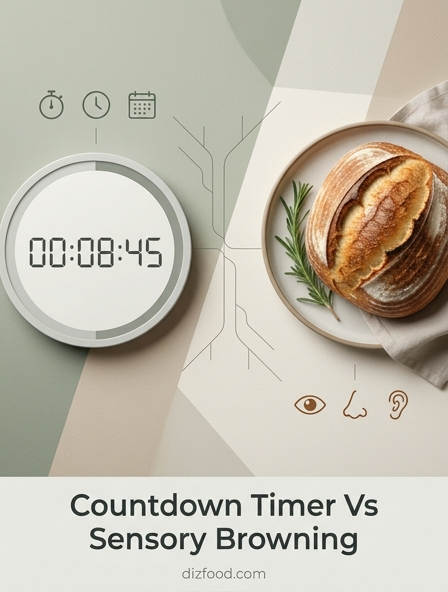
The Evolution of Kitchen Precision: Countdown Timers Explained
The journey of kitchen precision began with the humble mechanical countdown timer, a device that revolutionized how home cooks managed their time. Before the integration of digital chips, cooks relied on spring-loaded dials that provided a tactile and audible ticking, signaling a linear progression toward a finished meal. This method established the fundamental "time and temperature" rule of cooking, where the duration of heat exposure was the primary metric for success. As technology advanced, these mechanical tools evolved into digital displays integrated directly into ovens and microwaves, offering second-by-second accuracy.
Despite their precision in tracking time, countdown timers are essentially "blind" instruments. They operate on the assumption that external conditions are constant and that the food inside the appliance will behave exactly as predicted by a recipe. This reliance on duration over physical state remains a staple of the modern kitchen due to its simplicity and cost-effectiveness. However, the shift from mechanical to digital timers marked only the first phase of kitchen evolution, setting the stage for more complex feedback systems.
- Mechanical Timers: Relied on physical springs and gears.
- Digital Timers: Introduced quartz-crystal accuracy and multi-tasking capabilities.
- Integrated Systems: Linked the timer directly to the heating element's power state.
- Programmable Logic: Allowed for delayed starts and complex multi-stage cooking cycles.
The Art of Perfection: Understanding Sensory Browning Technology
Sensory browning technology represents a paradigm shift from temporal cooking to state-based cooking. Instead of asking "how long has this been cooking," sensory systems ask "what does the food look like right now?" This technology utilizes a sophisticated array of sensors, including infrared thermopiles and optical sensors, to monitor the surface of the food in real-time. By detecting the specific wavelengths of light reflected off a crust or the rate of moisture evaporation from the surface, the appliance can determine the exact level of caramelization without any human intervention.
The "art" of this technology lies in its ability to mimic the watchful eye of a professional chef. While a timer will continue to count down even if a steak is burning, a sensory browning system adjusts the heat intensity or terminates the cycle the moment the desired golden-brown hue is achieved. This is particularly useful in appliances like smart toasters and convection ovens, where the difference between a perfect crust and a charred surface is a matter of seconds. The technology effectively removes the guesswork associated with varying thicknesses, initial temperatures, and moisture levels in different food items.
Consistency vs Quality: Comparing Timer and Sensor Cooking
When comparing traditional timers to sensory technology, the debate often centers on the difference between consistency of process and quality of result. A countdown timer provides high process consistency; it will perform the exact same action every time it is set. However, because the starting state of food varies-such as a piece of bread being slightly more frozen or a chicken breast being thicker than usual-the quality of the output varies wildly. Sensory browning, conversely, prioritizes the quality of the end result by adapting the process to the specific needs of the item being cooked.
For high-volume kitchens or repetitive tasks, timers offer a level of predictability that is easy to manage. However, for the home cook seeking gourmet results, sensors provide a safety net that accounts for environmental variables. The following table highlights the core differences between these two methodologies:
| Feature | Countdown Timer | Sensory Browning |
|---|---|---|
| Primary Metric | Duration (Minutes/Seconds) | Surface Texture/Color |
| Adaptability | Zero; remains fixed | High; adjusts to food state |
| User Input | Required (Manual setting) | Minimal (Pre-set profiles) |
| Risk of Overcooking | High if settings are incorrect | Low due to real-time feedback |
| Ideal Application | Boiling eggs, baking cakes | Toasting, searing, roasting |
The Science of the Maillard Reaction in Sensory Browning
The Maillard reaction is the chemical cornerstone of savory cooking, occurring when heat causes a reaction between amino acids and reducing sugars. This process creates hundreds of different flavor compounds and responsible for the browning of meat and bread. Sensory browning technology is specifically engineered to detect the onset and progression of this reaction. Advanced optical sensors are calibrated to recognize the specific color spectrum associated with the Maillard effect, distinguishing between a pale tan, a rich golden brown, and the dark carbonization of burning.
From a scientific perspective, sensory systems often monitor "delta values" in color intensity. As the food undergoes the Maillard reaction, its reflectance properties change. The sensors pick up these shifts in the electromagnetic spectrum, feeding data into an algorithm that calculates the rate of browning. This allows the appliance to modulate power output-reducing heat as the food approaches the target color to prevent overshooting the chemical "sweet spot." Unlike a timer, which ignores chemistry, sensory systems are fundamentally rooted in the molecular transformation of food, ensuring that the flavor profile developed is as rich as possible without turning bitter.
Why Fixed Timers Often Lead to Overcooked Food
The primary flaw of the fixed timer is its inability to account for the "Initial State Variable." In a kitchen environment, several factors can render a standard cooking time obsolete. If a kitchen is particularly cold, an oven may take longer to recover its temperature after the door is opened. If a piece of meat has a higher fat content, it may cook faster than a leaner cut. Because a countdown timer is a linear, non-responsive tool, it cannot compensate for these fluctuations, leading to food that is frequently overcooked or unevenly finished.
- Variable Moisture Content: High moisture requires more energy to evaporate before browning can begin.
- Starting Temperature: Food straight from the refrigerator vs. room temperature changes the thermal curve.
- Ambient Humidity: High humidity in the oven can stall the browning process, making a standard timer inaccurate.
- Voltage Fluctuations: Minor drops in power can cause heating elements to run cooler than expected.
- Item Density: Larger batches of food absorb more heat, slowing down the cooking time for individual pieces.
By failing to recognize these five factors, fixed timers essentially "guess" the finish line. This often results in the user adding "just two more minutes," which is the most common cause of kitchen errors and ruined meals.
Smart Kitchen Features: How Sensory Browning Outperforms Clocks
The modern smart kitchen is defined by its move toward autonomy and intelligence. Sensory browning is the centerpiece of this movement, outperforming traditional clocks by integrating artificial intelligence with physical hardware. While a clock requires a human to know the correct time for a specific dish, a smart sensor-equipped appliance can identify the dish and determine the finish line on its own. This reduces the cognitive load on the cook, allowing them to focus on preparation rather than constant monitoring.
Furthermore, sensory systems provide superior integration with mobile applications and notifications. Instead of a simple "ding" when a timer expires, a sensory-driven oven can send a notification stating that the "Chicken has reached the optimal golden-brown crust." This contextual information is far more valuable than a time-based alert. It also allows for sophisticated features like "Keep Warm" modes that trigger precisely when the browning is complete, ensuring the food does not lose its textural integrity while waiting to be served. This level of precision is simply impossible with a standard clock mechanism.
Achieving the Perfect Golden Crust with Sensory Detection
The quest for the perfect golden crust is a matter of managing the balance between internal doneness and external crispness. Sensory detection excels here by focusing on the surface physics of the food. In many high-end toasters and air fryers, light-emitting diodes (LEDs) bounce light off the food surface. As the surface changes from white or pale to brown, the amount of light reflected back to the sensor changes. The system uses this feedback loop to ensure the crust reaches a specific level of "Giallo" or golden hue every single time.
- Uniformity: Sensors can detect if one side is browning faster and suggest rotation or adjust directional heat.
- Texture Retention: By stopping exactly at the peak of browning, the crust remains crisp rather than becoming hard or leathery.
- Visual Feedback: Many modern sensors provide a visual "progress bar" based on actual color rather than time remaining.
- User Customization: Users can select specific "shades" on a digital interface, which the sensor then targets with mathematical precision.
This level of control ensures that even difficult items, like gluten-free breads or sugar-heavy pastries, achieve a professional-grade finish without the risk of flash-burning that comes with high-heat timer settings.
Modern Cooking Dilemma: Set It and Forget It vs Real Time Feedback
The "set it and forget it" mentality was popularized by mid-century slow cookers and early microwaves, placing a premium on convenience over culinary nuance. However, the modern cooking dilemma arises when this convenience leads to mediocre results. A countdown timer encourages a passive approach where the cook disengages from the process. While this saves effort, it often results in a loss of control. Real-time feedback provided by sensory browning technology offers a middle ground: it provides the convenience of automation but maintains the precision of active monitoring.
The choice between these two methods often depends on the complexity of the dish. For a simple task like boiling pasta, a timer is more than sufficient. However, for a complex roast or a delicate pastry, real-time feedback is indispensable. The dilemma for consumers is whether to invest in the more expensive sensory hardware. As the technology becomes more accessible, the trend is shifting toward sensory systems because they offer a higher "success rate" for novice cooks, effectively bridging the gap between an amateur home cook and a seasoned professional.
The Technical Difference Between Time Based and Texture Based Cooking
Technically, time-based cooking is an "Open-Loop" system. In an open-loop system, the input (time) is independent of the output (the state of the food). The machine does not check if the food is cooked; it simply stops when the clock hits zero. Texture-based cooking, powered by sensory browning, is a "Closed-Loop" system. In this model, the output is constantly monitored and fed back into the controller to adjust the input. If the sensor detects that browning is occurring too slowly, it can signal the heating element to increase intensity.
| Logic Type | Methodology | Sensor Input |
|---|---|---|
| Open-Loop | Linear, predefined path | None (Clock only) |
| Closed-Loop | Dynamic, adaptive path | Optical, IR, Humidity |
| Result | Predicted outcome | Verified outcome |
This technical distinction is what allows sensory systems to handle "chaos variables" in the kitchen. For example, if the oven door is opened, a closed-loop system detects the heat loss and the stall in browning, subsequently extending the cook time automatically. An open-loop timer would simply continue counting down, leaving the food under-browned and undercooked.
Enhancing Flavor Profiles Using Advanced Sensory Browning Systems
Flavor is the ultimate goal of any culinary endeavor, and sensory browning systems are uniquely positioned to enhance it. By controlling the Maillard reaction with precision, these systems ensure that the food spends the maximum amount of time in the "flavor development zone" without crossing into the "bitter/burnt zone." When food is overcooked by a timer, the volatile aromatic compounds that give food its smell and taste are often destroyed by excessive heat. Sensory systems prevent this by tapering off the energy as the food reaches its peak aromatic state.
Advanced systems can even differentiate between different types of browning. For example, the caramelization of sugars in a fruit tart requires a different temperature curve than the searing of a protein. High-end sensory arrays can be programmed with "flavor profiles" that prioritize moisture retention alongside surface browning. This results in meat that is succulent on the inside while possessing a robust, flavorful crust on the outside. By prioritizing the chemical and physical state of the food over the ticking of a clock, these systems elevate the nutritional and sensory quality of every meal produced.

Comments