
Deciding between infrared and conventional heating is more than just a kitchen upgrade; it's about mastering efficiency and precision in your daily cooking. While conventional stovetops rely on thermal conduction-heating a coil or flame that then warms your pan-infrared technology uses electromagnetic radiation to transfer heat directly to your cookware with incredible speed. This means you spend less time waiting for water to boil and more time enjoying perfectly seared meals, all while significantly reducing ambient heat loss in your kitchen. Whether you prioritize the rapid response and energy savings of infrared or the familiar, steady reliability of traditional gas and electric ranges, understanding how these methods impact your energy bills and cook times is key to choosing the best fit for your culinary style.
| Feature | Infrared Heating | Conventional (Gas/Electric) |
|---|---|---|
| Heat Transfer | Direct electromagnetic radiation | Thermal conduction/convection |
| Preheat Speed | Instantaneous; reaches max temp in seconds | Slow; requires 5-10 mins to stabilize |
| Energy Efficiency | High (~80% efficiency); minimal heat loss | Lower (~50-65%); heats surrounding air |
| Temperature Control | Precise, digital, and rapid adjustments | Manual dial; slow response to changes |
| Cookware Needs | Requires flat-bottomed pots/pans | Universal; works with all materials/shapes |
| Safety Profile | Cool-to-touch surface; no open flames | High residual heat; fire/gas leak risks |
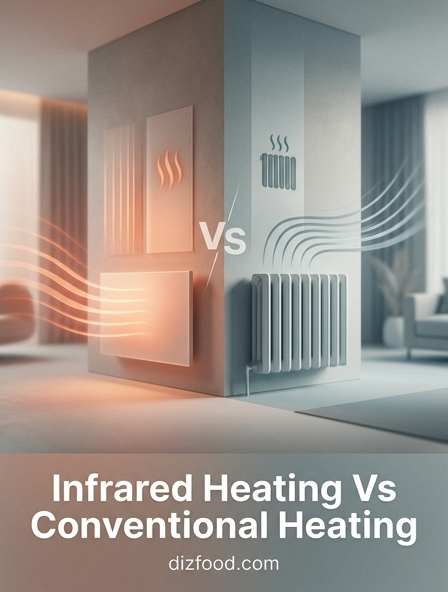
Understanding the Science of Radiant vs Convection Heat
In the culinary environment, the method by which heat is distributed significantly alters both comfort and air quality. Conventional heating relies primarily on convection. This process involves warming the air around a radiator or baseboard heater. As the air heats up, it becomes less dense and rises toward the ceiling, pushing cooler air down to be heated in a continuous cycle. In a kitchen, this often creates a stratified environment where the floor remains cold while the area near the ceiling is unnecessarily warm. Furthermore, convection currents can circulate airborne grease, dust, and flour particles throughout the cooking space.
Infrared heating operates through radiant science, mimicking the way the sun warms the earth. Instead of using the air as a medium, infrared waves travel through the room until they strike a solid object, such as a kitchen island, a tiled floor, or a person. These objects absorb the energy and then slowly release it back into the room. This creates a much more uniform temperature profile. Because radiant heat does not depend on air movement, it is not affected by drafts or the operation of high-powered kitchen extractor fans, which typically suck warm air out of a convection-heated room. The science of radiant heat ensures that the thermal mass of the kitchen itself becomes a secondary heat source, providing a steady and pervasive warmth that feels more natural than the dry, moving air produced by legacy systems.
Energy Efficiency Comparison Infrared vs Traditional Radiators
Energy efficiency in the kitchen is often measured by how quickly a system can reach a desired temperature and how well it maintains that level against heat loss. Traditional water-based radiators require a significant "warm-up" period, as the boiler must heat a large volume of water and circulate it through pipes before the room feels the effect. This lead time often results in energy being wasted when the kitchen is only occupied for short periods, such as during breakfast preparation.
Infrared panels are highly efficient because they convert nearly 100% of their electrical input into heat with almost instantaneous results. Because they heat the structure of the kitchen rather than the air, the room retains warmth even if a door is briefly opened. The following table highlights the core efficiency differences:
| Feature | Conventional Radiators | Infrared Panels |
|---|---|---|
| Warm-up Time | 20-30 Minutes | 3-5 Minutes |
| Heat Transfer | Air Circulation (Convection) | Direct Radiation |
| Energy Loss | High (through drafts/ceilings) | Low (stored in thermal mass) |
| Control Precision | Slow response to thermostat | Instant response to sensors |
By focusing energy on specific objects rather than trying to heat the entire volume of air, infrared systems can reduce energy consumption by up to 30% to 50% compared to traditional electric convection heaters or aging gas-fired systems.
Initial Installation Costs and Long Term Savings Potential
When renovating a kitchen, the financial implications of a heating system extend beyond the purchase price. Traditional central heating requires extensive plumbing, including copper piping, valves, and a central boiler. If you are extending a kitchen, the labor costs to tap into the existing wet system can be prohibitive. In contrast, infrared panels are relatively simple to install. Most units are "plug-and-play" or require only a basic electrical connection, which significantly reduces the initial outlay for professional labor. There is no need for heavy-duty pipework or the messy structural changes often associated with adding new radiators.
The long-term savings potential of infrared technology is driven by its low operational costs and lack of maintenance. While the price of electricity per unit may be higher than gas in some regions, the efficiency of infrared means you use fewer units of energy to achieve the same level of comfort. Furthermore, because infrared systems are modular, you can install them piece by piece as your budget allows. Over a fifteen-year period, the absence of annual boiler services, pump replacements, and pipe leaks makes infrared a more financially sound investment for the modern homeowner. When paired with solar panels, the operational cost of infrared can drop to near zero, a feat that traditional fossil-fuel-based systems cannot replicate.
Health Benefits of Infrared Panels over Forced Air Systems
Kitchens are high-moisture environments where hygiene is paramount. Traditional forced-air and convection systems can exacerbate respiratory issues by circulating allergens, pet dander, and fine cooking particles. Because convection relies on air movement, it creates a "dust loop" that is particularly problematic for asthma and allergy sufferers. In contrast, infrared heating is completely silent and does not move the air. This lack of circulation keeps the kitchen environment cleaner and reduces the spread of bacteria on food preparation surfaces.
Another significant health benefit involves the management of moisture and mold. Conventional heaters warm the air, which then holds more moisture. When this warm, moist air hits a cold kitchen wall, it condenses, leading to damp spots and mold growth. Infrared rays warm the walls directly, keeping them dry and preventing condensation from forming in the first place. This is especially useful in kitchens where steam from boiling pots is a constant factor. Additionally, many users find the "sun-like" warmth of infrared beneficial for joint health and blood circulation, providing a therapeutic effect while standing on hard kitchen floors for long periods of time.
Comparing Heat Retention and Thermal Comfort Levels
Thermal comfort in a kitchen is often compromised by the presence of large windows, tile floors, and stone countertops, all of which can feel cold to the touch. Conventional heating struggles to overcome the "cold radiation" from these surfaces. Even if the air is warm, your body will radiate its own heat toward a cold stone island, making you feel chilly. Infrared panels solve this by heating those surfaces directly. When your kitchen tiles and cabinets are warmed by radiant energy, they hold that heat for much longer than air ever could.
The heat retention of solid objects is far superior to that of gases. Once a kitchen's thermal mass is "charged" by infrared waves, the system can cycle off while the objects continue to radiate warmth. This results in a much more stable temperature with fewer fluctuations. Under convection heating, the moment the heater turns off, the air begins to cool rapidly, and the "wind chill" effect of air movement can make the room feel colder than the thermostat indicates. Infrared provides a "wrap-around" warmth that ensures the space under the kitchen table is just as warm as the area near the ceiling, eliminating the common problem of cold feet during winter months.
Environmental Impact and Carbon Footprint of Heating Methods
The environmental impact of kitchen heating is a growing concern for eco-conscious homeowners. Most conventional systems are powered by natural gas or oil boilers, which release carbon dioxide and other greenhouse gases directly into the atmosphere. Even high-efficiency condensing boilers are ultimately dependent on finite fossil fuels. As global energy grids transition toward renewable sources like wind and solar, electric-based heating systems like infrared become the cleaner choice. Infrared panels have a significantly lower carbon footprint over their lifecycle, as they are often made from recyclable materials like aluminum or glass and contain no toxic fluids or refrigerants.
The sustainability of infrared is further enhanced by its precision. Because you can heat specific zones rather than the whole house, you reduce the total energy load on the grid. Traditional systems often involve "short cycling" the boiler to heat a single room, which is highly inefficient. By using infrared, you are supporting a decentralized energy model. For those with domestic solar arrays, infrared panels can be timed to run during peak sunlight hours, effectively storing solar energy as thermal mass in the kitchen walls and floors. This synergy between renewable generation and radiant heating is a cornerstone of the modern low-carbon home.
Maintenance Requirements for Infrared vs Conventional Boilers
Maintenance is where the two systems diverge most sharply. A conventional central heating system is a complex network of moving parts, pressurized vessels, and chemical treatments. Homeowners must account for several recurring tasks:
- Annual boiler servicing to ensure safety and warranty compliance.
- Bleeding radiators to remove trapped air pockets.
- Power-flushing the system to remove sludge and magnetite.
- Replacing worn-out pumps, motorized valves, and thermostats.
In stark contrast, infrared heating panels are solid-state devices. They have no moving parts, no liquids to leak, and no filters to change. Once mounted on a kitchen wall or ceiling, they require nothing more than an occasional wipe with a damp cloth to remove dust. Most high-quality panels are rated for 100,000 hours of operation, which can equate to over 30 years of use in a standard domestic setting. This "fit and forget" nature makes them ideal for the busy kitchen environment, where the last thing a homeowner wants is a catastrophic boiler failure or a leaking pipe behind expensive cabinetry.
Zonal Heating Efficiency Infrared Panels vs Central Heating
The kitchen is often the busiest room in the house at specific times of the day-early morning and evening. Using a central heating system to warm the kitchen often requires heating the entire house, or at least several other rooms, which wastes energy in unoccupied spaces. While thermostatic radiator valves (TRVs) offer some control, they still rely on the central boiler being active. Infrared panels are the ultimate solution for "zonal heating." They allow the user to heat only the kitchen, and even specific areas within the kitchen, independently of the rest of the home.
For example, a small infrared panel could be placed near a breakfast nook to provide localized warmth without needing to bring the whole room up to temperature. This on-demand capability is highly efficient for modern lifestyles. Smart thermostats can be integrated with infrared panels to detect occupancy; the heat can trigger when someone enters the kitchen to prepare a meal and turn off automatically when they leave. This granular level of control is virtually impossible to achieve with the slow thermal lag of a traditional water-based radiator system. By heating only the spaces you use, when you use them, the efficiency gains over a traditional "always-on" central system are substantial.
Design Flexibility and Space Saving Heating Solutions
In many kitchens, wall space is at a premium due to the need for cabinets, appliances, and windows. Traditional radiators are often bulky and dictate the layout of the room, frequently occupying the very spot where a new cupboard or a larger fridge could have been placed. Infrared panels offer unparalleled design flexibility. Because they are thin (usually less than an inch thick) and lightweight, they can be installed in locations where a radiator would be impossible. Common kitchen placements include:
- Ceiling Mounting: This frees up all wall space and provides an unobstructed "rain" of warmth from above.
- Mirrored Finishes: An infrared panel can serve as a functional kitchen mirror, preventing steam buildup while heating the room.
- Picture Panels: Custom printed panels can display artwork or family photos, disguising the heater as a decorative element.
- Under-Counter Plinth Heaters: Small radiant sections can be tucked into the kickboards of cabinets.
This aesthetic versatility allows for a "hidden" heating system that does not interfere with the kitchen's visual flow. Whether the kitchen is a ultra-modern minimalist space or a rustic farmhouse, infrared panels can be integrated seamlessly into the architecture rather than being an eyesore that must be worked around.
The Future of Home Heating Infrared vs Legacy Systems
As we look toward the next decade, the "Future of the Home" is centered on electrification and smart integration. Legacy systems based on combustion are increasingly being phased out by building regulations and environmental mandates. The transition toward heat pumps is one path, but infrared panels are emerging as a vital secondary or primary source for high-use areas like kitchens. Their ability to integrate with the Internet of Things (IoT) allows them to be part of a holistic energy management system that monitors weather patterns, occupancy, and electricity prices in real-time.
The shift is also being driven by consumer demand for healthier, more comfortable living spaces. The limitations of convection-dry air, uneven temperatures, and high maintenance-are becoming less acceptable to modern homeowners. As infrared technology continues to mature, we are likely to see it become the standard for new builds and kitchen renovations. The combination of its low aesthetic impact, high energy efficiency, and compatibility with renewable energy makes it the logical successor to the 19th-century technology of water-filled pipes. In the kitchen of the future, heat will not be something that is blown around the room, but something that is intelligently projected exactly where and when it is needed.



Comments