
Finding the right rhythm in a busy commercial kitchen often comes down to your toast turnaround, and choosing between a conveyor toaster and a batch toaster can make or break your morning rush. While conveyor models offer a continuous "set and forget" workflow perfect for high-volume buffets and fast-food lines, batch or slot toasters provide the precise, manual control needed for specialty breads and lower-demand cafes. To truly maximize your kitchen's efficiency, you must balance raw hourly output against your available counter space and menu diversity. This comparison breaks down the essential performance metrics to help you decide which machine will keep your service moving seamlessly during peak hours.
| Feature | Conveyor Toaster | Batch (Slot) Toaster |
|---|---|---|
| Output Volume | High (300-1,500+ slices/hr) | Low to Mid (60-240 slices/hr) |
| Operation | Continuous feed; "set and forget" | Manual loading; timed cycles |
| Consistency | Highly uniform via belt speed | Variable; depends on manual timing |
| Bread Versatility | Best for standard bread & buns | Superior for thick-cut/artisan slices |
| Space Requirement | Large footprint; requires clearance | Compact; fits small countertops |
| Best Use Case | Hotel buffets & high-volume catering | Boutique cafes & low-volume diners |
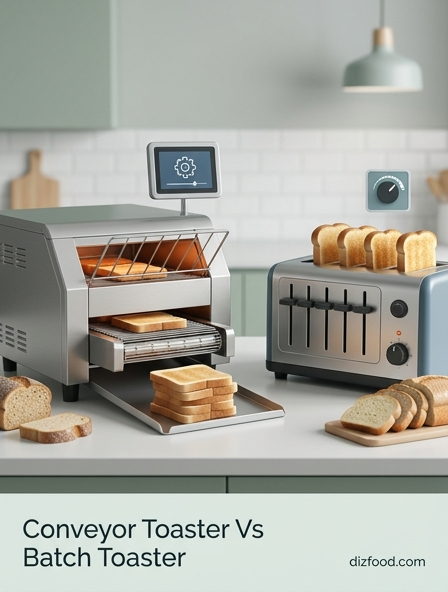
Comparing Throughput Efficiency Between Conveyor and Batch Toasters
Throughput efficiency represents the primary divide between conveyor and batch toasters in a professional kitchen environment. A conveyor toaster functions on a continuous-motion principle, allowing kitchen staff to feed bread products onto a moving belt that carries them through a heated chamber. This design eliminates the downtime associated with loading and unloading individual slots. High-end conveyor models can produce anywhere from 300 to over 1,500 slices per hour, depending on the belt width and heating element intensity. This makes them the undisputed champions of volume, as the workflow is linear and constant.
In contrast, batch toasters, often referred to as pop-up or slot toasters, operate on a fixed-cycle basis. While they are capable of delivering high-quality results for a small number of slices, they are limited by their physical capacity-usually two, four, or six slots. The throughput efficiency of a batch toaster is hindered by the manual intervention required to start each cycle and the "cool-down" period sometimes needed between heavy uses. While a four-slot toaster may be fast for a single order, it cannot compete with the cumulative output of a conveyor system over a sustained two-hour breakfast rush. For operations where toast is a secondary component of a plate, the batch toaster suffices; however, for toast-centric menus, the conveyor's ability to process items without interruption provides a significant logistical advantage.
Commercial Kitchen Volume Demands and Capacity Planning
Determining the right equipment requires a deep dive into peak-hour volume demands. Capacity planning is not merely about the total number of slices served per day, but the density of orders during the busiest sixty minutes of service. In a high-volume setting like a hotel breakfast buffet or a university dining hall, the demand is relentless. A conveyor toaster is the standard for these environments because it handles "burst" demand effectively. Staff can simply keep the belt full, and the machine dictates the pace of output, preventing backlogs in the kitchen or at the self-service station.
Small-scale cafes or artisanal sandwich shops often face different volume profiles. They may serve fewer slices overall, but require the ability to toast various types of bread-sourdough, rye, or thick-cut brioche-at different intervals. In these scenarios, capacity planning favors the batch toaster's versatility and smaller footprint. To help visualize these differences, consider the following capacity benchmarks:
- Low Volume (0-50 slices/hour): Standard 4-slot batch toaster is usually sufficient.
- Medium Volume (50-200 slices/hour): Heavy-duty 6-slot batch toaster or a compact conveyor model.
- High Volume (200-1000+ slices/hour): Large-form conveyor toaster with dual-belt options.
Overestimating capacity leads to wasted energy and counter space, while underestimating leads to customer frustration and bottlenecked service. Analyzing historical sales data for "toast-heavy" items is the most reliable method for choosing the correct hardware.
Toast Consistency and Bread Quality Control Standards
Quality control in toasting involves achieving the Maillard reaction-the browning of sugars and proteins-without drying out the interior of the bread. Conveyor toasters provide exceptional consistency once the belt speed and temperature are dialed in. Because every slice passes through the same heat zone for the exact same amount of time, the 100th slice will look identical to the first. This is crucial for franchises where brand standards require a uniform product across all locations. Many conveyor units also offer independent control over top and bottom heating elements, allowing for "one-sided" toasting often required for buns or bagels.
Batch toasters offer a different kind of quality control that is often preferred by gourmet chefs. Because the heating elements are in closer proximity to the bread, batch toasters can often achieve a crisp exterior while maintaining a moist, soft crumb inside. However, consistency can vary in cheaper batch models as the unit heats up over time; the third "pop" might be darker than the first due to residual heat in the chassis. Higher-end commercial batch units mitigate this with electronic sensors that adjust timing based on the internal temperature of the unit. For kitchens prioritizing artisanal quality and the ability to manually inspect each slice before it is "done," the batch toaster remains the preferred tool for precision over sheer uniformity.
Equipment Footprint and Countertop Space Management
In the high-stakes puzzle of commercial kitchen layout, countertop real estate is a premium asset. Conveyor toasters are notoriously bulky. Their footprint includes not just the machine itself, but also the "clearance" zones required for loading at the front and the collection tray at the back or bottom. Some models utilize a "return" feature where toast is sent back to the front to save space, but even these units require significant vertical and horizontal clearance to manage the heat they dissipate. They are generally not suited for cramped "line" setups where every inch is accounted for.
Batch toasters are the victors in space management. Their vertical orientation and compact rectangular shapes allow them to be tucked into corners or placed on narrow shelving units. Because they do not require a constant flow of air for a belt motor, they can often be placed closer to other equipment, provided there is enough ventilation for the rising heat. When planning space, kitchen managers must consider the following comparison:
| Feature | Conveyor Toaster | Batch Toaster |
|---|---|---|
| Average Width | 14 - 20 inches | 8 - 12 inches |
| Clearance Needed | High (front/back/sides) | Low (mostly top) |
| Portability | Difficult (heavy/large) | Easy (lightweight) |
Ultimately, a conveyor toaster is a dedicated station, whereas a batch toaster is a flexible tool that can be moved or stored when not in use during non-breakfast shifts.
Operational Energy Consumption and Utility Costs
The energy profiles of these two machines represent fundamentally different philosophies of utility consumption. A conveyor toaster is designed to be "always on." Most models require a significant warm-up period-often 15 to 30 minutes-to reach a stable operating temperature. Once active, the heating elements and the motor driving the belt draw a constant stream of electricity. Even with "power-save" modes that dim the elements during idle periods, the conveyor toaster is an energy-intensive appliance. It is most cost-effective when it is being used at near-capacity; running a conveyor toaster for three slices an hour is an expensive way to make toast.
Batch toasters are far more energy-efficient for "on-demand" service. They draw power only during the toasting cycle. While they do require a moment for the filaments to glow white-hot, there is no long-term preheating required for basic operation. This makes them ideal for businesses with sporadic toast orders throughout the day, such as a sandwich shop that only toasts bread upon request. However, it is worth noting that in a high-volume environment where a batch toaster is running 60 minutes an hour, the energy savings over a conveyor model diminish. Managers should look for "Energy Star" ratings or models with insulated carcasses that retain heat, reducing the load on the heating elements regardless of the toaster type chosen.
Ease of Use and Staff Training Requirements
Operational simplicity is a key factor in reducing labor costs and minimizing errors during a busy shift. Conveyor toasters are essentially "set it and forget it" machines. Once a manager has calibrated the belt speed and temperature for the house bread, the staff's only responsibility is to place the slices on the moving belt. This requires virtually zero training and allows staff to multitask-dropping the bread and then walking away to prep other parts of the meal. The machine handles the timing, ensuring that the toast is never burnt because of a distracted employee.
Batch toasters, while seemingly simple, require more active monitoring and manual dexterity. Staff must manually lower the lever, monitor the browning level (especially if the bread thickness or moisture content varies), and manually remove the toast when it pops up to prevent it from becoming cold or "sweating" in the slots. In a fast-paced environment, the "pop" of a batch toaster can easily be missed, leading to cold toast that must be discarded and remade. Furthermore, training is required to ensure staff do not use metal utensils to "fish out" stuck bread, which is a common safety hazard and a leading cause of damage to heating elements. For high-turnover kitchens with less experienced staff, the conveyor toaster provides a fool-proof workflow that reduces waste and ensures a consistent guest experience.
Maintenance Needs and Cleaning Durability Factors
The longevity of a toaster depends heavily on its maintenance schedule and the durability of its components. Conveyor toasters are complex machines with moving parts, including a drive motor, gears, and a stainless steel or wire mesh belt. These parts require regular inspection. Crumbs are a major enemy; if they accumulate in the motor housing or the belt tracks, they can cause mechanical failure. Daily cleaning of the crumb tray is mandatory, and the belt itself must be wiped down to prevent carbon buildup, which can leave black marks on the bread. However, because they are built for industrial use, the heating elements are often more robust and easier to replace than those in consumer-grade batch models.
Batch toasters have no moving parts other than the spring-loaded carriage. This simplicity makes them generally durable, but they are harder to clean internally. Crumbs often get lodged deep within the heating filaments, where they can smoke and create fire hazards or off-flavors. While most have a slide-out tray, it rarely catches 100% of the debris. Over time, the heating elements in batch toasters tend to warp or develop "dead spots" from repeated expansion and contraction. In a heavy-duty commercial setting, a batch toaster is often treated as a semi-disposable item with a 2-3 year lifespan, whereas a well-maintained conveyor toaster can serve a kitchen for a decade. Investing in a conveyor unit often means committing to a more rigorous, yet rewarding, maintenance routine.
Best Applications for Cafes Versus High Volume Buffets
The choice between these two machines often comes down to the specific business model. For a high-volume buffet, such as those found in hotels or large diners, the conveyor toaster is the only logical choice. It facilitates self-service, allowing guests to toast their own bread without the confusion of levers and timers. The continuous flow prevents "lines" from forming at the breakfast station, and the heat output is sufficient to keep up with hundreds of guests in a short window. In this application, the conveyor acts as a piece of infrastructure rather than just an appliance.
Conversely, a boutique cafe or an espresso bar usually prioritizes flexibility and counter space. These establishments may offer a variety of baked goods-bagels, thick sourdough, gluten-free slices, and English muffins. A batch toaster allows the barista to adjust the toasting level for each specific item quickly. Since the volume is lower and items are prepared to order, the "wait time" of a batch cycle is integrated into the overall ticket time. Furthermore, the aesthetic of a sleek, stainless steel batch toaster often fits better with the "front-of-house" decor in a cafe than the industrial, bulky look of a conveyor unit. The following list summarizes the best-fit scenarios:
- Conveyor: Schools, hotels, hospitals, large-scale diners, and catering halls.
- Batch: Specialty cafes, small sandwich shops, office breakrooms, and low-volume bars.
Toasting Speed Impact on Customer Service Efficiency
Speed is a metric of both "first-slice time" and "cumulative time." If a customer walks in and wants a single piece of toast, a batch toaster is often faster. It reaches peak temperature almost instantly and can deliver a finished product in 60 to 90 seconds. A conveyor toaster, if not already at operating temperature, will take much longer. Even when running, a single slice must travel the entire length of the belt, which might take 2 minutes or more depending on the setting. For on-demand, single-order service, the batch toaster provides a slight edge in initial response time.
However, the narrative shifts dramatically when the order size increases. If a table of six orders breakfast, a conveyor toaster can process the twelve slices of bread simultaneously in a single "train" of toast. The staff can drop the bread and move on to plating eggs and bacon. By the time the plates are ready, the toast is dropping into the collection tray. With a batch toaster, the staff would have to run multiple cycles or use multiple machines, requiring them to stop what they are doing to reload the slots. This "labor interruption" is the hidden cost of batch toasting. In professional service, the goal is to synchronize all components of a meal; the predictable, hands-off timing of a conveyor toaster makes this synchronization much easier for the kitchen lead to manage during the heat of service.
Final Verdict on Selecting the Best Commercial Toaster
Selecting the ideal toaster requires balancing the specific needs of your menu against the physical and financial constraints of your kitchen. There is no "superior" technology, only a "better fit" for specific operational goals. If your business model relies on speed, volume, and consistency-particularly in a self-service or high-output environment-the investment in a conveyor toaster is essential. The higher initial cost and larger footprint are offset by the dramatic reduction in labor and the guarantee of a uniform product that can keep pace with any rush.
On the other hand, if your kitchen values versatility, counter space, and energy efficiency for a varied menu, a high-quality commercial batch toaster is the more prudent choice. It allows for the precision needed for artisanal breads and fits into the flow of a smaller, more focused kitchen. When making your final decision, consider the "worst-case scenario" of your busiest Saturday morning. If the thought of waiting for a pop-up toaster creates a mental bottleneck, choose the conveyor. If your volume is manageable but your space is tight, stick with the batch. By aligning your equipment choice with your peak demand and labor availability, you ensure a smoother service and a better bottom line.




Comments