
Ever wondered why your toaster features a dedicated crumpet button alongside standard settings? While they both belong on the breakfast table, achieving the perfect golden crunch requires understanding the distinct thermodynamic needs of these griddle cakes. A crumpet setting is specifically engineered to deliver intense, one-sided heat to the porous top-crisping those iconic "nooks and crannies" while keeping the spongy base tender-whereas an English muffin setting provides balanced, dual-sided radiant heat to penetrate the denser, floury exterior of a split muffin. By mastering these specialized heating profiles, you can eliminate the disappointment of a soggy center or a burnt bottom, ensuring every bite delivers that elusive gourmet contrast between a shattered-crisp surface and a warm, pillowy interior.
| Feature | Crumpet Setting | English Muffin Setting |
|---|---|---|
| Heat Distribution | Unilateral (inner elements high) | Bilateral (even 50/50 split) |
| Texture Goal | Crispy "chimneys" / Soft base | Uniform edge-to-edge crunch |
| Heating Logic | Top-down searing intensity | Deep-core moisture reduction |
| Ideal Placement | Whole, holes facing center | Split, crumb facing center |
| Maillard Reaction | Focused on top surface peaks | Even browning on flat surfaces |
| Moisture Profile | High (retains internal steam) | Low (evaporates for rigidity) |
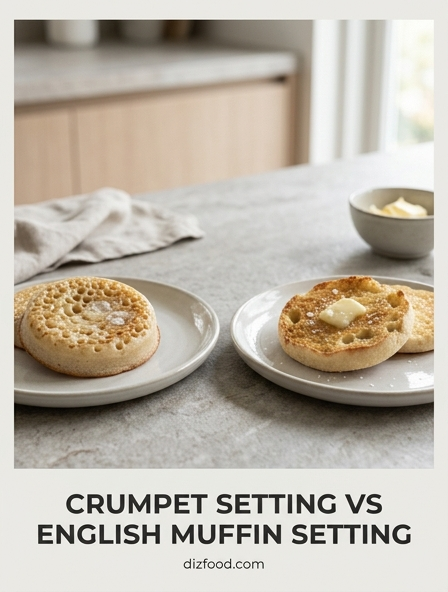
Understanding the Functional Differences of Crumpet and English Muffin Settings
Modern toasters often feature specialized settings designed to accommodate the unique structural properties of different bread types. While both crumpets and English muffins are staples of the breakfast table, their composition necessitates different thermal approaches. The crumpet setting is primarily designed to focus heat on one side of the product, typically the bottom, while providing a gentler warming effect to the porous top. This prevents the delicate, aerated surface from burning while ensuring the base achieves a sturdy, toasted structural integrity.
In contrast, the English muffin setting generally functions as a standard toasting cycle but may be calibrated for the specific density of the muffin dough. English muffins are typically split in half before toasting, creating two surfaces that require identical heat exposure to achieve the desired Maillard reaction. Understanding these functions prevents the common frustration of a charred crumpet top or an under-toasted English muffin center.
- Crumpet Mode: Concentrated heat on the outer elements, reduced heat on the inner elements.
- English Muffin Mode: Balanced heat across all active elements for uniform browning.
- Variable Timing: Adjustments in duration based on the moisture content of the dough.
The functional difference also extends to how the toaster handles moisture. Crumpets have a higher liquid-to-flour ratio during the cooking process, resulting in a rubbery texture if not toasted correctly. The specific crumpet setting manages this by driving moisture out of the base quickly, whereas the muffin setting focuses on the dry, craggy surface area created by the fork-splitting method.
How Heat Distribution Varies Between Crumpet and Muffin Modes
Heat distribution is the core engineering variable that separates a dedicated crumpet setting from a standard English muffin or toast cycle. In a standard toaster, all heating elements-typically nichrome wires wrapped around mica sheets-glow at a uniform temperature. When the English muffin mode is selected, the toaster maintains this equilibrium, ensuring that both the sliced interior and the floury exterior of the muffin receive equal thermal radiation. This is crucial for a bread that is symmetrical once sliced.
| Setting Mode | Inner Element Heat | Outer Element Heat | Primary Goal |
|---|---|---|---|
| Crumpet | Reduced (50-70%) | High (100%) | Crisp base, soft top |
| English Muffin | Full (100%) | Full (100%) | Even browning |
| Standard Toast | Full (100%) | Full (100%) | Uniform dehydration |
The crumpet setting modifies this distribution by redirecting power. Because a crumpet is not sliced, the heat must penetrate through the thick, spongy base without incinerating the top "chimneys" where steam escaped during the griddling process. By reducing the intensity of the elements facing the top of the crumpet, the toaster allows the heat to radiate upward from the bottom elements. This creates a temperature gradient that preserves the characteristic chewiness of the crumpet's upper layer while providing the necessary crunch at the bottom to support heavy toppings like butter or jam.
The Science of One Sided Toasting for Perfect Crumpets
The science behind one-sided toasting for crumpets lies in the unique cellular structure of the dough. Crumpets are fermented with yeast and often baking powder, creating a network of vertical tunnels. When heat is applied primarily to the bottom, it forces any remaining moisture upward through these tunnels. This steam-cooks the upper portion of the crumpet, maintaining its "springy" texture, while the direct radiant heat on the bottom caramelizes the sugars and starches in the crust. If heat were applied equally to the top, the thin walls of the bubbles would collapse and burn long before the thick base reached a toasted state.
This process is often referred to as biased heating. The outer elements of the toaster slot are boosted to a higher wattage, while the inner elements are dampened. To achieve the perfect result, the user must place the crumpets in the slots with the bottom side facing the high-heat elements. This directional toasting ensures that the "nooks" on the top remain soft and porous, ready to absorb melted butter, while the bottom remains rigid enough to be handled. Without this specific thermal bias, the crumpet loses its contrast in textures, which is the hallmark of a professionally prepared tea-time snack. This specialized cycle typically lasts slightly longer than a standard toast cycle to allow the heat to migrate through the dense, moist crumb without causing surface charring on the underside.
Why English Muffins Require Even Heat on Both Sides
English muffins are a fermented, high-hydration bread that is cooked on a griddle and then split. Unlike crumpets, they are characterized by a relatively uniform density throughout their thickness. When an English muffin is "fork-split," it reveals a highly irregular internal surface area. This craggy interior requires even, multidirectional heat to ensure that every peak and valley of the bread is exposed to the Maillard reaction. Even heat distribution is necessary because the muffin pieces are thin; there is no thick, protective base like that of a crumpet.
- Symmetrical Slicing: Since the muffin is split into two equal halves, both sides of each half need consistent heat.
- Moisture Evaporation: English muffins have a sourdough-like crumb that requires even dehydration to reach a crisp state.
- Consistent Browning: Uniform heat prevents the edges from burning while the center remains cold.
The English muffin setting often incorporates a specific timing profile that accounts for the "dusting" of cornmeal usually found on the exterior. This cornmeal can burn easily if subjected to the high-intensity bursts of a crumpet setting. Therefore, the muffin mode uses a more stable, medium-intensity heat across all elements. This ensures that the exterior remains golden and the interior becomes crunchy without the acrid taste of burnt cornmeal. By applying heat to both the smooth "crust" side and the porous "nook" side simultaneously, the toaster creates a rigid structure that can hold heavy spreads without becoming soggy or collapsing.
Comparing Internal Toaster Temperatures for Crumpets vs Muffins
Thermal dynamics within a toaster vary significantly depending on the selected bread setting. For English muffins, the internal temperature of the toaster reaches a steady state fairly quickly. The goal is to maintain a cavity temperature between 350°F and 400°F (175°C to 205°C). This range is sufficient to evaporate surface moisture and trigger the browning of starches without penetrating too deeply into the bread, which would result in a hard, biscotti-like texture. The evenness of the heat ensures that the muffin reaches this temperature threshold simultaneously on all surfaces.
Crumpet settings, however, often utilize a higher localized temperature on one set of elements while the overall cavity temperature might actually be lower or more fluctuate. The "hot" side of the slot may reach temperatures exceeding 450°F (230°C) to quickly crisp the thick base. Meanwhile, the air surrounding the top of the crumpet is kept closer to 300°F (150°C). This temperature delta is essential for the crumpet's structural integrity. Because crumpets are significantly denser than muffins-often weighing 30-50% more for the same surface area-they require more total thermal energy to warm through. The specialized crumpet cycle often extends the duration of heat application but modulates the intensity to prevent the high sugar content in some commercial crumpets from reaching the carbonization point too early in the process.
Achieving the Perfect Texture Using Specific Toaster Settings
The pursuit of the perfect breakfast texture is a balance between crispness and elasticity. For a crumpet, the "perfect texture" is defined by a dual experience: a glass-like crunch on the bottom and a warm, soufflé-like softness on the top. Utilizing the crumpet setting is the only way to achieve this without manual intervention. If one uses a standard setting, the crumpet often becomes "leathery" as the moisture is trapped between two toasted surfaces. The crumpet setting allows moisture to escape through the top holes, preserving the internal chew while the base provides a structural "plate" for the butter.
For English muffins, the goal is "crunch through and through." The muffin setting is optimized to create a brittle surface on the interior crags while keeping the very center of the bread slightly tender. This is achieved through a balanced radiant heat that hits the peaks of the fork-split surface first. These peaks brown and harden, providing the signature crunch. If the crumpet setting were used on a muffin, one side of the muffin half would be burnt while the other remained doughy. Achieving the desired texture requires the correct setting to ensure the heat interacts correctly with the surface geometry of the bread. Toaster manufacturers calibrate these settings by testing the "snap" of the bread and the depth of the toasted crust, ensuring that the user doesn't end up with a product that is either too soft to hold toppings or too hard to bite comfortably.
The Role of Nooks and Crannies in Choosing Your Toasting Level
The term "nooks and crannies" is often associated with English muffins, but it applies to the topography of both bread types in different ways. In an English muffin, these are the irregular air pockets exposed by splitting the muffin. These cavities increase the surface area of the bread significantly. Because there is more surface area, the muffin can absorb more radiant heat. When choosing a toasting level, a lower setting is often better for muffins because the "peaks" of the nooks can burn quickly if the wattage is too high. The muffin setting usually provides a more diffused heat to reach into the "valleys" without charring the "peaks."
In crumpets, the "nooks" are actually vertical vents that go from the bottom to the top. These holes act as chimneys. During toasting, these chimneys allow hot air to circulate within the body of the crumpet. The choice of toasting level here depends on how much "beading" of butter you desire. A higher crumpet setting will result in a firmer base, which seals the bottom of these chimneys, preventing butter from leaking through to your plate. If the toasting level is too low, the crumpet remains porous on the bottom, and the butter will simply run through the holes. Therefore, the "nook and cranny" structure dictates that crumpets generally require a higher intensity setting on the base than English muffins do on their split faces to ensure the bread performs its function as a vessel for condiments.
Common Toaster Symbols for Crumpets and English Muffins Explained
Iconography on kitchen appliances is designed for quick recognition, yet the symbols for crumpets and English muffins can sometimes be confusing, especially as they vary by brand and region. Most modern toasters use a stylized representation of the bread's cross-section or its heating requirement. Understanding these symbols is key to selecting the correct mode without referring to the manual every time you make breakfast.
- Single-Side Lines: A square or circle with horizontal lines on only one side typically indicates the Crumpet or Bagel setting. The lines represent the active heating elements.
- Double-Side Lines: A symbol with lines on both sides indicates the standard Toast or English Muffin setting, where all elements are active.
- The "Dot" Pattern: Some high-end European toasters use a circle with small dots inside to specifically represent the porous top of a crumpet.
- The "Split" Icon: A symbol showing two halves of a circle usually denotes an English muffin or bun setting, emphasizing the need for even heat on the split faces.
In many North American models, the "Bagel" button is the functional equivalent of the "Crumpet" button, as both items require one-sided toasting. However, a dedicated crumpet button may run for a slightly longer duration due to the higher moisture content of crumpets compared to bagels. If your toaster has both, the English muffin setting will typically be the "default" toast setting, whereas the crumpet setting will be the "specialty" toggle that alters the element behavior.
How to Avoid Burnt Edges with the Correct Toaster Selection
Burnt edges are the result of uneven heat distribution or an incorrect surface-area-to-heat ratio. English muffins are particularly prone to burnt edges because their perimeter is often thinner than their center. Using the dedicated English Muffin setting-which often features a slightly lower, more consistent heat-prevents the edges from reaching the combustion point before the center is toasted. If you use a high-heat "Toast" setting, the edges will carbonize while the middle remains soft. Furthermore, the cornmeal on the outside of English muffins has a lower burning point than the flour itself, making temperature control vital.
Crumpets face a different challenge. Their edges are protected by the "skin" formed by the crumpet ring during cooking. However, the top surface is highly susceptible to burning because the thin walls of the holes have very little mass. If the crumpet is toasted using a standard double-sided heat setting, these top edges will burn almost instantly. Using the crumpet setting protects these delicate structures by utilizing the "one-sided" heating method. To further avoid burnt edges:
- Check Centering: Ensure the bread is perfectly centered in the self-centering racks to avoid proximity to the wires.
- Moisture Content: Fresh crumpets are more moist and can handle more heat; dry or stale ones should be toasted on a lower setting.
- Clean Crumbs: Accumulation of crumbs in the bottom of the toaster can cause localized hotspots and smoke.
Maximizing Flavor by Matching Toaster Settings to Bread Type
The flavor of toasted bread is derived from the Maillard reaction, a chemical reaction between amino acids and reducing sugars that gives browned food its distinctive flavor. To maximize this in crumpets and English muffins, the heating profile must match the bread's chemistry. For English muffins, the flavor is all about the contrast between the tangy, fermented dough and the toasted, nutty peaks. The muffin setting facilitates this by ensuring the heat lasts long enough to develop these complex flavors without the bitterness of over-toasting. The result is a savory, toasted aroma that complements acidic toppings like marmalade.
For crumpets, the flavor profile is dominated by the butter absorption. A crumpet that is toasted on the wrong setting will not have the structural capacity to hold the amount of butter required for the traditional experience. The crumpet setting ensures the base is hot and "toasty" (adding a deep cereal flavor), while the top remains porous and absorbent. This allows the butter to mingle with the yeast-forward flavors of the soft dough inside the tunnels. By selecting the correct setting, you are not just heating the bread; you are engineering the physical and chemical state of the breakfast item to ensure the flavor molecules are delivered to the palate in the most effective way possible. Correct toasting turns a simple starch into a complex culinary experience through precise thermal application.


Comments