
Finding the perfect balance between kitchen efficiency and culinary precision often comes down to the "steamer showdown": the versatile rice cooker versus the specialized food steamer. If you're a minimalist looking to save counter space, a rice cooker with a steaming basket is a multitasking powerhouse that prepares fluffy grains while simultaneously wilting greens or steaming fish. However, for those prioritizing high-volume meal prep or delicate temperature control, a dedicated food steamer offers multi-tier stacking and precise timers that prevent overcooking. Whether you value the "set-it-and-forget-it" convenience of an all-in-one appliance or the expansive capacity of a standalone unit, choosing the right tool is the secret to unlocking vibrant, nutrient-dense meals every night.
| Feature | Rice Cooker Steamer | Dedicated Food Steamer |
|---|---|---|
| Primary Utility | Dual-purpose: Cooks grains & steams simultaneously. | Specialized: Optimized solely for steam circulation. |
| Capacity | Limited; usually 1 small shallow basket. | High; 2-3 stackable tiers for bulk cooking. |
| Control Level | Basic; dependent on rice cooking cycle. | Advanced; digital timers and 60-min reservoirs. |
| Flavor Integrity | Steam often absorbs aroma from the rice below. | Clean; no flavor transfer between different foods. |
| Space Efficiency | Excellent; one footprint for multiple tasks. | Requires extra counter/storage space. |
| Best For | Singles, couples, or quick side dishes. | Large families, meal-preppers, and entertainers. |
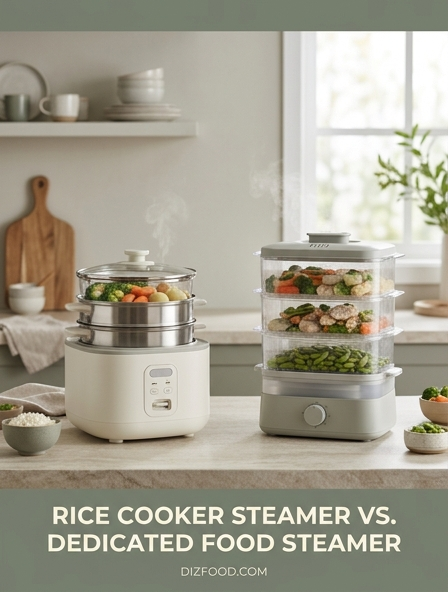
Rice Cooker Steamer vs Dedicated Steamer Comparison
When outfitting a modern kitchen, the debate between a multi-functional rice cooker and a dedicated food steamer often arises. Both appliances utilize the power of steam to cook food healthily, preserving nutrients and vitamins that are often lost during boiling or frying. However, their primary design philosophies differ significantly. A rice cooker is essentially a temperature-controlled vessel designed to boil water until it is absorbed by grain, with steaming often serving as a secondary feature via a plastic or metal basket insert. In contrast, a dedicated electric steamer is engineered specifically for the circulation of steam across one or more levels, prioritizing airflow and moisture distribution.
| Feature | Rice Cooker Steamer | Dedicated Food Steamer |
|---|---|---|
| Primary Function | Grains/Rice | Vegetables, Fish, Poultry |
| Versatility | High (Soups, Stews, Rice) | Low (Focuses on Steam) |
| Expansion | Single Level | Multi-Tiered |
| Footprint | Compact | Moderate to Large |
Understanding the fundamental differences helps in deciding which tool fits your culinary lifestyle. The rice cooker is the "jack-of-all-trades," perfect for those who want a one-pot meal. The dedicated steamer is a specialized tool for those who prioritize the texture and precision of delicate proteins and bulky vegetables. While they share the same scientific principle of heat transfer through water vapor, the user experience and the resulting culinary output can vary greatly depending on the volume and type of ingredients prepared.
Benefits of Steaming Food in a Rice Cooker
The primary advantage of using a rice cooker for steaming lies in its remarkable efficiency and "set it and forget it" nature. Most consumers find that the ability to cook a base grain and a side dish simultaneously is a game-changer for weeknight dinners. By placing a steaming basket over the cooking rice, the steam generated from the boiling water below cooks the vegetables or fish perfectly while flavoring the rice with the natural juices that drip down. This integration saves both time and energy, as you are utilizing a single heating element for two distinct components of a meal.
- Space Efficiency: Eliminates the need for multiple bulky appliances on the countertop.
- Simultaneous Cooking: Prepares rice and steamed sides at the same time.
- User-Friendly: Usually features simple one-touch operation or basic digital timers.
- Easy Cleanup: Fewer pots and pans to wash after the meal is finished.
- Energy Savings: Uses less electricity than running a stove and a separate steamer.
Furthermore, rice cookers are often built with heavy-duty non-stick inner pots that retain heat exceptionally well. This thermal mass ensures a steady flow of steam once the boiling point is reached. For small households or individuals living in apartments with limited storage, the rice cooker's ability to act as a steamer is not just a bonus; it is a practical necessity that simplifies the cooking process without sacrificing the nutritional benefits of a steamed meal.
Advantages of Using a Dedicated Electric Food Steamer
A dedicated electric food steamer is designed for the enthusiast who demands precision and volume. Unlike the limited space of a rice cooker insert, a dedicated steamer often features a transparent housing, allowing the cook to monitor the progress of the food without lifting the lid and releasing precious heat. The most significant advantage is the specialized heating element which is designed to produce steam almost instantly, often within thirty seconds of being turned on. This rapid steam generation is crucial for preserving the bright colors and crisp textures of greens like asparagus or broccoli.
Dedicated steamers also provide a cleaner flavor profile. In a rice cooker, the steam is often heavy and carries the starchiness of the rice below. A dedicated steamer uses fresh water from a separate reservoir, ensuring that the steam is pure. This is particularly important when preparing delicate seafood or dim sum, where the purity of the steam directly impacts the final taste. Additionally, these units often include features like external water inlets, which allow you to refill the reservoir during long cooking cycles without interrupting the steaming process or dropping the internal temperature. For those who meal prep in large batches or host dinner parties, the specialized nature of these machines provides a level of control and consistency that a multipurpose appliance simply cannot match.
Capacity and Tier Differences Between Steamers
Capacity is perhaps the most visible dividing line between these two kitchen tools. A rice cooker is vertically restricted by the depth of its inner pot. Most rice cooker steam baskets are shallow, allowing only for a single layer of vegetables or a small piece of fish. If you attempt to stack food too high in a rice cooker basket, the items at the bottom often become mushy while the items at the top remain undercooked due to poor circulation. This makes the rice cooker ideal for solo diners or couples, but less effective for larger families or varied diets.
- Single Tier (Rice Cooker): Best for small portions or side dishes intended for 1-2 people.
- Double Tier (Dedicated): Allows for the separation of proteins and vegetables to prevent flavor mixing.
- Triple Tier (Dedicated): Provides enough volume to cook an entire multi-course meal for a family of four.
- Removable Bases: Many dedicated steamers have removable floors to accommodate tall items like a whole chicken or corn on the cob.
Dedicated steamers excel because they utilize vertical space through stackable tiers. These tiers are usually perforated to allow steam to rise through every level. This design allows you to cook fish on the bottom tray (where it is hottest) and delicate greens on the top tray simultaneously. The sheer volume available in a three-tier dedicated steamer can exceed 9 to 12 quarts, whereas a rice cooker basket rarely exceeds 1 or 2 quarts of usable space. This makes the dedicated steamer the clear winner for anyone looking to prepare large quantities of food in one go.
Comparing Cooking Efficiency and Speed
Efficiency in steaming is measured by how quickly the water reaches boiling point and how effectively the steam is trapped. Rice cookers generally take longer to begin the steaming process because they must heat the entire volume of water and the heavy inner pot first. If you are cooking rice at the same time, the steam is only available once the water has reached a vigorous boil. This means your vegetables might be exposed to heat for 20 to 40 minutes, depending on the rice cycle, which can often lead to overcooking if you do not manually intervene and remove the basket early.
Dedicated steamers, on the other hand, are built for speed. Many models use a "rapid steam" system that channels a small amount of water over a high-output heating element, creating steam in less than a minute. This speed is not just about convenience; it is about culinary quality. The faster you can cook a vegetable, the more nutrients it retains. Furthermore, dedicated units usually have a timer that starts only when the steam is actually being produced, providing much more accurate results. While a rice cooker is efficient in terms of "work per watt" when multi-tasking, the dedicated steamer wins on pure speed and precision for individual ingredients. If your goal is a quick ten-minute steam for a side dish, the dedicated appliance is significantly more responsive than waiting for a full rice cooker cycle to reach its peak temperature.
Flavor Quality and Moisture Retention
Flavor quality is where the nuances of these two appliances truly become apparent. When you steam in a rice cooker, the process is often a closed loop. The juices from the steaming basket-such as oils from salmon or the earthy scent of broccoli-drip directly into the rice below. For many, this is a benefit as it seasons the rice naturally. However, for those seeking a neutral grain or those cooking ingredients that don't "pair" well, this can be a drawback. The moisture in a rice cooker is also very dense, which can sometimes lead to "soggy" results if the steam cannot escape efficiently.
- Flavor Purity: Dedicated steamers often include a drip tray that catches juices, preventing them from mixing with the water reservoir.
- Aroma Control: The clear tiers of a dedicated steamer allow for better ventilation, reducing the "boiled" smell sometimes associated with rice cooker steaming.
- Texture: Dedicated steamers provide a "dryer" steam environment that helps maintain the structural integrity of delicate foods.
Moisture retention is excellent in both, but the dedicated steamer offers more "breathability." Because the tiers are not submerged in a pot, the food is less likely to be sitting in a high-humidity "sauna" that ruins the snap of fresh vegetables. If you are a gourmet cook focusing on the delicate balance of a white fish fillet or the soft pleats of a dumpling, the moisture control of a dedicated steamer ensures that the skin doesn't get gummy or the flesh doesn't become waterlogged.
Space Saving vs Specialized Functionality
The decision often comes down to a battle for countertop real estate. Modern kitchens are often cluttered with air fryers, blenders, and coffee makers, making the addition of another single-use appliance a difficult choice. The rice cooker is the champion of space-saving. Because it performs multiple roles-boiling, steaming, and even baking or slow-cooking in some models-it justifies its permanent spot on the counter. For a minimalist, having a rice cooker that can also steam a head of cauliflower means one less box in the pantry.
However, specialized functionality has its own merits that shouldn't be overlooked. A dedicated steamer is often designed to be disassembled. The tiers usually nest within one another, meaning that while it looks large during use, it can be collapsed for storage. Furthermore, the specialized functionality includes features like "keep warm" modes that don't dry out the food, and specific settings for different food types (eggs, poultry, fish). If you find yourself steaming food more than three times a week, the "specialized" benefits-like the ability to steam two dozen eggs at once or a whole fish-outweigh the inconvenience of the extra space it occupies. It is a matter of frequency of use; a tool used daily is an investment, while a tool used once a month is clutter. The rice cooker serves the occasional user perfectly, while the dedicated steamer rewards the frequent healthy eater.
Temperature Control and Precision Settings
Precision is the hallmark of the dedicated food steamer. Most high-end dedicated models come equipped with digital interfaces that allow you to set exact timers for different tiers. Some even feature split-zone technology, where different sections of the steamer receive different amounts of steam or are timed to finish at the same moment despite having different cook times. This level of control is virtually non-existent in standard rice cookers, which usually operate on a simple thermal sensor that triggers a "warm" mode once the water has evaporated from the bottom of the pot.
- Digital Timers: Essential for precise items like soft-boiled eggs or custard.
- Delayed Start: Allows you to prep food and have it start steaming right before you get home.
- Automatic Shut-off: Prevents overcooking once the timer hits zero, a feature often lacking in manual rice cookers.
- Variable Steam Flow: Some dedicated units allow for high or low steam intensity.
When using a rice cooker to steam, you are largely at the mercy of the rice's cooking curve. If the rice takes 35 minutes but the fish takes 12, you must manually track the time and intervene. This negates the convenience of the appliance. A dedicated steamer removes the guesswork, providing a consistent environment where 10 minutes always means 10 minutes of active steam. For recipes that require exact timing to prevent the toughening of proteins, the electronic precision of a dedicated unit is an indispensable advantage.
Cleaning and Maintenance for Each Appliance
Maintenance requirements vary based on the complexity and materials of the unit. Rice cookers are generally very easy to clean because they consist of only three main parts: the lid, the non-stick inner pot, and the steam tray. Most of these components are dishwasher safe, though hand-washing the non-stick pot is recommended to extend its life. The main unit of the rice cooker simply needs a quick wipe down. Because the steam is generated within the pot, there are no internal tubes or hidden reservoirs that can grow mold or accumulate mineral scale.
Dedicated steamers require a bit more attention. Because they use a separate water reservoir, mineral buildup (limescale) can occur on the heating element over time, especially if you have hard water. This requires periodic descaling with vinegar or a specialized solution. Additionally, a dedicated steamer has more "surface area" to clean-multiple tiers, lids, and a drip tray. While most of these plastic parts are dishwasher safe, they are bulky and can take up a lot of space in the rack. One must also ensure the drip tray is emptied and cleaned thoroughly, as it catches food particles and fats that can become unsanitary if left sit. However, because the food never touches the heating element directly in a dedicated steamer, there is rarely any "burnt-on" food to scrub, making the overall cleaning process relatively light but slightly more involved than the simple pot-and-basket setup of a rice cooker.
Which Steamer is Best for Your Kitchen Needs
Ultimately, the choice depends on your specific dietary habits and the size of your household. If you are a student, a single professional, or someone who views rice as the primary foundation of every meal, a high-quality rice cooker with a steam basket is likely the best choice. It offers unmatched convenience, takes up less space, and handles the basics of steaming vegetables and small proteins with ease. It is the economical choice for those who value multi-functionality over specialized performance.
- Choose a Rice Cooker Steamer if: You have a small kitchen, cook for 1-2 people, and primarily eat rice with simple steamed sides.
- Choose a Dedicated Steamer if: You are focused on a high-protein/low-carb diet, cook for a large family, or enjoy steaming diverse foods like tamales, dumplings, and whole fish.
On the other hand, if you are committed to a healthy lifestyle that involves steaming large quantities of varied ingredients, or if you enjoy hosting and need to prepare several side dishes at once, the dedicated electric steamer is a worthy investment. The ability to stack multiple tiers, the precision of digital timers, and the rapid steam generation make it a superior tool for those who prioritize food texture and flavor purity. By assessing how much counter space you are willing to sacrifice and how often you plan to use the steaming function, you can select the appliance that will most effectively help you reach your culinary and nutritional goals.

Comments