
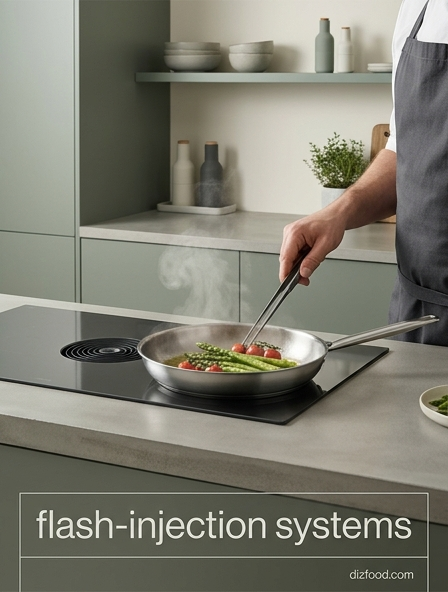
Defining Flash Injection Technology
Flash injection technology represents a significant departure from traditional steam generation methods in commercial and high-end residential kitchens. Unlike conventional systems that rely on a separate boiler tank to create steam, flash injection utilizes a high-precision atomizing nozzle. This nozzle sprays controlled bursts of water directly onto the high-speed heating elements or the rotating fan assembly inside the oven cavity. The immediate contact between the fine water mist and the intense heat results in an instantaneous transition from liquid to vapor, filling the cooking chamber with steam in seconds.
- Direct spray mechanism for rapid vaporization.
- Elimination of a bulky external boiler tank.
- Integration with convection fan systems for distribution.
- High-pressure atomization of water molecules.
This method allows for a more compact appliance design while offering chefs unprecedented control over the humidity levels within the cooking environment. By removing the need to maintain a reservoir of boiling water, flash injection systems provide a more responsive and hygienic solution for modern culinary applications, ensuring that steam is only produced exactly when the cooking process requires it.
Instant Steam Generation Benefits
The primary advantage of flash injection systems is the sheer speed at which they can achieve full steam saturation. In a fast-paced professional kitchen, waiting for a traditional boiler to reach temperature can lead to significant delays and slowed service times. Flash injection eliminates this bottleneck by producing steam on demand. This "instant-on" capability is particularly beneficial during peak hours when oven doors are frequently opened and closed, causing heat and moisture loss that must be recovered immediately.
- Reduced preheating times for steam-based cooking cycles.
- Rapid recovery of humidity levels after door openings.
- Lower idle energy consumption as no water reservoir is kept hot.
- On-demand moisture control for specific recipe stages.
Furthermore, the ability to generate steam instantly allows for complex multi-stage cooking profiles. A chef can program an initial burst of steam to allow bread dough to expand fully, followed by a dry heat phase for crust development, all within the same automated cycle. This level of responsiveness ensures that the cooking environment adapts to the food, rather than the food being subject to the slow fluctuations of a traditional boiler system.
Precision Temperature Management
Precision is the cornerstone of modern gastronomy, and flash injection systems offer a level of thermal accuracy that is difficult to match with atmospheric steaming. Because the steam is created directly within the airflow of the oven, the system can modulate the amount of moisture to an exact percentage. This prevents the common issue of temperature overshooting, which often occurs when a large volume of pre-boiled steam is released into a chamber. The integration of sensors allows the system to adjust the injection frequency based on real-time feedback.
- Fine-tuned control over moisture percentages (0% to 100%).
- Prevention of thermal spikes during steam introduction.
- Stable environment for delicate items like custards and terrines.
- Synchronization between heating elements and water atomization.
By managing the latent heat of the steam, these systems allow for "low-temperature steaming," a technique essential for delicate proteins like seafood or sous-vide style results without the plastic bags. The precision ensures that the internal temperature of the product is reached gently and accurately, reducing the risk of overcooking and ensuring consistent results across every batch produced in the kitchen.
Preserving Essential Nutrients
Flash injection steaming is widely regarded as one of the healthiest cooking methods available due to its ability to lock in vitamins and minerals. Traditional boiling often leaches water-soluble nutrients, such as Vitamin C and B-complex vitamins, into the cooking liquid. Even traditional steaming can result in nutrient loss if the process is prolonged due to slow steam generation. Flash injection optimizes the cooking window, exposing food to the necessary heat for the shortest duration possible, thereby maintaining the biological integrity of the ingredients.
- Minimal leaching of water-soluble vitamins.
- Reduced oxidation of sensitive phytonutrients.
- Retention of natural minerals within the cellular structure.
- Faster cooking times minimize heat-sensitive nutrient degradation.
The high-density steam created by flash systems surrounds the food quickly, creating a protective barrier that seals in moisture and nutrients. Because the steam is fresh and not recirculated from a stagnant boiler, there is no flavor transfer between different food items, and the nutritional profile remains untainted. This makes it an ideal technology for hospitals, schools, and health-conscious restaurants where the nutritional value of the meal is as important as its flavor.
Enhancing Food Texture and Color
Visual appeal and mouthfeel are drastically improved when using flash injection technology. The rapid introduction of moisture prevents the surface of the food from drying out prematurely, which is critical for maintaining vibrant colors in vegetables. Chlorophyll, the pigment responsible for the green color in plants, is highly sensitive to prolonged heat; by shortening the cooking cycle through efficient steam transfer, flash injection keeps vegetables looking bright and fresh rather than dull and grey.
| Food Type | Texture Improvement | Visual Benefit |
|---|---|---|
| Vegetables | Crisp-tender snap | Vibrant, natural hues |
| Proteins | Succulent and juicy | Reduced shrinkage |
| Bakery | Elastic crumb structure | Glossy, golden crust |
| Starches | Uniform hydration | Plump, distinct grains |
For proteins, the controlled humidity ensures that the exterior does not become tough or leathery. In baking, the ability to "flash" the oven with steam during the initial minutes of the bake is what creates the professional-grade crust found in artisanal breads. The steam gelatinizes the starches on the surface of the dough, resulting in a thin, crispy, and translucent crust that is impossible to achieve in a dry environment.
Energy Efficiency in Modern Kitchens
In the context of rising utility costs and sustainability mandates, the energy efficiency of flash injection systems is a major selling point. Traditional boiler-based ovens must constantly heat a large volume of water to a boil and maintain that temperature throughout the day, regardless of whether steam is being used at that moment. This results in significant "standby" energy loss. Flash injection systems, conversely, only consume the energy required to heat the specific amount of water being injected for the current cooking task.
- Elimination of energy-intensive boiler preheating.
- Lower water consumption due to precise metering.
- Reduced heat load in the kitchen, lowering cooling costs.
- Minimal scale buildup maintains heating element efficiency.
Because these systems are more efficient at transferring heat via moisture, cooking temperatures can often be lowered without increasing cooking times. This dual benefit of lower operating temperatures and reduced idle time leads to a measurable decrease in a facility's carbon footprint and monthly energy expenditures. For high-volume operations, these savings can contribute significantly to the total return on investment for the equipment.
Uniform Heat Distribution Mechanics
A common challenge in large-scale cooking is the presence of hot and cold spots within the oven cavity. Flash injection systems solve this by utilizing the oven's internal convection fans to distribute the atomized water. As the water hits the fan or the heating elements located around it, the resulting steam is immediately integrated into the high-velocity airflow. This creates a homogeneous mixture of hot air and moisture that reaches every corner of the oven simultaneously, ensuring that a tray at the bottom cooks identically to a tray at the top.
- Centrifugal force from fans aids in water atomization.
- Convection currents carry steam into the center of dense food loads.
- Elimination of stagnant air pockets through continuous circulation.
- Balanced moisture levels across all rack positions.
This uniformity is essential for "multi-level cooking," where various dishes are prepared at once. Without the consistent heat distribution provided by the flash-injected steam, chefs would be forced to rotate pans manually, leading to heat loss and uneven results. The synergy between the injection nozzle and the convection system ensures that the thermodynamic properties of the steam are utilized to their fullest potential.
Reducing Scaling and Maintenance
Maintenance is often the hidden cost of steam-generating equipment. Traditional boilers are notorious for "scaling"-the buildup of calcium and magnesium deposits that occurs when water is boiled. This scale acts as an insulator, forcing the heating elements to work harder and eventually leading to mechanical failure. Flash injection systems significantly mitigate this issue because they do not hold standing water. The water is sprayed and evaporated instantly, leaving far less opportunity for mineral deposits to accumulate on critical components.
- No boiler tank to drain, flush, or descale.
- Simplified water filtration requirements compared to boilers.
- Easier access to injection nozzles for routine cleaning.
- Longer lifespan of heating elements due to direct cooling.
While flash injection systems still require a water filtration system to protect the small diameter of the injection nozzles, the overall maintenance regimen is far less intensive. Most modern units feature automated cleaning cycles that specifically target the injection area, ensuring that any minor mineral residue is removed daily. This reliability translates to less downtime and lower service costs for the kitchen operator over the life of the appliance.
Flash Injection vs Traditional Boilers
The debate between flash injection and boiler-based systems often centers on volume and recovery. Historically, boiler systems were preferred for heavy-duty steaming because they could produce a massive, continuous volume of vapor. However, advancements in flash injection nozzle design and high-output heating elements have largely closed this performance gap. Today, flash injection is favored for its agility and lower cost of ownership, while boilers are increasingly reserved for specialized, industrial-scale steaming applications where water quality is extremely poor.
| Feature | Flash Injection | Traditional Boiler |
|---|---|---|
| Start-up Speed | Near-instant | 15-30 minutes |
| Maintenance | Low (No tank) | High (Frequent descaling) |
| Control | Highly responsive | Slower adjustment |
| Energy Use | On-demand | Continuous standby heat |
Choosing between the two often depends on the specific menu. For a kitchen that requires a variety of cooking methods-roasting, baking, and steaming-the flash injection system offers the versatility needed to switch modes quickly. The lack of a reservoir also means a smaller footprint, making flash systems ideal for kitchens where space is at a premium.
The Future of Healthy Steaming
Looking ahead, the evolution of flash injection technology is moving toward integration with Artificial Intelligence and the Internet of Things (IoT). Future systems will likely use advanced optical sensors to detect the surface moisture of food and automatically adjust the flash injection rate to prevent dehydration or sogginess. This "smart steaming" will take the guesswork out of complex recipes, allowing even entry-level staff to produce five-star results. Additionally, there is a push toward even greater water conservation through closed-loop systems that can recapture and filter condensate.
- AI-driven moisture adjustment based on food type.
- Enhanced water recovery and recycling systems.
- Integration with smart kitchen management software.
- More compact and powerful injection modules for small appliances.
As consumer demand for healthy, minimally processed food grows, the role of flash injection in both commercial and residential settings will expand. The technology aligns perfectly with the trend toward "clean eating" and transparency in food preparation. By combining the ancient benefits of steam with 21st-century precision, flash injection is set to remain the gold standard for healthy, efficient, and high-quality culinary production.



Comments