
Embarking on a culinary journey often leads to a fork in the road: do you prefer the slow, aromatic discovery of global seasonings or the high-octane adrenaline of a capsaicin-fueled gauntlet? Spice rack exploration is a masterclass in nuance, inviting you to layer complex profiles like smoky chipotle, earthy turmeric, and floral cardamom to elevate daily meals into gourmet experiences. On the flip side, hot sauce tasting challenges offer a visceral, thrill-seeking adventure where the focus shifts from subtle undertones to testing your physical limits against escalating Scoville heat units. Whether you are building a sophisticated palate through the art of blending or chasing the ultimate endorphin rush of a "da bomb" style finish, both paths offer a transformative way to redefine your relationship with flavor.
| Feature | Spice Rack Exploration | Hot Sauce Challenges |
|---|---|---|
| Primary Goal | Culinary depth and flavor balance | Physical endurance and heat peaks |
| Sensory Focus | Aroma, texture, and complex layering | Capsaicin intensity and vinegar tang |
| Measurement | Flavor profiles (Bitter, Sweet, Savory) | Scoville Heat Units (SHU) |
| Pace | Slow, methodical, and cumulative | Rapid, escalating, and intense |
| Versatility | Essential for daily meal preparation | Niche/Social events and dare-style tasting |
| Outcome | Enhanced cooking skills & palate | Adrenaline rush & "survivor" bragging rights |
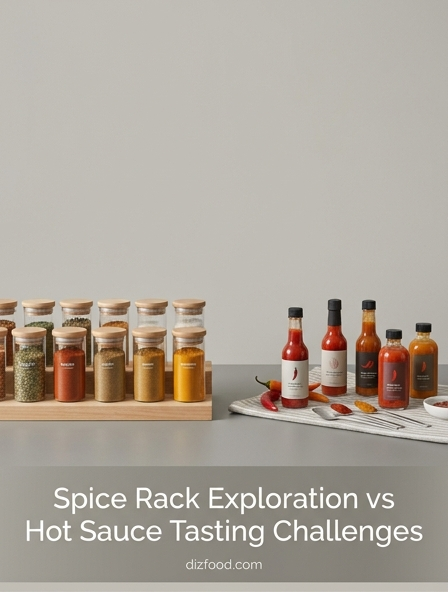
Comparing Culinary Spice Nuance and Hot Sauce Heat
In the modern kitchen, a fascinating dichotomy exists between the subtle art of spice rack exploration and the aggressive intensity of hot sauce tasting challenges. Culinary spice nuance refers to the layered complexity achieved by using dry aromatics like cardamom, star anise, and toasted coriander. These ingredients are designed to build a foundation of flavor that evolves as the dish cooks, offering a sensory experience that focuses on scent, depth, and the interplay between sweet, earthy, and floral notes. The goal here is harmony, where no single ingredient overpowers the others, but rather contributes to a cohesive gastronomic narrative.
Conversely, hot sauce heat focuses on the immediate physiological response triggered by capsaicin. While craft hot sauces certainly emphasize flavor profiles-often incorporating fruits, vinegars, and fermented garlic-the primary objective of a "challenge" is often the endurance of pain and the sensation of temperature. Where a dry spice might whisper, a concentrated habanero or ghost pepper sauce screams. Understanding the difference between these two worlds is essential for any home cook. One involves the patient extraction of oils through heat and fat, while the other involves a direct chemical interaction with pain receptors on the tongue.
- Spice Nuance: Focused on complexity, aroma, and lingering aftertastes.
- Hot Sauce Heat: Focused on intensity, impact, and immediate sensory reaction.
- Culinary Balance: The bridge where heat meets depth to enhance a meal.
Dry Spice Exploration vs Liquid Chili Challenges
The physical medium of seasoning significantly alters how we interact with flavor. Dry spice exploration typically involves a tactile relationship with whole seeds, barks, and powders. The cook must decide whether to bloom these spices in oil, toast them dry to release volatile compounds, or grind them into bespoke masalas. This process is rhythmic and methodical, requiring an understanding of how dry matter reconstitutes within the moisture of a dish. It is a slow-burn discovery that rewards patience and a keen sense of smell.
Liquid chili challenges, however, represent a more modern, fast-paced approach to culinary engagement. These bottled concoctions are ready-to-use and designed for high-impact delivery. In a challenge setting, the participant navigates a progression of liquids that vary in viscosity and vinegar content, each stepping up the ladder of intensity. The challenge lies not in the preparation, but in the consumption. While dry spices are integrated into the cooking process, hot sauces are often applied as a finishing touch or used as a standalone medium for testing one's limits. The following steps outline the typical progression of a liquid chili challenge:
- Initial tasting of mild, vinegar-forward jalapeño sauces.
- Transitioning to mid-tier serrano and cayenne blends with more fruit notes.
- Engaging with high-viscosity habanero and scotch bonnet sauces.
- Confronting "super-hot" extracts containing ghost peppers or Carolina Reapers.
Aromatic Flavor Profiles versus Scoville Scale Intensity
When evaluating the contents of a spice rack, the primary metric is the aromatic profile. This includes the volatile oils that give rosemary its piney scent or cumin its earthy, musk-like quality. These profiles are qualitative, judged by the nose and the palate's ability to detect subtle shifts in regional varieties. For instance, the difference between Vietnamese cinnamon and Ceylon cinnamon is a matter of sweetness and oil concentration, requiring a refined palate to distinguish and utilize effectively in baking or savory applications.
In contrast, the world of hot sauces relies heavily on the Scoville Scale, a quantitative measurement of capsaicinoid concentration. While flavor still matters in premium brands, the Scoville Heat Unit (SHU) provides a definitive benchmark for intensity. This numerical ranking turns flavor into a sport, where participants compare the "burn" of different peppers. The table below illustrates how aromatic profiles and Scoville ratings provide different frameworks for understanding kitchen ingredients.
| Ingredient Type | Primary Metric | Key Characteristics |
|---|---|---|
| Aromatic Dry Spices | Essential Oil Content | Fragrance, complexity, flavor layering |
| Hot Sauces | Scoville Heat Units (SHU) | Pungency, physical bite, endurance levels |
| Fusion Ingredients | Hybrid Balance | Smoky heat, seasoned pungency |
Navigating the Spice Rack vs Hosting Hot Sauce Tastings
Navigating a well-stocked spice rack is a solo journey of organization and discovery. It requires an understanding of shelf life, as the potency of ground spices fades over time. A cook must learn to differentiate between the cooling effect of fennel seeds and the numbing sensation of Sichuan peppercorns. This aspect of kitchen management is about maintenance and preparation, ensuring that the building blocks of a thousand different recipes are organized, fresh, and accessible. It is the librarian's side of cooking, where categorization leads to better creative output.
Hosting a hot sauce tasting, on the other hand, is a social event centered on shared experience and, often, shared suffering. It is a curated performance where a host organizes a "flight" of sauces, usually paired with neutral carriers like chicken wings, cauliflower bites, or crackers. The atmosphere is one of excitement and trepidation. Unlike the solitary act of blending a curry powder, a hot sauce tasting is interactive, featuring communal reactions, the frantic reaching for milk or bread, and the collective discussion of how flavor transitions into pure heat. While the spice rack is about the "how" of cooking, the hot sauce tasting is about the "wow" of the immediate experience.
Kitchen Pantry Essentials vs Extreme Heat Endurance
Every functional kitchen relies on a core group of pantry essentials. These are the workhorse spices like black peppercorns, kosher salt, garlic powder, and smoked paprika. These ingredients are not meant to challenge the eater; they are meant to sustain the dish. They provide the necessary seasoning that elevates meat, vegetables, and grains to a palatable level. An essential spice collection is built on utility, focusing on ingredients that can be used across various cuisines to provide a consistent baseline of flavor. Without these, even the most complex dishes would taste flat and uninspired.
Extreme heat endurance belongs to a different category of culinary pursuit. This involves sauces and dried peppers that push the boundaries of what is considered "food" and move into the realm of "dare." Ingredients like the Carolina Reaper or the Pepper X are cultivated specifically for their staggering capsaicin levels, often exceeding two million SHU. Engaging with these requires a different mindset-one of physical and mental fortification. While a pantry essential is used to make a meal better, an extreme hot sauce is used to see how much a person can handle. This distinction highlights the two roles of ingredients in the kitchen: those that nourish and those that test.
- Essential Spices: Black pepper, cumin, oregano, turmeric.
- Heat Endurance: Ghost pepper flakes, scorpion pepper mashes, high-SHU extracts.
- Common Ground: Red pepper flakes and cayenne, which bridge the gap between flavor and heat.
The Art of Seasoning vs The Thrill of Spicy Challenges
The art of seasoning is a fundamental skill that separates amateur cooks from professionals. It is the precise application of spices and herbs to enhance the natural flavors of ingredients. Seasoning requires constant tasting and adjustment, adding a pinch of salt here or a dash of ground ginger there to achieve a perfect equilibrium. It is an exercise in restraint and intuition. When a dish is perfectly seasoned, the spices do not stand out; instead, they make the main components shine brighter. It is a quiet, intellectual process that prioritizes the enjoyment of the food above all else.
The thrill of spicy challenges ignores the concept of restraint in favor of adrenaline. These challenges are designed to overwhelm the senses. Whether it is a "One Chip Challenge" or a tiered hot wing competition, the goal is to cross the threshold of comfort. There is a psychological component to this-a "benign masochism" where the brain enjoys the rush of endorphins that follow the initial burn. This is less about the culinary art and more about the thrill of the "edge." In the kitchen, this translates to a shift from the subtle seasoning of a broth to the aggressive dousing of a dish in a sauce that promises to linger for hours.
Global Spice Varieties versus Modern Hot Sauce Trends
The history of global spice varieties is the history of trade, exploration, and empire. From the Silk Road to the Spice Islands, the movement of peppercorns, cloves, and nutmeg shaped the world's economy for centuries. Each region developed its own signature blends, such as Ras el Hanout in North Africa or Garam Masala in India. These varieties are deeply rooted in geography and tradition, representing the terroir of their origins. Exploring these spices is a way of traveling through time and space, understanding how different cultures have used dry aromatics to preserve food and enhance life.
Modern hot sauce trends are a much newer phenomenon, driven by the craft movement and internet culture. While chili peppers originated in the Americas and spread globally, the current "hot sauce boom" is characterized by small-batch producers experimenting with unique fermentations and high-heat hybrids. We see trends like "sweet-heat" (honey and habanero) or "savory-heat" (black garlic and reaper). These trends are fast-moving, often popularized by YouTube shows and social media influencers. The table below compares the traditional roots of spices with the contemporary landscape of hot sauces.
| Feature | Global Spice Varieties | Modern Hot Sauce Trends |
|---|---|---|
| Origin | Ancient Trade Routes | Craft Kitchens & Viral Media |
| Complexity | Terroir and blending techniques | Fermentation and pepper hybridization |
| Focus | Cultural heritage and daily diet | Innovation, branding, and heat levels |
Balancing Spice Aromatics with Capsaicin Intensity
The most successful spicy dishes are those that manage to balance aromatic depth with heat intensity. If a dish is only hot, it lacks soul; if it is only aromatic without any "bite," it can sometimes feel incomplete, especially in cuisines like Thai, Mexican, or Indian. Achieving this balance requires an understanding of how capsaicin interacts with other flavors. Fat, for example, can coat the tongue and mellow the burn, allowing the nuances of the spices to emerge. Acid from citrus or vinegar can brighten the heat, making it feel more vibrant rather than just heavy and oppressive.
To balance these elements, a cook must layer the ingredients correctly. Starting with whole aromatics in oil builds the base, while adding chili elements later in the process can control the final heat level. The following steps provide a guide for achieving this equilibrium in the kitchen:
- Toast whole spices (cumin, coriander) to release their deep, earthy oils.
- Incorporate aromatics like onions, garlic, and ginger to provide a savory mid-note.
- Introduce heat through fresh chilies or hot sauce, tasting as you go to ensure the burn doesn't mask the spice blend.
- Finish with fresh herbs or a squeeze of lime to provide a counterpoint to the capsaicin.
Flavor Building with Spices vs Hot Sauce Sensation
Flavor building is a cumulative process. When using a spice rack, you are essentially building a wall of flavor, brick by brick. Each addition-turmeric for color and earthiness, smoked paprika for depth, or celery seed for bitterness-adds a new dimension. This is particularly evident in slow-cooked meals like stews, braises, or dry rubs for barbecue. The spices penetrate the proteins and vegetables, creating a deep-seated flavor that persists in every bite. It is a slow, pervasive sensation that warms the palate from the back to the front.
Hot sauce sensation is more of a vertical experience. It is a sharp, immediate peak of flavor and heat that sits on the surface of the food. Because hot sauces are liquid and often acidic, they hit the tongue quickly and evaporate or wash away relatively fast, leaving the capsaicin behind to do its work. This sensation is "bright" and "loud." It doesn't necessarily permeate the food as much as it coats it. This makes hot sauce an excellent tool for correcting a bland meal or adding a final "pop" of excitement to a dish that is already well-flavored but needs an extra kick to engage the senses fully.
Understanding Spice Origins vs Hot Sauce Heat Levels
To truly master the kitchen, one must understand the origins of their tools. Dry spices often have a botanical story; for example, saffron is the stigma of a crocus flower, while vanilla comes from an orchid. Understanding these origins helps a cook respect the potency and cost of these ingredients. Knowledge of whether a spice is a root, a seed, or a bark dictates how it should be treated-whether it needs to be ground, soaked, or infused. This botanical education is the foundation of culinary expertise, linking the garden to the plate.
Understanding hot sauce requires a more chemical and agricultural perspective. It is about the specific capsicum species and the cultivation techniques used to stress the plants, which increases capsaicin production. Heat levels are not just about the type of pepper but also how the sauce is processed. Some sauces use whole peppers for a more natural heat, while others use distilled capsaicin extracts for a more chemical, piercing burn. Recognizing these differences allows a person to choose the right "weapon" for their culinary goals, whether it is a flavorful fermented sauce for a taco or a blistering extract for a dare.
- Spice Origins: Focus on botany, geography, and historical trade.
- Hot Sauce Levels: Focus on agriculture, chemistry, and capsaicin concentration.
- Integration: Using origin-based knowledge to select the right heat level for a specific cuisine.




Comments