
Whether you're aiming to channel your inner Italian nonna or perfect the delicate pleats of a traditional gyoza, choosing between a pasta making workshop and a dumpling folding circle is the ultimate crossroad for any aspiring carb-connoisseur. While pasta classes focus on the rigorous chemistry of semolina and egg to achieve that signature al dente snap, dumpling circles prioritize the rhythmic, communal art of thin-skinned elasticity and structural integrity. Both disciplines demand a deep understanding of hydration and gluten development, but the real secret to mastering your dough art lies in "tactile intuition"-the ability to feel the tension and moisture of the flour in your hands. Mastering this single skill allows you to pivot between a silky pappardelle and a translucent har gow with professional ease, transforming simple pantry staples into sculptural, edible masterpieces.
| Feature | Pasta Making Workshops | Dumpling Folding Circles |
|---|---|---|
| Primary Focus | Dough thickness & tensile strength | Edge sealing & pleating aesthetics |
| Dough Composition | High-protein flour + egg/semolina | All-purpose flour + hot/cold water |
| Essential Tools | Pasta rollers, brass cutters, chitarra | Small rolling pins, bamboo steamers |
| Core Skill | Uniformity in gluten development | Fine motor dexterity & tension control |
| Social Dynamic | Structured, technique-heavy learning | Repetitive, rhythmic social gathering |
| End Result | Focus on sauce-to-noodle ratio | Focus on filling-to-wrapper integrity |
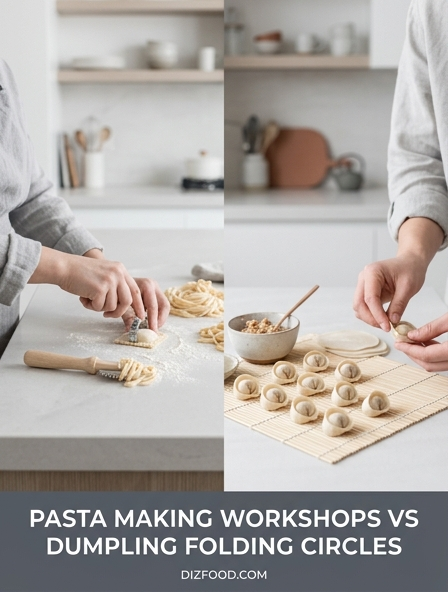
Pasta Making Workshops vs Dumpling Folding Circles
The culinary world offers few experiences as tactile and rewarding as working with fresh dough. Pasta making workshops and dumpling folding circles represent two of the most popular flour-based interactive experiences, yet they offer distinct atmospheres and technical focuses. A pasta workshop often feels like a structured masterclass in Italian heritage, where the transformation of simple ingredients-flour and eggs-into elegant ribbons or stuffed parcels takes center stage. Participants learn the architectural integrity of dough, understanding how moisture and protein levels dictate the final bite of a pappardelle or a delicate agnolotti.
In contrast, dumpling folding circles tend to emphasize the communal and repetitive nature of Asian comfort food. While the dough is equally important, the focus frequently shifts toward the artistry of the seal and the efficiency of the assembly line. These gatherings often mirror the traditional "jiaozi" gatherings found in Chinese households, where the goal is to produce a high volume of food through collective effort. While pasta workshops might highlight the individual's ability to master a machine or a rolling pin, dumpling circles celebrate the rhythm of the group. Both experiences provide a deep dive into "slow food" culture, encouraging participants to disconnect from digital distractions and reconnect with the sensory pleasures of flour-dusted hands and the aromatic promise of a shared meal.
Comparing Italian Flour Techniques and Asian Dough Traditions
The fundamental difference between these two crafts lies in the chemistry of the dough. Italian pasta traditions are heavily reliant on the specific properties of "00" flour and durum wheat semolina. The high gluten content of durum provides the necessary structural strength to withstand boiling while maintaining an "al dente" texture. Most importantly, the addition of eggs in many northern Italian traditions introduces fat and protein, resulting in a rich, golden dough that is silky and elastic.
Asian dumpling traditions, conversely, utilize a diverse range of starches and flours depending on the regional style. While wheat-based wrappers are common for potstickers and gyoza, many dim sum classics utilize rice flour, tapioca starch, or wheat starch to achieve translucency and a characteristic "chewy" or "bouncy" mouthfeel. Unlike the egg-rich pasta dough, most dumpling wrappers are vegan, consisting simply of flour and water (sometimes boiling water to partially gelatinize the starch). This difference in ingredients leads to distinct handling requirements:
| Feature | Italian Pasta | Asian Dumplings |
|---|---|---|
| Primary Flour | Durum Semolina / 00 Flour | All-Purpose Wheat / Rice Starch |
| Liquid Base | Whole Eggs or Yolks | Hot or Cold Water |
| Gluten Goal | High Elasticity | Variable (Soft to Translucent) |
| Texture Focus | Bite and Structure | Softness and Elasticity |
Mastering the Art of Kneading and Shaping
Kneading is the foundational skill for both crafts, yet the physical demands differ. In a pasta workshop, students are taught the "well" method, where eggs are whisked into a flour fortress. The kneading process for pasta is vigorous; the goal is to develop a strong gluten network that can be stretched into paper-thin sheets without tearing. This requires a rhythmic heel-of-the-hand motion that can last ten to fifteen minutes, resulting in a dough that is firm and resists a thumbprint.
For dumplings, the kneading process is often more about achieving a smooth, "earlobe-soft" consistency. The dough is usually more hydrated than pasta dough, making it more pliable for intricate folding. Shaping is where the two paths diverge significantly. Pasta shaping often involves tools-brass cutters, chitarra strings, or fluted wheels-to create geometric shapes like garganelli or farfalle. Dumpling shaping is a manual art form. The "pleat" is the signature of a skilled dumpling maker. Whether it is the classic "half-moon" with three pleats, the "money bag" cinch, or the sophisticated "bird's beak" used in har gow, the hands are the primary instruments. Mastering the tension of the dough so it holds a heavy filling without bursting during the steam or fry is the ultimate test of the maker's dexterity.
Essential Tools for Noodles and Wrappers
The toolkit for a pasta maker is often mechanical and specialized. To achieve the consistent thinness required for lasagna or tagliatelle, a hand-cranked or electric pasta machine is indispensable. These machines use graduated rollers to compress the dough. Other essential tools include:
- Mattarello: A long, slender Italian rolling pin used for hand-rolling large sheets of dough.
- Ravioli Stamp: Metal or wooden forms used to seal and cut stuffed pasta simultaneously.
- Gnocchi Board: A ridged wooden paddle used to create textures that hold sauce.
Dumpling making relies on a different set of hardware, much of which is designed for high-heat cooking and delicate manipulation. The tools are often simpler but require significant practice to master. Key items include:
- Small Rolling Pin: Unlike the large Italian pin, this is short and thin, designed for one-handed use to roll the edges of a wrapper thinner than the center.
- Bamboo Steamer: Stackable baskets that allow steam to circulate around the dumplings without direct water contact.
- Dough Cutter: A simple circular mold or a sharp knife used to portion "logs" of dough into uniform discs.
- Chopsticks: Often used as the primary tool for placing the exact amount of filling in the center of the wrapper.
The Social Dynamics of Flour Based Classes
The environment of a pasta making workshop is frequently celebratory and instructional. These classes are popular for "date nights" or high-end team building, often accompanied by wine pairings and a sit-down meal. There is a certain level of individual focus as each participant tries to master their own piece of dough. The teacher usually demonstrates a technique, and the students replicate it at their own stations. It is an educational experience that culminates in a refined, multi-course dinner where the fruits of one's labor are served with professional sauces.
Dumpling circles, however, are inherently more communal and informal. The very name "circle" implies a non-hierarchical structure. In these sessions, the work is often shared; one person might roll the wrappers while three others fold. This creates a natural environment for conversation and storytelling. Because a single person can rarely eat just one dumpling, the volume of production is much higher than in a pasta class. This high-repetition environment fosters a "flow state" where the group works in unison. While pasta classes focus on the "chef" experience, dumpling circles focus on the "home" experience, making them ideal for large families or groups looking for a relaxed, chatty atmosphere where the barrier to entry is low but the ceiling for mastery is high.
Filling Styles for Ravioli and Potstickers
The interior of these dough vessels defines their regional identity. Italian fillings for ravioli, tortellini, and agnolotti often revolve around dairy and cured meats. A classic ricotta and spinach filling relies on the creaminess of the cheese and the freshness of the greens, usually seasoned with nutmeg and Parmigiano-Reggiano. Meat-based fillings like those in Tortellini di Bologna are dense and savory, featuring mortadella, prosciutto, and pork loin. The moisture content must be carefully controlled; if the filling is too wet, the pasta dough will become soggy and tear during the boil.
Dumpling fillings, particularly for potstickers (guotie) and gyoza, prioritize a balance of protein, aromatics, and crunch. Ground pork is the most traditional base, often mixed with finely minced cabbage that has been salted and squeezed to remove excess water. The flavor profile is built on ginger, garlic, scallions, soy sauce, and sesame oil. Unlike the smooth, pureed textures often found in Italian fillings, dumpling interiors often have more texture. Variations include:
- Shrimp and Chive: A classic Cantonese combination where the shrimp provides a snap.
- Beef and Celery: A northern Chinese staple known for its bold, savory flavor.
- Mushroom and Tofu: A popular vegetarian option that uses umami-rich dried shiitakes.
- Soup Dumplings (Xiao Long Bao): A technical marvel where solidified collagen (aspic) is folded into the meat, melting into a hot broth when steamed.
Difficulty Levels of Pasta and Dumpling Skills
When assessing the learning curve, both crafts offer beginner-friendly entry points and expert-level challenges. Pasta making is often seen as "harder" in the initial stages because the dough itself is temperamental. Getting the hydration right-ensuring it isn't too crumbly to roll or too sticky to cut-requires a tactile intuition that takes time to develop. However, once the dough is mastered, using a pasta machine to make fettuccine is relatively straightforward. The "boss level" of pasta is undoubtedly hand-formed shapes like orecchiette or the incredibly rare su filindeu (threads of God).
Dumplings have a "lower floor" but a "higher ceiling" regarding manual dexterity. Almost anyone can successfully seal a dumpling with a simple fork crimp, making it accessible for children and beginners. However, the move from a basic seal to a professional 12-pleat crescent is a significant jump in difficulty. It requires precise finger placement and a specific "pinch and tuck" rhythm that must be done quickly to prevent the dough from drying out. Furthermore, specialized dumplings like Xiao Long Bao require the chef to fold the dough over a liquid-adjacent filling without any leaks, a task that often takes months of daily practice to perfect. While pasta difficulty is often about the dough's chemistry, dumpling difficulty is almost entirely about the hand's geometry.
Cultural Significance of Handmade Dough Workshops
Beyond the ingredients, these workshops serve as vessels for cultural preservation. In Italy, making pasta by hand is a link to the "Nonna" archetype-the grandmother who serves as the guardian of the family's culinary secrets. Each region has a shape that tells a story: the "little ears" (orecchiette) of Puglia or the "priest stranglers" (strozzapreti) of Emilia-Romagna. A pasta workshop is an act of reclaiming heritage from the industrial age of boxed noodles, asserting that the labor of the hand adds a flavor that a machine cannot replicate.
Dumpling circles carry a heavy symbolic weight in Asian cultures, particularly during the Lunar New Year. The shape of a dumpling resembles a silver ingot (yuanbao), ancient Chinese currency; thus, making and eating them is a ritual for inviting wealth and prosperity into the home. The act of gathering around a table to fold dumplings is a cornerstone of "reunion" culture. It is a time for generations to bridge the gap, where elders pass down techniques to the youth while discussing family matters. Participating in a dumpling folding circle is not just about food preparation; it is an exercise in communal harmony and a physical manifestation of the wish for a "full" and "wrapped" family unit. Both workshops offer modern urbanites a way to touch history through the medium of flour.
Texture and Flavor Profiles of Fresh Pasta and Dumplings
The sensory experience of fresh dough is vastly superior to its processed counterparts, but the desired results are opposites. Fresh egg pasta is prized for its "silky" and "tender" quality. Because of the eggs and the rolling process, the pasta has a porous surface that is specifically designed to "grab" onto sauces. When you bite into a fresh tagliatelle, it should offer a slight resistance-the al dente snap-followed by a rich, buttery finish that complements cream, ragù, or simple olive oil.
Dumpling wrappers are judged by their "elasticity" and "cleanness." A good wheat wrapper should be thin enough to see the filling but strong enough to have a "chewy" (often called "Q" texture in Taiwan) consistency. The flavor of the wrapper is intentionally neutral, serving as a clean vessel for the highly seasoned filling inside. When pan-fried, the contrast between the crispy, golden bottom and the soft, steamed top creates a complex mouthfeel that pasta rarely seeks to emulate. In the case of crystal dumplings (made with starches), the goal is a gummy, translucent skin that is almost jelly-like. These profiles highlight the different culinary philosophies: Italian pasta is often the star of the plate, whereas a dumpling wrapper is the perfect supporting actor to a flavorful interior.
Choosing the Best Culinary Experience for Groups
Deciding between a pasta workshop and a dumpling circle depends on the group's goals and the desired "vibe" of the event. Both are excellent for team building, but they cater to different energy levels. If the group is looking for a sophisticated, structured evening with a focus on technique and a formal seated dinner, a pasta workshop is the superior choice. It feels like an event, often requiring more space for pasta machines and large rolling boards. It is particularly well-suited for smaller groups (6-12 people) where the instructor can give personalized feedback on dough consistency.
If the group is larger, more casual, or includes various skill levels, a dumpling folding circle is often more successful. The "assembly line" nature of dumplings allows people to contribute at their own pace-some can focus on the dough, some on the filling, and others on the folding. It is a more "mobile" experience where people can stand, move around, and switch stations easily. Additionally, dumplings are often more inclusive for dietary restrictions, as the dough is typically vegan and the fillings can be easily adapted for gluten-free (using rice starch) or vegetarian needs. Ultimately, the choice comes down to whether you want to master a machine-aided craft or engage in a hand-crafted communal tradition.


Comments