
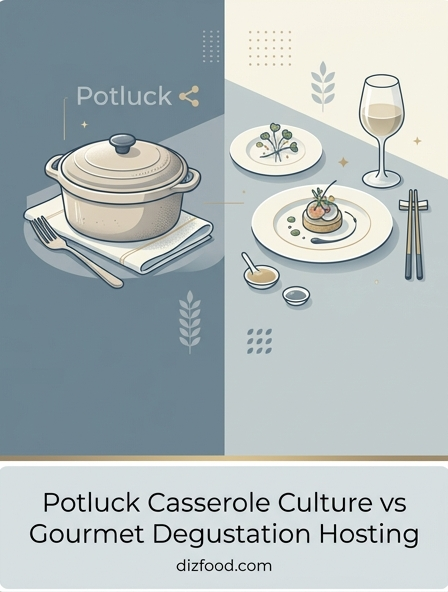
Choosing between the communal warmth of potluck casserole culture and the refined precision of gourmet degustation hosting is about more than just food; it's about defining the social DNA of your event. While a potluck leans into the "more the merrier" spirit, where nostalgic comfort dishes create a relaxed, low-pressure environment for the host, a degustation menu transforms your dining room into a high-end culinary stage, offering a curated multi-course narrative designed to dazzle. Whether you are looking for a budget-friendly gathering where every guest contributes to the flavor profile or an aspirational evening of technical mastery and wine pairings, understanding the logistical trade-offs between shared effort and creative control is the secret to hosting a memorable dinner party that fits your lifestyle.
| Feature | Potluck Casserole Culture | Gourmet Degustation Hosting |
|---|---|---|
| Primary Focus | Inclusivity & community connection | Culinary artistry & sensory storytelling |
| Cost Distribution | Crowdsourced; low individual overhead | High host investment; premium ingredients |
| Host Prep Time | 1-2 hours (coordination & setup) | 12-48+ hours (prep, plating, & pairing) |
| Menu Control | Eclectic, unpredictable, & varied | Strictly curated, synchronized 5-9 courses |
| Atmosphere | Boisterous, casual, and high-energy | Intimate, focused, and sophisticated |
| Cleanup Level | Minimal (guests take dishes home) | Significant (large volume of glassware/plates) |
The Evolution of Modern Dinner Party Styles
The landscape of domestic entertaining has undergone a radical transformation over the last century, swinging between the extremes of utilitarian communal feeding and high-concept culinary performance. In the post-war era, the dinner party was often a rigid affair defined by French service and strict etiquette. However, as suburban culture blossomed, the "covered dish" or potluck emerged as a symbol of democratic dining, where the labor of hospitality was distributed among all participants. This shift prioritized convenience and volume, allowing the kitchen to become a place of assembly rather than just high-stakes production.
In contrast, the 21st century has seen a resurgence of the "host-as-chef" persona, fueled by the globalization of food media and the democratization of professional-grade kitchen technology. Modern hosts often find themselves choosing between two distinct philosophies: the inclusive, chaotic warmth of the casserole culture or the curated, precision-driven world of the degustation menu. This evolution reflects broader societal changes, moving from a standard of formality to a bifurcated world of "ultra-casual" versus "ultra-bespoke" experiences. Key milestones in this evolution include:
- The 1950s rise of the Pyrex dish and the standardized casserole.
- The 1970s dinner party as a site of social climbing and exoticism.
- The 1990s "slow food" movement emphasizing ingredient provenance.
- The contemporary era of "Instagrammable" multi-course tasting menus.
Today, the modern dinner party is less about adherence to a single rulebook and more about the intentional selection of a "vibe." Whether it is a shared pan of lasagna or an eleven-course exploration of root vegetables, the kitchen remains the central stage for these social performances.
Community Connection in Potluck Casserole Culture
At the heart of the potluck is a fundamental rejection of the host's ego. Casserole culture is built on the premise that the gathering is more important than the individual skill of the cook. By its very nature, a potluck is a collage of different culinary backgrounds, skill levels, and family histories. When guests arrive with a dish wrapped in a towel to keep it warm, they are bringing more than just sustenance; they are contributing to a collective safety net. This style of hosting removes the pressure of perfection, creating an environment where the conversation can take center stage because the food is reliable, hearty, and familiar.
The casserole itself-a vessel that cooks and serves-is the perfect metaphor for this communal spirit. It represents a "set it and forget it" mentality that allows the host to actually interact with their guests rather than being sequestered in the kitchen. In many communities, from neighborhood block parties to religious gatherings, the potluck serves as a vital social glue. It fosters a sense of belonging that is difficult to replicate in more structured settings. The ritual of the "buffet line" encourages movement and spontaneous interaction, breaking down the hierarchies often found in seated, plated service. It is a celebration of the "good enough," where the warmth of the dish is matched by the warmth of the company, proving that community is built one shared scoop at a time.
The Refinement of Gourmet Degustation Hosting
Gourmet degustation hosting is an exercise in narrative and control. Unlike the "everyone brings a dish" approach, a tasting menu is a singular vision orchestrated by a host who takes on the role of both curator and creator. This style of hosting is about the journey of the palate, often involving six, eight, or even twelve small courses designed to showcase specific techniques or ingredients. The kitchen becomes a laboratory of precision, where timers, tweezers, and temperature probes are the primary tools. For the host, the satisfaction lies in the mastery of the craft and the ability to surprise and delight guests with unexpected flavor combinations and textures.
The refinement of this style requires a rigorous level of planning that begins weeks before the first guest arrives. The host must consider the progression of acidity, richness, and temperature to ensure the menu does not overwhelm the senses. The process typically follows a specific cadence:
- The Amuse-Bouche: A single, intense bite to awaken the palate.
- The Transition: Light vegetable or seafood courses that build complexity.
- The Crescendo: A main protein dish that serves as the conceptual anchor.
- The Refreshment: A palate cleanser, often citrus or herb-based.
- The Finale: A dessert that balances sweetness with technical artistry.
In this environment, the guest's role is to receive and appreciate. It is a form of theater where the table is the stage, and each plate is a new scene. While it may seem formal, the intimacy of a degustation-sharing a sequence of unique moments-can create a profound sense of connection through shared sensory discovery.
Casserole Comfort vs Degustation Sophistication
Choosing between casserole comfort and degustation sophistication is often a choice between emotional nostalgia and intellectual stimulation. Casseroles provide a sensory "hug"-they are soft, warm, and evoke memories of childhood and home. They rely on the melding of flavors over long periods, resulting in dishes that are often better the next day. Degustation, conversely, is about the "now." It focuses on the peak of freshness, the snap of a perfectly blanched vegetable, or the fragile crunch of a tuile. While one offers the reliability of a well-worn path, the other offers the thrill of a new adventure.
| Feature | Potluck Casserole Culture | Gourmet Degustation |
|---|---|---|
| Primary Goal | Sustenance and Social Ease | Culinary Artistry and Experience |
| Service Style | Self-Service Buffet | Timed, Plated Courses |
| Kitchen Atmosphere | Relaxed, Multitasking | High-Precision, Focused |
| Flavor Profile | Homogenous, Savory, Rich | Contrasted, Layered, Experimental |
| Guest Participation | Contributory (Bring a Dish) | Receptive (Passive Dining) |
Ultimately, the "comfort" of the casserole lies in its inclusivity; it accommodates dietary restrictions through variety. The "sophistication" of the degustation lies in its exclusivity; it demands the guest's full attention and trust in the host's vision. Both styles have their place in the modern kitchen, serving different emotional and social needs depending on the occasion and the desired atmosphere.
Budget Friendly Sharing vs Luxury Culinary Experiences
The economic divide between these two hosting styles is significant, yet both offer unique forms of "value." Potluck culture is inherently budget-friendly because it decentralizes the cost of the meal. A host only needs to provide a main dish or even just the space, while guests contribute according to their means. This makes frequent socializing accessible even in times of economic tightening. The "luxury" of a potluck is the abundance of choice and the low barrier to entry, ensuring that no one is priced out of the social circle. It is a resilient model that thrives on common ingredients-grains, legumes, and affordable proteins-transformed through slow cooking.
Gourmet degustation, however, is an investment in luxury. The costs associated with this style extend beyond just high-end ingredients like wagyu beef, truffles, or rare seafood. There is the "hidden" cost of specialized equipment (sous-vide circulators, specialized glassware, fine linens) and the immense cost of time. A ten-course meal might take forty hours of preparation. In this context, luxury is defined by the exclusivity of the experience and the labor-intensive nature of the preparations. For the host, the expense is a gift to the guests-an offering of rare flavors and undivided attention. While the potluck represents the economy of the many, the degustation represents the craftsmanship of the few, turning a simple meal into a high-value cultural event.
Social Dynamics of Communal Dining and Plated Courses
The way food is served dictates the rhythm of conversation and the energy of the room. In communal dining, such as a potluck, the social dynamics are fluid. People stand, move around the buffet, and sit in different clusters. This "controlled chaos" allows for a high volume of interaction across different social groups. It is particularly effective for large families or neighborhood groups where the goal is to mix and mingle. Because the service is non-linear, there is no pressure to finish at a certain time, allowing the night to unfold organically. Common traits of this dynamic include:
- High levels of movement and physical interaction.
- Decentralized focus; no one person is the center of attention.
- A casual atmosphere where latecomers can easily integrate.
- Loud, energetic cross-talk and shared laughter.
Plated courses, specifically in a tasting menu format, create a much more focused and rhythmic social experience. The table becomes a captive audience. Each course acts as a natural break in the conversation, allowing for a "reset" every twenty minutes. The social dynamic is often more intimate and intellectual, as guests discuss the nuances of the food they are experiencing simultaneously. This structure favors deeper, more linear conversations among a smaller group. The host guides the pace, ensuring that the energy of the room rises and falls with the menu. It is a more choreographed form of social engagement that prioritizes quality of connection over quantity of interactions.
From Church Basements to Michelin Inspired Tables
The lineage of modern entertaining can be traced through the institutional spaces that defined mid-century social life. The church basement was the ultimate laboratory for the potluck. Here, the "covered dish" was a tool for community survival and religious fellowship. These gatherings were defined by large-batch cooking, where recipes were passed down through index cards and the focus was on satiety. The aesthetics were secondary; the goal was to feed the crowd. This tradition solidified the casserole-tuna noodle, green bean, or tater-tot-as a symbol of humble, collective care. It was an era of "big-batch" thinking that prioritized the group over the individual.
As food culture shifted toward the professionalization of the home cook, the influence of Michelin-starred restaurants began to permeate the domestic kitchen. Television and the internet brought the secrets of high-end kitchens into the home, inspiring a new generation of hosts to emulate the precision of professional chefs. The "church basement" sensibility was replaced by the "chef's table" ambition. People began to buy mandolines, learn the art of the reduction sauce, and plate their food with geometric precision. This transition reflects a shift in status markers; where once social standing was shown by the ability to host a "seamless" large event, it is now often shown by the ability to execute a technically demanding, restaurant-quality meal for a select few. The journey from the basement to the tasting table is a journey from communal survival to individual self-expression.
The Art of the Multi Course Tasting Menu
Creating a multi-course tasting menu is akin to composing a symphony. It requires an understanding of how different elements interact over time. The "art" lies in the balance; a successful menu must have a beginning, a middle, and an end, with each course building upon the previous one without causing palate fatigue. The host must be a master of timing, ensuring that plates are hot, wines are paired correctly, and the transition between courses is invisible to the guest. This requires a level of organization that borders on the military, often involving "mise-en-place" (everything in its place) long before the first guest knocks on the door.
The technical progression of a tasting menu often looks like this:
- The Opening: A light, acidic bite to stimulate salivation.
- The Texture Play: A course focused on contrast, such as something creamy paired with something crisp.
- The Ocean: A delicate fish or shellfish course that introduces subtle richness.
- The Earth: A vegetable-forward dish that highlights seasonal produce.
- The Heart: The heaviest course, usually featuring roasted meats or complex starches.
- The Bridge: A cheese or small savory-sweet transition.
- The Sweet Finale: A dessert that provides closure through sugar and fat, but remains light enough to not overfill.
For the host, the reward is the "hush" that falls over the table when a particularly beautiful or delicious plate is set down. It is the art of creating a singular, fleeting moment that exists only for those in the room, making the intense labor of the kitchen worth every second.
Why We Crave Potluck Nostalgia and Simplicity
In an increasingly digital and curated world, there is a growing backlash against the "perfect" meal. Many people are finding themselves fatigued by the pressure of high-end hosting and the aesthetic demands of social media. This has led to a powerful resurgence of potluck nostalgia. There is something deeply grounding about a dish that is "ugly delicious"-a bubbling, browned casserole that doesn't need a garnish to be satisfying. We crave this simplicity because it represents a time when social interaction felt less like a performance and more like a relief. The potluck offers a psychological break from the "optimization" of every other part of our lives.
The simplicity of the potluck also speaks to a desire for authenticity. When a friend brings a dish they've made from their grandmother's recipe, it carries an emotional weight that a sous-vide steak rarely achieves. This "nostalgia dining" is about several key factors:
- The comfort of predictable, salty, and savory flavors.
- The lack of pretension; no one has to explain how to eat a casserole.
- The shared responsibility, which reduces the host's anxiety and the guest's guilt.
- The physical act of sharing from the same large dish, which reinforces communal bonds.
By embracing the casserole, we are embracing the imperfections of our homes and our lives. It is an admission that we don't need a Michelin star to have a meaningful evening-we just need a fork and a friend.
Balancing Casual Gathering with High End Hospitality
The most successful modern hosts are often those who can bridge the gap between these two worlds, creating an "elevated casual" experience. This hybrid approach takes the warmth and ease of the potluck and seasons it with the intentionality and quality of a degustation. For example, a host might provide a single, masterfully executed main course (high-end hospitality) while asking guests to bring sides or desserts (casual gathering). This allows for a focus on quality without the overwhelming labor of a ten-course menu. It creates a space where the food is exceptional, but the atmosphere remains relaxed and approachable.
Achieving this balance requires a keen understanding of "hospitality" versus "service." Service is the technical act of delivering food; hospitality is the emotional act of making guests feel welcome. A host can serve a simple pot roast but do so with the care and presentation of a fine-dining establishment. Conversely, one can serve a complex tasting menu in a way that feels unpretentious and fun. The key is to match the effort to the audience and the occasion. Whether it's a "taco night" using artisanal, hand-pressed tortillas or a "casserole party" where everyone brings high-quality, farm-to-table ingredients, the blending of these styles represents the future of the American kitchen. It is a philosophy that values both the art of the chef and the heart of the community.

Comments