
Deciding between a chef counter and a banquette nook depends entirely on the "vibe" you want to anchor your kitchen's social life. If you love being in the thick of the action, the chef counter offers a front-row seat to the culinary process, making it perfect for high-energy, casual interactions where the cook and guest remain connected through the art of meal prep. Conversely, the banquette nook fosters a more intimate, leisurely atmosphere, utilizing cozy corners and upholstered seating to encourage deep, face-to-face storytelling that lingers long after the plates are cleared. Whether you prioritize the theatrical pulse of a functional breakfast bar or the secluded, restaurant-style comfort of a built-in booth, choosing the right seating arrangement transforms your kitchen from a mere utility room into the ultimate heart of the home for meaningful conversation.
| Feature | Chef Counter | Banquette Nook |
|---|---|---|
| Social Dynamic | Interactive; focus on the "show" and prep. | Intimate; focus on face-to-face connection. |
| Seating Style | High-perch stools; linear or L-shaped. | Low-profile benches; cozy, wrap-around. |
| Space Footprint | Vertical; ideal for narrow paths/islands. | Compact; utilizes dead corners efficiently. |
| Comfort Level | Short-term; better for quick bites/drinks. | Long-term; cushioned for extended lounging. |
| Ergonomics | Side-by-side; less direct eye contact. | Inward-facing; maximizes group visibility. |
| Best Use Case | Solo breakfasts or hosting while cooking. | Family game nights or lingering coffee talks. |
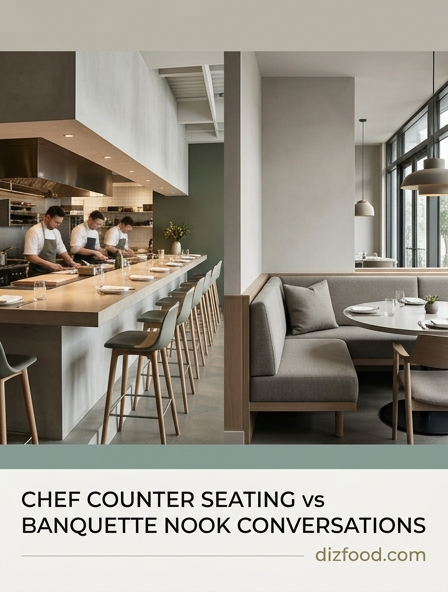
Chef Counter Dynamics and High Energy Talk
The chef's counter represents the pulse of a modern kitchen, acting as a stage where the boundary between service and consumption dissolves. At these high-top perches, the dialogue is characterized by a staccato rhythm, often mirroring the rapid movements of the culinary team. Conversations here are rarely hushed; instead, they are punctuated by the sizzle of a sear, the rhythmic chopping of knives, and the occasional shout of a command. Diners seated at the counter find themselves part of a collective experience, where the energy of the staff bleeds into the guest experience, encouraging a more extroverted social flow.
Engagement at the counter often shifts between the dining pair and the kitchen staff, creating a triadic communication style. This environment is ideal for those who find traditional silence awkward, as the ambient noise provides a consistent backdrop that fills gaps in conversation. The following elements define the high-energy talk at a chef's counter:
- Transactional Interaction: Direct questions to the chef about ingredients or techniques.
- External Stimulation: Using the visual "show" of the kitchen as a shared conversation starter.
- Shared Communal Energy: A sense of being "in on the action" alongside other diners.
- Casual Fluidity: A less formal atmosphere that permits louder laughter and animated gestures.
Because the seating is linear, eye contact between dining partners is angled rather than direct, which often leads to a more relaxed, side-by-side commentary on the surrounding spectacle. This physical orientation facilitates a "low-pressure" social environment where the focus is outward toward the craft, making it a favorite for those seeking entertainment alongside their meal.
The Intimacy of Private Banquette Nook Dialogue
In stark contrast to the kinetic energy of the counter, the banquette nook offers a sanctuary designed specifically for the art of the private conversation. These recessed seating areas utilize soft upholstery and physical barriers to create an acoustic "envelope," allowing guests to speak in lower registers without being overheard. The architecture of a nook encourages a face-to-face orientation, which naturally deepens the level of emotional and intellectual engagement between diners. Within these semi-enclosed spaces, the outside world-and the rest of the restaurant-fades into the periphery.
The psychological impact of the "nook" cannot be overstated. By providing a sense of enclosure, these spaces trigger a relaxation response that allows for more vulnerable and detailed storytelling. To maximize the intimacy of these spaces, designers often focus on the following steps:
- Acoustic Buffering: Using high-backed plush seating to absorb ambient restaurant noise.
- Fixed Proximity: Ensuring the table width is narrow enough to allow for close proximity without overcrowding.
- Soft Lighting: Utilizing localized, dimmable lights to focus the visual field solely on the dining partner.
- Minimal Distraction: Positioning nooks away from high-traffic service aisles to prevent interruptions.
When diners choose a banquette, they are prioritizing the internal world of their relationship over the external world of the kitchen. The conversation tends to be more linear and continuous, as there are no chefs to interrupt or visual displays to pull attention away from the speaker. It is the preferred choice for business negotiations, romantic milestones, or deep catching-up between long-distance friends.
Balancing Culinary Theater with Personal Connection
The choice between a counter and a nook often boils down to a trade-off between sensory input and interpersonal focus. While the counter provides "culinary theater," it can sometimes serve as a distraction that pulls diners away from one another. Conversely, while a nook fosters deep connection, it may lack the excitement that makes a night out feel special. Modern restaurant design seeks to bridge this gap by offering varying degrees of "semi-open" seating that allows for both observation and privacy.
Understanding the balance requires looking at how each seating style serves different social objectives. The table below compares the primary features of these two distinct dining environments:
| Feature | Chef's Counter | Banquette Nook |
|---|---|---|
| Focus | Process and Performance | Person and Presence |
| Eye Contact | Peripheral/Side-by-side | Direct/Facial focus |
| Noise Level | Vibrant/High-decibel | Muted/Controlled |
| Social Flow | Extroverted/Engaged with staff | Introverted/Private |
For many, the ideal experience involves a hybrid approach. Some diners prefer to start at the counter for an appetizer to soak in the energy, then migrate to a more secluded table for the main course and deeper discussion. This transition recognizes that the human social battery fluctuates; we often crave the thrill of the theater early in the evening but require the quiet of the nook as the night matures and the dialogue becomes more profound.
How Seating Arrangements Shape Dining Room Discourse
The physical layout of a dining room acts as a silent conductor for the conversations that happen within it. When a restaurant prioritizes counter seating, it signals a desire for a fast-paced, communal atmosphere where the food is the protagonist. When it leans into banquettes and nooks, it emphasizes the importance of the guest's personal life. These arrangements do not just accommodate social needs; they actively shape the length, tone, and subject matter of the discourse.
Architectural choices influence the "social grammar" of the room in several key ways:
- Verticality: High stools at a counter suggest a temporary, high-energy stay, whereas low-slung banquettes invite lingering.
- Boundary Definition: Physical walls or dividers around a nook create a "safe zone" for sensitive topics.
- Sightlines: At a counter, the sightlines are directed at the kitchen staff, making them part of the social circle. In a nook, the sightlines are inward-facing.
- Sound Travel: Hard surfaces near counters reflect sound, encouraging louder, more boisterous talk, while soft nook materials dampen the voice.
Because humans are highly responsive to their environment, a diner who is naturally quiet may become more talkative at a vibrant counter, while a loud group may naturally lower their voices when tucked into a secluded corner. The design of the space essentially gives the diners a set of "social cues" that tell them how to behave and how to speak. Consequently, the seating chart is one of the most powerful tools a restaurateur has for managing the "vibe" of the establishment.
Kitchen Counter Vibrancy Versus Corner Table Quiet
The sensory contrast between the kitchen counter and the corner table is a study in extremes. At the counter, the air is often warmer, the lighting sharper, and the smells more intense as dishes are plated inches from the guest's nose. This sensory bombardment creates a sense of immediacy. Dialogue here is often reactive-comments about the heat of the stove, the precision of the plating, or the aroma of a freshly deglazed pan. It is a "living" conversation that evolves in real-time with the production of the meal.
In contrast, the corner table or nook offers a curated quiet. The sensory input is filtered, allowing the diners' internal thoughts to take center stage. The following factors contribute to this distinct atmosphere:
- Distance from the Heat: Removing the physical heat of the kitchen allows for a cooler, more composed physical state.
- Controlled Acoustics: Corner tables leverage the surrounding walls to trap sound, creating a private bubble.
- Slowed Pacing: Without the visual cue of a busy kitchen, guests often feel less rushed to finish their plates.
- Focused Intention: The lack of external "show" forces the diners to generate their own entertainment through conversation.
Choosing between these two depends largely on the "sensory budget" of the diner. Those who have spent a long day in a quiet office may crave the vibrancy of the counter to wake up their senses. Conversely, those who have been in high-stress, noisy environments all day may seek the refuge of a corner table to decompress and reconnect with a loved one in a controlled, low-stimulus environment.
Choosing Your Atmosphere for Meaningful Interactions
Meaningful interaction is not a one-size-fits-all concept. For some, a meaningful interaction is a deep, three-hour discussion about life goals; for others, it is a shared moment of awe over a perfectly executed dish. The seating arrangement you choose should align with the "meaning" you hope to extract from the evening. If the goal is education and discovery, the chef's counter is unparalleled. If the goal is reconciliation, celebration of an anniversary, or a delicate business deal, the banquette is the superior tool.
When selecting a seat for your next outing, consider these social objectives:
- Educational Dining: Choose the counter to learn about regional ingredients and professional techniques directly from the source.
- Relationship Building: Choose a nook for first dates or sensitive conversations where eye contact and body language are paramount.
- Solo Exploration: The counter is the gold standard for solo diners, providing built-in entertainment and a sense of belonging without the need for a partner.
- Celebratory Groups: A large banquette allows a group to feel "apart" from the rest of the room, fostering a "clubhouse" mentality.
Ultimately, the atmosphere acts as a catalyst for the interaction. A chef's counter turns a dinner into a shared adventure, while a banquette turns it into a shared confidence. By matching the physical environment to the social intent, guests can ensure that the setting supports, rather than hinders, the quality of their dialogue. The "best seat in the house" is entirely dependent on who you are with and what you need to say to them.
Sensory Engagement at the Chef Front Row
The "Front Row" at a chef's counter is a multi-sensory experience that fundamentally alters how food is discussed. When you see the sweat on a cook's brow or the precise flick of a wrist during a sauté, the food ceases to be an anonymous product and becomes a narrative of labor and craft. This transparency leads to a specific type of conversation that is grounded in the "now." Diners often find themselves narrating the action, acting as amateur commentators on the culinary process unfolding before them.
This engagement is driven by a combination of visual, auditory, and olfactory stimuli that are absent at a standard table. The differences in sensory access are outlined below:
| Sense | Counter Experience | Table Experience |
|---|---|---|
| Visual | Active prep, plating, and flames | Finished dish presentation only |
| Auditory | Orders called, pans clanging, chef banter | Background music and general hum |
| Olfactory | Raw ingredients to final caramelization | The aroma of the served plate |
Because of this proximity, the conversation is often "interrupted" by the arrival of new sensory data. "Look at how they're handling that fish," or "Do you smell that truffle oil?" are common refrains. This makes the counter an excellent choice for casual acquaintances or "foodie" friends who want to bond over a shared interest. The sensory engagement provides a constant stream of "social fuel," ensuring that the energy level remains high throughout the duration of the meal.
Creating Focused Moments in Secluded Banquette Seating
Secluded banquette seating is the architectural equivalent of a deep breath. In a world of constant notification and digital noise, the physical enclosure of a banquette serves as a boundary that protects the diners' attention. The design of these spaces is intentionally "low-bandwidth" regarding external stimuli, which forces the brain to redirect its focus toward the person sitting across the table. This is where "focused moments" are born-those parts of a meal where you lose track of time and the surrounding restaurant disappears.
To achieve this level of focus, the design of the banquette relies on several psychological principles:
- The Prospect-Refuge Theory: Humans feel most relaxed when they have a secure "back" (the banquette wall) and a clear view of their surroundings without being exposed.
- Reduced Peripheral Vision: High sides on a booth or nook limit visual distractions from other tables.
- Tactile Comfort: Soft fabrics and padded seats encourage the body to settle in, signaling to the brain that it is safe to engage in long-form thought.
- Acoustic Intimacy: The "cradle" shape of many nooks reflects the speakers' voices back toward them, creating a private soundstage.
Within these focused moments, the dialogue often shifts from the "what" (the food, the weather) to the "why" (feelings, motivations, and plans). The seclusion provides the emotional safety necessary for deeper disclosure. In this way, the banquette is not just a place to eat; it is a tool for maintaining and deepening human relationships in an increasingly distracted world.
The Impact of Proximity on Social Dining Flows
Proximity is the "invisible hand" of dining room social dynamics. At a chef's counter, the physical distance between the diner, their neighbor, and the staff is minimized, often to within eighteen inches. This breach of "personal space" is consensual and expected, leading to a breakdown of traditional social barriers. It encourages "cross-talk"-conversations that jump between different parties or between guests and the kitchen. The social flow here is lateral and porous, moving easily across the line of the counter.
In a banquette, proximity is strictly controlled. You are very close to your dining partner but significantly distanced from everyone else. This creates a "siloed" social flow. The differences in proximity impact the interaction in several ways:
- Staff Interaction: At the counter, the server/chef is a constant presence; in a nook, the server is an occasional "intruder" into a private space.
- Social Accountability: Being inches away from a chef makes you more likely to offer immediate, positive feedback.
- Spontaneous Connection: Counters facilitate meeting strangers, whereas nooks are designed to prevent it.
- Volume Control: Close proximity in a nook allows for whispering, while the distance at a counter requires a projected voice.
The flow of the evening is dictated by these distances. A counter meal feels like a public event, a shared piece of performance art where the proximity creates a sense of "we." A banquette meal feels like a private contract, where the proximity creates a sense of "us." Understanding these flows allows diners to choose the right level of social exposure for their specific mood or occasion.
Designing Restaurant Spaces for Varied Social Needs
Modern restaurant architecture is moving away from uniform seating in favor of "zoned" environments. Designers recognize that a single dining room must accommodate a wide spectrum of social needs, from the high-energy "foodie" to the couple celebrating a quiet anniversary. By integrating both chef's counters and secluded banquettes, a restaurant can maximize its appeal and ensure that every guest finds a space that matches their internal tempo. The goal is to create a "social landscape" that offers both "prospect" (the view of the kitchen) and "refuge" (the quiet nook).
Effective zoning involves a strategic mix of furniture, lighting, and materials to define these areas without using literal walls. The following table illustrates how design elements are varied to create these distinct social zones:
| Design Element | Counter (Action Zone) | Banquette (Comfort Zone) |
|---|---|---|
| Materials | Stainless steel, marble, hard woods | Velvet, leather, acoustic panels |
| Lighting | Task lighting, bright pendants | Amber tones, recessed LED strips |
| Seating Height | Bar height (42 inches) | Standard height (18-20 inches) |
| Floor Treatment | Tile or polished concrete | Carpet or inset rugs |
When these zones are balanced correctly, a restaurant becomes a dynamic ecosystem. The vibrant energy of the counter provides a "pulse" that prevents the quiet areas from feeling stagnant, while the nooks provide a "weight" that prevents the restaurant from feeling like a frantic cafeteria. This intentional variety allows for "meaningful interactions" of all types, proving that the most important ingredient in a meal is often the chair you choose to sit in.



Comments