
Deciding between a meticulously arranged charcuterie board and a vibrant tapas-style grazing spread often defines the entire atmosphere of your gathering. While charcuterie focuses on the artisanal assembly of premium cured meats, aged cheeses, and shelf-stable accompaniments like nuts and cornichons to create a visual centerpiece, tapas-style grazing leans into a more dynamic, culinary experience featuring a variety of small, often warm, prepared dishes. Charcuterie offers a "set it and forget it" convenience perfect for wine pairings and low-maintenance mingling, whereas tapas encourage a flowing social energy through a continuous rotation of bold, Mediterranean-inspired flavors. Choosing the right style depends on whether you want a static, aesthetically-pleasing focal point or a diverse, multi-course journey that keeps your guests moving and engaged with every bite.
| Feature | Charcuterie Board Assembly | Tapas-Style Grazing |
|---|---|---|
| Primary Focus | Cured meats, cheeses, and preserves. | Small, diverse cooked and fresh plates. |
| Temperature | Room temperature / Chilled. | Mix of hot, warm, and cold dishes. |
| Preparation | Slicing, pairing, and aesthetic styling. | Active cooking, seasoning, and plating. |
| Social Flow | Centralized; guests gather around one spot. | Dynamic; guests move for new dish arrivals. |
| Best Paired With | Full-bodied wines and craft beers. | Sangria, cocktails, and light spirits. |
| Maintenance | Low; remains stable for hours. | High; requires replenishing and clearing plates. |
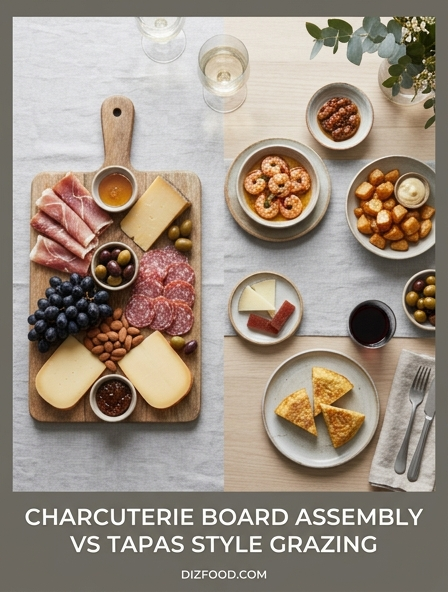
Defining Charcuterie Board Assembly and Tapas Style Grazing
In the realm of modern entertaining, two distinct culinary styles dominate the kitchen: charcuterie board assembly and tapas-style grazing. While often used interchangeably in casual conversation, they represent different philosophies of food preparation and service. Charcuterie, traditionally rooted in the French art of meat preservation, focuses on the curation and arrangement of pre-prepared elements. The primary task for the host is the selection and aesthetic placement of cured meats, artisanal cheeses, and various shelf-stable accompaniments. It is a dry-service style that emphasizes preservation and the harmony of room-temperature ingredients.
Tapas-style grazing, conversely, originates from the Spanish tradition of small plates served alongside drinks. Unlike the singular landscape of a charcuterie board, tapas often involve active cooking and the presentation of multiple, independent dishes. This style is more dynamic, frequently incorporating hot elements, sauces, and complex flavor profiles that require kitchen preparation immediately before serving. The defining characteristics of each can be summarized as follows:
- Charcuterie: Focused on assembly, cured items, room temperature service, and a single communal surface.
- Tapas: Focused on culinary preparation, individual dish identities, a mix of hot and cold temperatures, and staggered service.
Understanding these definitions is essential for any host. A charcuterie board is often a static centerpiece, while a tapas spread is a fluid, evolving meal. One relies on the quality of the purveyor's products, while the other relies on the host's skill behind the stove.
The Art of Cold Cuts Versus Prepared Small Plates
The distinction between charcuterie and tapas is most visible in the level of "kitchen work" required. The art of charcuterie is largely one of sourcing and slicing. A high-end board showcases the craftsmanship of the butcher and the cheesemaker. The host's role is to act as a curator, choosing the right percentage of fat-to-lean ratios in a Salami, the specific age of a Manchego, and the crunch of a Marcona almond. The "cooking" is finished long before the host enters the kitchen; the skill lies in how these items are cut-wafer-thin ribbons of prosciutto or rustic chunks of aged cheddar-to maximize their surface area and flavor release.
Tapas-style grazing shifts the focus back to the heat of the kitchen. A "small plate" is often a miniature version of a composed dish. It involves searing, poaching, frying, or braising. For example, while a charcuterie board might offer a cold slice of chorizo, a tapas menu would feature Chorizo al Vino, where the sausage is simmered in red wine until the sugars caramelize. This creates a more labor-intensive hosting experience but offers a wider range of textures and depths. While cold cuts rely on salt and fermentation for impact, prepared small plates rely on fresh herbs, heat, and the immediate marriage of ingredients. The former is a celebration of the pantry, while the latter is a celebration of the sauté pan.
Comparing Visual Presentation and Table Layout Techniques
Visual presentation is where these two styles diverge most sharply in terms of table geometry. A charcuterie board is typically a "horror vacui" style of presentation-a fear of empty space. The goal is to create a lush, overflowing mosaic where every gap is filled with nuts, seeds, or berries. The eye is meant to wander across a single, continuous landscape of color and texture. Boards are often built from the center out, using larger items like cheese blocks as anchors and "rivers" of meat to guide the guest's eye.
Tapas presentation is more modular and segmented. Instead of one large board, the table is populated by various small vessels, often traditional terracotta "cazuelas" or ceramic plates. This layout allows for negative space on the table, giving each dish its own visual identity. It also prevents the cross-contamination of flavors, which is vital when serving dishes with oils or sauces. The following table compares the typical layout elements of both styles:
| Feature | Charcuterie Board | Tapas Style |
|---|---|---|
| Surface | Large wooden or slate slab | Multiple individual dishes |
| Arrangement | Overlapping and crowded | Spaced and distinct |
| Height | Relatively flat/low profile | Varied heights using bowls |
| Garnish | Integrated (herbs, nuts) | Specific to each dish |
Key Ingredient Differences Between Boards and Tapas
The ingredient lists for these two styles may overlap in origin, but they differ significantly in application. Charcuterie boards prioritize "ready-to-eat" items with long shelf lives. The staples include hard and soft cheeses, cured meats like bresaola or capicola, and preserved goods like cornichons, olives, and fruit preserves. These items are chosen for their ability to sit out for several hours without losing their integrity. The ingredients are the stars themselves, unmasked by heavy sauces or complex seasonings.
Tapas ingredients are often fresh and perishable, intended for immediate consumption. Seafood plays a much larger role in tapas, such as octopus (pulpo), shrimp (gambas), or boquerones (anchovies in vinegar). Fresh vegetables like Padrón peppers or eggplants are transformed through heat, rather than served raw or pickled. While bread is a secondary vehicle on a charcuterie board, it is often a primary ingredient in tapas, such as "Pan con Tomate," where the bread is toasted, rubbed with garlic, and topped with fresh tomato pulp and oil. The ingredient philosophy of tapas is about transformation through culinary technique, whereas charcuterie is about the appreciation of the ingredient in its preserved state.
- Board Staples: Fig jam, honeycomb, prosciutto, brie, grapes.
- Tapas Staples: Garlic shrimp, patatas bravas, meatballs, croquettes.
Hosting Dynamics for Communal Platters and Individual Servings
The social dynamic of the kitchen and dining room changes based on the chosen serving style. A charcuterie board encourages a "gathering" effect. Guests usually stand or sit around a central point, picking at items throughout the evening. It is a highly informal, low-maintenance style for the host, as all the work is completed before the first guest arrives. This allows the host to be fully present in the conversation, rather than tethered to the stove. The communal nature of the board fosters a shared experience, where everyone interacts with the same platter.
Tapas hosting is more rhythmic and interactive. Tapas are often served in "waves," moving from lighter cold dishes to heavier hot plates. This requires the host to move between the kitchen and the social area, creating a sense of anticipation among guests. It feels more like a structured event or a progressive meal. Because tapas are often served in individual or small-group portions, they can also accommodate dietary restrictions more easily than a crowded board where everything touches. The hosting process follows a more traditional culinary flow:
- Initial cold snacks (olives, almonds) to greet guests.
- Light prepared bites (bruschetta, skewers).
- Warm signatures (tortilla española, calamari).
- Heavy finishers (braised meats or hearty stews).
Temperature and Texture Profiles in Modern Grazing
Temperature management is perhaps the greatest technical difference between these two kitchen outputs. A successful charcuterie board relies almost entirely on room-temperature service. In fact, serving cheese or cured meats straight from the refrigerator is considered a mistake, as the cold masks the delicate fats and aromas. The goal is a consistent, ambient temperature that allows the oils in the meat to soften and the cheese to become supple. Textures on a board are generally divided between the creamy (brie), the chewy (salami), and the crunchy (crackers).
Modern tapas grazing thrives on temperature contrast. A hallmark of a great tapas spread is the oscillation between a chilled gazpacho, a room-temperature slice of tortilla, and a piping hot plate of fried potatoes. This variety keeps the palate engaged and prevents "flavor fatigue." Textures in tapas are also more diverse due to cooking methods; you have the crispiness of a deep-fried croquette, the silkiness of a slow-cooked garlic oil, and the bite of a charred vegetable. While a board is a steady-state experience, tapas provide a sensory roller coaster of hot and cold, soft and crisp, which requires careful timing from the kitchen to ensure everything is eaten at its thermal peak.
Essential Tools for Assembling the Perfect Spread
Equipping a kitchen for these styles requires different sets of tools. For charcuterie, the "board" itself is the most important piece of equipment. Large slabs of olive wood, acacia, or slate provide the canvas. Beyond the surface, a set of specialized cheese knives is essential-the spade for hard cheeses, the perforated blade for soft cheeses, and the fork-tipped knife for serving. Ramekins and small bowls are also necessary to contain wet items like honey, mustard, or marinated olives, preventing their liquids from soaking into the bread or crackers.
Tapas preparation requires a more traditional array of cookware. Small cast-iron skillets or traditional clay cazuelas are used for both cooking and serving, as they retain heat well. Mandolines are frequently used to get the precise thinness for potato slices or vegetable garnishes. Additionally, the "pincho" style of tapas requires a large supply of high-quality toothpicks or bamboo skewers to secure toppings to bread bases. The following list outlines the essential inventory for both:
- Charcuterie Tools: Cheese wire, marble slabs, honey dipper, pâté spreader.
- Tapas Tools: Mini fryers, clay baking dishes, citrus zester, mortar and pestle.
- Common Ground: High-quality chef's knives and small serving tongs.
Traditional Spanish Influence Versus Modern Platter Trends
The history of these styles informs how they are executed today. Tapas have a storied history in Spain, originally serving as a "lid" (tapa) to cover glasses of sherry from fruit flies, eventually evolving into an elaborate culinary tradition. This heritage is deeply rooted in the bar culture of Andalusia and the Basque Country. In these regions, tapas are a way of life, often eaten standing up with a drink in hand. The focus is on traditional recipes passed down through generations, such as Gambas al Ajillo or Patatas Bravas, which remain relatively unchanged.
In contrast, the modern charcuterie board has exploded as a global trend, largely driven by social media aesthetics. While its roots are in French charcuterie shops, the contemporary "grazing board" has become a maximalist art form that incorporates global influences. It is not uncommon to see a modern board featuring Middle Eastern hummus, Italian prosciutto, and American craft cheeses all in one place. While tapas remain tethered to their geographical and cultural identity, the modern board has become a "fusion" platform. This allows for more creative freedom but often lacks the specific cultural narrative that accompanies a traditional Spanish tapas evening. One is a preservation of heritage; the other is an evolution of visual culinary art.
Flavor Pairing Strategies for Boards and Small Bites
Pairing flavors on a charcuterie board is about finding balance between salt, fat, acid, and sugar. Because the items are eaten in various combinations by the guests, the host must provide a "palette" of flavors that work well together in any configuration. A common strategy is to pair "funky" cheeses with sweet jams, or high-fat meats with acidic pickles. This creates a self-correcting system where the guest can customize each bite. The interplay is usually subtle, relying on the natural profiles of the ingredients.
In tapas, the pairing is more intentional and occurs within the dish itself. The chef controls the flavor profile of each bite. For instance, a classic tapa will balance the smokiness of pimentón (Spanish paprika) with the richness of olive oil. The drinks are also paired specifically with the style of food-Manzanilla sherry with salty seafood, or a bold Rioja with spicy meats. The following table illustrates common pairing logic for both styles:
| Style | Primary Flavor | Ideal Counterpoint |
|---|---|---|
| Charcuterie | Salt (Prosciutto) | Sweet (Dried Apricot) |
| Charcuterie | Cream (Brie) | Acid (Cornichon) |
| Tapas | Smoke (Chorizo) | Earth (Roasted Peppers) |
| Tapas | Brine (Anchovies) | Fat (Extra Virgin Olive Oil) |
Choosing the Best Serving Style for Your Social Event
The decision between assembling a charcuterie board or preparing tapas-style grazing depends largely on the "vibe" of the event and the host's kitchen capacity. If the goal is a relaxed, low-pressure evening where the host wants to spend the maximum amount of time with guests, the charcuterie board is the superior choice. It is also the better option for large crowds, as it can be scaled up easily and serves as a natural focal point for the room. It requires no reheating and very little mid-party cleanup, making it the "set it and forget it" of the entertaining world.
If the event is intended to be the main activity of the evening, or if the host enjoys the performance of cooking, tapas are the way to go. Tapas are better suited for smaller, more intimate groups where guests can appreciate the nuances of each cooked dish. It is also the better choice for a formal dinner alternative, as it provides a more substantial and varied caloric intake. When choosing, consider these three factors:
- Time: Do you have hours to prep and cook (Tapas), or 30 minutes to assemble (Board)?
- Space: Do you have a large table for one board, or many small surfaces for dishes?
- Equipment: Is your kitchen equipped for frying and searing, or just slicing and arranging?
Ultimately, both styles celebrate the joy of communal eating. Whether you choose the curated elegance of a board or the culinary diversity of tapas, the success lies in the quality of ingredients and the thoughtfulness of the presentation.

Comments