
Deciding between a spoonable smoothie bowl and a quick drinkable shake often comes down to the science of satiety versus the necessity of speed. While drinkable shakes are the undisputed champions of morning convenience, offering a rapid dose of bioavailable nutrients, smoothie bowls win on psychological and physiological fullness. By incorporating crunchy toppings like hemp seeds, toasted oats, or fresh berries, smoothie bowls force you to chew, a process that triggers essential digestive enzymes and signals your brain that you are consuming a substantial meal rather than just a beverage. Whether you are looking for a mindful, nutrient-dense ritual to power your morning or a high-protein fuel source to sip during your commute, understanding how texture and consumption speed affect your hunger hormones is key to staying energized until lunch.
| Feature | Smoothie Bowl + Toppings | Drinkable Shake |
|---|---|---|
| Satiety Level | High; chewing triggers fullness hormones. | Moderate; liquid passes through stomach faster. |
| Prep & Consumption | 10-15 mins; requires sitting down. | 2-5 mins; ideal for "on-the-go" transit. |
| Avg. Caloric Range | 400-700+ kcal (high density). | 200-400 kcal (leaner profile). |
| Digestion | Slower; salivation aids enzyme breakdown. | Rapid; quick nutrient absorption. |
| Texture Variety | Diverse: crunchy, creamy, and fibrous. | Uniform: smooth, thin, or velvety. |
| Best Use Case | Post-workout recovery or slow weekends. | Busy workdays and pre-gym fueling. |
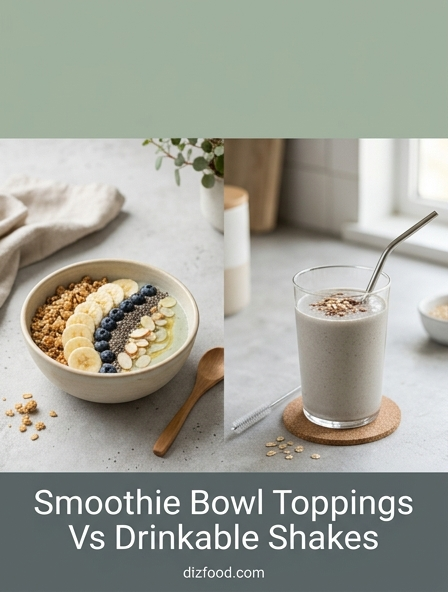
Texture Profiles: Crunch vs Liquid
The sensory experience of a kitchen-crafted smoothie bowl versus a drinkable shake is primarily defined by its structural integrity. A drinkable shake relies on a homogenous, emulsified state where the goal is maximum smoothness. Using high-powered blenders, ingredients like frozen spinach, protein powders, and bananas are pulverized into a silky liquid that flows easily through a straw. The texture is consistent from the first sip to the last, offering a predictable and rapid consumption experience that prioritizes fluidity over variety.
In contrast, smoothie bowls are designed around a foundation of thick, spoonable base material, often achieved by using less liquid or more frozen solids. This base serves as a canvas for a diverse array of toppings that introduce complex architectural textures. The juxtaposition of a creamy acai or mango base against the sharp, brittle snap of toasted almonds or the gritty pop of chia seeds creates a multi-sensory profile. While shakes are uni-dimensional, bowls are experiential, requiring the palate to navigate various densities. Common textural elements in bowls include:
- Crisp: Freeze-dried berries and toasted coconut flakes.
- Crunch: Clusters of granola, roasted pepitas, or cacao nibs.
- Chew: Goji berries, sliced dates, or fresh banana rounds.
- Cream: Dollops of almond butter or Greek yogurt swirls.
This variance in mouthfeel does more than just provide culinary interest; it dictates the speed of the meal. The mechanical resistance provided by solids ensures that the eater engages more deeply with the food, transforming a quick nutrient delivery system into a deliberate culinary event.
Satiety Science: Chewing vs Drinking
The biological difference between consuming a smoothie bowl and a drinkable shake lies in the "mastication effect." When we chew solid toppings such as nuts, seeds, or whole fruit pieces, the body initiates a complex series of satiety signals that are often bypassed during liquid consumption. The act of chewing triggers the release of histamine in the brain, which communicates with the hypothalamus to signal fullness. Furthermore, the longer a food remains in the mouth, the more time the brain has to register the caloric intake, a process known as sensory-specific satiety.
Drinkable shakes are often consumed rapidly, leading to a phenomenon where the gut is physically full, but the brain has not yet received the chemical signals to stop eating. Research consistently shows that liquid calories do not elicit the same compensative reduction in subsequent food intake as solid calories do. By adding toppings that require vigorous chewing, smoothie bowls effectively bridge the gap between a snack and a meal. This difference is often reflected in the hormonal response of the body:
| Feature | Drinkable Shake | Smoothie Bowl |
|---|---|---|
| Ingestion Rate | Fast (approx. 2-5 minutes) | Slow (approx. 15-20 minutes) |
| Cephalic Phase | Minimal activation | High activation through chewing |
| Ghrelin Suppression | Short-term / Rapid return | Sustained suppression |
Ultimately, the inclusion of solids forces a slower pace of ingestion. This allows the stomach to stretch and release leptin, the hormone responsible for telling the body it has had enough, well before the bowl is empty.
Digestion Benefits of Smoothie Bowl Toppings
The digestive process begins in the kitchen and continues in the mouth, long before food reaches the stomach. Smoothie bowl toppings play a critical role in optimizing this process through the activation of salivary enzymes. When we drink a shake, the liquid passes through the oral cavity so quickly that salivary amylase-the enzyme responsible for breaking down carbohydrates-has little time to interact with the food. This can sometimes lead to bloating or a feeling of heaviness as the stomach is forced to do the "heavy lifting" that should have started in the mouth.
By incorporating solid toppings like hemp hearts, sliced strawberries, or granola, the eater is forced to engage in mechanical digestion. This mixing of food with saliva not only pre-digests starches but also coats the bolus in enzymes that facilitate smoother transit through the esophagus. Additionally, the fiber structure of whole toppings remains more intact than those pulverized in a high-speed blender. While blending breaks down insoluble fiber into smaller particles, whole toppings provide the "roughage" necessary for healthy peristalsis.
Key digestive advantages of toppings include:
- Increased Salivation: Enhances the chemical breakdown of nutrients.
- Improved Transit Time: Intact fibers help regulate the speed of the digestive tract.
- Enzyme Priming: The act of chewing signals the pancreas and stomach to prepare for incoming nutrients.
For individuals with sensitive digestive systems, the transition from a rapidly gulped shake to a mindfully chewed bowl can significantly reduce post-meal discomfort and improve nutrient assimilation.
Nutrient Density in Bowls vs Shakes
While the base of a shake and a bowl may be identical, the toppings on a smoothie bowl offer an opportunity for exponential increases in nutrient density. In a drinkable shake, the ingredients must be blendable; fibrous greens, hard nuts, or large fruit chunks can clog straws or create an unappealing "gritty" texture. This often limits the shake to soft fruits, powders, and liquids. Consequently, shakes can sometimes become high in sugar and low in the diverse micronutrients found in raw, unblended whole foods.
The smoothie bowl format encourages the addition of "superfood" accents that are better left unblended to preserve their nutritional integrity and texture. For example, cacao nibs provide a potent dose of magnesium and antioxidants that can be lost in the heat of high-friction blending. Similarly, chia and flax seeds, when left whole or lightly crushed as toppings, provide a different fiber profile than when they are completely emulsified into a liquid. The variety of toppings typically used in bowls creates a broader spectrum of vitamins and minerals in a single serving.
Common nutrient boosters for bowls include:
- Bee Pollen: High in B vitamins and enzymes (sensitive to heat/blending).
- Pumpkin Seeds: Rich in zinc and healthy fats.
- Fresh Berries: Provide intact anthocyanins and vitamin C.
- Nut Butters: Offer concentrated monounsaturated fats and protein.
By layering these ingredients, the bowl becomes a comprehensive meal that hits multiple nutritional targets-healthy fats, complex carbohydrates, and lean proteins-more effectively than a standard blended drink.
Caloric Impact of Added Textures
One of the most significant differences between these two kitchen staples is the caloric density introduced by toppings. A drinkable shake is generally calorie-controlled by the volume of the blender jar. However, once that same mixture is poured into a bowl, the "topping tax" begins. While toppings add essential nutrients and satiety, they also significantly increase the energy density of the meal. It is not uncommon for a "healthy" smoothie bowl to double in calories once granola, nut butter, and honey are applied.
In a kitchen setting, it is important to distinguish between "volume" and "density." A shake might be high volume due to added ice or water, keeping calories low. A bowl, however, is often more concentrated. For those monitoring caloric intake, the choice of toppings is a high-stakes decision. Granola, while delicious, is often toasted with oils and sugars, making it one of the most calorie-dense additions available. Understanding the caloric weight of common toppings is essential for balancing the meal:
| Topping (2 tbsp) | Approx. Calories | Primary Macro |
|---|---|---|
| Hemp Hearts | 110 | Fat/Protein |
| Granola | 80-120 | Carbohydrates |
| Almond Butter | 190 | Fat |
| Cacao Nibs | 130 | Fat/Fiber |
While the shake offers a more predictable caloric ceiling, the bowl offers a customizable range. This makes the bowl a superior choice for athletes needing high energy, but a potential trap for those seeking weight loss if portions aren't strictly measured in the kitchen.
Blood Sugar Response to Solid Toppings
The glycemic response to a meal is heavily influenced by its physical form. When fruit is blended into a drinkable shake, its cellular structure is broken down, making the naturally occurring sugars (fructose) more bioavailable and quicker to absorb. This can lead to a rapid spike in blood glucose, followed by an insulin surge and an inevitable "crash." For individuals managing energy levels or insulin sensitivity, the liquid nature of a shake can be a disadvantage.
Adding solid toppings to a smoothie bowl fundamentally alters this metabolic pathway. The inclusion of fats (nuts/seeds) and fibers (whole fruit/granola) as toppings creates a physical barrier in the stomach, slowing the rate of gastric emptying. This results in a slower, more sustained release of glucose into the bloodstream. Instead of a sharp peak, the blood sugar curve becomes a gentle hill, providing steady energy for hours. This is largely due to the following factors:
- Soluble Fiber: Found in toppings like chia seeds, it forms a gel that slows sugar absorption.
- Protein/Fat Pairing: Adding almond slices or hemp seeds to a fruit-heavy base blunts the glycemic load.
- Particle Size: Larger particles take longer for the body to process than the micro-particles in a shake.
By strategically choosing toppings, the home cook can transform a high-glycemic fruit base into a balanced, diabetic-friendly meal that supports metabolic health rather than disrupting it.
Visual Satiety and Portion Control
The psychology of eating is deeply tied to visual perception, a concept known as "visual satiety." In the kitchen, a drinkable shake is often served in an opaque tumbler or a narrow glass, making it difficult for the eye to register the actual volume of food being consumed. Because the liquid disappears quickly, the brain may feel "cheated" of a meal, leading to hunger shortly after. This is why many people find themselves reaching for a snack an hour after a protein shake.
A smoothie bowl, conversely, leverages visual cues to enhance the feeling of fullness. The wide surface area of a bowl allows the eater to see every ingredient. The vibrant colors of dragon fruit, the arrangement of sliced kiwi, and the scattering of seeds create a "feast for the eyes" that triggers the cephalic phase of digestion. When we see a large, decorated bowl, our brain registers a substantial meal, which preemptively begins the process of appetite suppression. Key psychological factors include:
- The Delboeuf Illusion: A bowl that looks full creates a sense of abundance compared to a half-empty glass.
- Color Variety: Diverse colors signal a range of nutrients, increasing psychological satisfaction.
- Mindfulness: The requirement of a spoon prevents "distracted drinking," forcing the eater to focus on the task.
This visual confirmation of food intake is a powerful tool for portion control. It turns the act of eating into a conscious ritual, ensuring that the body feels as fed as it actually is.
Convenience Factors: Portability vs Presentation
In the modern kitchen, the choice between a shake and a bowl is often dictated by the clock. The drinkable shake is the ultimate "on-the-go" solution. It can be blended in sixty seconds, poured into a travel mug, and consumed during a commute, in a gym locker room, or during a meeting. The shake's lack of toppings is its greatest asset in this context; there is no need for a spoon, no risk of spilling solids, and the container fits into a standard cup holder. For those with a "grab-and-go" lifestyle, the shake is the practical winner.
However, the smoothie bowl represents the "slow food" movement within the kitchen. It is not portable; it requires a flat surface, a spoon, and several minutes of assembly. The presentation is the point. Layering toppings is a creative outlet that rewards the eater with a restaurant-quality aesthetic at home. While the shake is about efficiency, the bowl is about the experience. To decide which fits a lifestyle, one must weigh these factors:
- Shake: Minimal cleanup, one-handed consumption, fast prep.
- Bowl: High visual appeal, social media-worthy, requires "sit-down" time.
Ultimately, the shake serves the utilitarian need for fuel, while the bowl serves the emotional and sensory need for a meal. Most kitchen enthusiasts find a place for both-using shakes for busy workdays and bowls for mindful weekend mornings.
Ingredient Synergy in Layered Bowls
Layering toppings on a smoothie bowl is more than an aesthetic choice; it is a way to maximize nutrient synergy-the concept that certain nutrients are more effective when consumed together. In a blended shake, everything is mixed at once, but in a bowl, the strategic placement of toppings can enhance the bioavailability of the base ingredients. For example, many of the vitamins found in common smoothie bases (like Vitamins A, D, E, and K from spinach or fortified milks) are fat-soluble, meaning they require fat to be absorbed by the body.
By adding toppings like walnuts, avocado slices, or sunflower seeds, you provide the necessary lipid transport for these vitamins. Similarly, the vitamin C in fresh fruit toppings can significantly increase the absorption of non-heme iron found in a spinach or kale-based smoothie bowl. This interplay creates a more bio-available meal than a simple liquid blend. Consider these synergistic pairings often used in bowls:
- Vitamin C + Iron: Strawberries topped over a green base.
- Healthy Fats + Fat-Soluble Vitamins: Nut butter paired with mango or carrot-based blends.
- Probiotics + Prebiotics: Greek yogurt dollops paired with banana or honey.
The "layered" approach ensures that these components stay distinct until the moment of consumption, preventing the oxidation of certain delicate antioxidants that can occur when they are blended at high speeds and exposed to air. This kitchen strategy turns a simple snack into a highly efficient delivery system for health.
Customizing Macros with Smoothie Toppings
The greatest advantage of the smoothie bowl in a kitchen setting is the ability to precision-tune macronutrients after the base is made. A drinkable shake is often "locked in" once the blender stops. If you realize the shake is too carb-heavy, it is difficult to fix. With a bowl, however, the toppings serve as a final adjustment layer to meet specific dietary goals for the day, whether that is increasing protein, boosting healthy fats, or adding complex fiber.
This customization makes the smoothie bowl an ideal tool for families or households with different nutritional needs. A single "base" can be made in the blender, but the toppings can be tailored for each individual. An athlete might add hemp hearts and granola for high energy and protein, while someone on a lower-carb path might opt for toasted coconut and almonds. The kitchen becomes a laboratory for macro-management. Common customization strategies include:
| Goal | Recommended Toppings | Benefit |
|---|---|---|
| Muscle Recovery | Hemp seeds, Greek yogurt | High Bioavailable Protein |
| Long-term Energy | Nut butters, Chia seeds | Sustained Fat Burn |
| Digestive Health | Fresh berries, Flax meal | High Insoluble Fiber |
This modularity allows for a level of dietary flexibility that a standard shake simply cannot match, turning the morning routine into a personalized nutrition plan.

Comments