
Deciding between a dedicated electric egg cooker and the classic stovetop boiling pot often comes down to your craving for precision versus flexibility. While the traditional pot is a kitchen staple that handles any volume of eggs with ease, it requires a watchful eye and a bit of "boiling intuition" to avoid overcooking and that dreaded green ring around the yolk. In contrast, an electric egg cooker offers "set it and forget it" convenience, utilizing precise steam technology to deliver consistent soft, medium, or hard-boiled results every single time without the guesswork. Whether you are a meal-prep enthusiast looking for effortless peeling or a culinary purist who prefers manual control, understanding how these two methods compare in speed, texture, and cleanup is the secret to achieving your version of the perfect egg.
| Feature | Electric Egg Cooker | Traditional Boiling Pot |
|---|---|---|
| Consistency | Precision steam; automatic shut-off. | Variable; depends on manual timing. |
| Ease of Use | Hands-free; no monitoring required. | Requires active boiling/timer watch. |
| Peelability | High; steam loosens shell membrane. | Moderate; relies on "ice bath" shock. |
| Capacity | Limited (usually 6-12 eggs max). | Flexible (limited only by pot size). |
| Speed | Fast; no need to boil large water volume. | Slower; includes water heat-up time. |
| Versatility | Single-use (often includes poaching). | Multi-purpose kitchen essential. |
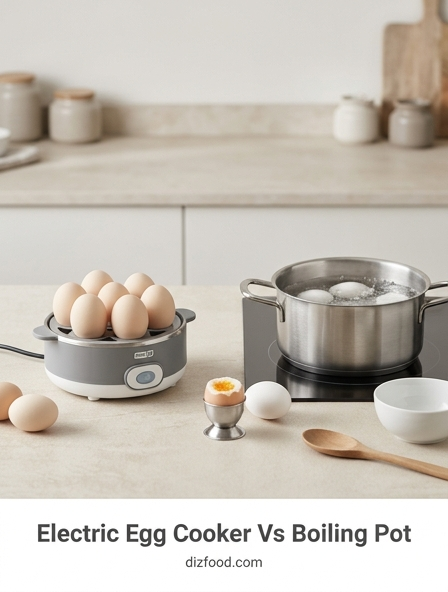
Electric Egg Cooker vs Boiling Pot Comparison
In the modern kitchen, the debate between specialized appliances and traditional multi-purpose cookware is epitomized by the electric egg cooker versus the standard boiling pot. While both tools are designed to achieve the same end goal-transforming raw eggs into a cooked state-their methodologies differ significantly. A boiling pot relies on submersion in a large volume of turbulent, heated water, utilizing conduction as the primary heat transfer method. Conversely, an electric egg cooker typically utilizes steam, using a small, precise amount of water to create a high-temperature vapor environment within a sealed chamber.
| Feature | Electric Egg Cooker | Boiling Pot |
|---|---|---|
| Heating Method | Steam-based | Submersion/Boiling |
| Monitoring | Automatic Shut-off | Manual Timer Required |
| Versatility | Specific to Eggs | Universal Cooking |
| Precision | High (Measured Water) | Variable (Temperature/Time) |
The choice between these two often comes down to a trade-off between kitchen minimalism and specialized convenience. A boiling pot is a staple of every household, capable of cooking pasta, soups, and vegetables, whereas the electric egg cooker is a "unitasker" that promises to perfect one specific ingredient. For enthusiasts who consume eggs daily, the consistency offered by the specialized electronics may outweigh the footprint of an extra device. However, for the occasional cook, the traditional pot remains a reliable, if more labor-intensive, alternative.
Precision and Consistency in Egg Doneness
Achieving the perfect yolk-whether it be a runny soft-boiled center or a creamy, fully set hard-boiled interior-requires precise temperature control and timing. The electric egg cooker excels in this arena by removing the variables of human error. Most models operate on the principle of water volume; you add a specific amount of water using a graduated measuring cup, and the machine runs until the water has completely evaporated, triggering an automatic shut-off. This ensures that the eggs are exposed to the exact amount of thermal energy required every single time.
In contrast, using a boiling pot introduces several variables that can lead to inconsistent results. These include:
- The initial temperature of the water (starting from cold vs. boiling).
- The altitude of the kitchen, which affects the boiling point of water.
- The size and material of the pot, influencing how long it retains heat.
- The intensity of the burner flame or induction setting.
When boiling eggs in a pot, even a thirty-second delay in removing them from the heat can result in an overcooked green ring around the yolk. The electric cooker eliminates this risk with its audible alert and instant heat cessation. For those who demand "jammy" yolks for avocado toast or ramen, the specialized cooker provides a level of repeatability that is difficult to match with a manual stovetop method, where one must constantly watch the clock and manage the heat levels.
Speed and Time Efficiency Differences
Time efficiency in the kitchen is often measured not just by the cooking duration, but by the "active" time required from the cook. The boiling pot method is notoriously slow during the initial phase. To cook six eggs, one must fill a medium pot with enough water to cover them by an inch, then wait five to ten minutes for that water to reach a rolling boil. Only then does the actual cooking timer begin. Total elapsed time can easily exceed fifteen to twenty minutes from start to finish.
The electric egg cooker is designed for rapid deployment. Because it uses steam rather than submersion, it only requires a few tablespoons of water. This tiny volume reaches steaming temperatures in less than a minute. While the actual "cooking" phase might take a similar amount of time to the boiling method, the lack of a long pre-heating phase significantly shortens the total cycle. Typically, a batch of hard-boiled eggs is ready in about 10 to 12 minutes from the moment the "on" switch is flipped.
Furthermore, the "set it and forget it" nature of the electric cooker enhances efficiency. A cook can start the eggs and walk away to shower or prep other meal components without fear of a pot boiling over or eggs cracking due to turbulent water. The boiling pot requires constant proximity to ensure the water maintains a simmer and to catch the exact moment the timer expires, making it the less efficient choice for a busy morning routine.
Ease of Use and Automation Features
The primary appeal of an electric egg cooker lies in its user-friendly interface, which often consists of a single button. Most units come with a specialized measuring cup that indicates the water levels for soft, medium, and hard-boiled results based on the number of eggs being cooked. This replaces the need for complex charts or mental math. A unique feature of many cookers is the integrated piercing pin, located at the bottom of the measuring cup, which allows the user to prick the large end of the egg to prevent cracking and ensure a symmetrical shape.
Standard boiling, while conceptually simple, requires a more hands-on approach. The user must manage the following steps carefully:
- Selecting the right pot size to prevent eggs from bumping into each other.
- Carefully lowering eggs into boiling water with a slotted spoon to avoid breakage.
- Adjusting the heat to maintain a gentle simmer rather than a violent boil.
- Preparing an ice bath manually to stop the cooking process immediately.
Automation is the dividing line here. An electric cooker will chime and turn itself off, preventing the eggs from overcooking even if the user is in another room. The boiling pot offers no such safety net; if you forget the eggs on the stove, the water will eventually evaporate, leading to burnt eggs and a damaged pot. For families with children or distracted professionals, the safety and simplicity of the automated appliance provide significant peace of mind that a traditional stove cannot offer.
Capacity for Small vs Large Batches
When considering capacity, the boiling pot is the undisputed champion. A standard 6-quart Dutch oven or stockpot can comfortably accommodate two dozen eggs or more in a single layer, making it the ideal choice for holiday meal prep, deviled egg platters for parties, or weekly meal prepping for a large family. The only limitation is the physical size of the vessel and the amount of water your stove can efficiently heat. For large-scale production, the pot method is significantly more scalable.
Electric egg cookers are generally designed for personal or small-family use. Most consumer models feature a single rack that holds six or seven eggs. While "double-decker" models exist that can handle 12 to 14 eggs, they are still physically limited by the dimensions of the heating plate and the steam dome. If you need to cook 20 eggs in an electric cooker, you would have to run three separate cycles, which would take much longer than a single large pot on the stove.
However, for small batches of one to three eggs, the electric cooker is far more logical. Heating a large pot of water for a single egg is a waste of time and resources. The cooker treats one egg with the same precision as six, making it the superior tool for solo diners or couples who only need a few eggs for a quick breakfast. Therefore, the choice depends on your typical volume: choose the pot for entertaining and the cooker for daily individual use.
Energy Consumption and Utility Costs
From an ecological and economic standpoint, the electric egg cooker is the more efficient appliance. It operates on a low-wattage heating element, typically between 300 and 500 watts, and only runs for a short duration. Because it only needs to heat a few ounces of water to create steam, very little energy is wasted. The enclosed plastic or metal dome retains heat effectively, ensuring that the thermal energy is directed almost entirely toward the eggs themselves.
In contrast, a boiling pot on a stovetop-especially an electric coil or gas burner-is remarkably inefficient for this specific task. To boil eggs, you must heat several liters of water, which requires a significant amount of energy to reach 212°F (100°C). A standard stovetop burner consumes between 1,000 and 3,000 watts. Additionally, a large amount of heat escapes into the surrounding kitchen air rather than being absorbed by the water or the eggs. This not only increases your electricity or gas bill but can also uncomfortably warm the kitchen during summer months.
While the difference in a single use might amount to only a few cents, the cumulative effect over a year of frequent egg consumption is noticeable. Using an electric cooker reduces water waste significantly, as the boiling method requires several cups of water that are eventually poured down the drain. For those looking to minimize their carbon footprint and optimize kitchen utility costs, the specialized steamer is the clear winner in thermal efficiency.
Cleaning and Maintenance Requirements
Cleaning a boiling pot is a straightforward process. Since the pot only contains water and eggs, there is rarely any stubborn food residue. Most stainless steel or non-stick pots are dishwasher safe, and any calcium deposits left behind by hard water can be easily scrubbed away with a standard sponge. The eggs themselves are contained within their shells, so the vessel remains hygienic throughout the process. Maintenance is virtually non-existent, as a high-quality pot can last for decades without mechanical failure.
Electric egg cookers require a bit more attention due to their specialized components. The heating plate is prone to "scaling"-the buildup of mineral deposits from evaporated water-which can appear as brown or white spots. If not cleaned regularly, this buildup can reduce the heating efficiency and eventually cause the sensor to malfunction. Users must occasionally perform a "deep clean" by wiping the plate with distilled vinegar. While the egg trays and lids are usually dishwasher safe, the base contains the electrical components and must be carefully hand-cleaned.
Furthermore, because many electric cookers involve piercing the egg shell, there is a small risk of an egg leaking during the cooking process. If an egg cracks and leaks onto the heating plate, it can bake onto the surface, requiring significant scrubbing. Additionally, the small piercing pin on the measuring cup must be kept clean and dry to prevent rusting or bacterial growth. In terms of long-term durability and ease of maintenance, the simplicity of the boiling pot offers a distinct advantage over the mechanical complexity of the electric cooker.
Kitchen Storage and Counter Space Impact
The impact on kitchen organization is a major factor for those living in apartments or homes with limited storage. A boiling pot is an essential item that most people already own. It stacks easily with other pots and pans or sits on the stovetop. It does not require dedicated "real estate" in the pantry because its utility extends across all meals. Choosing to use a pot for eggs adds zero additional clutter to the kitchen environment.
The electric egg cooker, however, is a classic example of a "unitasker" that can contribute to kitchen crowding. While most models are compact-roughly the size of a large grapefruit or a small toaster-they still require a dedicated spot on the counter or in a cabinet. For those who follow a minimalist philosophy, owning a device that only performs one function is often seen as an unnecessary burden. It also requires an available electrical outlet, which can be a premium in older kitchens.
On the positive side, the small footprint of the cooker makes it highly portable. It is an excellent solution for:
- Dorm rooms where a stove is not available.
- Office breakrooms for healthy snacks.
- Recreational vehicles (RVs) and campers.
The Science of Easy Peeling Success
One of the greatest frustrations in egg preparation is the shell sticking to the whites, resulting in a pitted, unattractive egg. This is largely governed by the temperature of the egg when it starts cooking and the method of heat application. The electric egg cooker has a secret weapon: steam. Steam molecules are smaller and move faster than liquid water molecules, allowing them to penetrate the porous eggshell more effectively. This helps to shrink the membrane away from the shell almost instantly, creating a clean separation that makes peeling effortless.
The boiling pot method often struggles with peeling because many people start their eggs in cold water. As the water slowly heats up, the egg whites have time to fuse to the interior membrane. To get "easy-peel" eggs in a pot, you must use the "hot start" method-dropping cold eggs directly into already boiling water. However, this increases the risk of the shell cracking due to thermal shock as the air pocket expands rapidly. The electric cooker's piercing tool solves this by providing an escape vent for that air, allowing for a "hot start" via steam without the breakage.
Regardless of the method used, the "shock" phase is critical. Both methods require the eggs to be moved into an ice bath immediately after cooking. However, because the steam method in an electric cooker consistently provides a more intense initial heat blast to the exterior of the egg without the turbulence of bubbling water, it generally yields a higher percentage of perfectly smooth, easy-to-peel eggs compared to traditional boiling.
Final Verdict on the Best Method
Deciding between an electric egg cooker and a boiling pot depends entirely on your lifestyle, dietary habits, and kitchen philosophy. Neither tool is objectively "better," but one will certainly suit your specific needs more effectively than the other. If you are a high-volume egg consumer who values precision and time-saving automation, the electric cooker is a transformative investment. It eliminates the guesswork and frees you from the stove, making it an essential tool for those who want consistent results with zero effort.
However, the boiling pot remains the king of versatility and capacity. For the home cook who only prepares eggs occasionally or needs to boil dozens at a time for social gatherings, the pot is the more practical and economical choice. It doesn't require extra storage space, it's easier to maintain, and it doesn't add to the "appliance graveyard" in your cabinets. To help you decide, consider the following summary:
- Choose the Electric Cooker if: You eat eggs daily, have limited time in the morning, struggle with peeling, or live in a small space like a dorm or RV.
- Choose the Boiling Pot if: You prefer a minimalist kitchen, cook for large groups, want dishwasher-safe cleanup, and don't mind monitoring a timer.
In the end, the science of the perfect egg remains the same: controlled heat and rapid cooling. Whether you achieve that through the high-tech steam of a specialized cooker or the reliable convection of a stovetop pot, the result-a nutritious and delicious protein-is what truly matters in the kitchen.

Comments