
| Feature | Spiralizer | Mandoline (Ribbon Cut) |
|---|---|---|
| Primary Cut Shape | Long, curly spirals (Spaghetti/Fettuccine) | Wide, flat ribbons (Pappardelle/Sheets) |
| Best Produce Types | Firm, long items (Zucchini, Carrots, Beets) | Almost any firm fruit/veg (Radish, Potato) |
| Manual Effort | High (Continuous cranking or pushing) | Medium (Rapid sliding motion) |
| Safety Profile | High (Blades are usually recessed) | Lower (Exposed blades; requires guard/glove) |
| Storage & Size | Bulky; requires more counter/cabinet space | Slim, flat profile; fits easily in drawers |
| Ideal Dish | Low-carb pasta swaps & curly fries | Vegetable lasagna, salads, & garnishes |
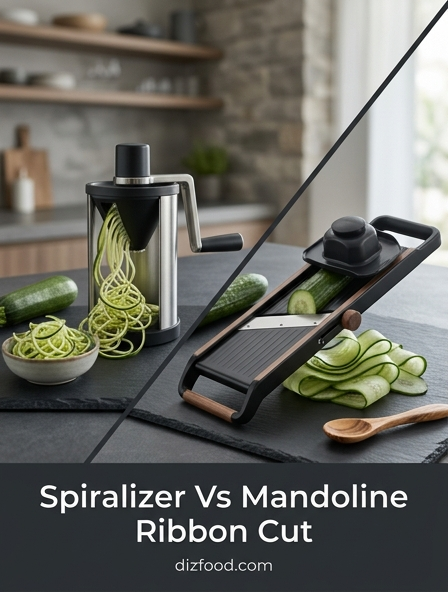
Spiralizer vs Mandoline for Making Vegetable Ribbons
When it comes to transforming dense vegetables into delicate, pasta-like strands or wide, elegant ribbons, the kitchen tool you choose dictates the final aesthetic and culinary application. The spiralizer and the mandoline are the two primary contenders for this task, yet they operate on entirely different mechanical principles. A spiralizer typically uses a hand-crank or motorized mechanism to rotate a vegetable against a fixed blade, resulting in continuous, curly strands. In contrast, a mandoline relies on a flat, razor-sharp stationary blade where the user slides the vegetable back and forth to create uniform slices or wide ribbons.
The choice between these two often comes down to the desired shape of the ribbon. Spiralizers are designed for volume and length, making them ideal for creating "zoodles" or long curly fries that mimic the experience of eating spaghetti. Mandolines are more focused on geometric precision and width. While a spiralizer can create thin, flat ribbons with the right attachment, they will always have a circular or helical curve. A mandoline produces perfectly straight, flat ribbons that are excellent for layered dishes like vegetable lasagna or sophisticated garnishes. Understanding the strengths of each tool is the first step in mastering vegetable-forward cooking.
- Spiralizer: Best for long, continuous, curly strands and "pasta" substitutes.
- Mandoline: Best for wide, flat, straight ribbons and uniform thickness control.
- Mechanism: Spiralizers use rotation; mandolines use linear sliding action.
Understanding the Difference Between Spiralized and Mandoline Sliced Ribbons
The fundamental difference between a spiralized ribbon and a mandoline-sliced ribbon lies in the structural integrity and curvature of the vegetable fiber. When you use a spiralizer, the vegetable is centered on a spindle and pushed through a blade as it turns. This process cuts across the natural grain of the vegetable in a helical pattern. The result is a ribbon that naturally wants to curl and spring, which provides a significant amount of "loft" on the plate. This makes spiralized ribbons feel lighter and more voluminous, which is why they are favored for salads where a dressing needs to coat every nook and cranny.
Mandoline slicing, however, produces a ribbon that is generally cut along the longitudinal axis of the vegetable. These ribbons are flat, wide, and lack the internal tension that causes curling. Because the mandoline allows for incredibly fine adjustments-often down to a fraction of a millimeter-the ribbons can be made translucent. This level of thinness is difficult to achieve with a standard spiralizer. Mandoline ribbons are preferred for decorative plating, such as "carpaccio" style vegetable arrangements or wrapping around fillings to create elegant appetizers. While the spiralizer offers whimsy and length, the mandoline offers professional-grade precision and flat surfaces.
| Feature | Spiralizer Ribbon | Mandoline Ribbon |
|---|---|---|
| Shape | Helical/Curly | Flat/Straight |
| Length | Potentially very long | Limited to length of vegetable |
| Texture | Springy and airy | Smooth and dense |
Best Tools for Creating Perfect Veggie Pasta and Ribbon Cuts
Achieving the perfect ribbon cut requires selecting a tool that matches your kitchen habits and the types of vegetables you use most frequently. For heavy-duty veggie pasta production, a countertop spiralizer with a vacuum-suction base is the gold standard. These units offer multiple blade inserts, allowing you to switch from a spaghetti-cut to a wide ribbon-cut (often called the "c-blade" or "flat blade") in seconds. These tools are particularly effective for firm vegetables like sweet potatoes and butternutsquash, providing the torque necessary to process them without hand fatigue.
If your goal is more oriented toward delicate ribbons for salads or pickling, a high-quality V-blade mandoline or a Japanese-style mandoline (like a Benriner) is superior. The Japanese mandoline is particularly praised by professional chefs for its incredibly sharp, adjustable blade that can produce ribbons so thin they are nearly see-through. For those with limited space, handheld 2-in-1 spiralizers are available, though they lack the stability of countertop models and are better suited for softer vegetables like zucchini. Regardless of the tool, the "best" option is one that provides a secure grip and a blade that can be sharpened or replaced, as dull blades are the primary cause of ragged edges and kitchen accidents.
- Countertop Spiralizer: Best for bulk pasta replacement and hard root vegetables.
- Japanese Mandoline: Best for razor-thin ribbons and precision garnishes.
- Handheld Spiralizer: Best for small kitchens and quick, single-serving zucchini ribbons.
- V-Blade Mandoline: Best for soft vegetables like tomatoes or eggplants.
Efficiency Comparison: Spiralizer Speed vs Mandoline Precision
Efficiency in the kitchen is often a trade-off between speed and the level of detail required for a dish. The spiralizer is the undisputed champion of speed when it comes to high-volume vegetable processing. Because the vegetable is locked into the device, a few turns of the handle can transform an entire large zucchini into a pile of ribbons in less than thirty seconds. This makes it the preferred tool for families or meal-preppers who need to create large quantities of vegetable base for dinner. The continuous motion of the spiralizer means there is very little downtime between cuts.
The mandoline, while slower for volume, excels in precision efficiency. When you need every single ribbon to be exactly two millimeters thick for a tiered vegetable terrine, the mandoline is much faster than trying to achieve that consistency with any other tool. However, the mandoline requires more focus and a slower physical movement to ensure safety and uniformity. You are also limited by the length of the vegetable; once you reach the end, you must use a safety guard which can sometimes be cumbersome and slow down the process. In summary, if you are racing to get a healthy dinner on the table, grab the spiralizer. If you are crafting a gourmet meal where the visual uniformity of the ribbons is paramount, the mandoline is worth the extra time.
Safety Features of Spiralizers and Mandolines for Ribbon Cutting
Safety is a critical consideration because both tools utilize extremely sharp blades designed to slice through tough fibers. The spiralizer is generally considered the safer of the two tools for beginners. In a countertop spiralizer, the vegetable is held in place by a spiked handle and a circular blade housing. Your hands are typically several inches away from the cutting surface at all times, and the force is applied through a crank. This physical separation significantly reduces the risk of accidental nicks. Many modern spiralizers also feature "enclosed" blade systems where the sharp edges are only exposed during the actual cutting process.
Mandolines, conversely, are often cited as one of the most dangerous tools in the kitchen if used improperly. The motion involves sliding your hand directly toward a stationary blade. To mitigate this risk, quality mandolines come with a "food guard" or "pusher" that grips the vegetable, keeping your fingers away from the steel. Furthermore, many chefs recommend using a cut-resistant glove (made of Kevlar or stainless steel mesh) when operating a mandoline. Safety features to look for include:
- Non-slip feet: Prevents the tool from sliding across the counter during use.
- Locking mechanisms: Ensures the blade is tucked away when the tool is in storage.
- Enclosed blade cartridges: Allows for blade changes without touching the sharp edges.
- Finger guards: Essential for mandoline use to finish the last inch of the vegetable.
Texture and Thickness: How Each Tool Impacts Your Vegetable Ribbons
The physical texture of a vegetable ribbon dictates how it interacts with heat and liquid. Spiralized ribbons tend to be thicker and have a more "toothy" or al dente texture once cooked. Because they are often helical, they have more surface area exposed to air, which can help them shed moisture during a quick sauté. This is vital for zucchini, which can otherwise become soggy. The spiralizer's ribbons are generally uniform in thickness but can vary in width depending on the specific blade used. The resulting texture is hearty, making it a viable substitute for grain-based pasta.
Mandoline ribbons offer a much broader range of textural possibilities because of the adjustable blade depth. You can create ribbons that range from paper-thin "shavings" to thick, sturdy planks. Very thin mandoline ribbons have a delicate mouthfeel and soften almost instantly when exposed to dressing or heat. This makes them ideal for raw applications, such as a shaved fennel and radish salad. If you cut them thicker, they provide a satisfying "snap" that a spiralized ribbon cannot replicate. The flat surface of a mandoline cut also allows for better caramelization if you are searing the ribbons in a pan, as there is more direct contact between the vegetable surface and the hot metal.
Top Vegetables for Spiralized Spirals vs Mandoline Ribbon Slices
Not all vegetables are created equal when it comes to these two tools. The physical shape and density of the produce will often dictate which tool you should reach for. Spiralizers require vegetables that are at least two inches long and an inch thick, with a relatively straight shape. They also need to be solid throughout; a hollow vegetable like a bell pepper will simply fall apart in a spiralizer. Mandolines are more forgiving regarding the internal structure of the vegetable but require a flat surface or a steady hand to start the cut.
For the spiralizer, zucchini is the gold standard, followed closely by firm root vegetables like carrots, parsnips, and beets. Large radishes (like Daikon) also spiralize beautifully into long, crisp ribbons. For the mandoline, vegetables with a wider diameter or those that are more delicate are preferred. Cucumbers produce beautiful, long ribbons that are perfect for sushi or salads. Asparagus spears, when laid flat, can be shaved into elegant ribbons that are impossible to create with a spiralizer. Potatoes are also better suited for the mandoline if you are looking to make wide ribbons for frying into "ribbon chips."
- Best for Spiralizer: Zucchini, Butternut Squash (neck), Sweet Potatoes, Daikon Radish.
- Best for Mandoline: Cucumbers, Asparagus, Fennel, Eggplant, Large Carrots.
- Avoid Spiralizing: Celery, Eggplant, Bell Peppers.
- Avoid Mandoline: Very small or round items without a guard.
Cleaning and Storage: Spiralizer vs Mandoline Practicality
In a busy kitchen, the ease of cleaning and storage can be the deciding factor in whether a tool is used or left to gather dust. Spiralizers, particularly countertop models, tend to be bulkier. They consist of several parts: the main base, the crank handle, and multiple blade plates. Cleaning can be a challenge because vegetable fibers often get stuck in the small teeth of the blades. Most manufacturers recommend rinsing them immediately after use to prevent juices from drying and "gluing" the fibers in place. While many are dishwasher safe, the high heat can sometimes dull the blades over time.
Mandolines are generally more streamlined and easier to store. A standard mandoline is a single, flat board that can slide into a narrow drawer or hang on a pot rack. Because the blade is usually a single straight or V-shaped piece of metal, it is easier to wipe clean with a brush. However, extreme caution must be taken during cleaning to avoid cuts. Many modern mandolines feature "fold-away" legs or blade guards that make them very compact. If you have a small apartment kitchen, the mandoline wins on storage practicality. If you have a large pantry and cook for a crowd, the extra space required for a spiralizer is a justifiable trade-off for its high-volume output.
Kitchen Versatility: Beyond Just Making Ribbon Cuts
While both tools are famous for ribbons, their utility extends into various other culinary tasks. A mandoline is arguably one of the most versatile tools in a chef's arsenal. Beyond ribbons, it is used for julienning vegetables for stir-frys, making perfect potato slices for gratin, shaving hard cheeses, and even slicing citrus for cocktails. Some models come with waffle-cut blades for making crinkle-cut fries. The ability to control thickness precisely makes it useful for everything from homemade potato chips to thin onion slivers for burgers.
The spiralizer is more specialized but still offers some variety. By changing the blade, you can move from wide ribbons to thin "angel hair" strands or thicker "curly fry" cuts. Some high-end spiralizers even have attachments for peeling or coring apples. However, the spiralizer is fundamentally limited by its rotational requirement. You cannot use it to slice a tomato or shave a block of parmesan. It is a "one-trick pony" that performs its trick exceptionally well. If you are looking for a tool that can assist with 75% of your vegetable prep, the mandoline is the better investment. If you are specifically focused on low-carb pasta alternatives, the spiralizer is the superior specialist tool.
Choosing the Right Tool for Your Ribbon Cut Recipes
Ultimately, the decision between a spiralizer and a mandoline depends on your specific cooking goals. If your primary motivation is health-oriented-specifically replacing grain-based noodles with vegetable alternatives-the spiralizer is the correct choice. Its ability to create long, continuous strands provides a sensory experience very close to eating pasta, which is difficult to replicate with the shorter, flatter ribbons produced by a mandoline. It is the better tool for hearty, sauce-heavy dishes like "zucchini bolognese" or "sweet potato pad thai."
On the other hand, if you are a culinary enthusiast who values presentation, precision, and versatility, the mandoline is the better fit. It allows you to explore professional techniques like vegetable "carpaccio," delicately layered terrines, or ultra-thin pickling. The mandoline is about finesse and control. Before purchasing, consider your comfort level with sharp blades and the amount of storage space available. Many home cooks eventually find a place for both: the spiralizer for quick weeknight family meals and the mandoline for detailed weekend entertaining. By choosing the tool that matches the recipe's requirement for either "bulk and curl" or "precision and flatness," you ensure the best possible texture and visual appeal for your vegetable dishes.

Comments