
Essential Tools for Perfect Ribbons
Creating elegant vegetable ribbons requires the right equipment to ensure consistency and ease of motion. While a standard chef's knife can achieve this with enough practice, specialized tools are often more efficient for the home cook. The most common tool is the Y-peeler, which provides a wide blade and a stable grip, allowing for long, continuous strokes. Swivel peelers are also effective, though they may offer slightly less control for wider vegetables like zucchini or squash.
Beyond hand-held peelers, other instruments can elevate your kitchen repertoire. Consider these essentials for your toolkit:
- Y-Peeler: Best for wide, flat ribbons with deep reach.
- Mandoline Slicer: Ideal for producing hundreds of identical, translucent strips quickly.
- Spiralizer: Useful for creating curled or noodle-like ribbon shapes.
- Vegetable Shears: Handy for trimming the edges of wider ribbons to maintain a uniform appearance.
Selecting high-quality stainless steel blades ensures that the tool glides through the vegetable fibers without tearing, resulting in a professional-grade finish every time.
Best Vegetables for Ribbon Slicing
Not every vegetable is suitable for ribboning; the best candidates possess a firm texture and a relatively straight structure. Root vegetables and certain gourds are the primary choices because their dense flesh holds up well under the pressure of a blade. Carrots, for example, produce vibrant, crunchy ribbons, while cucumbers offer a refreshing, watery snap that is perfect for summer salads. Choosing the right vegetable depends on whether you intend to serve them raw or lightly blanched.
Below are some of the most popular vegetables used for this technique:
| Vegetable | Texture | Best Usage |
|---|---|---|
| Zucchini | Soft/Pliant | Pasta substitute |
| Carrots | Firm/Crisp | Garnish/Salads |
| Asparagus | Delicate | Lightly sautéed |
| Daikon Radish | Dense/Crunchy | Pickling/Asian dishes |
Always select produce that is fresh and taut; limp vegetables will snag against the peeler, resulting in jagged edges and uneven thickness.
Mastering the Vegetable Peeler Technique
The vegetable peeler is the most accessible tool for creating ribbons, but mastering its use requires a specific technique to ensure safety and aesthetic appeal. The goal is to produce a single, unbroken strip that spans the entire length of the vegetable. This requires a steady hand and consistent downward pressure. If the pressure is too light, the ribbon will be paper-thin and fragile; if it is too heavy, the blade may get stuck or produce chunky, unattractive pieces.
- Place the vegetable flat on a cutting board to provide a stable base.
- Hold the top of the vegetable firmly with your non-dominant hand.
- Start the peeler at the very top and pull downward in one smooth motion.
- Rotate the vegetable slightly after each pass to maintain an even shape.
By following these steps, you avoid the common mistake of peeling only one side, which eventually makes the vegetable too thin to handle. Instead, working in a circular fashion keeps the core centered and the ribbons uniform.
Using Mandolines for Uniform Strips
For chefs who require high-volume production with absolute precision, the mandoline is an indispensable tool. Unlike a hand-held peeler, a mandoline allows you to set a specific depth, ensuring that every single ribbon is identical in thickness. This is particularly important for dishes where even cooking times are essential, such as vegetable carpaccio or baked vegetable chips. The flat platform provides the stability needed to process large items like sweet potatoes or eggplants that might be too cumbersome for a small peeler.
When using a mandoline, the vegetable is pushed across a fixed blade. This action produces wide, flat sheets that can be used as-is or stacked and sliced further into thinner ribbons. It is vital to use the safety guard provided with the machine, as the blades are exceptionally sharp and positioned in a way that makes finger slips dangerous. With the right setting, you can achieve ribbons so thin they become translucent, adding a sophisticated, airy texture to your culinary creations.
Advanced Knife Skills for Ribbons
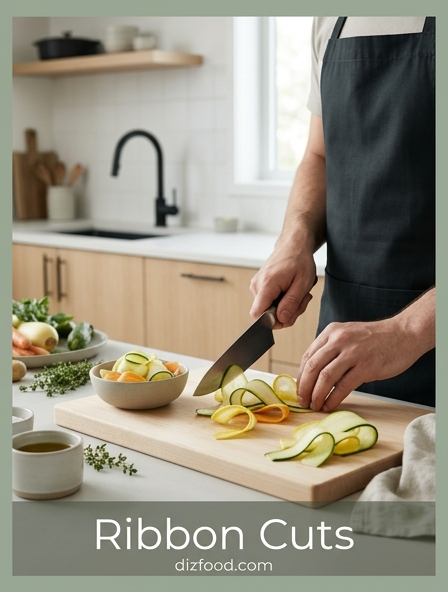
While mechanical tools offer speed, nothing matches the prestige of hand-cut ribbons using a chef's knife. This technique, often referred to in French cuisine as "chiffonade" when applied to leafy greens, can be adapted for solid vegetables. It requires a razor-sharp blade and a rhythmic "rocking" motion. For solid vegetables like cucumbers, the process involves "unrolling" the vegetable by cutting a continuous thin layer from the outside toward the core, much like unrolling a spool of paper.
To succeed with a knife, focus on these key elements:
- Blade Sharpness: A dull knife will crush the vegetable cells instead of slicing them.
- Anchor Point: Keep the tip of the knife in contact with the board for better leverage.
- Width Consistency: Use your knuckles as a guide to maintain a steady width for each strip.
- Finger Positioning: Always use the "claw grip" to protect your fingertips.
Hand-cutting allows for custom widths that peelers cannot achieve, giving the chef total creative control over the final presentation.
Preparation Tips for Consistent Cuts
The secret to perfect ribbons often lies in the preparation work before the blade ever touches the vegetable. To ensure every cut is clean and uniform, you must first create a stable work surface. This often involves "squaring off" the vegetable. By slicing a small sliver off one side of a round vegetable like a carrot or zucchini, you create a flat base that prevents the vegetable from rolling or wobbling during the ribboning process.
- Wash and thoroughly dry the produce to prevent the blade from slipping.
- Trim both ends of the vegetable to create clean entry and exit points.
- Peel away the tough outer skin if it is bitter or overly fibrous.
- Ensure the vegetable is at room temperature; very cold vegetables can be brittle and prone to snapping.
Once the vegetable is stabilized and prepped, your movements will be more fluid, reducing the risk of jagged edges. Proper preparation also ensures that you can utilize as much of the vegetable as possible before reaching the seeded core.
Safety Practices for Precision Slicing
Creating ribbons involves moving sharp blades at high speeds or with significant pressure, making safety a primary concern. The most common injuries occur when the vegetable becomes too small to hold securely, tempting the cook to place their fingers too close to the blade. To prevent this, always stop slicing once you reach the core or when the vegetable becomes thin enough to lose its structural integrity. These leftover pieces are perfect for stocks or dicing into soups.
Using a cut-resistant glove is highly recommended for beginners, especially when working with a mandoline or a sharp Y-peeler. Additionally, ensuring your cutting board is secured with a non-slip mat or a damp paper towel underneath prevents the entire setup from shifting mid-cut. Focus on the task at hand and avoid distractions, as precision slicing requires visual concentration to maintain thickness and avoid accidents. By respecting the tools and maintaining a tidy workspace, you can produce beautiful ribbons without compromising your physical safety.
Plating Techniques for Elegant Dishes
The visual appeal of ribbons lies in their ability to create volume and movement on the plate. Instead of laying them flat, which can look limp, try "nesting" the ribbons to provide height. By gently tossing the ribbons in a bowl with a light dressing before plating, you give them a glisten that catches the light. You can then use kitchen tweezers or your fingers to twirl the strips into mounds, similar to how one plates spaghetti.
Consider these plating strategies for maximum impact:
- Twirling: Roll individual ribbons into tight cylinders for a structured look.
- Intertwining: Mix different colored ribbons, like purple and orange carrots, for contrast.
- Draping: Lay long ribbons over a protein to create a soft, veil-like effect.
- Scattering: Use shorter, curled ribbons to add texture to the top of a salad.
Height is the key to professional plating; the more air you can incorporate between the ribbons, the more appetizing and sophisticated the dish will appear to the diner.
Maintaining Texture and Freshness
Vegetable ribbons have a high surface-area-to-volume ratio, which means they lose moisture and oxidize much faster than whole or diced vegetables. To keep them crisp, it is essential to store them correctly if they are not being served immediately. An ice water bath is the most effective method for maintaining turgidity. Submerging the ribbons in cold water for 10 to 15 minutes causes the cells to swell, making the ribbons extra crunchy and often causing them to curl into attractive shapes.
However, do not leave them in water for too long, as this can dilute their flavor. Once removed from the ice bath, spin them in a salad spinner or pat them dry with a lint-free towel. If you are dressing the ribbons, do so only seconds before serving. Acidic dressings containing vinegar or lemon juice will quickly break down the cell walls, turning your crisp ribbons into a soggy mess. For the best results, use a light oil-based vinaigrette and a gentle hand when tossing.
Creative Ways to Serve Ribbons
Ribbon cuts offer a versatile way to reimagine classic dishes by swapping out traditional carbohydrates for nutrient-dense vegetables. One of the most popular uses is as a gluten-free pasta alternative. Zucchini ribbons, often called "zoodles" when thin, can be lightly sautéed or served raw with a warm pesto or marinara sauce. The wide surface area of the ribbons is excellent for holding onto thick sauces, providing a satisfying mouthfeel without the heaviness of grain-based noodles.
Beyond pasta, consider these creative applications:
- Summer Rolls: Use wide cucumber ribbons as a refreshing wrap for shrimp and herbs.
- Pickled Garnishes: Quick-pickle red onion or daikon ribbons for a tangy taco topping.
- Salad Bases: Replace chopped lettuce with a mound of shaved asparagus or carrot ribbons.
- Dessert Accents: Use a peeler on firm fruits like apples or pears for a sophisticated tart topping.
By experimenting with different textures and flavors, you can transform simple produce into a focal point of any meal, showcasing both your technical skill and culinary creativity.

Comments