
When it comes to achieving that pristine, translucent slice of protein, choosing between a Sashimi knife (traditionally the Yanagiba) and a Sujihiki is a definitive choice between specialized tradition and multi-functional versatility. The Yanagiba is a single-bevel masterpiece designed with a surgical focus, featuring a hollow-ground back (Urasuki) that allows the blade to glide through raw fish with minimal friction, preserving the delicate cellular structure for superior taste and texture. In contrast, the Sujihiki serves as the sleek, double-beveled counterpart to the Western carving knife, offering a symmetrical edge that is easier to track for those accustomed to standard kitchen knives while excelling at slicing everything from chilled wagyu to cured salmon. Whether you demand the exacting precision of a dedicated sushi master or the nimble, all-around performance of a modern slicer, understanding these structural nuances is the key to elevating your culinary artistry.
| Feature | Sashimi Knife (Yanagiba) | Sujihiki Knife |
|---|---|---|
| Edge Geometry | Single-bevel (Right-handed standard) | Double-bevel (50/50 or 70/30) |
| Primary Use | Raw fish, Nigiri, and Sashimi prep | Slicing cooked meats, roasts, and fish |
| Blade Back | Concave (Urasuki) to prevent sticking | Flat/Smooth on both sides |
| Slicing Action | Extreme precision; pulls slightly to one side | Straight, intuitive tracking; versatile |
| Skill Level | Advanced; requires specific technique | Beginner to Intermediate friendly |
| Maintenance | Complex sharpening on whetstones | Standard sharpening procedures |
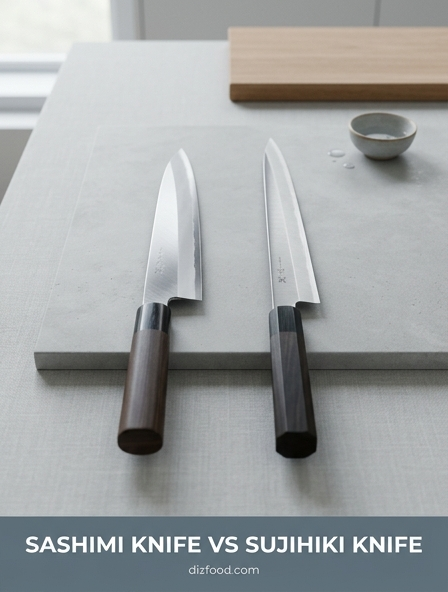
Sashimi Knife vs Sujihiki Main Differences
The primary distinction between a Sashimi knife, most commonly the Yanagiba, and a Sujihiki lies in their edge geometry and historical lineage. The Yanagiba is a traditional Japanese tool designed specifically for the art of slicing raw fish. It features a single-bevel edge, meaning only one side is ground to a sharp point while the other remains slightly concave. In contrast, the Sujihiki is the Japanese interpretation of a Western carving or slicing knife. It utilizes a double-bevel edge, sharpened on both sides, which makes it more approachable for those accustomed to European cutlery.
| Feature | Sashimi Knife (Yanagiba) | Sujihiki Knife |
|---|---|---|
| Edge Grind | Single Bevel (Kataba) | Double Bevel (Ryoba) |
| Primary Use | Raw Fish/Nigiri | Cooked Meats/General Slicing |
| Blade Thickness | Thicker Spine | Consistently Thin |
| User Skill | Advanced/Specialized | Intermediate/Versatile |
Beyond the edge, the physical construction differs significantly. A Yanagiba often has a thicker spine at the heel to provide rigidity for the single-bevel grind, whereas the Sujihiki maintains a uniform thinness throughout the blade. This difference affects how the knife moves through protein; the Yanagiba is designed to "steer" through the cut to create a glass-like surface on fish, while the Sujihiki is built for straight, symmetrical slicing through various textures of meat.
Understanding Single Bevel vs Double Bevel Blades
To appreciate these knives, one must understand the physics of the bevel. A single-bevel blade, or Kataba, is a hallmark of traditional Japanese craftsmanship. One side is flat or slightly concave (known as the Urasuki), which creates an air pocket between the blade and the food. This prevents delicate fish from sticking and allows for an incredibly acute edge angle, often between 8 to 12 degrees. However, this design causes the knife to pull naturally to one side, requiring a specific technique to ensure a straight cut.
The double-bevel blade, or Ryoba, found on the Sujihiki, is sharpened symmetrically on both sides. This is the standard for most modern kitchen knives. Because the pressure is equalized on both sides of the edge, the knife travels straight through the ingredient without the lateral drift associated with single-bevel tools. Benefits of the double-bevel design include:
- Ease of use for both left and right-handed cooks (unless specifically ground otherwise).
- Lower learning curve for those transitioning from Western knives.
- Greater stability when slicing through denser proteins like smoked brisket or roasted ham.
- Simplified sharpening process on whetstones for general maintenance.
While the single-bevel Sashimi knife offers unparalleled precision for aesthetic presentation, the double-bevel Sujihiki provides a more predictable experience for high-volume prep work and varied kitchen tasks.
The Role of the Yanagiba in Japanese Cuisine
In the world of Washoku (traditional Japanese cuisine), the Yanagiba is more than just a tool; it is an extension of the chef's hand. Its primary role is to slice blocks of boneless fish fillets into sashimi or nigiri toppings. The length and sharpness allow the chef to complete a cut in a single, fluid pulling motion. This "one-stroke" technique is vital because it preserves the cellular structure of the fish, ensuring that the flavor remains intact and the surface of the slice has a brilliant, glossy sheen.
The concave back (Urasuki) is the secret to its success in the sushi bar. By minimizing the surface area in contact with the fish, it reduces friction and prevents the delicate proteins from tearing. This level of precision is necessary because, in Japanese cuisine, the texture and visual appeal of raw fish are considered just as important as the taste. Using a dull or improper knife would result in a "cloudy" surface, which is seen as a sign of poor craftsmanship. Therefore, the Yanagiba is strictly reserved for soft, boneless proteins, as its extremely hard and thin edge is susceptible to chipping if it encounters bone or hard surfaces.
Sujihiki Knife Versatility for Meat and Fish
The Sujihiki is often referred to as a "flesh slicer," and its versatility is its greatest asset. While it can certainly be used for sashimi, its double-bevel construction makes it far more resilient when dealing with a variety of kitchen tasks. Unlike the Yanagiba, which is limited to raw seafood, the Sujihiki excels at slicing through cooked roasts, turkey, and even charcuterie. Its narrow profile allows it to navigate around silver skin and fat caps with minimal resistance.
Professional chefs often prefer the Sujihiki in a fast-paced Western kitchen for several reasons:
- Multi-protein capability: It can transition from slicing a raw tuna loin to carving a medium-rare tenderloin without a change in technique.
- Durability: The edge is generally more robust than a single-bevel knife, making it less likely to chip during frantic service hours.
- Agility: Because it is usually lighter than a traditional Yanagiba, it causes less wrist fatigue during repetitive tasks.
- Accessibility: It handles more like a long Petty knife or a slim Gyuto, making it intuitive for any culinary professional.
For the home cook or the professional who needs one knife to handle all slicing duties, the Sujihiki is the pragmatic choice. It offers a bridge between Japanese precision and Western utility, ensuring that everything from Sunday roasts to Friday night sushi can be handled with a single high-performance tool.
Blade Geometry and Precision Slicing Comparison
The geometry of these two knives dictates their performance on the cutting board. A Yanagiba has a distinct "shinogi" line, where the blade tapers sharply to the edge. This creates a wedge-like effect that helps the sliced portion of fish fall away from the block. The spine is surprisingly thick at the base, providing the weight necessary to glide through the fish with almost no downward pressure. This weight-to-edge ratio is unique to Japanese single-bevel cutlery.
The Sujihiki, however, prioritizes a thin profile from spine to edge. This "laser" geometry minimizes the displacement of the food being cut. When slicing a large roast or a delicate piece of smoked salmon, the Sujihiki passes through the material with zero "wedging," which is critical for achieving paper-thin slices. Comparison of their physical attributes reveals:
| Attribute | Yanagiba Geometry | Sujihiki Geometry |
|---|---|---|
| Spine Thickness | Thick (3mm - 5mm) | Thin (2mm - 2.5mm) |
| Blade Height | Narrow | Narrow to Medium |
| Cross-section | Asymmetrical / Concave back | Symmetrical / Flat or Convex |
| Taper | Abrupt at the Shinogi | Gradual distal taper |
Precision with a Yanagiba is about the finish of the cut-the smoothness of the surface. Precision with a Sujihiki is about the uniformity of the slice thickness across a large piece of meat. Both require a sharp edge, but they utilize their mass and angles in entirely different ways to achieve their respective goals.
Maintenance and Sharpening Requirements for Each Style
Maintenance is where the two styles diverge most sharply. Sharpening a Yanagiba is a ritualized process that requires specialized knowledge of Japanese whetstones. Because of the single-bevel design, the sharpener must maintain the flat "Urasuki" on the back and the wide "Kiriha" on the front. This involves a technique called "Uraoshi," where the back side is lightly polished to remove the burr without changing the concave shape. If done incorrectly, the knife's unique cutting properties can be destroyed permanently.
The Sujihiki is much easier for the average user to maintain. Since it is a double-bevel knife, it is sharpened much like a standard chef's knife or Gyuto. The user simply alternates sides on the whetstone, usually at a 12 to 15-degree angle. Key maintenance steps for both include:
- Regular honing on high-grit stones (3000 to 8000 grit) to maintain a refined edge.
- Strict hand-washing and immediate drying to prevent rust, especially if the blade is made of high-carbon steel.
- Storing in a wooden "saya" (sheath) to protect the long, vulnerable edge from contact with other tools.
- Using only soft wooden or synthetic cutting boards to prevent edge rolling or chipping.
While the Sujihiki is more forgiving, both knives require a commitment to whetstone sharpening. Using a pull-through sharpener or a honing steel on these high-hardness Japanese steels is discouraged, as it can cause micro-chipping along the brittle edge.
Choosing the Right Blade Length for Slicing
Length is the most critical factor when selecting a dedicated slicer, regardless of whether it is a Yanagiba or a Sujihiki. The goal of these knives is to complete a cut in one long, continuous pull. If the blade is too short, the chef is forced to use a "sawing" motion, which creates ridges in the meat and destroys the clean finish. Typically, these knives range from 210mm to 330mm in length.
For home kitchens, a 240mm or 270mm Sujihiki is often the sweet spot. It provides enough length to slice through a medium-sized roast or a side of salmon while still being manageable in a smaller workspace. Professional sushi chefs almost exclusively use Yanagibas that are 300mm or longer. The extra length allows for the long, sweeping draw-cuts required for large blocks of tuna (Maguro). When choosing your length, consider the following:
- Board Size: Ensure your cutting board is large enough to accommodate the full stroke of the knife.
- Protein Size: If you frequently slice large briskets or whole salmon, lean toward 300mm.
- Ceiling Height/Space: Long knives can be cumbersome in cramped galley kitchens or low-clearance areas.
A longer blade generally offers a cleaner cut, but it also requires more skill to control. Beginners should start with a 240mm Sujihiki, while dedicated sushi enthusiasts will find the 270mm-300mm Yanagiba to be the standard for traditional preparation.
Traditional Sashimi Knife Handling and Technique
Handling a Yanagiba requires a departure from Western knife grips. Traditional Japanese technique emphasizes the "pull-cut" (Hiki-giri). Instead of pushing the knife forward and down, the chef starts with the heel of the blade against the fish and pulls the knife toward their body in one smooth motion, ending at the tip. The weight of the blade does most of the work; the chef's hand merely guides the direction.
The grip is usually a "pinch grip" where the thumb and index finger choke up on the blade, but with the index finger often extended along the spine to provide better directional control. Because the Yanagiba is single-bevel, it has a tendency to steer to the left (for a right-handed user). To counteract this, the chef must slightly tilt the knife or adjust the angle of their wrist. This subtle "steering" is actually an advantage in the hands of an expert, allowing them to create decorative shapes and paper-thin translucent slices (Usu-zukuri) that are impossible to achieve with a double-bevel blade. Mastery of this technique is a prerequisite for any professional sushi chef and takes years of practice to perfect.
Why Chefs Prefer the Sujihiki for Multi Purpose Tasks
In a high-pressure professional kitchen, efficiency often trumps tradition. This is why many non-sushi chefs gravitate toward the Sujihiki. Its double-bevel nature makes it a "forgiving" tool that can be handed to a sous-chef or line cook without a lengthy tutorial on single-bevel physics. It functions perfectly as a carving knife for the Sunday roast, a slicer for cold cuts, and a precision tool for portioning raw proteins during prep.
The Sujihiki also excels in "west-meets-east" fusion cooking. For example, when slicing a protein that has been seared or crusted-such as a pepper-crusted tuna or a smoked duck breast-the Sujihiki's balanced edge cuts through the crust and the soft interior evenly. A Yanagiba's delicate edge might struggle with the hard crust, leading to potential damage. Furthermore, the Sujihiki's symmetrical grind makes it much easier to achieve straight vertical slices on tall items like a rib roast or a large loaf of pate. For the modern chef who needs to move quickly between different types of cuisine, the Sujihiki offers a level of operational flexibility that the highly specialized Yanagiba simply cannot match.
Final Verdict on Sashimi Knife vs Sujihiki Selection
The decision between a Sashimi knife and a Sujihiki ultimately depends on your specific culinary focus and your willingness to master specialized sharpening techniques. If your primary goal is the authentic preparation of Japanese sushi and sashimi, the Yanagiba is indispensable. Its ability to create the traditional glossy finish on raw fish is unmatched by any other tool. However, it is a demanding knife that requires a commitment to learning both its unique cutting motion and its complex maintenance routine.
For most other users, including professional chefs in Western-style restaurants and home enthusiasts, the Sujihiki is the superior choice. It offers 95% of the slicing performance of a Yanagiba with 100% more versatility. It is easier to sharpen, easier to use, and can handle a wider variety of foods including cooked meats and poultry. When making your final selection, consider the following summary:
| User Profile | Recommended Knife | Reasoning |
|---|---|---|
| Traditional Sushi Chef | Yanagiba | Essential for authentic texture and presentation. |
| General Professional Cook | Sujihiki | Versatile across different proteins and high-volume prep. |
| Home Cooking Enthusiast | Sujihiki | Intuitive handling and easier maintenance on whetstones. |
| Sashimi Specialist (Home) | Yanagiba | Provides the specific "one-stroke" feel for raw fish. |
Whether you choose the specialized Yanagiba or the versatile Sujihiki, adding a dedicated Japanese slicer to your kit will significantly elevate the quality of your protein preparation and the presentation of your final dishes.

Comments