
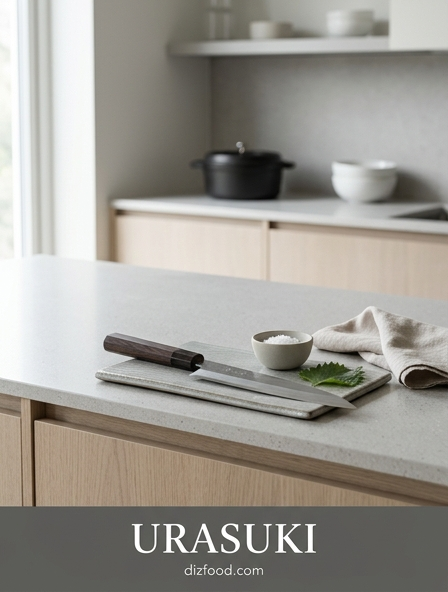
Cellular Integrity and Blade Precision
The urasuki, or the concave depression on the back of a traditional Japanese single-bevel knife, is fundamental to maintaining the cellular integrity of delicate ingredients. When a blade passes through organic tissue, the pressure exerted by the steel can rupture cell walls, leading to the loss of moisture and vital nutrients. However, the urasuki creates a localized air pocket between the blade and the ingredient, significantly reducing the surface area in contact with the food.
This reduction in friction ensures that the knife glides through proteins and vegetables without crushing their internal structures. By preserving these microscopic boundaries, the chef ensures that the natural juices remain trapped within the slice rather than being squeezed out onto the cutting board. The result is a superior texture and a more vibrant appearance. Precision in the kitchen is not merely about the sharpness of the edge, but about how the blade's geometry interacts with the biological composition of the food, turning a simple cut into an act of preservation.
Anatomy of the Perfect Slice
Achieving the perfect slice requires a deep understanding of how a single-bevel knife interacts with the material it penetrates. The urasuki plays a critical role here by providing "food release," which prevents thin slices from sticking to the back of the blade. This is especially vital when working with fatty fish or starchy vegetables that naturally adhere to flat surfaces. The geometry of the blade involves several key components that work in harmony:
- Urasuki: The concave ground surface that minimizes suction.
- Uraoshi: The thin, flat rim surrounding the urasuki that provides structural strength.
- Shinogi Line: The ridge where the blade flat meets the bevel, directing the food away.
In practice, this anatomy allows for translucent slices of sashimi or perfectly uniform julienne strips. Without the urasuki, the drag created by a flat back would cause the ingredient to tear or deform, ruining the clean lines required in high-end culinary presentation. The perfect slice is therefore a product of engineering, where the absence of metal is as important as the edge itself.
Mastering Grain Direction for Texture
In professional culinary prep, the direction of the grain dictates the final mouthfeel of the dish. Whether dealing with the long fibers of beef or the delicate myocommata in fish, the urasuki-backed blade allows for a level of directional control that double-bevel knives cannot match. Because the back of the knife is concave, the chef can press the flat Uraoshi edge against the ingredient to guide the cut with extreme accuracy.
Slicing against the grain breaks down tough fibers, making the food easier to chew, while slicing with the grain can provide a snappy, firm texture. The hollow ground back reduces the "wedge effect," meaning the blade does not force the fibers apart prematurely. This allows the chef to navigate the internal architecture of the food with surgical precision. Mastering this technique ensures that every piece of food offers a consistent sensory experience, highlighting the natural quality of the ingredients through thoughtful mechanical separation.
Geometric Consistency in Culinary Prep
Uniformity is the hallmark of professional kitchen work, and the geometry of the urasuki is a primary driver of this consistency. When a chef performs repetitive tasks like Katsuramuki (sheeting a radish), the concave back ensures that the thickness of the slice remains constant from start to finish. This is achieved through the unique "offset" nature of the single-bevel design, which allows the blade to travel in a straight line relative to the flat back.
| Cut Style | Urasuki Benefit | Resulting Texture |
|---|---|---|
| Sashimi Slicing | Zero suction | Smooth, glossy surface |
| Vegetable Sheeting | Uniform thickness | Translucent and flexible |
| Fine Mincing | Reduced drag | Crisp, clean edges |
By utilizing the flat Uraoshi as a guide, the chef can maintain a specific angle and depth across hundreds of repetitions. This geometric reliability is essential not only for visual appeal but also for even cooking times, ensuring that every component of a dish reaches its peak flavor simultaneously.
Knife Bevel and Structural Impact
The structural impact of a knife on food is determined by its bevel angle and the relief provided by the urasuki. In a traditional Western knife, the symmetrical double bevel pushes the food apart on both sides, which can lead to bruising in sensitive herbs or crushing in soft proteins. Conversely, the single-bevel knife with an urasuki concentrates all the displacement on the bevel side, leaving the back side of the ingredient entirely undisturbed.
This structural isolation is crucial for maintaining the "shine" on a cut surface. When the cells are cut cleanly rather than torn, the surface reflects light, a quality highly prized in Japanese cuisine known as "kire." The urasuki acts as a relief valve for the physical forces generated during the cut. Without this concave space, the lateral pressure would be too great, causing the blade to steer or "drift" during deep cuts. This mechanical advantage allows for thinner, more delicate preparations that would be impossible with standard kitchen cutlery.
Fibrous Resistance and Cutting Mechanics
Different foods offer varying levels of resistance based on their fibrous density. Root vegetables like burdock or lotus root possess a rigid cellulose structure that can trap a blade through friction. The mechanics of the urasuki address this by minimizing the surface contact between the steel and the tough fibers. As the blade enters the material, the concave back ensures that only the very edge and the narrow Uraoshi rim touch the food.
This reduction in surface area translates directly to a reduction in the force required to complete a stroke. For the chef, this means less fatigue over long shifts and a lower risk of the knife slipping due to excessive pressure. The cutting motion becomes a fluid, pull-based action rather than a forced push. By understanding how the urasuki bypasses fibrous resistance, a culinary professional can execute complex prep work with greater speed and safety, ensuring that even the most difficult ingredients are handled with elegance and mechanical efficiency.
Surface Area Optimization for Flavor
The way a knife interacts with food has a direct consequence on the flavor profile of the final dish. A clean cut facilitated by the urasuki minimizes the surface area of ruptured cells, which in turn reduces the rate of oxidation. When cell contents are exposed to air, enzymes begin to break down, often resulting in bitterness or off-flavors, particularly in ingredients like onions, garlic, and aromatic herbs.
Furthermore, a smooth, un-bruised surface allows for better interaction with seasonings and sauces. Instead of a jagged, absorbent surface that soaks up liquid and becomes soggy, a clean-cut slice allows sauces to coat the exterior evenly without compromising the internal texture. This optimization ensures that the true essence of the ingredient remains the focal point. In high-end culinary arts, the urasuki is more than a design feature; it is a tool for flavor management, ensuring that every slice tastes as fresh as the moment the ingredient was harvested.
The Physics of Clean Separation
The physics of cutting involves managing the forces of adhesion and cohesion. Adhesion occurs when the moisture in food creates a vacuum seal against the flat surface of a knife. This "stiction" is the enemy of speed and precision in the kitchen. The urasuki solves this by introducing a controlled pocket of air that breaks the vacuum. This allows the food to fall away from the blade effortlessly after every stroke.
- The blade edge initiates the split in the material.
- The bevel side pushes the "waste" or "slice" away.
- The urasuki prevents the main body of the ingredient from gripping the back of the knife.
By leveraging these physical principles, the chef can maintain a high tempo without having to manually clear the blade. This is particularly important when working with starchy items like potatoes or sticky proteins like squid. The result is a clean separation that preserves the intended shape of the food and allows for the seamless repetition of intricate slicing patterns.
Symmetry and Professional Visual Appeal
In the world of professional gastronomy, visual appeal is inextricably linked to the quality of the tools used. The urasuki enables a level of symmetry and sharp definition that defines modern plating standards. Because the back of the blade is hollow, the chef can achieve a perfectly vertical cut on one side of the ingredient, resulting in corners and edges that are sharp and well-defined. This creates a striking contrast on the plate, where the geometry of the food mimics architectural precision.
When multiple slices are stacked or shingled, the uniformity provided by the urasuki-backed blade creates a rhythmic visual pattern. Any irregularity in thickness or a dull, ragged edge would be immediately apparent to the discerning diner. The professional visual appeal of a dish depends on the light reflecting off clean, flat planes of food. Using a knife with a properly maintained urasuki ensures that every component contributes to a cohesive and aesthetic presentation, signaling to the guest that the chef possesses both technical skill and respect for the craft.
Biomechanical Precision in Slicing Mastery
Mastery of the urasuki involves a synergy between the knife's unique geometry and the chef's biomechanical movements. Unlike symmetrical knives, a single-bevel knife requires a specific grip and a pulling motion to maximize the benefits of the concave back. The urasuki changes the center of gravity of the blade, often making it feel more responsive and nimble in the hand. This allows the chef to use subtle wrist pivots to adjust the path of the cut mid-stroke.
Biomechanical efficiency is reached when the chef learns to trust the blade's ability to guide itself along the flat Uraoshi. This reduces the need for heavy-handed corrections and allows for a more relaxed, sustainable cutting style. Over time, the relationship between the chef's hand and the urasuki's relief becomes intuitive, leading to a "flow state" where the knife feels like an extension of the body. This level of precision is the pinnacle of culinary mastery, where high-tech blade smithing meets the refined motor skills of a dedicated professional.


Comments