
If you're chasing that paper-thin, translucent slice of prosciutto or a perfectly uniform stack of roast beef, choosing between a manual crank and an automatic meat slicer is your first step toward culinary precision. Manual crank slicers, often styled as traditional flywheel machines, offer an unparalleled level of tactile control, allowing you to feel the resistance of the blade and adjust your pace for delicate, artisanal cuts. In contrast, automatic meat slicers are the powerhouses of efficiency, utilizing high-torque electric motors to maintain consistent blade speed for high-volume output with minimal physical effort. While both tools can achieve professional deli-thin results, the manual crank excels in preserving meat texture through low heat friction, whereas the automatic version dominates in speed and convenience for busy kitchens.
| Feature | Manual Crank (Flywheel) | Automatic (Electric) |
|---|---|---|
| Slicing Precision | Ultra-fine control; ideal for delicate charcuterie. | Highly consistent; calibrated for uniform thickness. |
| Speed & Volume | Low to Moderate; depends on operator rhythm. | High; handles bulk slicing with motor efficiency. |
| Heat Generation | Minimal; preserves fat marbling and flavor. | Higher friction; may slightly warm sensitive fats. |
| Ease of Use | Requires skill and physical coordination. | User-friendly; set thickness and push/start. |
| Maintenance | Mechanical simplicity; requires regular oiling. | Complex; requires motor care and electrical safety. |
| Best For | Artisan boutiques and gourmet enthusiasts. | Commercial delis and high-traffic kitchens. |
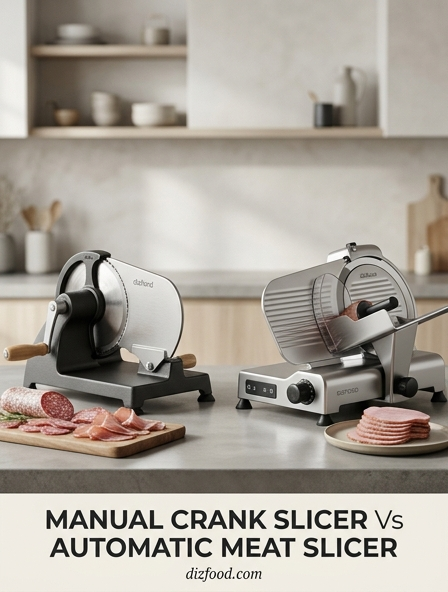
Manual Crank vs Automatic Meat Slicers
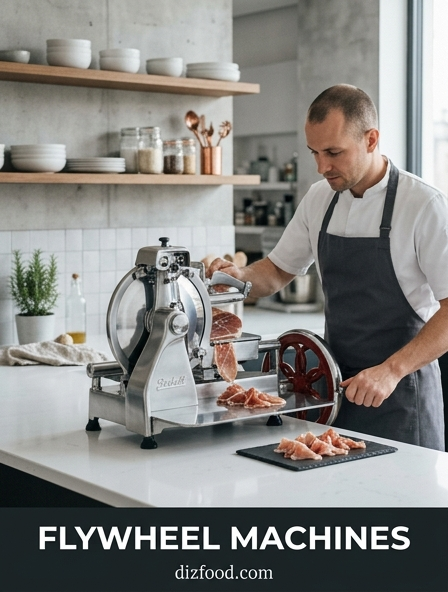
The fundamental distinction between a manual crank slicer and an automatic meat slicer lies in the power source and the level of physical engagement required by the operator. A manual crank slicer, often referred to as a flywheel slicer in high-end culinary circles, relies entirely on human energy. The user turns a large wheel or handle, which simultaneously rotates the blade and moves the carriage back and forth. This traditional method offers a tactile connection to the food, allowing the chef to feel the resistance of the muscle fibers and adjust their rhythm accordingly. These machines are often celebrated for their aesthetic appeal and historical craftsmanship, frequently seen in boutique charcuteries where the display of the slicing process is as important as the product itself.
In contrast, an automatic meat slicer is powered by an electric motor that drives both the circular blade and the reciprocating motion of the product carriage. Once the thickness is set and the meat is secured, the machine performs the repetitive task without further manual intervention. This technological leap was designed to solve the problem of high-volume production in commercial delis and butcher shops. While the manual slicer represents a marriage of mechanics and human finesse, the automatic slicer represents industrial efficiency and consistency. Choosing between them involves weighing the value of artisanal control against the necessity of rapid, labor-free output in a modern kitchen environment.
Slicing Speed and Output Efficiency
When evaluating the throughput of a kitchen, the speed of slicing becomes a critical metric. Automatic meat slicers are the undisputed champions of volume. Most commercial automatic units can be set to various speeds, often producing between 30 and 60 slices per minute with perfect regularity. This allows staff to multitask, preparing other orders or packaging products while the machine works. The efficiency gained here is not just in the speed of the blade, but in the reduction of operator fatigue, which typically slows down manual production over the course of a long shift.
Manual crank slicers operate at the pace of the individual user. While a skilled operator can achieve impressive speeds for short bursts, maintaining that momentum is physically demanding. Furthermore, the manual process requires the operator's full attention and both hands-one to turn the crank and often one to catch or arrange the slices. In a fast-paced environment, this dedicated labor can become a bottleneck. The following table illustrates the general performance expectations between the two types:
| Feature | Manual Crank Slicer | Automatic Meat Slicer |
|---|---|---|
| Slices Per Minute | 10-25 (Variable) | 40-60 (Consistent) |
| Operator Labor | 100% Constant Effort | Minimal (Set and Forget) |
| Multitasking Ability | None | High |
| Volume Suitability | Low to Medium | High / Industrial |
Initial Cost and Long Term Value
The financial commitment required for these machines varies significantly based on their build quality and intended use. Interestingly, high-end manual flywheel slicers can often be more expensive than standard automatic slicers due to their intricate mechanical parts, decorative finishes, and the "artisan" premium. However, entry-level manual crank slicers for home use are generally the most affordable option on the market. When purchasing for a commercial kitchen, an automatic slicer is an investment in labor savings. If a machine saves an employee two hours of manual labor per day, it can pay for itself within the first year of operation through reduced payroll costs.
Long-term value is also dictated by maintenance and durability. Manual slicers have fewer electronic components, meaning there are no circuit boards to fry or motors to burn out. If properly lubricated and sharpened, a manual slicer can last for decades. Automatic slicers, while robust, are subject to electrical failures and require more complex repairs. To maximize the lifespan of either machine, the following costs should be considered:
- Replacement Blades: Both require periodic blade replacement, though automatic units often wear blades faster due to higher friction.
- Electrical Costs: Automatic units consume significant power, whereas manual units have zero energy overhead.
- Professional Servicing: Automatic machines often require certified technicians for motor or belt repairs.
- Lubrication: Manual gears require specific food-grade greases to maintain a smooth rotation.
Thickness Precision and Cut Quality
Precision is the hallmark of a quality slicer, regardless of its power source. Manual crank slicers are often praised for their "cold" slicing ability. Because the blade rotates at a lower RPM compared to an electric motor, it generates less heat. This is vital for delicate cured meats like Prosciutto di Parma or Jamón Ibérico, where heat can melt the intramuscular fat and alter the flavor profile. The manual control allows the user to slice paper-thin pieces that remain structurally intact and chemically unchanged by the friction of the blade.
Automatic slicers provide unparalleled consistency in thickness across hundreds of slices. Once the gauge plate is locked in, every slice will be identical to the last, which is essential for portion control and food costing in a commercial setting. However, at high speeds, the friction can occasionally cause "shingling" or slight tearing in very soft cheeses or extremely fatty meats. For standard deli meats like turkey, ham, or roast beef, the automatic slicer's precision is more than sufficient and prevents the slight variations that can occur when a human operator tires on a manual machine and inadvertently alters their cranking pressure or speed.
Ease of Cleaning and Sanitization
Sanitization is the most labor-intensive aspect of owning a meat slicer, as these machines are prone to harboring bacteria in small crevices. Manual crank slicers, particularly traditional flywheel models, are often designed with an open architecture. This makes it easier to see and reach the areas behind the blade and around the carriage. Because they lack internal motors and complex wiring, some manual components can be more easily wiped down without fear of damaging sensitive electronics. However, the intricate gears of the crank mechanism must be kept free of debris to prevent jamming.
Automatic slicers are modern marvels of food safety engineering, but their design is inherently more enclosed to protect the motor. This can create "harbor points" for meat juices and proteins. Most modern automatic slicers feature "tool-less" disassembly, allowing the blade guard, meat grip, and carriage to be removed for deep cleaning. To ensure safety and hygiene, users should follow a strict cleaning protocol:
- Set the thickness gauge to zero to prevent accidental cuts during cleaning.
- Unplug the unit (if automatic) or lock the flywheel (if manual).
- Remove all detachable components and soak them in a sanitizing solution.
- Wipe the main body with a non-abrasive cloth and food-safe degreaser.
- Sanitize the blade from the center outward to avoid the sharp edge.
- Air dry all parts before reassembling to prevent rust or mold.
Safety Mechanisms and Risk Factors
Meat slicers are among the most dangerous tools in a kitchen if not used correctly. Manual crank slicers possess a unique risk because the operator is physically close to the moving parts. If the user's rhythm is interrupted or if they reach to grab a slice while the blade is still spinning, injury can occur. However, the speed is controlled by the user, which provides a degree of reactive safety-if you see a problem, you simply stop moving your arm. Many manual slicers also feature a locking pin for the flywheel to prevent accidental rotation when not in use.
Automatic slicers include advanced safety features to mitigate the risks of high-speed operation. These often include "no-volt release" switches, which prevent the machine from automatically restarting after a power outage, and emergency stop buttons. Many models also have interlocks that prevent the machine from running if the blade guard is removed. Despite these features, the sheer power of the motor means that accidents can be more severe because the machine will not stop upon contact with resistance. Proper training is the most effective safety mechanism, ensuring that operators never bypass guards and always use the provided "last-cut" pusher rather than their hands to guide the product.
Space Requirements and Portability
In a crowded kitchen, every square inch of counter space is valuable. Manual crank slicers vary wildly in size. Small, home-use manual slicers are extremely portable and can be tucked away in a cabinet when not in use. However, professional flywheel slicers are massive, heavy centerpieces that often require a dedicated pedestal or a very deep countertop. Because they do not require an electrical outlet, manual slicers offer the ultimate portability for outdoor catering, farmers' markets, or tableside service, where power cables would be an encumbrance or a tripping hazard.
Automatic slicers are generally heavy due to the internal motor and cast-aluminum housing. They are designed to be stationary fixtures. Because they require a standard or high-voltage outlet, their placement is dictated by the kitchen's electrical layout. They also require significant clearance for the carriage to move back and forth automatically without hitting walls or other equipment. When planning a kitchen layout, the footprint of an automatic slicer must include "swing space" for the operator to clean and maintain the unit. For mobile food trucks or small kiosks, the compact nature of a manual slicer is often more practical than the bulky, power-hungry automatic alternative.
Manual Control vs Motorized Power
The choice between manual and motorized power often comes down to the texture of the product being sliced. Motorized power provides the "grunt work" needed to slice through dense or semi-frozen products. If a kitchen frequently processes blocks of hard cheddar or frozen ribeye for cheesesteaks, an automatic slicer's motor will provide the necessary torque that would otherwise exhaust a human operator. The constant RPM of an electric blade ensures that it doesn't "bog down" when hitting tougher connective tissue.
On the other hand, manual control is preferred by purists for delicate, room-temperature products. When you turn the crank yourself, you can slow down for a particularly soft section of fat or speed up for a leaner muscle. This level of finesse is impossible to achieve with a motor that runs at a fixed speed. Furthermore, manual machines are silent. In an open-concept kitchen or a quiet deli, the loud hum of a 1/2 horsepower motor can be disruptive to the atmosphere. The silent, rhythmic clicking and whirring of a manual flywheel slicer adds to the ambiance and signals a commitment to traditional food preparation methods.
Commercial vs Home Kitchen Suitability
The suitability of a slicer depends largely on the frequency of use and the volume of food. For the average home cook, a manual crank slicer is often the superior choice. It is easier to store, requires no electricity, and is sufficient for slicing a single roast or a few blocks of cheese for a party. The lower price point also makes it more accessible for domestic budgets. Automatic slicers are rarely necessary for home use unless the user is a dedicated hobbyist who processes large quantities of game meat or makes their own bacon in bulk.
In a commercial setting, the decision is usually based on the business model. A high-volume sandwich shop or a grocery store deli would struggle to survive without an automatic slicer; the labor costs alone would be prohibitive. However, high-end restaurants often prefer the manual flywheel slicer for its precision and visual appeal. The following list summarizes where each type excels:
- Home Kitchen: Compact manual slicers for occasional use.
- High-Volume Deli: Automatic slicers for speed and portion consistency.
- Boutique Charcuterie: Flywheel manual slicers for "cold" slicing and aesthetics.
- Outdoor Catering: Manual slicers to avoid power dependency.
- Industrial Food Prep: Heavy-duty automatic slicers for continuous operation.
Final Verdict on Slicing Performance
Deciding between a manual crank slicer and an automatic meat slicer is a matter of prioritizing either the process or the result. If the goal is the highest possible volume with the least amount of human effort, the automatic slicer is the clear winner. It brings industrial-grade consistency to the kitchen, ensuring that food costs are managed and production schedules are met. It is the workhorse of the modern food industry, designed to handle the rigors of 24/7 operation with minimal downtime.
However, if the goal is the highest possible quality for delicate cured meats, or if the act of slicing is part of the culinary presentation, the manual crank slicer remains unsurpassed. It offers a level of control and "thermal protection" for the meat that electricity cannot replicate. While it requires more physical effort and a higher level of skill to operate, the results are often superior in texture and flavor. Ultimately, the automatic slicer is a tool of efficiency, while the manual crank slicer is a tool of craft. Most kitchens find that their specific needs-whether dictated by the menu, the volume of customers, or the available labor-will naturally point toward one of these two distinct mechanical philosophies.



Comments