
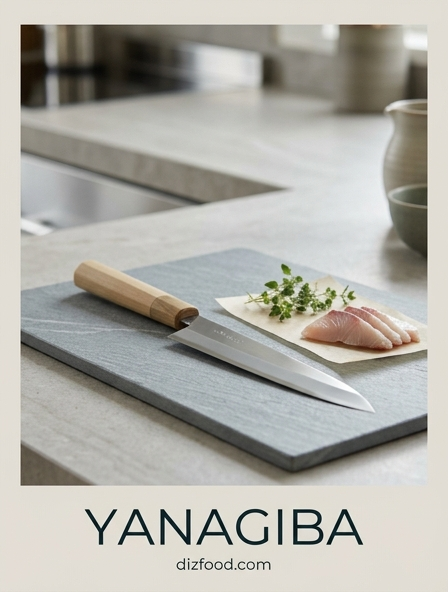
Understanding Blade Geometry Basics
The Yanagiba is the quintessential Japanese slicing knife, defined by its long, slender profile and specialized blade geometry. Unlike common Western kitchen knives, the traditional Yanagiba features a single bevel design, known as Kataba. This unique construction consists of a sharpened front side and a hollow-ground back side called the Urasuki. The purpose of this geometry is to minimize surface tension and friction during the slicing process, allowing the blade to glide through delicate proteins without tearing the cellular structure of the fish.
- Shinogi Line: The ridge where the blade flat meets the primary bevel.
- Urasuki: The concave back surface that creates an air pocket.
- Uraoshi: The thin flat rim around the concave back for structural strength.
The interplay between these geometric features ensures that the knife moves away from the food as it cuts, preventing sticking. This precision is essential for professional sushi chefs who require clean, glossy surfaces on raw fish to preserve both flavor and aesthetic appeal. Understanding these basics is the first step in appreciating the technical complexity of Japanese cutlery.
The Art of Single Bevel Precision
The single bevel edge of a Yanagiba represents the pinnacle of Japanese culinary engineering. By sharpening only one side of the blade, the edge angle can be made significantly more acute than a double bevel knife. This razor-sharp profile allows for a level of precision that is impossible to achieve with symmetrical blades. When a chef draws the Yanagiba through a piece of tuna or yellowtail, the single bevel geometry dictates the direction of the cut, requiring a specific technique to master the natural "steering" of the blade. This steering effect occurs because the beveled side pushes against the meat while the flat, hollow back creates zero resistance.
The result is a surface so smooth it appears polished, which is a hallmark of high-end sashimi. The single bevel also allows for incredibly thin slicing, often referred to as Usuzukuri. This artistry is not merely for show; the lack of cellular damage means the fish retains its natural juices and texture for a superior mouthfeel. Mastering the single bevel requires a deep understanding of how the steel interacts with the ingredients, transforming a simple kitchen tool into a precise instrument of culinary expression.
Versatility of Double Bevel Designs
While the traditional Yanagiba is a single bevel tool, modern variations and the closely related Sujihiki offer double bevel designs that cater to a broader range of kitchen tasks. Double bevel slicers are sharpened on both sides, typically at a 50/50 or 70/30 ratio. This symmetry makes the knife much easier to control for those accustomed to Western-style cutlery, as the blade tracks straight through the food without the lateral pull associated with single bevel edges. These knives are highly versatile, capable of handling everything from raw fish to cooked roasts and delicate vegetables.
- Ease of Use: No learning curve regarding blade steering or specialized grip adjustments.
- Ambidexterity: Suitable for both right-handed and left-handed users without custom ordering.
- Durability: The thicker edge profile provides more resilience against chipping during heavy use.
For home cooks or chefs working in high-volume Western kitchens, the double bevel design provides a balance between the extreme sharpness of Japanese steel and the practical utility required for diverse menu items. It remains a staple for those who need a reliable slicer that performs consistently across various protein types.
Traditional Japanese Craftsmanship vs Modern Utility
The conflict between tradition and modernity is nowhere more evident than in the construction of the Yanagiba. Traditional knives are often forged using high-carbon steels like Shirogami (White Steel) or Aogami (Blue Steel). These materials are prized for their ability to take a frighteningly sharp edge, though they require meticulous care to prevent rust. In contrast, modern utility versions utilize high-performance stainless steels or powdered metallurgy steels like VG-10 or SG2, which offer exceptional corrosion resistance and edge retention with less maintenance.
| Feature | Traditional Carbon Steel | Modern Stainless Steel |
|---|---|---|
| Sharpness | Highest potential edge | Excellent but slightly less acute |
| Maintenance | High (Must dry immediately) | Low (Corrosion resistant) |
| Durability | Brittle, prone to chipping | Tougher, better for high volume |
Choosing between the two involves balancing the desire for historical authenticity and ultimate performance against the practical realities of a busy kitchen environment. While purists insist on carbon steel for its ease of sharpening, modern alloys have narrowed the performance gap significantly.
Comparing Edge Sharpness and Performance
When comparing the edge sharpness of a Yanagiba to other knives, the difference lies in the micro-geometry of the apex. Because the Yanagiba is meant for a long, single-stroke pull cut, the edge must be refined to a mirrored finish. A single bevel Yanagiba can reach an edge angle as low as 10 to 12 degrees, whereas a standard Western chef's knife sits between 15 and 20 degrees. This extreme thinness allows the Yanagiba to sever fibers with minimal downward pressure, which is vital when working with soft, delicate fish that would otherwise be crushed or bruised.
Performance is also dictated by the length of the blade. Standard Yanagiba lengths range from 240mm to 330mm. The extra length ensures that the chef can complete a cut in one continuous motion. Stopping mid-cut or using a sawing motion creates "steps" or irregularities in the meat, which ruins the presentation. The performance of a high-end Yanagiba is measured by its ability to maintain this level of "atom-splitting" sharpness through several service shifts, ensuring every slice of sashimi is as perfect as the first.
Maintenance and Sharpening Requirements
Maintaining a Yanagiba is an intensive process that requires specific tools and techniques. Unlike Western knives that can be touched up with a honing rod, a single bevel Japanese knife must only be sharpened on whetstones. Using a rod on a Yanagiba can destroy the delicate edge geometry and round off the Shinogi line. The sharpening process involves two distinct stages: working the beveled side to establish the edge and then lightly "kissing" the flat Urasuki side to remove the burr.
- Soaking: Prepare whetstones by soaking them in water until air bubbles stop rising.
- Bevel Work: Maintain a consistent angle on the primary bevel, following the knife's factory grind.
- Uraoshi Sharpening: Lay the back flat on a high-grit stone to remove the burr without changing the concavity.
- Cleaning: Wipe the blade dry immediately and apply Tsubaki oil if using carbon steel.
Daily maintenance also includes ensuring the blade remains dry and clean throughout service. For carbon steel models, a patina will naturally develop over time, providing a layer of protection against deep rust, though acidic foods must still be handled with caution.
Ideal Slicing Tasks for Each Blade
The Yanagiba is a specialized tool, and its effectiveness depends on matching the blade to the task. While it is the king of the sushi bar, it is not a general-purpose knife. Using a Yanagiba for tasks it wasn't designed for, such as cutting through bone or frozen food, will result in immediate damage to the brittle edge. Its primary domain is the preparation of raw proteins where the goal is a flawless finish.
- Sashimi: Creating uniform slices of raw fish for platter presentation.
- Nigiri: Slicing fish to the perfect length and thickness to drape over rice.
- Skinning: The long, flat profile is ideal for removing skin from large fillets.
- Finishing Roasts: A double-bevel Sujihiki version is excellent for slicing boneless cooked meats.
For home cooks, the Yanagiba excels at slicing smoked salmon, carpaccio, or even delicate terrines. However, the single bevel version remains the preferred choice for anyone serious about traditional Japanese cuisine, where the tool's specialized geometry directly influences the flavor profile of the dish by preserving the integrity of the ingredients.
Mastering the Single Bevel Technique
Using a Yanagiba requires a departure from standard Western cutting techniques. Instead of a rocking motion or a forceful downward push, the Yanagiba relies on the "pull-cut." The chef starts the cut at the heel of the blade and draws it back toward the body in one smooth, fluid arc, finishing at the tip. Because of the Kataba geometry, the blade naturally wants to veer to the left (for a right-handed user). Mastering the technique involves learning to compensate for this pull with subtle wrist adjustments to ensure the cut remains perfectly vertical.
The grip is also distinct; many chefs use a "point-finger" grip, where the index finger rests on the spine of the blade for increased tactile feedback and directional control. This allows for microscopic adjustments during the slice. It is a meditative process that rewards patience and practice. Once mastered, the single bevel technique allows for a speed and precision that makes high-volume sashimi preparation look effortless. Proper form not only improves the final product but also reduces hand fatigue during long hours at the cutting board.
Durability and Long Term Use
While the Yanagiba appears delicate, it is a tool built for a lifetime of professional use if treated correctly. The durability of these knives is found in the quality of the lamination process. Traditional Yanagiba are often "Ni-mai" (two layers), where a hard steel core is forge-welded to a softer iron backing. This combination provides the hardness necessary for a sharp edge while allowing the softer iron to absorb shock and prevent the entire blade from snapping. Over years of use and sharpening, the blade will slowly become narrower, a process that eventually requires "thinning."
Thinning involves grinding down the entire primary bevel to maintain the original geometry as the edge moves up into the thicker part of the blade. A well-maintained Yanagiba can last a chef their entire career, becoming a personal extension of their hand. The longevity is also tied to the handle, typically made of Ho wood with a buffalo horn bolster. These handles are designed to be replaceable, ensuring that even if the wood wears out or stains, the precious steel blade can be fitted with a new grip and continue its service in the kitchen.
Selecting the Best Slicer for You
Choosing the right Yanagiba requires a self-assessment of your skill level and kitchen needs. For a beginner or a home cook who wants the aesthetic of a Japanese slicer without the maintenance headache, a stainless steel, double-bevel Sujihiki or a stainless Yanagiba is often the best starting point. However, if your goal is to master traditional sushi and sashimi, a single-bevel carbon steel blade is the only way to achieve authentic results. Consider the following factors before making a purchase:
- Length: 270mm is the "goldilocks" size for most home and professional kitchens.
- Steel Type: Decide if you can commit to the drying and oiling requirements of high-carbon steel.
- Handle Style: Traditional Wa-handles offer better balance for slicing, while Western handles offer a familiar weight.
Investing in a Yanagiba is as much about the steel as it is about the commitment to the craft. A high-quality slicer is a significant investment, but for those dedicated to the art of the kitchen, it provides a level of performance that no other tool can replicate. Researching the maker and the region of origin, such as Sakai or Seki, can also provide insight into the knife's character and heritage.

Comments