
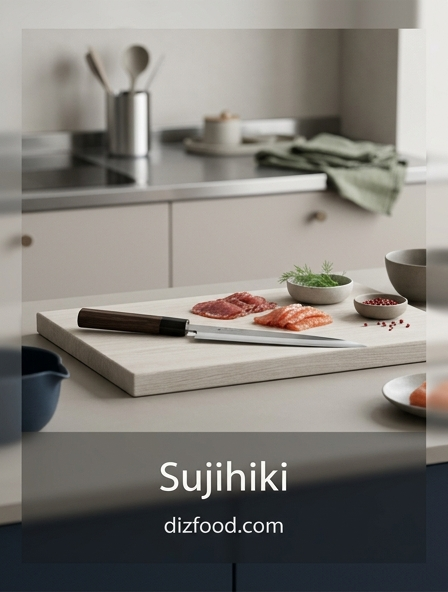
Understanding Sujihiki and Yanagiba Blade Geometry
The Sujihiki is often referred to as the Japanese equivalent of a Western slicing knife, but its geometry is significantly more refined. Unlike the Yanagiba, which features a single-bevel (kataba) grind designed specifically for sushi and sashimi, the Sujihiki is typically a double-bevel (ryoba) blade. This symmetry makes it more intuitive for those accustomed to European cutlery while maintaining the characteristic thinness of Japanese steel. The blade profile is narrow and low, minimizing surface area contact with the protein to reduce friction and drag during long, sweeping strokes.
While the Yanagiba relies on a concave back (urasuki) to create an air pocket for effortless food release, the Sujihiki uses its extreme distal taper and thin edge to achieve similar results across a wider variety of tasks. It is exceptionally capable of navigating between muscle tissues and fat caps. The following factors define its geometry:
- Narrow blade height for reduced surface resistance.
- Double-bevel edge for straight, balanced tracking.
- Acute edge angles, usually between 9 and 12 degrees per side.
- Extended blade length to accommodate single-stroke slicing.
High Carbon Versus Stainless Steel Performance
Choosing between high carbon and stainless steel for a Sujihiki involves a trade-off between peak performance and ease of maintenance. High carbon steels, such as Aogami (Blue Steel) and Shirogami (White Steel), are favored by purists because they can be sharpened to an incredibly fine, toothy edge. These steels provide a feedback that many chefs find superior when performing delicate work on expensive proteins. However, carbon steel is reactive; it will develop a patina over time and can rust if not dried immediately after use, especially when slicing acidic ingredients.
Modern stainless steels like VG10, Ginsan (Silver 3), and powdered steels like R2 or SG2 offer a compelling alternative. These materials are highly resistant to corrosion and staining, making them ideal for high-volume commercial environments. While they were historically harder to sharpen, modern metallurgy has produced stainless alloys that rival carbon steel in edge retention and sharpness. Professional kitchens often prefer stainless Sujihikis to prevent metallic odors or discoloration from transferring to light-colored fish or meats during service.
Single Bevel Precision or Double Bevel Versatility
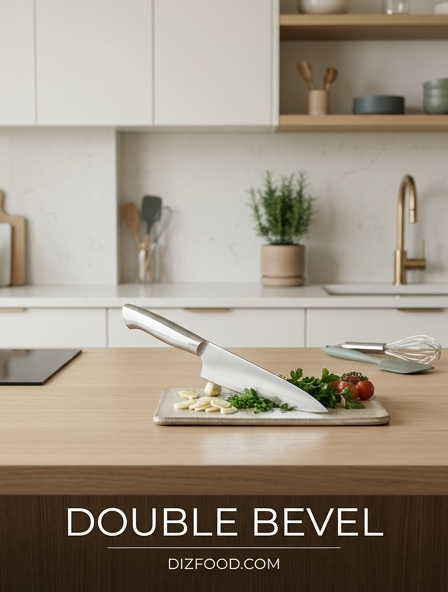
The choice between a single bevel and a double bevel slicer depends on the specific culinary application and the skill level of the user. Single bevel knives, like the Yanagiba, offer unmatched precision for decorative cuts and ultra-thin sashimi, but they require a specific technique to prevent the blade from steering to one side. In contrast, the double bevel Sujihiki is far more versatile, allowing for straight vertical cuts through large roasts, cooked meats, and raw proteins without the learning curve associated with single-edge tools.
| Feature | Single Bevel (Yanagiba) | Double Bevel (Sujihiki) |
|---|---|---|
| Primary Use | Raw fish and precision garnishes | All-purpose slicing and carving |
| Ease of Use | Requires specialized technique | Intuitive for most users |
| Sharpening | Asymmetric, multi-stone process | Standard symmetric sharpening |
| Steering | Naturally pulls to the side | Tracks straight through food |
Ergonomics of Traditional Wa Handles
The traditional Japanese "Wa" handle is a hallmark of the Sujihiki, providing a lightweight and balanced feel that shifts the center of gravity toward the blade. These handles are typically made from woods like Ho (Magnolia), Cherry, or Ebony, and are often capped with a buffalo horn or synthetic ferrule. The most common shapes are the octagonal (hachikaku) and the D-shape, both designed to provide a secure grip even when hands are wet or oily. Because the handle is tang-mounted and lighter than the blade, it allows for a "pinch grip" that maximizes control over the tip of the knife.
This ergonomic design is essential for a slicing knife, as it reduces wrist fatigue during repetitive tasks. Unlike the heavy, riveted Western handles, the Wa handle allows for a more delicate touch, which is crucial when navigating the subtle textures of a prime rib or a side of salmon. The simplicity of the friction-fit design also means that the handle can be replaced if it becomes damaged over years of heavy use, ensuring the longevity of the high-quality blade.
Determining the Ideal Blade Length for Your Kitchen
When selecting a Sujihiki, blade length is the most critical factor for achieving clean, professional cuts. A longer blade allows the chef to complete a slice in a single, continuous draw motion, which prevents the "sawing" effect that can tear delicate fibers and leave an uneven surface. While shorter blades offer more control in tight spaces, they often fail to cover the surface area of larger proteins.
Consider the following standard lengths based on your typical tasks:
- 210mm to 240mm: Ideal for home cooks or those working in smaller kitchens. Perfect for small roasts, poultry, and charcuterie.
- 270mm: The industry standard for professional chefs. It provides enough length for large briskets or salmon sides while remaining manageable.
- 300mm and above: Specialist tools for large-scale production. Used primarily for carving very large proteins or for high-volume catering environments.
Ideally, the blade should be at least two inches longer than the widest item you intend to slice to ensure a smooth, uninterrupted motion.
The Role of Rockwell Hardness in Edge Retention
The Rockwell Scale (HRC) measures the hardness of the steel, and for a Sujihiki, this number is a key indicator of how long the edge will stay sharp. Most Japanese slicing knives fall between 60 and 64 HRC, which is significantly harder than standard Western cutlery. This high level of hardness allows the blade to be ground to a much thinner and more acute angle without the edge rolling or folding during use. Consequently, a Sujihiki can maintain its razor-like performance through hundreds of slices before requiring a touch-up on a whetstone.
However, increased hardness comes with the trade-off of increased brittleness. A knife with an HRC of 63 or higher is more susceptible to chipping if it strikes a bone or a hard cutting board. Therefore, using a Sujihiki requires a refined technique and a soft cutting surface, such as wood or high-quality synthetic rubber. Understanding the HRC of your knife helps in determining the appropriate sharpening frequency and the level of care needed during high-pressure service periods.
Mastering the Slicing Technique for Clean Cuts
The secret to a perfect slice lies in the "pull-cut" technique, which utilizes the entire length of the Sujihiki's blade. Unlike a chef's knife that uses a rocking motion, a slicer should move in one direction. To master this, start with the heel of the blade against the protein and pull the knife toward you in a long, smooth stroke. The weight of the knife should do most of the work; applying excessive downward pressure can crush the cells of the meat, causing juice loss and a ragged appearance.
- Position the protein on a stable, non-slip cutting board.
- Place the heel of the Sujihiki at the furthest point of the cut.
- Draw the blade back steadily, using a slight downward angle.
- Finish the cut at the tip of the knife just as it clears the meat.
- Lift the knife and reset at the heel for the next slice.
Consistency is key. By maintaining a constant angle and a fluid motion, you ensure that every slice has a uniform thickness and a polished, professional sheen.
Comparing Damascus Patterns and Hand Hammered Finishes
The aesthetic finish of a Sujihiki often serves both functional and decorative purposes. Damascus cladding, or Suminagashi, involves layering different types of steel to create a marbled appearance. While primarily visual, these layers can provide a softer outer shell that protects the hard inner core steel from snapping. Beyond the beauty of the ripples, the subtle texture of Damascus can slightly reduce the suction between the blade and the food, though its impact on performance is generally secondary to the blade's grind.
Hand-hammered finishes, known as Tsuchime, offer a more pronounced functional benefit. The indentations created by the hammer act as small air pockets, significantly reducing the surface tension between the blade and the protein. This is particularly useful when slicing fatty meats or oily fish, as it prevents the slices from sticking to the side of the knife. When choosing between finishes, chefs often weigh the elegant, traditional look of Damascus against the rugged, utilitarian advantages of a Tsuchime surface, both of which add a unique character to the kitchen toolset.
Essential Maintenance for Long Lasting Sharpness
Maintaining a Sujihiki requires a commitment to proper cleaning and sharpening protocols. Because these knives are ground so thinly, they should never be placed in a dishwasher or left soaking in a sink. Instead, they should be hand-washed with mild soap and immediately dried with a soft cloth. For carbon steel variants, applying a thin layer of food-grade mineral oil or Tsubaki oil is essential to prevent oxidation and rust during storage. This ritual not only preserves the metal but also allows the chef to inspect the edge for any micro-chips.
Sharpening should be performed exclusively on high-quality whetstones. Honing rods, especially those made of coarse steel, are generally too aggressive for the hard, brittle edges of a Japanese slicer and can cause more harm than good. A progression of stones, starting from a 1000-grit for setting the edge to a 6000-grit or higher for polishing, will ensure the Sujihiki retains its ability to glide through proteins. Regular stropping on leather can also help maintain the edge between full sharpening sessions.
Balancing Weight and Flexibility for Diverse Tasks
The physical feel of a Sujihiki varies significantly between manufacturers, often categorized as either "lasers" or "workhorses." Laser-style Sujihikis are incredibly thin and lightweight, offering maximum finesse for delicate tasks like slicing raw fluke or carpaccio. These blades provide very little resistance but require a gentle hand. On the other hand, workhorse Sujihikis have a bit more spine thickness and weight, providing the momentum needed to slice through heavier items like smoked brisket or large turkeys without the blade wandering.
Flexibility is another factor to consider. While a Sujihiki is generally stiffer than a Western boning knife, a slight amount of flex can be beneficial when following the contours of a large muscle group or working around a rib cage. However, too much flex can compromise the accuracy of long, straight slices. The ideal balance is found in a blade that feels rigid enough to track straight but thin enough at the tip to perform detailed trimming. Choosing the right weight and flex profile ensures that the knife becomes a natural extension of the chef's hand.

Comments