
Choosing between a ceramic blade and a traditional steel blade can significantly elevate your culinary efficiency, as each material brings distinct strengths to the cutting board. While high-carbon steel remains the industry standard for its rugged durability and ease of sharpening, ceramic knives-crafted from zirconium dioxide-offer an incredibly sharp, lightweight alternative that resists rust and chemical reactions with acidic foods. Whether you are a home cook looking for a low-maintenance tool for precision slicing or a professional needing a versatile workhorse for heavy-duty tasks, understanding the technical trade-offs in edge retention and brittleness is essential for selecting the best knife for your kitchen.
| Feature | Ceramic Blade | Steel Blade |
|---|---|---|
| Edge Retention | Extreme; stays sharp 10x longer. | Moderate; requires frequent honing. |
| Durability | Brittle; prone to chipping/snapping. | Tough; flexible and impact-resistant. |
| Maintenance | Rust-proof; requires diamond sharpener. | Prone to corrosion; easy to resharpen. |
| Weight | Ultra-lightweight; reduces hand fatigue. | Heavier; provides better balance/heft. |
| Reactivity | Inert; won't brown fruit or transfer ions. | Can react with acids or leave metallic taste. |
| Best Use Case | Precision slicing of fruits and veggies. | Heavy chopping, deboning, and frozen foods. |
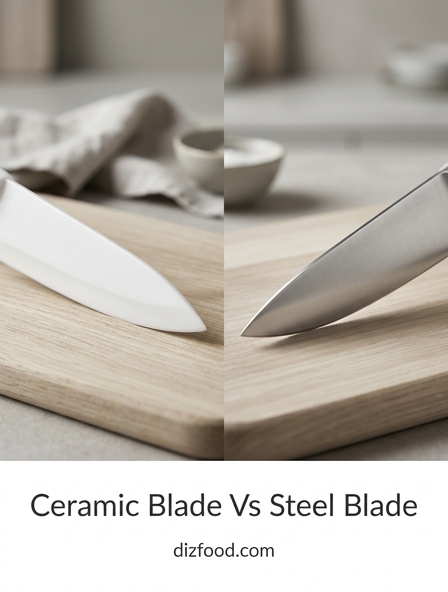
Ceramic vs Steel Blade Edge Retention Comparison
The primary appeal of ceramic cutlery lies in its extraordinary hardness, which directly correlates to superior edge retention. Most ceramic blades are crafted from zirconium dioxide, a material that registers significantly higher on the Mohs scale of mineral hardness than even the finest high-carbon steels. In practical kitchen settings, this means a ceramic knife can maintain its factory-sharp edge for months or even years without requiring a touch-up, whereas a steel blade might require honing after every significant meal preparation. Steel blades, while capable of achieving a razor-sharp edge, are subject to microscopic rolling and dulling during contact with cutting boards and various food textures.
| Feature | Ceramic Blade | Steel Blade |
|---|---|---|
| Hardness (Mohs Scale) | 8.2 to 8.5 | 5.0 to 6.5 |
| Retention Period | Ultra-long (Months/Years) | Short to Medium (Days/Weeks) |
| Edge Geometry | Extremely thin and brittle | Robust and flexible |
Because steel is a softer material, its edge undergoes plastic deformation. This requires the user to frequently use a honing rod to realign the teeth of the blade. Ceramic, conversely, does not "roll"; it either remains sharp or sustains microscopic chips that eventually dull the tool. While the initial sharpness of a high-end steel knife may slightly exceed that of a ceramic one, the ceramic blade will consistently outperform the steel blade in longevity between sharpening intervals, making it a favorite for those who dislike frequent maintenance.
Durability and Impact Resistance Differences
While ceramic excels in hardness, it suffers significantly in terms of toughness and impact resistance. Durability in the kitchen is often defined by how well a tool handles accidental drops, twisting motions, or contact with hard surfaces. Steel is a ductile material, meaning it can absorb energy and deform slightly without shattering. If a steel knife is dropped on a tile floor, it may suffer a bent tip or a small dent, both of which are usually repairable. This inherent flexibility makes steel the ideal choice for heavy-duty tasks such as deboning meat, splitting squash, or prying apart frozen items.
- Steel Resilience: High impact resistance; can withstand lateral pressure and torsion.
- Ceramic Fragility: Low impact resistance; prone to catastrophic failure if dropped.
- Lateral Stress: Steel bends under pressure; ceramic snaps or cracks immediately.
- Surface Sensitivity: Ceramic should only be used on soft wood or plastic boards to prevent chipping.
Ceramic blades are essentially sophisticated glass. Their molecular structure does not allow for the "give" that metallic bonds provide. Consequently, using a ceramic knife to hack through bone or even firm cheese can result in the blade snapping at the bolster or large chunks of the edge breaking away. This limitation necessitates a more disciplined cutting technique, strictly limited to straight vertical slices. For users who tend to be rough with their equipment or work in fast-paced environments where items are frequently knocked over, the durability of steel remains the undisputed standard for safety and longevity.
Corrosion Resistance and Chemical Reactivity
One of the most significant advantages of ceramic over steel is its complete immunity to rust and chemical reactions. Ceramic is a non-metallic, inorganic material that does not contain iron. Therefore, it is physically impossible for a ceramic blade to rust, regardless of how long it stays wet or what chemicals it is exposed to. This makes it an excellent choice for slicing acidic fruits like lemons, tomatoes, and pineapples, which can often cause "pitting" or discoloration on even the most high-quality stainless steel blades over time.
Steel, even the "stainless" variety, is susceptible to oxidation. Stainless steel contains chromium to create a protective oxide layer, but this layer can be compromised by salt, harsh detergents, or prolonged exposure to moisture. Carbon steel, favored by many professional chefs for its sharpness, requires immediate drying and oiling to prevent rust. Furthermore, steel can react with highly acidic foods, occasionally leaving a faint metallic tang or causing the food to brown prematurely due to the transfer of metal ions. Ceramic remains chemically neutral, ensuring that the flavor profile of delicate ingredients remains entirely untainted by the tool used to process them.
In environments where knives are frequently left in the sink or used in humid coastal climates, ceramic offers a "set it and forget it" level of maintenance regarding cleanliness. It does not require the protective oils or specialized storage conditions that high-performance steel blades demand to remain in pristine condition. For the home cook who prioritizes hygiene and ease of care, the chemical inertness of ceramic provides a distinct edge over traditional metallurgy.
Weight and Ergonomic Handling Benefits
The weight of a knife profoundly influences the user's experience, particularly during long sessions of food preparation. Ceramic blades are significantly lighter than their steel counterparts, often weighing about half as much as a similarly sized steel chef's knife. This reduction in mass is achieved because the density of zirconium dioxide is lower than that of steel alloys. For individuals who suffer from arthritis, carpal tunnel syndrome, or general wrist fatigue, the lightweight nature of ceramic can make kitchen work much more accessible and less painful.
- Reduced Fatigue: Less physical effort is required to move the blade through repetitive slicing motions.
- Precision Control: The lack of weight allows for high maneuverability when performing intricate tasks like peeling or garnishing.
- Balance Profile: Ceramic knives are often handle-heavy, which some users find provides better control over the tip.
- Portability: Their lightness makes them ideal for picnic kits or camping sets where every ounce matters.
However, weight is a double-edged sword. Steel knives utilize their mass to help the blade fall through denser foods; the "heft" of a heavy German steel knife does much of the work when cutting through a thick cabbage or a large roast. Some chefs find ceramic knives to feel "toy-like" or unsubstantial, preferring the tactile feedback and momentum that a heavier steel blade provides. Ergonomics is ultimately subjective, but for speed and light-duty repetitive slicing, the effortless handling of a ceramic blade is difficult to match, providing a nimble feel that changes the dynamic of kitchen prep work.
Maintenance and Sharpening Requirements
The maintenance cycles for ceramic and steel blades are fundamentally different, requiring different tools and skill levels. Steel knives are high-maintenance but user-serviceable. A cook can maintain a steel edge indefinitely using a combination of honing steels, whetstones, and strops. Because steel is relatively soft, it is easy to grind away old material to reveal a fresh edge. This allows a steel knife to be a "forever" tool, as it can be reshaped and sharpened thousands of times over several decades of use.
Ceramic knives present a unique challenge. Because they are harder than standard sharpening stones, they cannot be sharpened with traditional aluminum oxide or silicon carbide whetstones. Sharpening ceramic requires diamond-coated wheels or stones. Furthermore, the brittle nature of the material makes it prone to cracking during the sharpening process if too much pressure is applied. Most manufacturers recommend sending ceramic knives back to a professional service facility for sharpening, as the average home cook lacks the specialized equipment necessary to grind zirconium dioxide safely.
While you may go years without needing to sharpen a ceramic knife, once it does become dull or develops micro-chips, the process of restoring it is much more complex than with steel. Steel blades require a "little and often" approach to maintenance, which many enthusiasts find rewarding. Ceramic blades are more of a "use until dull" tool that requires professional intervention to restore. For the consumer, the choice depends on whether they prefer a tool they can maintain themselves or one that stays sharp longer but requires outsourced servicing.
Material Composition and Manufacturing Process
The creation of a steel blade is a process of metallurgy involving the melting and alloying of iron with carbon and other elements like vanadium, molybdenum, or chromium. These blades are either forged under high pressure or stamped from large sheets of metal. Forged blades undergo a heat-treatment process where the metal is heated to critical temperatures and then quenched in oil or water to lock the crystalline structure, followed by tempering to reduce brittleness. This results in a material that is both hard and tough, capable of holding an edge while resisting breakage.
Ceramic blades are produced through a completely different industrial process known as "sintering." High-purity zirconium dioxide powder is pressed into a mold at incredibly high pressures-often exceeding 10,000 pounds per square inch. The resulting "green" blade is then fired in a kiln at temperatures exceeding 1,400 degrees Celsius for several days. During this process, the powder particles fuse together into a solid, dense mass. After firing, the blades are ground on diamond-impregnated wheels to create the final cutting edge. This creates a non-porous, incredibly dense surface that is harder than any natural metal found in common kitchen tools.
The manufacturing of steel is an ancient art perfected by modern chemistry, while ceramic knife production is a product of high-tech material science originally developed for aerospace and automotive applications. The differing molecular bonds-metallic bonds in steel which allow for electron sharing and flexibility, versus ionic/covalent bonds in ceramics which are rigid and fixed-dictate the fundamental performance characteristics of each knife type in the kitchen.
Food Safety and Flavor Transfer Factors
Food safety and the preservation of pure flavors are areas where ceramic blades often outperform steel. Because ceramic is non-porous and chemically inert, it does not absorb odors, oils, or food particles. This prevents the "cross-contamination" of flavors; for example, you can slice a pungent onion, give the ceramic blade a quick rinse, and immediately slice an apple without the apple picking up any onion-like aftertaste. Furthermore, the absence of metal ions means that ceramic will not cause the enzymatic browning that occurs when certain fruits and vegetables react with steel.
Steel knives, particularly those made of high-carbon steel, can sometimes impart a metallic taste to delicate foods. They can also react with the acids in foods to create a dark patina on the blade, which is harmless but can transfer a grayish tint to light-colored ingredients like potatoes or onions. While stainless steel is much better in this regard than carbon steel, it is still not as chemically neutral as ceramic. From a sanitary perspective, ceramic is also highly resistant to bacteria growth because its surface is so smooth that there are virtually no microscopic "valleys" for microbes to hide in.
Additionally, ceramic knives are often easier to clean thoroughly. They are unaffected by strong detergents and will not suffer from the "clouding" that can affect some metal finishes. For kitchens that prioritize the most clinical levels of hygiene and the most pristine flavor profiles-such as in the preparation of sashimi or high-end vegetarian cuisine-ceramic offers a specialized advantage that traditional steel struggles to replicate without significant care and immediate cleaning.
Common Use Cases for Kitchen and Outdoors
The utility of each blade material varies based on the environment and the task at hand. In a professional kitchen, a chef will often reach for a ceramic knife specifically for "prep work" involving soft produce. Ceramic is the king of the "slicing" world; it is perfect for tomatoes, bread, boneless meats, and leafy greens. Its ability to glide through skins without crushing the delicate interior makes it a specialized tool for presentation-focused cooking. However, it is rarely a chef's only knife, as its limitations are too great for a full shift of diverse tasks.
- Kitchen Use (Ceramic): Slicing fruit, dicing vegetables, cutting boneless proteins, fine garnishing.
- Kitchen Use (Steel): Chopping through joints, hacking hard squash, dicing frozen foods, crushing garlic.
- Outdoor Use (Steel): Batoning wood, skinning game, prying, and all-weather survival tasks.
- Outdoor Use (Ceramic): Lightweight backpacking for simple food prep; generally avoided for rugged use.
In outdoor and survival contexts, steel is the nearly universal choice. The demands of the outdoors-such as batoning wood, striking fire steels, and skinning animals with thick bones-would destroy a ceramic blade in seconds. Furthermore, the ability to sharpen a steel knife on a smooth river stone in an emergency makes it indispensable for field work. Ceramic knives are occasionally used by ultra-light backpackers who only need to cut cordage or prepare soft food, but for any "serious" outdoor application, the durability and versatility of steel are mandatory requirements.
Price Point and Long Term Value Analysis
When analyzing price and value, one must distinguish between initial cost and the cost over the lifespan of the tool. Ceramic knives are often available at a lower entry-level price point than high-quality forged steel knives. A decent ceramic chef's knife can be purchased for a fraction of the cost of a professional Japanese or German steel knife. For the casual home cook who wants a sharp tool without a large upfront investment, ceramic offers an attractive value proposition. However, this value is often offset by the "disposable" nature of cheaper ceramic blades; if they chip or snap, they are usually not worth the cost of professional repair.
Steel knives represent a more significant initial investment, but their long-term value is vastly superior. A well-maintained steel knife can last for generations, becoming a kitchen heirloom. Because they are repairable, a steel knife that suffers a nick or a broken tip can be ground down and restored to full utility. When you factor in the cost of professional sharpening for ceramic blades versus the ability to sharpen steel at home for free, the "cost per use" of a steel knife eventually drops below that of ceramic.
The "value" of ceramic is found in its convenience-the time saved by not needing to sharpen it frequently. The "value" of steel is found in its reliability and permanence. For a student or someone in a temporary living situation, a ceramic knife is a cost-effective, high-performance solution. For a serious cook or a homeowner looking to build a permanent kitchen kit, investing in high-quality steel provides much better amortized value over decades of service.
Final Verdict on Blade Material Performance
The debate between ceramic and steel is not about which material is objectively "better," but rather which tool is appropriate for the specific task and the user's habits. Ceramic blades are specialized instruments designed for precision and longevity of edge. They are the scalpel of the kitchen-highly efficient at slicing, chemically pure, and incredibly light. They are best suited for individuals who prioritize a maintenance-free experience and primarily prepare fruits, vegetables, and boneless meats. For these users, the effortless glide of a ceramic blade is a revelation in efficiency.
Steel remains the quintessential workhorse. Its versatility, toughness, and ease of home maintenance make it the backbone of any serious culinary environment. A steel knife can do everything a ceramic knife can do, albeit with more frequent sharpening, whereas a ceramic knife cannot perform many of the heavy-duty tasks that steel handles with ease. Steel is the material of choice for those who value a tactile connection to their tools and require a knife that can survive the rigors of a busy, sometimes chaotic kitchen or the unpredictable demands of the outdoors.
Ultimately, most well-equipped kitchens benefit from having both. A high-quality steel chef's knife serves as the primary tool for 90% of tasks, while a ceramic utility or paring knife serves as a specialized companion for acidic foods and delicate slicing. By understanding the physical limitations of ceramic and the maintenance needs of steel, a cook can leverage the strengths of both materials to create a more efficient and enjoyable cooking experience. Neither replaces the other; they complement one another in a modern culinary toolkit.

Comments