
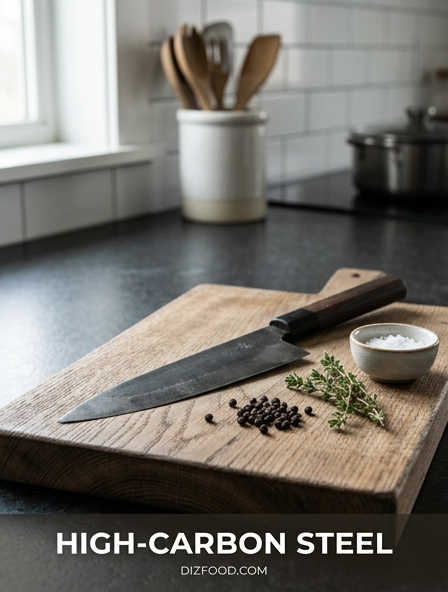
Unrivaled Edge Retention
High-carbon steel is celebrated in culinary circles primarily for its exceptional edge retention. Unlike softer stainless steel counterparts, high-carbon alloys possess a hardness that allows the blade to remain razor-sharp even after extensive use on demanding surfaces like end-grain wood boards. This durability means that the microscopic teeth of the blade do not roll or dull as quickly during repetitive tasks such as mincing herbs or dicing fibrous vegetables. The hardness, often measured on the Rockwell scale, ensures that the geometry of the edge remains consistent over time. Consequently, users experience fewer interruptions during meal preparation, leading to a more efficient workflow.
While stainless steel may require honing after every few uses to maintain a functional bite, high-carbon steel holds its keenness through multiple shifts. This characteristic is not merely a convenience; it is a fundamental requirement for precision work where a dull blade could lead to uneven cuts or safety hazards. The following factors contribute to this superior retention:
- Carbide formation during heat treatment
- Consistent grain structure density
- Resistance to lateral edge deformation
- High Rockwell Hardness (HRC) ratings
The Science of Carbon Content
The defining characteristic of high-carbon steel lies in its chemical composition, specifically the ratio of carbon to iron. In the context of kitchen cutlery, high-carbon steel typically contains between 0.6% and 1.0% carbon. This addition of carbon is what allows the steel to be heat-treated to a significantly higher hardness than standard stainless alloys. During the forging process, carbon atoms integrate into the iron lattice, creating a dense molecular structure that resists deformation. This structural integrity is the foundation of the tool's performance.
While chromium is often added to stainless steel to prevent rust, its presence can sometimes lead to a "gummy" steel that is harder to sharpen to a fine point. High-carbon steel prioritizes the formation of iron carbides, which are incredibly hard particles that enhance wear resistance and edge stability. The balance of elements is crucial, as shown below:
| Element | Function in Kitchen Steel |
|---|---|
| Carbon | Increases hardness and tensile strength |
| Iron | Provides the primary structural base |
| Manganese | Improves grain structure and toughness |
Superior Slicing Precision
Precision in the kitchen is often the difference between a mediocre dish and a culinary masterpiece. High-carbon steel allows for a much thinner blade geometry than most other materials. Because the steel is inherently stronger and stiffer, bladesmiths can grind the edge to a more acute angle, often between 10 and 15 degrees. This acute angle reduces the force required to pass the knife through food, allowing it to glide through delicate proteins and brittle vegetables without crushing the cell walls. This preservation of cellular structure is vital for maintaining the texture and flavor profile of ingredients.
Whether performing a translucent julienne or a clean sashimi slice, the feedback provided by a high-carbon blade is unmatched. The chef feels exactly where the blade is positioned, enabling micro-adjustments that are impossible with thicker, more cumbersome knives. This level of control fosters a sense of confidence, allowing for more intricate techniques and faster preparation times without sacrificing the visual appeal of the finished plate. The rigidity of the high-carbon core ensures that the blade does not wander during long, vertical cuts.
Why Professional Chefs Choose Carbon
In a professional kitchen, the choice of a knife is a personal and tactical decision. Most seasoned chefs gravitate toward high-carbon steel because it behaves predictably under pressure. In high-stakes environments where hundreds of covers are served nightly, the efficiency provided by a carbon blade is invaluable. These knives offer a tactile "feel" for the cutting surface, often described as a more "surgical" experience compared to the muted feedback of stainless steel. Furthermore, the ability to quickly restore an edge during a brief lull in service is a significant advantage.
Chefs also appreciate the character development of the tool; as the knife is used, it evolves with the cook. The weight, balance, and sharpening profile of high-carbon steel are tailored for those who spend eight to twelve hours a day with a knife in hand. The professional preference is driven by several key factors:
- Rapid tactile feedback loop
- Extreme ease of maintenance on stones
- Superior balance for reduced hand fatigue
- Ability to hold a more acute edge angle
Easier Resharpening for Busy Kitchens
While high-carbon steel is hard, it is paradoxically easier to sharpen than many modern stainless steels. This is because the lack of high chromium content makes the steel less "slippery" against whetstones. When a high-carbon knife finally does lose its edge, it responds quickly to abrasive stones, allowing a chef to raise a burr and refine the apex with minimal effort. This responsiveness is crucial in a busy kitchen where time is the most precious commodity. A chef can spend five minutes on a medium-grit stone and return a carbon blade to a factory-sharp condition.
In contrast, a stainless blade might require more aggressive grinding and significantly more time to achieve the same result. The ease of resharpening ensures that the tool is always at peak performance, reducing the physical strain on the user. To maintain this performance, the following tools are commonly used in conjunction with high-carbon blades:
- Water whetstones (1000 to 6000 grit)
- Leather strops for edge refinement
- Ceramic honing rods for daily maintenance
Carbon Steel vs Stainless Steel Durability
When discussing durability, one must distinguish between edge retention and environmental resistance. Stainless steel is designed to resist corrosion and staining, making it a "low maintenance" option for many. However, high-carbon steel offers a different kind of durability: structural longevity. While carbon steel is prone to rust if neglected, its ability to withstand thousands of sharpening cycles without losing its structural integrity is superior. Stainless steel can often become brittle if hardened too much, leading to chipping along the edge.
In contrast, well-forged high-carbon steel maintains a toughness that absorbs the impact of the cutting board. The durability of carbon steel is managed through proper care, whereas the durability of stainless steel is often a tradeoff for a less refined edge. The table below highlights the practical differences in durability:
| Feature | High-Carbon Steel | Stainless Steel |
|---|---|---|
| Edge Stability | Exceptional | Moderate |
| Impact Resistance | High | Varies |
| Rust Resistance | Low | High |
High Carbon Molecular Strength
The molecular strength of high-carbon steel is a product of the martensitic transformation that occurs during quenching. When the steel is heated to a critical temperature and rapidly cooled, the carbon atoms are trapped within the iron structure, creating a highly stressed and extremely hard crystalline arrangement. This molecular density is what allows the knife to hold a "toothy" edge that excels at cutting through skins like those found on tomatoes or peppers. Unlike other alloys that may have large, clumpy carbides, high-carbon steel can be refined to have very fine grain structures.
This fine grain is essential for achieving a "scary sharp" edge that remains stable during use. The inherent stiffness of the material also prevents the blade from flexing excessively during heavy tasks, ensuring that the force applied by the chef is transferred directly to the ingredient. This rigidity provides a sense of power and reliability that is essential for both heavy butchery and delicate vegetable preparation, making the blade feel like an extension of the hand.
Longevity of Professional Grade Tools
A high-carbon steel knife is often viewed as a lifelong investment. Because the material allows for repeated sharpening without degrading the core quality of the steel, these knives are frequently passed down through generations of cooks. The longevity of these tools is tied to the fact that they do not rely on thin coatings or superficial treatments for their performance; the quality is consistent through the entire thickness of the blade. As the knife is sharpened over the decades, its profile may change, but the steel's ability to take an edge remains constant.
This is in stark contrast to cheaper, stamped blades that are often discarded once they become dull or damaged. To ensure this longevity, professional-grade tools require a partnership between the tool and the user, focusing on consistent care and proper technique. Key longevity practices include:
- Periodic thinning of the blade geometry
- Proper storage in a dry, wooden block
- Consistent oiling during long storage periods
- Avoiding the use of glass or stone cutting boards
Performance in High Volume Slicing
High-volume slicing demands a tool that minimizes fatigue while maximizing output. High-carbon steel excels in this arena due to its effortless cutting ability. In environments like busy catering kitchens or high-traffic prep stations, the "bite" of a carbon steel edge allows for rapid, rhythmic slicing. The steel's ability to maintain its apex despite hundreds of repetitions means the chef doesn't have to increase downward pressure as the shift progresses. This reduction in required force significantly lowers the risk of repetitive strain injuries in the wrist and forearm.
Furthermore, the clean cuts produced by high-carbon steel help ingredients stay fresh longer by minimizing the bruising of the surface area. When cell walls are sliced cleanly rather than crushed, the ingredients retain their moisture and vibrant color. For high-volume tasks like slicing pounds of onions or prepping large quantities of protein, the consistency of a carbon blade ensures that the first slice is just as perfect as the last, maintaining the high standards required in professional food service.
Mastering the Patina and Protection
The most distinctive visual trait of high-carbon steel is the development of a patina. This oxidation layer is not a sign of damage but rather a protective shield and a badge of honor. As the steel reacts with acidic foods like lemons or onions, it forms a complex layer of oxides that range in color from blue and gray to deep black. This patina acts as a barrier against more harmful red rust. Mastering the care of high-carbon steel involves understanding how to balance moisture and airflow.
A well-maintained knife is wiped dry immediately after use and occasionally treated with food-grade mineral oil. This ritual of care creates a deep connection between the chef and their tools. Over time, the patina tells the story of the meals prepared, reflecting the unique history of the kitchen. To maintain a healthy patina, follow these steps:
- Hand wash with mild soap and warm water
- Dry thoroughly with a lint-free cloth immediately
- Apply a thin coat of food-safe oil if stored overnight
- Avoid soaking the blade in the sink

Comments