
Choosing between carbon steel and stainless steel knives is a defining moment for any home cook or professional chef, as it dictates the balance between precision performance and everyday practicality. Carbon steel is the darling of purists, offering an incredibly sharp, easy-to-hone edge that rewards meticulous care with unparalleled slicing accuracy, though it requires diligent drying to prevent rust. On the other hand, stainless steel is the workhorse of the modern kitchen, favored for its high chromium content that resists corrosion and staining, making it the ideal low-maintenance choice for those who value durability and ease of use. Whether you crave the laser-like precision of a high-carbon blade or the rugged, worry-free nature of stainless steel, understanding how these alloys interact with your cutting board is the first step toward mastering your culinary craft.
| Feature | Carbon Steel Knives | Stainless Steel Knives |
|---|---|---|
| Edge Sharpness | Superior; achieves a finer, "scary sharp" edge. | High; excellent, but slightly less refined. |
| Edge Retention | Excellent; stays sharp longer through heavy use. | Moderate to Good; requires more frequent honing. |
| Maintenance | High; must be dried and oiled to prevent rust. | Low; highly resistant to rust and oxidation. |
| Hardness (HRC) | Typically higher (58-65 HRC); more brittle. | Typically lower (54-60 HRC); more flexible. |
| Sharpening Ease | Easier; responds quickly to whetstones. | Harder; tougher alloys require more effort. |
| Reactivity | Develops a unique patina; reacts to acidic foods. | Non-reactive; maintains a polished look. |
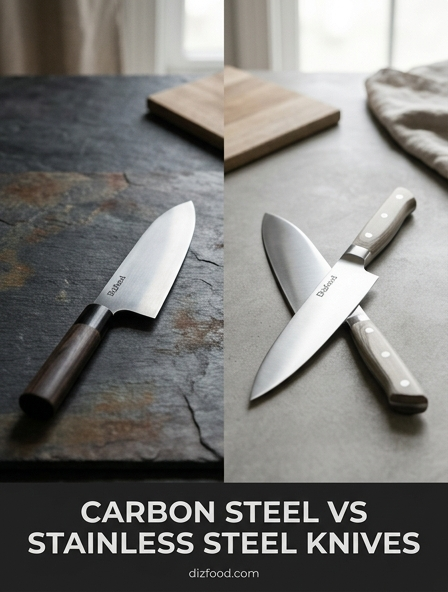
Carbon Steel vs Stainless Steel Composition and Basics
The fundamental difference between carbon steel and stainless steel knives lies in their elemental makeup, which dictates how the metal behaves under stress, heat, and moisture. All steel is primarily composed of iron and carbon, but the ratios and additional alloying elements create distinct categories for culinary tools. Carbon steel typically contains a higher percentage of carbon, often ranging from 0.6% to over 1.0%. This high carbon content allows the metal to be hardened to a significant degree through heat treatment, resulting in a dense, fine-grained structure that is prized by bladesmiths for its purity and potential for extreme sharpness.
In contrast, stainless steel is defined by the addition of chromium. To be classified as stainless, the alloy must contain at least 10.5% to 12% chromium. This element reacts with oxygen to form an invisible, protective layer of chromium oxide on the surface of the blade, which prevents the iron from rusting. While stainless steel also contains carbon for hardness, it often includes other elements like molybdenum, vanadium, and nickel to enhance toughness and corrosion resistance. The following list highlights the primary components found in these alloys:
- Iron: The base metal for both types of steel.
- Carbon: Provides the hardness and ability to hold a sharp edge.
- Chromium: Added to stainless steel to prevent rust and oxidation.
- Molybdenum: Often added to stainless to increase strength and resistance to pitting.
- Vanadium: Enhances wear resistance and grain refinement in high-end steels.
Sharpness and Edge Retention Comparison
When discussing performance, "sharpness" refers to the fineness of the apex, while "edge retention" refers to how long that apex remains functional before becoming dull. Carbon steel is widely regarded as the gold standard for absolute sharpness. Because it lacks the large chromium carbides found in stainless steel, it can be ground to a much finer, more acute angle without the edge crumbling. This makes carbon steel the preferred choice for tasks requiring surgical precision, such as julienning delicate herbs or slicing raw fish for sashimi.
Stainless steel has historically struggled with edge retention compared to carbon steel, but modern metallurgy has closed the gap significantly. High-end "super steels" and powdered metallurgy stainless steels can now achieve hardness levels previously reserved for carbon alloys. However, the edge on a stainless knife is often described as "toothy" due to the larger carbide structures, whereas carbon steel feels "smooth." The choice often comes down to the specific steel grade used in the knife's construction.
| Feature | Carbon Steel | Stainless Steel |
|---|---|---|
| Maximum Sharpness | Excellent (Finer grain) | Very Good |
| Edge Retention | High (Harder steel) | Moderate to High |
| Ease of Honing | Very Easy | Moderate |
| Typical Hardness | 60-65 HRC | 54-62 HRC |
Corrosion Resistance and Chromium Content Explained
Corrosion resistance is the most significant practical difference for the average user. Stainless steel is designed to withstand the harsh, wet environment of a kitchen. The chromium content creates a "passive layer" that self-heals when scratched, protecting the underlying iron from moisture and acidic foods like lemons, onions, and tomatoes. This makes stainless steel knives ideal for high-volume environments where a knife might sit on a cutting board for several minutes while covered in fruit acids or meat juices without immediate cleaning.
Carbon steel, lacking this chromium shield, is highly reactive. Exposure to moisture or acid causes the metal to oxidize almost instantly. If left wet, a carbon steel blade will develop orange rust, which can pit the metal and ruin the edge. However, not all oxidation is bad. Over time, carbon steel develops a "patina"-a grey or blue oxidation layer that actually provides a small measure of protection against further deep rusting. Understanding this chemical vulnerability is essential for anyone considering a non-stainless blade.
- Stainless: Highly resistant to rust; requires minimal drying.
- Carbon: Reacts to acids; can rust within minutes if left wet.
- Semi-Stainless: Steels with 8-10% chromium that offer a middle ground.
Maintenance Requirements and Daily Care Differences
The maintenance routine for these two steels involves very different levels of discipline. Stainless steel knives are relatively "set and forget." While they should never be put in a dishwasher, they can handle being left on a counter for a short duration or rinsed and left in a drying rack. They are the workhorses of the busy home kitchen where convenience is a priority. Their toughness allows them to handle slightly more abuse, such as cutting through frozen foods or making contact with hard bones, though this is still generally discouraged.
Carbon steel knives require a "wipe as you go" philosophy. Professional chefs who use carbon steel often keep a damp cloth and a dry cloth nearby, wiping the blade after every few cuts. This ritual prevents the steel from discoloring the food or developing rust. After use, carbon steel must be washed by hand, dried immediately with a towel, and often treated with a food-safe oil, such as camellia oil, to seal the metal from humidity in the air. The following steps are recommended for carbon steel care:
- Wipe the blade immediately after cutting acidic ingredients.
- Wash by hand using mild soap and warm water.
- Dry thoroughly with a soft cloth, ensuring no moisture remains on the spine.
- Apply a thin layer of mineral or camellia oil if the knife will be stored.
- Store in a dry area, preferably outside of a humid knife block.
The Pros and Cons of a Carbon Steel Patina
A patina is a surface oxidation that develops on carbon steel knives through regular use. Unlike rust, which is destructive and orange, a patina is a stable form of oxidation that manifests as shades of grey, blue, purple, or black. For many enthusiasts, the patina is a badge of honor, representing the history of the meals prepared with the tool. It acts as a protective barrier, making the steel slightly less reactive to acidic foods over time. Once a deep patina is established, the knife becomes much easier to maintain.
However, the process of developing a patina has its downsides. During the initial "break-in" period, a carbon steel knife can impart a metallic taste or even a slight grey discoloration to foods, particularly onions and light-colored proteins. This can be off-putting to some cooks. Additionally, an uneven patina can look "dirty" to those who prefer the pristine, mirrored finish of a stainless steel blade. Managing a patina requires an appreciation for the organic evolution of the tool, which is a subjective preference in the kitchen.
- Pros: Reduces reactivity over time, protects against rust, creates a unique aesthetic.
- Cons: Can discolor food initially, can impart a metallic scent, looks mottled or stained.
Sharpening Ease and Blade Grinds
Sharpening is where carbon steel truly shines. Because the steel is generally more "pure" and less gummy than stainless, it responds exceptionally well to whetstones. Even at high hardness levels, carbon steel abrades cleanly, allowing the user to feel the edge "talking" to the stone. This feedback makes it easier for beginners to learn the art of sharpening and for professionals to achieve a hair-shaving edge in a fraction of the time it would take to sharpen a similarly hard stainless blade.
Stainless steel, particularly lower-grade varieties, can be difficult to sharpen because the metal tends to "burr" or roll rather than wear away cleanly. The chromium makes the steel more abrasion-resistant, which sounds like a benefit but actually makes the sharpening process more tedious. When it comes to blade grinds, carbon steel is often used in traditional Japanese single-bevel knives, which allow for extreme precision. Stainless steel is more common in Western-style double-bevel grinds, which prioritize durability and versatility for general kitchen tasks.
- Abrasive Response: Carbon steel sheds metal predictably; stainless can be "gummy."
- Feedback: Carbon steel provides better tactile feedback during sharpening.
- Grind Suitability: Carbon is ideal for complex, thin grinds; stainless is better for robust, thicker grinds.
Durability and Resistance to Chipping
Durability is often misunderstood in the context of knife steels. While carbon steel is "stronger" in terms of its ability to hold a shape under pressure, its high hardness makes it brittle. A very hard carbon steel knife is prone to micro-chipping if it hits a bone, a fruit pit, or a glass cutting board. It does not flex well; under extreme lateral stress, a carbon steel blade is more likely to snap or chip than to bend. This makes it a specialized tool that requires careful technique and a soft wooden cutting board.
Stainless steel is generally tougher and more ductile. The alloying elements allow the metal to absorb impact better. If a stainless steel knife hits something hard, the edge is more likely to "roll" (deform) rather than chip. A rolled edge can often be steeled back into alignment with a honing rod, whereas a chip in carbon steel requires significant grinding on a whetstone to repair. For households where multiple people-perhaps with varying skill levels-will use the knives, the durability of stainless steel is a significant advantage.
| Property | Carbon Steel | Stainless Steel |
|---|---|---|
| Impact Toughness | Lower (Brittle) | Higher (Ductile) |
| Chipping Risk | High if misused | Low |
| Flexibility | Minimal | Moderate to High |
Cost Comparison and Long Term Value
The cost of a knife is influenced by the steel type, the manufacturing process, and the brand reputation. Generally, mass-produced stainless steel knives are the most affordable option. Because stainless steel is easier to stamp and process in large factories, it dominates the entry-level market. However, high-end stainless steels (like R2 or HAP40) can be extremely expensive due to the complexity of the powdered metallurgy required to create them. These high-end options provide the best of both worlds but at a premium price point.
Carbon steel knives often occupy the mid-to-high price range, especially those handcrafted by Japanese artisans. While the raw material may not always be more expensive than premium stainless, the labor involved in forging, heat-treating, and grinding carbon steel is often higher. In terms of long-term value, a well-maintained carbon steel knife can last a lifetime and can be sharpened many more times than a cheap stainless knife. However, if the maintenance is neglected and the knife rusts, the value depreciates instantly. Stainless steel offers better "value" for those who want a reliable tool without the risk of accidental destruction.
- Entry Level: Dominated by stainless steel (stamped blades).
- Mid-Range: Forged stainless and traditional carbon steel options.
- Premium: Hand-forged carbon steel and powdered stainless steels.
Best Use Cases for Professionals and Home Cooks
Choosing between these two steels depends entirely on the environment and the user's habits. For a professional chef working a high-speed line, a stainless steel knife is often the logical choice. The fast pace of a service kitchen makes it difficult to provide the constant attention carbon steel requires. Stainless steel is also the standard for butchers and those working with high volumes of moisture and protein, where hygiene and corrosion resistance are paramount.
Home cooks who view cooking as a meditative hobby often gravitate toward carbon steel. The ritual of care, the developing patina, and the effortless slicing performance provide a tactile satisfaction that stainless steel often lacks. Carbon steel is also ideal for enthusiasts who enjoy sharpening their own knives, as it rewards good technique with an unparalleled edge. The following list outlines the best scenarios for each:
- Stainless Steel: Families with kids, busy weeknight cooking, high-acid meal prep, and humid environments.
- Carbon Steel: Knife enthusiasts, sushi preparation, precision vegetable work, and users who enjoy tool maintenance.
- The Hybrid Approach: Stainless-clad carbon steel, which features a carbon core for sharpness protected by stainless steel outer layers.
Final Verdict Choosing the Right Knife Steel
The "better" steel is entirely subjective. If you value convenience, durability, and a clean aesthetic, stainless steel is the superior choice. Modern stainless alloys have reached a level of performance where the average cook will never find them lacking. They are reliable, rust-proof, and capable of handling the rigors of a modern kitchen without constant supervision. For 90% of home cooks, a high-quality stainless steel knife is the most practical investment.
However, for those who prioritize the ultimate cutting experience and don't mind the "work" of maintenance, carbon steel is unmatched. It offers a connection to traditional craftsmanship and a level of sharpness that makes kitchen tasks feel effortless. The ability to easily sharpen carbon steel means it will likely stay sharper than a stainless knife that the owner is afraid to sharpen themselves. Ultimately, you should choose the steel that matches your personality: the low-maintenance workhorse or the high-performance thoroughbred.
- Choose Stainless if: You want a "worry-free" tool that stays bright and resists abuse.
- Choose Carbon if: You want the sharpest edge possible and enjoy the process of caring for your tools.
- Consider Clad Steel if: You want the performance of carbon with the ease of stainless.

Comments