
Deciding between a mandoline slicer and a spiralizer depends on whether you prioritize mathematical precision or culinary creativity in your daily meal prep. The mandoline slicer is the ultimate kitchen workhorse for achieving professional-grade, uniform slices-perfect for everything from paper-thin potato chips to delicate radish garnishes-ensuring even cooking and a refined aesthetic. On the other hand, the spiralizer is a game-changer for health-conscious cooks looking to swap traditional pasta for vibrant vegetable noodles or add whimsical textures to salads. While both tools drastically cut down on manual chopping time and elevate your plating, understanding their unique strengths will help you choose the right instrument to maximize your kitchen efficiency and artistic flair.
| Feature | Mandoline Slicer | Spiralizer |
|---|---|---|
| Primary Function | Uniform flat slices, julienne, and crinkle cuts. | Creating long, continuous ribbons or "noodles." |
| Typical Output | Chips, matchsticks, and translucent wafers. | Spaghetti, fettuccine, and curly garnishes. |
| Best Culinary Use | Gratins, slaws, pickles, and professional plating. | Zoodles, low-carb pasta swaps, and salads. |
| Thickness Range | Highly adjustable (often 0.5mm to 9mm). | Fixed (determined by specific blade inserts). |
| Safety Profile | High risk; requires hand guards/cut-resistant gloves. | Lower risk; blades are usually semi-enclosed. |
| Ideal Ingredients | Firm produce, citrus, and semi-hard cheeses. | Long, firm vegetables (zucchini, carrots, beets). |
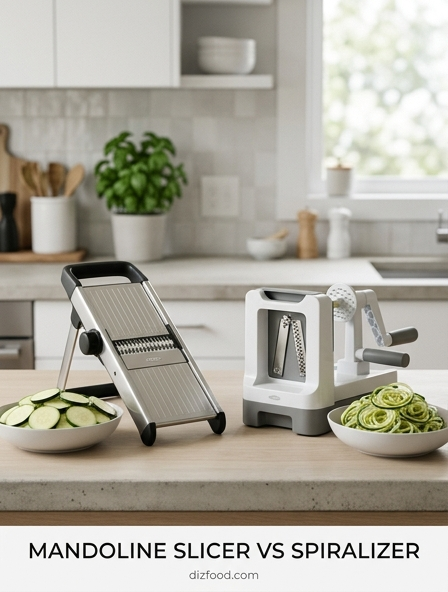
Mandoline Slicer vs Spiralizer Main Differences
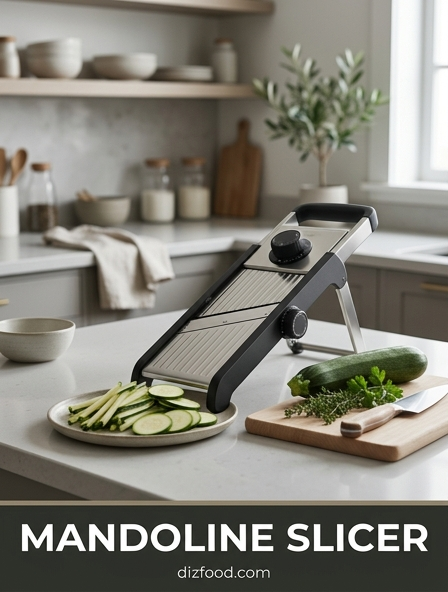
The fundamental distinction between a mandoline slicer and a vegetable spiralizer lies in the geometry of the cut and the mechanics of the tool. A mandoline is designed for precision and uniformity in flat planes. It consists of a flat surface with a fixed or adjustable blade where the user slides the food item back and forth to create consistent slices, rounds, or julienne strips. The primary goal of a mandoline is thickness control, allowing a chef to achieve paper-thin transparency that is nearly impossible to replicate with a traditional kitchen knife.
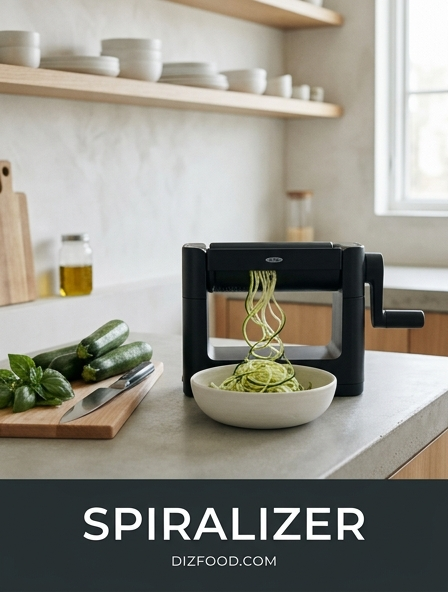
In contrast, a spiralizer is engineered to transform the physical structure of a vegetable into long, continuous curls or ribbons. Rather than sliding food across a flat plane, a spiralizer usually involves a cranking mechanism or a twisting motion that feeds the produce into a circular blade assembly. This results in "noodles" or spiral shapes often used as grain-free pasta alternatives. While the mandoline focuses on the cross-section of the vegetable, the spiralizer focuses on the longitudinal transformation of the produce into a structural coil.
| Feature | Mandoline Slicer | Vegetable Spiralizer |
|---|---|---|
| Motion | Linear sliding | Rotational cranking |
| Resulting Shape | Slices, rounds, julienne | Noodles, ribbons, curls |
| Main Benefit | Uniform thickness | Textural transformation |
Best Uses for a Kitchen Mandoline
A kitchen mandoline is an indispensable tool for tasks requiring high-volume, identical cuts. It excels in preparations where cooking times must be perfectly synchronized, such as in a potato gratin or a vegetable tian. When every slice of potato or eggplant is exactly three millimeters thick, they will all soften at the same rate in the oven, preventing the common issue of having some pieces mushy while others remain crunchy. It is also the premier tool for creating homemade chips-whether from potatoes, beets, or plantains-where thinness is the key to achieving a crispy texture without burning.
Beyond thick slices, many mandolines come with julienne attachments that make short work of salads and garnishes. It is the perfect device for "shaving" vegetables like fennel, radishes, or Brussels sprouts to create delicate, airy slaws that absorb dressings quickly. The precision of a mandoline is also favored by professional chefs for aesthetic presentation, allowing for beautiful, overlapping scales of cucumber or zucchini to garnish plates. Below are the most common applications:
- Creating translucent cucumber or radish slices for gourmet salads.
- Preparing uniform apple or pear slices for tarts and galettes.
- Quickly julienning carrots or bell peppers for stir-fry and slaw.
- Slicing onions into paper-thin rings for burgers or pickling.
- Producing consistent potato rounds for chips and scalloped dishes.
When to Choose a Vegetable Spiralizer
The vegetable spiralizer is the tool of choice when the objective is to replace traditional carbohydrates or to add a whimsical, voluminous visual element to a dish. It gained immense popularity with the rise of low-carb and gluten-free diets, as it can turn a humble zucchini or sweet potato into a plate of "zoodles" or "swoodles." The spiralizer is unique in its ability to maintain the length of the vegetable fiber, creating strands that can be twirled around a fork just like spaghetti. This makes it a functional alternative for those looking to increase their vegetable intake without sacrificing the experience of eating pasta.
Additionally, spiralizers are excellent for creating specialized garnishes and curly fries that are difficult to achieve with any other tool. When you want to create a "nest" of crispy potatoes or a bird's nest salad, the spiralizer provides the necessary length and curl. It is also a fantastic tool for encouraging children to eat more vegetables, as the curly shapes are often more appealing than standard chopped pieces. You should reach for the spiralizer when you have firm, cylindrical vegetables like cucumbers, carrots, or daikon radishes and you want to completely reinvent their structural role in a recipe, moving them from a side component to the main base of the meal.
Precision Slices vs Healthy Vegetable Noodles
When comparing the output of these two tools, we are essentially looking at the difference between precision engineering and creative substitution. The mandoline provides "precision slices." This is about the refinement of a classic cut. For instance, if you are making a traditional French onion soup, the mandoline ensures every onion slice is identical, leading to an even caramelization. This tool is about enhancing the existing form of the vegetable by making it more uniform and professional. It is a tool of efficiency and exactness, favoring dishes where the vegetable remains a slice of its original self.
On the other hand, the spiralizer focuses on "healthy vegetable noodles." This is less about precision and more about transformation. The goal here is often dietary substitution. By changing the shape of a vegetable from a solid block to a thin, coiled strand, you change the way it interacts with sauces and the way it feels in the mouth. A spiralized carrot has a different "bite" than a sliced carrot. While the mandoline is a staple of high-end culinary technique and prep work, the spiralizer is a staple of the modern health-conscious kitchen, aimed at recreating the comfort-food experience of pasta using nutrient-dense, whole-food ingredients.
Speed and Prep Time Comparison
In terms of raw speed for bulk tasks, the mandoline is significantly faster for traditional slicing. Once the thickness is set and the safety guard is in place, a user can process a whole bag of potatoes into thin rounds in mere minutes. The back-and-forth motion is highly efficient, and there is very little downtime between pieces of produce. However, the speed of the mandoline is often balanced by the need for extreme caution; if you rush without a guard, the risk of injury is high, which can lead to a "slow is smooth, smooth is fast" approach.
The spiralizer generally requires more setup and prep time per item. Most spiralizers require you to trim the ends of the vegetable perfectly flat to ensure it stays centered on the turning spindle. The actual process of cranking the handle takes longer than a quick slide on a mandoline. Furthermore, because spiralizers produce such a high volume of "noodles" from a single vegetable, the bowl fills up quickly, often requiring you to stop and clear the workspace. While the spiralizer is faster than hand-cutting noodles with a knife, it is generally slower than a mandoline for basic prep. However, if the goal is to make a large batch of vegetable pasta, the spiralizer is the only tool that can do the job in a reasonable timeframe.
Safety Considerations for Both Tools
Safety is a paramount concern for both devices, as they utilize incredibly sharp blades, but the risks manifest differently. The mandoline is often cited as one of the most dangerous tools in the kitchen. Because the user's hand moves toward the blade in a rapid motion, the risk of a "slip" leading to a severe laceration is high. Most mandoline injuries occur when the user reaches the end of a vegetable and attempts those last few slices without using a safety guard. Professional chefs often wear cut-resistant chainmail or Kevlar gloves when using a mandoline to mitigate this risk.
Spiralizers are generally considered safer because the blade is often housed within a plastic frame, and the user's hand is usually on a crank or a pusher rather than directly guiding the food against the blade. However, they are not without risks. The blades on a spiralizer are often multi-pointed and can be very sharp to the touch during setup or cleaning. The primary safety concerns for both tools involve:
- Mandoline: Exposed blades, high-speed hand movement, and the temptation to skip the safety pusher.
- Spiralizer: Sharply pointed "teeth" on the spindle and multi-blade cartridges that can cut fingers during removal.
- Both: Extremely sharp stainless steel that requires focused attention and proper storage away from children.
Ease of Cleaning and Maintenance
Maintenance is where these tools can become a chore. The mandoline is relatively straightforward because it is mostly a flat surface. Most modern mandolines are dishwasher safe, though hand-washing is recommended to keep the blades sharp. The main difficulty with a mandoline is cleaning the underside of the blade and the julienne teeth, which can trap small fibers of ginger or onion. Because the blades are fixed and very sharp, scrubbing them with a sponge requires extreme care to avoid slicing the sponge or your hand.
Spiralizers are notoriously difficult to clean because of their design. The blade plates usually feature tiny, circular holes or complex patterns that trap vegetable fibers and skins. If you spiralize something starchy like a sweet potato or fibrous like a beet, the residue can dry and harden quickly, making it nearly impossible to remove without a dedicated stiff-bristled brush. Additionally, the main body of a countertop spiralizer has various nooks, crannies, and tracks for the sliding mechanism that can collect juice and small bits of produce. While many parts are dishwasher safe, they take up significant real estate on the rack, and the heat of the dishwasher can eventually dull the specialized blades used for fine noodles.
Versatility Across Different Produce
The mandoline wins on sheer versatility across different types of produce. It can handle almost anything from hard root vegetables like parsnips to softer items like tomatoes (provided the blade is exceptionally sharp) and even citrus fruits for garnishes. Its ability to create various cuts-straight, crinkle, waffle, and julienne-makes it a multi-purpose powerhouse. It is also excellent for hard cheeses and cold butter. If it can be held in a hand or a guard and slid across a plane, the mandoline can process it.
The spiralizer is much more limited in its scope. It requires produce that is firm and structurally sound. Soft vegetables like tomatoes or very fibrous ones like celery simply will not work; they will turn into a mushy mess or clog the blades. The vegetable must also have a certain diameter and length to be gripped by the spindle and pushed through the blades. However, within its niche, the spiralizer provides a result that a mandoline simply cannot achieve. The table below compares their suitability for common kitchen items:
| Produce Type | Mandoline Performance | Spiralizer Performance |
|---|---|---|
| Potatoes/Root Veg | Excellent (Slices/Chips) | Excellent (Curly Fries/Noodles) |
| Zucchini | Excellent (Carpaccio) | Excellent (Zoodles) |
| Tomatoes | Good (if sharp) | Poor (Too soft) |
| Cabbage | Excellent (Shredding) | Poor (Fails to spiral) |
| Hard Cheese | Excellent (Shaved) | Poor |
Storage and Kitchen Space Impact
When it comes to kitchen real estate, the mandoline is the clear favorite for those with limited space. Most mandolines are designed to be flat or have a foldable kickstand, allowing them to slide easily into a shallow drawer or stand vertically in a narrow cabinet. Handheld mandolines are even smaller, taking up no more room than a standard grater. This makes the mandoline an easy addition to any kitchen, as it doesn't require a dedicated shelf. Its compact nature also means it is easier to pull out for a quick task, such as slicing a single onion.
Countertop spiralizers, conversely, are quite bulky. They have a large horizontal or vertical footprint and often come with multiple interchangeable blade plates that require their own storage container. Because of their size, they often end up relegated to the back of a deep cupboard or a pantry shelf, which can lead to them being used less frequently. While handheld "pencil sharpener" style spiralizers exist and are much more compact, they are limited to small, thin vegetables and are significantly more labor-intensive to use. If you have a small kitchen, the purchase of a full-sized spiralizer requires a deliberate commitment to the lifestyle change of making vegetable noodles frequently.
Final Verdict for Your Cooking Needs
The choice between a mandoline slicer and a spiralizer ultimately depends on your culinary goals and your dietary habits. Neither tool is strictly "better" than the other; rather, they serve different masters. If you are a traditional cook who values precision, aesthetics, and speed in classic recipes, the mandoline is a mandatory investment. It will elevate your salads, gratins, and sautés to a professional level of uniformity. It is a foundational tool for general meal prep that will be used across a wide variety of cuisines.
However, if your primary goal is healthy eating, calorie reduction, or finding creative ways to incorporate more vegetables into your diet as a pasta substitute, the spiralizer is the superior choice. It offers a unique textural experience that a mandoline cannot replicate. For many, having both is the ideal scenario, but if you must choose one, consider these final points:
- Choose a Mandoline if you frequently make chips, gratins, slaws, or need paper-thin garnishes.
- Choose a Spiralizer if you are focused on low-carb living, "zoodles," or creative vegetable-based main dishes.
- Prioritize the Mandoline for space-saving and versatility.
- Prioritize the Spiralizer for family-friendly, fun vegetable shapes that encourage healthy eating.
Both tools require a commitment to safety and a bit of patience for cleaning, but they both offer a massive upgrade over basic knife work for their respective tasks.

Comments